
Choosing the right Vibration Isolator in 2026 requires more than comparing prices or rubber hardness. The correct choice protects machinery, improves measurement accuracy, and reduces structural noise. It must also match the equipment’s weight, operating speed, mounting pattern, and environmental conditions.
David J. Inman, a respected vibration researcher and author of Engineering Vibration, defines the subject clearly: “Vibration is a mechanical oscillation about an equilibrium point.” That simple statement explains why isolation decisions cannot rely on appearance alone. A compact compressor may need a different solution from a precision microscope, even when both operate in the same building. Their frequencies, loads, and sensitivity levels differ.
A reliable selection process begins with field evidence. Record the machine’s operating frequency, measure nearby floor vibration, and identify shock or impact events. Then compare isolator stiffness, damping, load capacity, deflection, and transmissibility. Air springs, elastomer mounts, wire rope isolators, and spring systems each offer practical strengths. None is perfect.
Small details matter.
An isolator that works well at 60 Hz may perform poorly during startup. Excessive softness can create movement, alignment problems, or unsafe sway. Excessive stiffness can transmit vibration directly into the floor. I have seen specifications look impressive until installation exposed uneven loading and poor anchoring. That is an uncomfortable reminder: calculations need real measurements.
This guide explains how to evaluate these factors, question supplier claims, and avoid common selection mistakes. The goal is not simply quieter equipment. It is stable, measurable, and dependable performance over time.
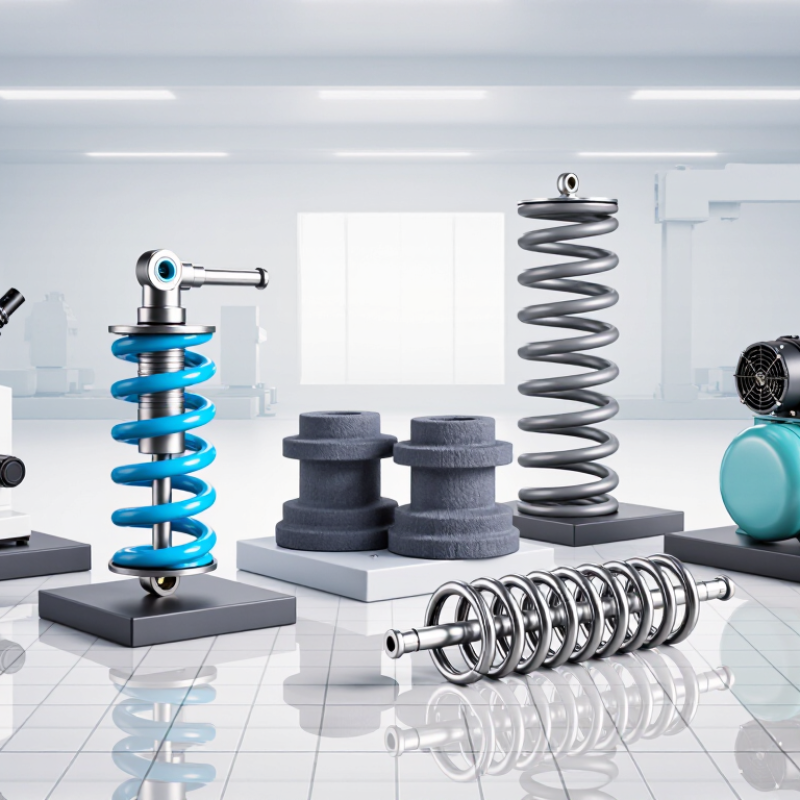
A vibration isolator separates a machine from the structure supporting it. It uses elastic elements, damping, or both to reduce unwanted motion. Think of a compressor on a concrete floor: each rotating cycle sends force into the slab. An isolator interrupts that path, so less vibration reaches nearby equipment, rooms, or people.
The key measure is natural frequency. Effective isolation usually begins when operating speed exceeds the isolator’s natural frequency by roughly 1.4 times. Greater separation improves performance.
ISO 20816-1 evaluates machine vibration using RMS velocity, commonly reported in millimetres per second. However, a low reading at one test point may hide movement elsewhere. Field experience matters.
Selection should match load, frequency, stroke, temperature, and installation conditions. For sensitive equipment, the U.S. National Institute for Occupational Safety and Health identifies 2.5 m/s² as a common hand-arm vibration action value. That figure concerns worker exposure, not machine isolation, but it shows why measured vibration needs context.
Static deflection is equally important. A soft mount can isolate better, yet it may allow excessive movement during startup or shutdown.
A 2023 ASHRAE Handbook chapter on sound and vibration control also stresses that equipment, piping, and structural connections must be treated as one system. A neat calculation can still mislead. Real floors are rarely perfect. Check alignment, preload, and actual operating speed after installation.
Begin with the machine, not the isolator. Record operating speed, load changes, start-up behavior, and nearby structural connections. A rotating imbalance creates a strong running-speed peak. Gear faults appear at mesh frequencies and sidebands. Reciprocating equipment adds impacts and harmonics. Pumps may transmit both mechanical vibration and hydraulic pulsation.
Measure before selecting.
Use calibrated accelerometers at the machine feet, frame, and supporting floor. Capture acceleration, velocity, displacement, and frequency spectra during normal and worst-case operation. ISO 20816-1:2016 stresses that vibration evaluation depends on machine type, mounting, and measurement location. It does not provide one universal acceptable value. For human exposure, ISO 2631-1:1997 uses frequency-weighted RMS acceleration, which helps separate comfort concerns from equipment protection.
Define the isolation requirement in numbers. Specify supported mass, center of gravity, allowable movement, operating frequency, shock loads, and required natural frequency. Static deflection matters because a softer mount usually improves low-frequency isolation, but it can increase motion during start-up. Check transmissibility across the full speed range. The U.S. Department of Energy’s 2022 Industrial Decarbonization Roadmap identifies motor-driven systems as major industrial energy users, so small alignment errors can create persistent losses. Do not trust a single test point. I have seen a quiet machine become unstable after a load change. Recheck the spectrum after installation, because the first assumption may be wrong.
Choosing a vibration isolator starts with measured data, not catalog preference. Record forcing frequency, static load, temperature, stroke, and allowable movement. ISO 10846-1 recommends measuring dynamic transfer behavior under defined conditions. A field accelerometer near the machine feet can expose resonance that a visual inspection misses.
Measure twice.
Steel springs suit heavy equipment and low natural frequencies. They offer predictable performance, but need lateral restraints and damping.
Elastomer mounts are compact and easier to install. Their stiffness changes with temperature, aging, and load direction.
Air mounts can achieve very low frequencies, often below 2 Hz, when supplied with stable pressure. However, leaks, uneven loading, and compressor noise require attention.
Wire-rope isolators tolerate shock and harsh environments, but their nonlinear response complicates calculations.
Compare transmissibility near the operating speed, not only at the rated load. ISO 2631-1 evaluates whole-body vibration, while European exposure rules set an action value of 0.5 m/s² A(8) and a limit value of 1.15 m/s² A(8). These figures help define risk, but they do not replace machine-specific testing.
A 2024 industrial vibration market report from MarketsandMarkets describes rising demand for predictive monitoring, yet market forecasts cannot determine a mount’s real stiffness. That is the weak point. Installation errors matter. Measure the loaded natural frequency, inspect deflection after commissioning, and question any design that looks perfect only on paper.
Match capacity before chasing performance. Each isolator should carry the real operating load, not only the equipment’s shipping weight. Include fluids, accessories, uneven loading, startup torque, and maintenance conditions. A pump weighing 800 kilograms may need four isolators, but its center of gravity can shift the reactions significantly. Load it honestly.
Frequency comes next. The 2023 ASHRAE Handbook—HVAC Applications links effective isolation to operating speed, forcing frequency, and building response. Design teams commonly seek 80–90% isolation, but that target depends on the frequency ratio and damping. When disturbing frequency is close to the isolator’s natural frequency, resonance can amplify motion. Keep separation.
Damping changes the answer. High damping reduces resonance peaks, yet it can transmit more vibration at higher frequencies. ISO 10846-1 provides methods for measuring dynamic transfer stiffness under controlled preload, which is more reliable than trusting a catalogue value alone. Ask for tested stiffness, static deflection, and damping data at the expected load. A neat spreadsheet can still mislead.
Environment matters just as much. Outdoor chillers may face ultraviolet exposure, rain, ozone, and temperature swings. Food-processing areas may require washable, corrosion-resistant materials. Check whether oil, refrigerant, salt air, or cleaning chemicals contact the isolator. I would also inspect the installation after commissioning, because a compressed pad, loose anchor, or rigid pipe connection can defeat a correct selection. Not everything behaves as predicted.
Installing the selected vibration isolator begins with accurate load information. Record the equipment weight, operating speed, center of gravity, and expected temperature. Check the isolator’s rated load against the actual load at each support. Uneven loading can cause rocking, noise, and early fatigue.
Prepare a clean, level mounting surface. Remove oil, loose paint, and debris. Position each isolator according to the approved layout, then confirm alignment with a straightedge. Do not guess. Tighten fasteners with a calibrated torque wrench, while avoiding excessive compression. Leave the specified clearance around moving parts and flexible connections.
Testing should start before full operation. Measure baseline vibration at the equipment and nearby structure. A portable vibration meter can record acceleration, velocity, and frequency. Run the equipment at normal speed, then compare readings with the installation criteria. Watch for unusual movement, contact marks, resonance, or rising temperature. Stop the test if a support shifts. A rushed installation may look acceptable at low speed. It may fail under real operating conditions.
Tips: Recheck bolt torque after the first operating cycle. Inspect for settlement, cracked elastomer, corrosion, and uneven gaps. Keep dated readings, photographs, and maintenance notes. Small changes often reveal larger problems. In practice, inspection schedules are sometimes too optimistic; adjust them after reviewing actual vibration trends. Ask a qualified engineer to review uncertain results, especially when measured values remain unstable.
Record operating speed, supported mass, load changes, start-up behavior, temperature, and nearby structural connections. Measure twice.
Measurements reveal forcing frequencies, resonance, and movement that visual checks may miss. Use calibrated accelerometers at the machine feet, frame, and supporting floor.
Capture acceleration, velocity, displacement, and frequency spectra during normal and worst-case operation. Do not trust one test point.
Greater static deflection often improves low-frequency isolation. However, softer supports may allow more movement during start-up.
Steel springs suit heavy equipment and low natural frequencies. Elastomers are compact but change with temperature, aging, and load direction. Air mounts can provide very low frequencies, but leaks require attention.
Uneven loading can cause rocking, noise, and early fatigue. Oil, loose paint, debris, poor alignment, and excessive bolt compression can also create problems.
Measure baseline vibration before full operation. Run the equipment at normal speed and compare readings with the design criteria. Watch for shifting supports, contact marks, resonance, or rising temperature.
Recheck bolt torque after the first operating cycle. Inspect for settlement, cracked elastomer, corrosion, and uneven gaps. Keep dated readings and photographs. Inspection schedules may be too optimistic.
Choosing the right Vibration Isolator begins with understanding how unwanted motion is created, transmitted, and felt by nearby equipment or structures. Start by identifying the main vibration sources, such as rotating machinery, impact loads, or external movement, then define the isolation goals, operating speed, load range, allowable displacement, and surrounding conditions. These details help determine whether springs, elastomeric elements, air mounts, or another isolation method will provide the best balance of flexibility, stability, and cost.
The selection process should consider load capacity, natural frequency, damping, temperature, moisture, chemicals, and available space. A properly matched isolator should support the equipment without excessive deflection while reducing vibration across the required operating range. Correct installation is equally important: align the system, distribute the load evenly, prevent unwanted contact, and verify performance through measurement and observation. Regular inspections can identify settling, wear, leakage, or changes in vibration, allowing maintenance or adjustment before performance declines.
