
Industrial Vibration Isolators & Base Supports: Series I
Factory-direct vibration control assemblies, pre-engineered inertia frames, and composite elastomeric pads configured for high-efficiency mechanical isolation and zero-maintenance operational longevity.
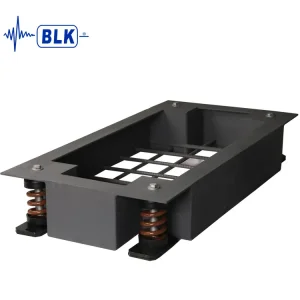
High-Quality CPB type Inertia Bases & Pump Supports

Low Price BK-PM Type Polymer Damping Pad
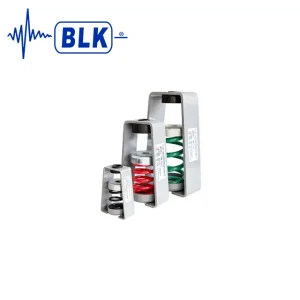
Custom Anti-vibration Spring Hangers

Custom BK-DSR Type Damped Rubber Mounts
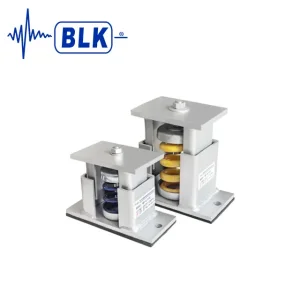
High-Quality MB Type Anti-vibration Spring Mounts
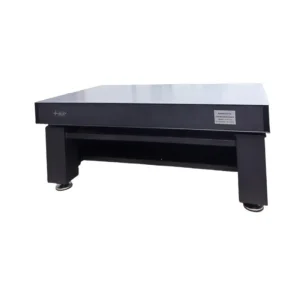
High-Quality BK-RT Type Damped Vibration Platform
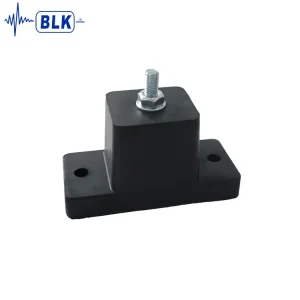
Low Price BKTS Type Rubber Pad

High-Quality BKH Type Rubber Mounts
Structural Kinematics & Dynamic Mass Stabilization
Why heavy-duty centrifugal rotating machinery demands engineered inertia bases: dynamic mass ratio stabilization, operational center-of-gravity lowering, and torsional alignment under transient mechanical loads.
Rotational Mass & Center of Gravity
Operating fluid pumps, compressors, and chillers generate multi-axis unbalance forces during initial spool-up and intermittent flow fluctuations. Without an inertia mass, high-mounted driving motors cause the assembly's combined center of gravity (CG) to sit significantly above the isolation plane, generating severe lateral rocking and diagonal pitching moments.
- Lowers total mechanical center of gravity below the isolator shear line.
- Eliminates uneven deflection across peripheral helical spring isolators.
- Maintains uniform static compression across all perimeter contact points.
Shaft Alignment & Flexural Rigidity
End-suction and horizontal split-case pumps experience severe nozzle loads resulting from thermal pipe expansion and fluid hydraulic hammer. Bellking CPB-type inertia bases feature structural steel perimeter channels with welded internal structural cross-members, providing the monolithic flexural stiffness required to prevent motor-to-pump shaft misalignment.
- Prevents long-term bearing wear, mechanical seal leaks, and shaft deflection.
- Resists pipe nozzle moments conforming to Hydraulic Institute (HI) standards.
- Eliminates floor-slab induced resonant deflection in elevated plant rooms.
Dynamic Transmissibility Attenuation
Adding dead mass directly increases the total mechanical inertia $m$, which substantially drops the system's natural frequency $f_n$ for any given isolator spring stiffness $k$. By elevating the frequency ratio $r = f_d / f_n$ well beyond the $\sqrt{2}$ threshold, dynamic energy transmissibility $T$ to the structural foundation is driven down to negligible levels.
- Achieves over 95% to 99% structural isolation efficiency in acoustic rooms.
- Damps high-amplitude transient vibrations during motor starts and sudden valve shutoffs.
- Dissipates fluid-borne turbulent energy across concrete aggregate matrices.
The system's undamped natural frequency $f_n$ (in Hz) and theoretical transmissibility $T$ govern the selection of inertia mass ratio and spring static deflection $\delta_{st}$ (in inches or mm):
Transmissibility: T = √[ (1 + (2ζr)²) / ((1 - r²)² + (2ζr)²) ]
Where: r = f_d / f_n (Frequency Ratio), ζ = Damping Ratio (c / c_c)
Design Standard: For optimal mechanical life per ASHRAE Guidelines, an inertia base mass ratio of 1.0 to 2.0 times the total operating equipment weight is specified, establishing a frequency ratio $r \ge 3.0$ and ensuring dynamic isolation efficiency exceeds 95%.
CPB Inertia Base Selection & Dimensional Standards
Fabricated from structural channel members conforming to ASTM A36, fully integrated reinforcing rebar matrices, and cantilever outrigger brackets engineered for high-deflection spring isolators.
| Equipment Type & Motor Power | Recommended Frame Depth | Concrete Mass Ratio | Spring Static Deflection | ASHRAE Floor Condition |
|---|---|---|---|---|
| End-Suction Pumps (1.5 kW – 15 kW) | 150 mm (6 inches) | 1.0 × Pump & Motor Weight | 25 mm (1.0 in) Standard Helical | Slab-on-Grade or Stiff Lower Floors |
| Centrifugal Pumps (18.5 kW – 75 kW) | 200 mm (8 inches) | 1.5 × Total Wet Weight | 25 mm – 50 mm Spring Isolators | Elevated Floors (Span ≤ 9 meters) |
| Heavy Split-Case Pumps (90 kW – 250 kW) | 250 mm (10 inches) | 1.5 to 2.0 × Operating Mass | 50 mm (2.0 in) Restrained Springs | Critical Roof & Long-Span Floors |
| High-Pressure Booster Skids & Gensets | 300 mm (12 inches) | 2.0 × Operating Equipment Weight | 50 mm Restrained Springs with Snubbers | Upper Level Penthouse Mechanical Rooms |
| Rotary Screw Chillers & Compressors | 250 – 300 mm Channel | 1.5 × Total Operating Mass | 25 mm – 50 mm High Deflection | Above Acoustically Sensitive Spaces |
Reinforcement & Structural Channel Geometry
Standard structural channel depths range from 150 mm to 300 mm, configured to house high-density 3,000 to 4,000 PSI concrete. An engineered grid of #4 (12 mm) or #5 (16 mm) deformed steel reinforcing bars is welded on 150 mm to 200 mm centers in both longitudinal and transverse directions, positioned 50 mm above the base perimeter bottom to resist positive and negative flexural moments.
- Cantilevered outrigger spring mounting brackets with integrated leveling bolts.
- Motor slide rail provisions welded directly to channel beams for quick belt tensioning.
- Embedded full-perimeter steel forms prevent concrete spalling and micro-cracking.
Anti-Corrosion Surface Engineering (Dacromet & Galvanizing)
Industrial plant rooms, cooling towers, and coastal mechanical plants subject steel frames to high humidity and condensates. Bellking integrates Dacromet electro-diffusion coating that achieves over 900 hours in neutral salt spray testing (ASTM B117), exceeding traditional paint coatings by 500% without hydrogen embrittlement hazards on high-tensile spring coils.
- Passes rigorous 900-hour continuous salt spray chamber testing.
- Hot-dip galvanized (ISO 1461) structural steel options for marine atmospheres.
- Chemical-resistant polyurethane and epoxy finishes for wastewater facilities.
Field-Proven Industrial & Infrastructure Scenarios
How Bellking inertia bases and vibration attenuation assemblies solve dynamic resonance and structure-borne noise challenges across mission-critical facilities worldwide.
1. High-Rise Skyscraper Mechanical Rooms
In modern supertall commercial towers, central plant rooms located on intermediate transfer floors or rooftop penthouses sit directly above corporate offices or luxury residential suites. Flexible structural floor slabs exhibit low natural frequencies (typically 4–8 Hz).
Bellking Solution: Heavy concrete inertia bases equipped with 50 mm deflection large-diameter open spring mounts deliver an isolation system frequency below 2.2 Hz, decoupling fluid pulsing frequencies and eliminating low-frequency structure-borne humming (NC 25 compliance).
2. Hyperscale Data Centers & Edge Server Hubs
Massive server farms utilize banks of continuous primary and secondary chilled water pumps and high-tonnage centrifugal chillers. Unmitigated mechanical vibrations travel through structural pillars, inducing acoustic noise that accelerates disk drive read/write head micro-failures.
Bellking Solution: Pre-welded CPB bases with integral motor adjustment brackets and BK-PM polymer damping pads provide zero-rocking pump starts and absorb hydraulic shockwaves, ensuring uptime reliability across tier-IV mission-critical data infrastructure.
3. Semiconductor Fabs & Metrology Cleanrooms
Photolithography scanners, atomic force microscopes (AFM), and coordinate measuring machines (CMM) demand generic vibration criteria (VC-D through VC-F levels: < 3.12 μm/s RMS). Mechanical equipment in adjacent sub-fab utility rooms generates strong vibration spectra.
Bellking Solution: Customized BK-VT active-ready passive platforms coupled with ultra-low natural frequency (1.7 Hz) pneumatic air mounts create a complete kinetic break between building ground tremors and sensitive nanotechnology inspection tools.
International Regulatory Alignment & Market Dynamics
Navigating seismic restraint mandates, ASHRAE acoustic guidelines, and ISO 10816 machinery vibration standards across North America, Europe, the Middle East, and Asia-Pacific.
Seismic & Wind Restraint Mandates (IBC & OSHPD)
In North America and seismically active regions along the Pacific Rim, mechanical installations must satisfy International Building Code (IBC) Chapter 13 and ASCE 7 seismic force criteria ($S_{DS}$ spectral acceleration). Building regulations require that all isolated equipment withstand 3-axis dynamic accelerations without shearing anchorage points or rupturing pressurized piping headers.
Bellking supplies all-directional seismic-restrained spring mounts integrated with heavy-duty ductile iron housings, replaceable neoprene impact snubbers, and certified load capacity testing verified by independent accredited laboratories.
European Decarbonization & Acoustic Norms
Under European standards EN 1299 and VDI 2062, mechanical equipment manufacturers face intense scrutiny regarding both acoustic noise pollution and embodied carbon life-cycle impact. Bellking engineers modular lightweight high-tensile channel designs compatible with low-carbon geo-polymer and recycled-aggregate concrete fills.
Additionally, full RoHS and REACH environmental compliance across all rubber curing and polymer elastomer production processes guarantees zero toxic VOC off-gassing in LEED- and BREEAM-certified green building environments.
The Kunshan Manufacturing Superiority
Vertical integration from raw alloy smelting to automated robotic welding, delivering unmatched customization velocity, strict QA traceability, and dramatic lead-time compression.
Precision Robotic Fabrication
Our 2,000 m² modern manufacturing base in Kunshan incorporates multi-axis CNC laser cutting lines, high-precision hydraulic brake presses, and automated 6-axis robotic welding cells. All frame welds conform to AWS D1.1 structural welding standards, ensuring zero porosity and continuous root penetration.
Agile 1:1 Custom Prototyping
Where traditional Western manufacturers require 10 to 14 weeks for bespoke, non-standard inertia base geometries, Bellking delivers engineered CAD submittal packages within 24 hours and completed custom frames in as little as 3 to 5 business days, drastically compressing overall MEP project critical paths.
Full In-House QA & Testing
Every production batch undergoes comprehensive quality verification: automated servo-hydraulic tension/compression spring calibration, Rockwell hardness screening, magnetic particle weld inspection, and dynamic resonance spectrum verification using multi-channel FFT analyzers.
Technological Roadmap: AI-Driven & Smart Damping
Integrating predictive digital twins, IoT condition telemetry, and advanced composite materials into the next generation of industrial inertia systems.
IoT Smart Inertia Mounts
Embedded wireless MEMS triaxial accelerometers and temperature sensors installed directly within the spring isolator housings continuously broadcast vibration signatures via LoRaWAN/NB-IoT to centralized building management systems (BMS), detecting pump bearing degradation before catastrophic lockup occurs.
Ultra-High Performance Concrete (UHPC)
Transitioning to fiber-reinforced UHPC and synthetic polymer mineral casting matrices yields material damping ratios ($\zeta > 0.08$) that are five to eight times greater than standard gray concrete. This dramatically curtails resonant amplification during machine transient run-down phases.
Active Magnetorheological Systems
Hybrid active-passive isolator mounts featuring electromagnetically controlled magnetorheological (MR) fluids allow real-time adaptive dynamic damping. Real-time microprocessors adjust fluid viscosity in milliseconds to damp sudden hydraulic surge shocks while preserving ultra-soft isolation during steady-state RPM.
Engineering Verification & PE Calculation Packages
Complete structural submittals, Finite Element Analysis (FEA) modal simulations, and stamped professional engineering packages for rapid municipal and consultant approvals.
Complete Engineering Documentation
Bellking provides consulting engineers and mechanical contractors with full project submittal packages within 24 hours. Each package includes 3D BIM/Revit models, point load distribution schedules, static deflection calculations, and FEA modal frequency verification demonstrating zero intersection between floor resonance and equipment running speeds.
- Professional Engineer (PE) stamped calculation packages upon request.
- Detailed 2D/3D DWG & IFC BIM family integration for clash detection.
- Seismic and wind restraint anchor sizing matching ACI 318 Appendix D criteria.
Field Installation & Commissioning Assurance
Proper installation of concrete-filled inertia bases is critical to achieving calculated acoustic attenuation. Bellking provides clear step-by-step casting manuals, height-saving bracket templates, and temporary leveling shims to ensure concrete curing without pre-loading spring coils.
- 1-Year unconditional replacement warranty backed by technical engineering support.
- Comprehensive post-commissioning vibration signature audit guidelines.
- Global shipping logistics with tailored heavy-duty export crating.
Industrial Vibration Isolators & Base Supports: Series II
Explore specialized pneumatic isolators, precision rubber mounts, and high-deflection spring elements designed to complement your inertia base and mechanical support configurations.
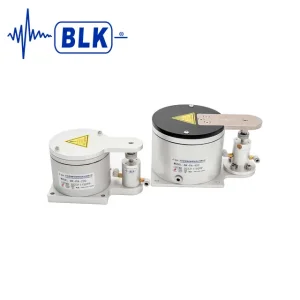
High-Quality BK-PA Type Precision Air Mounts
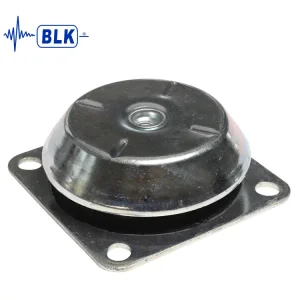
High-Quality BKHQ Type Rubber Mounts
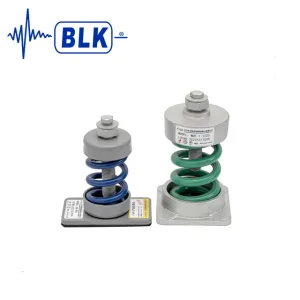
High-Quality MD Type Anti-vibration Spring Mounts
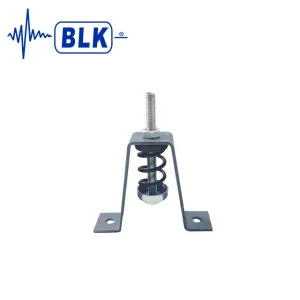
High-Quality HV Type Spring Hangers
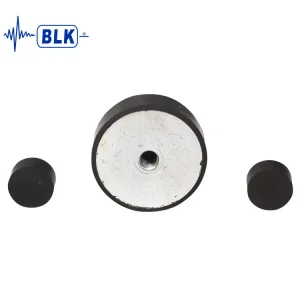
Custom BKDE Type Rubber Mounts
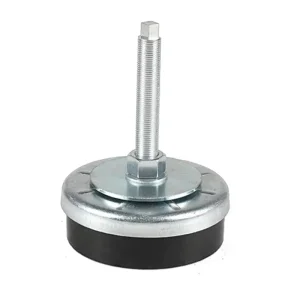
Low Price BKAL Type Adjustment Rubber Feet
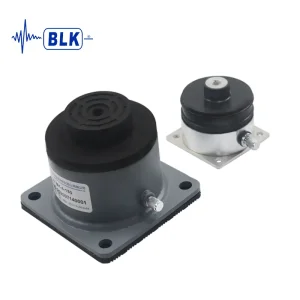
High-Quality BK-A Type Air Mounts
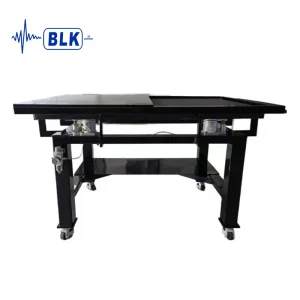
Custom BK-VT Type Vibration Platform
Technical & Procurement Inquiries
Detailed engineering answers covering inertia base sizing, mass calculations, concrete pouring protocols, seismic snubber setups, and warranty terms.