
Precision Engineered Rubber Vibration Isolators
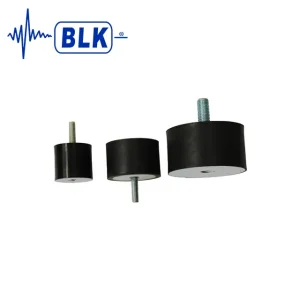
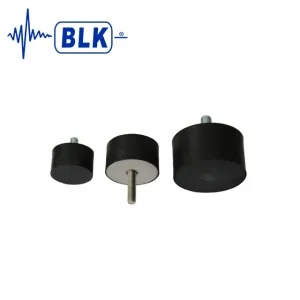
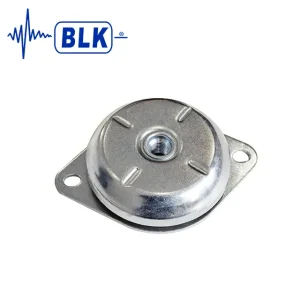
Explore our top-tier vulcanized rubber-to-metal vibration mounts designed for HVAC compressors, industrial fans, variable speed pumps, and precision measurement foundations.





Elastomeric Damping Mechanics: Dynamic Viscoelasticity & Isolation Theory
Understanding why standard industrial equipment requires engineered rubber isolators rather than rigid steel anchoring. A rigorous engineering assessment of dynamic stiffness, transmissibility, and loss factor.
The Dynamic Transmissibility Ratio
Vibration isolation occurs exclusively when the ratio of excitation frequency (fd) to system natural frequency (fn) surpasses √2 (≈1.414). Bellking rubber vibration isolators are formulated to yield an optimal frequency ratio of fd / fn ≥ 3, ensuring isolation efficiency beyond 90% across rotational and reciprocating industrial machinery.
Shear vs. Compression Deformation
Rubber possesses nearly incompressible volumetric properties (Poisson's ratio ν ≈ 0.499). While compression loading handles substantial static loads with modest deflections, shear loading exhibits significantly lower dynamic stiffness (Kdynamic), unlocking low natural frequencies (down to 5–8 Hz) for superior structural acoustic decoupling without risk of metal-to-metal fatigue.
Internal Loss Factor (η ≈ 0.15–0.50)
Unlike undamped coil springs that exhibit infinite resonant amplitude spikes at peak resonance, synthetic and natural rubber compounds possess internal hysteretic damping. The viscoelastic loss tangent absorbs vibrational energy and dissipates it harmlessly as thermal micro-energy, completely preventing high-amplitude mechanical surging during startup and shutdown cycles.
Where δst represents static deflection under load. Achieving 4 mm of static deflection yields an isolator natural frequency of ~7.9 Hz, isolating any 1,500 RPM motor excitation frequency (25 Hz) with ~90% efficiency.
Rubber Vibration Isolators: Factory Direct Pricing Architecture
Clear, unvarnished insight into B2B manufacturing pricing. Price variances depend directly on elastomer formulation, insert metallurgies, dynamic fatigue tolerances, and volume scale.
| Mount Series | Elastomer / Core Polymer | Load Range per Mount | Static Deflection | Coating / Metal Grade | Wholesale Price Indicator (USD) |
|---|---|---|---|---|---|
| BKVV Series (Male/Male) | Natural Rubber (NR 55° Shore A) | 5 kg – 180 kg | 1.5 – 3.5 mm | Zinc-Plated / Q235B | $0.85 – $3.40 / pc |
| BKVD Series (Male/Female) | High-Grade Nitrile (NBR 60° A) | 10 kg – 250 kg | 2.0 – 4.0 mm | Dacromet (900h Salt Spray) | $1.20 – $4.80 / pc |
| BKDD Series (Female/Female) | Chloroprene (Neoprene CR) | 15 kg – 320 kg | 2.5 – 5.0 mm | Galvanized / 304 Stainless | $1.50 – $5.90 / pc |
| BKVE / BKDE Types | EPDM (Weather/Ozone Resistant) | 20 kg – 450 kg | 3.0 – 6.0 mm | Q235B Cold Extruded Steel | $2.10 – $7.20 / pc |
| BKH / BKM Marine Mounts | Engineered Oil-Proof NBR / NR | 50 kg – 1,200 kg | 4.0 – 9.0 mm | Cast Iron Flange + 316 Bolts | $12.50 – $38.00 / pc |
| BK-DSR / BKSWA Cushions | Multilayer Polyurethane Damped | 100 kg – 4,500 kg | 5.0 – 15.0 mm | Heavy Dacromet Steel Frame | $24.00 – $85.00 / pc |
Why Global OEMs Source Rubber Isolators from China (Bellking Kunshan)
Over 70% of global industrial elastomeric dampers originate within the Yangtze River Delta industrial belt. Here is why procurement teams transition from Western distributors to direct Kunshan manufacturing.
Full Material Formulation Control
We blend high-purity natural polymers, NBR, and EPDM on closed internal mixers. Customized durometer ranges (40° to 75° Shore A ±3°) ensure exact tensile elongation (>450%) and negligible permanent compression set (<18% after 22h at 70°C, ASTM D395).
Automated Robotic Bonding & Vulcanization
Metal fatigue and rubber-to-metal delamination are critical failure modes. Bellking employs automated multi-station degreasing, silane bonding adhesive priming, and high-pressure vacuum transfer vulcanization to achieve destructive peel strengths exceeding 15 MPa.
National High-Tech & 37 Patents
With 16 national invention patents and university R&D partnerships, Bellking bridges the gap between low-cost commodity parts and mission-critical vibration engineering. Every production batch is logged with dynamic stiffness curves and frequency spectrum reports.
Aggressive Lead Times (24h to 3 Days)
Western lead times of 8 to 16 weeks cripple construction and mechanical schedules. Standard catalogue mounts dispatch within 24 hours from Kunshan, while tailored 1:1 CNC non-standard molds and sample fabrications are ready within 3 working days.
Systemic Vibration Control: Across 6 Macro Industry Sectors
Engineered rubber isolators operate as mechanical filters against structure-borne noise, secondary radiated acoustics, and cyclic dynamic fatigue. Here is how our hardware integrates into macro engineering assets.
HVAC Chillers, AHUs & Rooftop Fans
Rooftop installations transmit low-frequency humming directly into concrete floor slabs. BKVV and BKDD isolators decouple centrifugal compressors and scroll chillers, arresting structure-borne noise transmission before it reaches tenant workspaces below.
Power Substations & Dry Transformers
Magnetostrictive core hum in 50/60 Hz dry-type transformers produces continuous 100 Hz and 120 Hz fundamental vibrations. High-durometer silicone and damped synthetic mounts achieve up to 25 dB(A) structural noise reduction.
Industrial Pumps & Fluid Handling
Pumping systems generate both mechanical unbalance and hydraulic pressure pulses. Combining BKVD cylindrical mounts with concrete inertia bases stabilizes rotational center-of-gravity, eliminating nozzle shear stress and extending mechanical seal lifespans.
Semiconductor Metrology & Cleanrooms
Lithography equipment and scanning electron microscopes fail in the presence of ambient ground micro-tremors (VC-D and VC-E criteria). Multilayer elastomeric isolation pads eliminate high-frequency acoustic floor resonance without emitting VOC off-gassing.
Marine Gensets & Propulsion Systems
Vessel hulls act as massive acoustic sounding boards. BKH marine-rated mounts feature fail-safe interlock steel retainers that remain mechanically locked during catastrophic sea-state pitch and roll, surviving 3G to 5G dynamic shock acceleration.
Heavy Stamping Presses & Forging Lines
Repetitive high-energy impact shocks destroy building footings and neighboring CNC accuracy. Custom BKCN cone mounts and BK-DSR damping units absorb crushing kinetic pulse loads, protecting shop floor infrastructure.
Modern Technology Trends & International Procurement Specifications
Global engineering buyers demand rigorous certification frameworks, extended field lifespans, and eco-sustainable elastomeric compounds. Here is what defines cutting-edge anti-vibration hardware in 2026 and beyond.
Eco-Elastomers & REACH Compliance
Modern cleanroom, medical, and European installations strictly forbid carcinogenic polycyclic aromatic hydrocarbons (PAHs) and toxic heavy metal vulcanization activators. Bellking formulas are 100% compliant with EU RoHS 3 and REACH regulations, eliminating foul odor and hazardous off-gassing.
Dacromet Corrosion Protection
Traditional electro-galvanized coatings fail under 72 hours in high-humidity or coastal salt-fog environments, leading to thread seizure and interface oxidation. We utilize zinc-aluminum flake Dacromet coatings that endure 900+ hours of continuous neutral salt spray (ASTM B117) without red rust.
FEA Dynamic Simulation & Life Prediction
Using non-linear finite element analysis (Mooney-Rivlin and Ogden material models), we calculate internal strain concentrations and thermal buildup under continuous cyclical dynamic excitation. This simulation workflow delivers guaranteed 15+ year design operational lifespans under continuous plant loads.
Frequently Asked Questions: Sizing, Durability & Quotations
Direct answers to real mechanical engineering and procurement inquiries, formulated from over 1,000 completed vibration isolation projects globally.
What parameters are essential to obtain an exact quotation and sizing plan?
- Total Operating Weight: Including fluids, inertia mass, and auxiliary piping loads.
- Support Geometry: Number of mounting points and precise distance to the center of gravity (to account for unequal corner loading).
- Excitation Speed: Operating RPM or motor frequency (e.g., 1,450 RPM = 24.16 Hz).
- Operating Environment: Ambient operating temperatures, exposure to cutting oils, hydraulic fluids, ozone, or marine salt air.
- Static Deflection Constraint: Maximum permissible mechanical drift and misalignment tolerance for drive shafts or duct connections.
When should an engineer specify Rubber Mounts versus Coil Spring Isolators?
How does rubber durometer (Shore A) impact vibration isolation performance?
What causes vulcanized rubber mounts to fail prematurely, and how is it prevented?
Can Bellking provide custom threaded studs, non-standard metric/imperial pitches, or 316 stainless steel?
Specialty Dampers, Pads & High-Impact Rubber Buffers
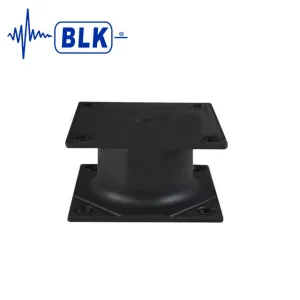
Explore our heavy-duty damped mounts, multi-layer anti-vibration composite pads, and elastomeric crane end-stop buffers built for aggressive industrial installations.





Need Certified Vibration Isolation Sizing for Your Equipment?
Submit your equipment parameters (total operating weight, center of gravity, operating RPM, and site environmental factors). Bellking's engineering team provides full vibration analysis calculation sheets and competitive factory-direct pricing within 24 hours.