Industrial Anti-Vibration Mounts: Heavy Equipment & Transformer Isolation
Factory-direct dynamic damping solutions engineered with matrix springs, oil-resistant nitriles, and visco-elastic polymers for mission-critical substation and industrial installations.

Acoustic & Mechanical Dynamics of Transformer Vibration
Understanding the interplay between core magnetostriction, electromagnetic winding forces, and structural resonance to mitigate low-frequency tonal propagation.
Magnetostriction & Core Harmonics
The fundamental source of power transformer humming originates from magnetostriction within the grain-oriented silicon steel core laminations. When subjected to alternating magnetic flux, the ferromagnetic domains mechanically oscillate at twice the line frequency. For standard 50 Hz power grids, the base excitation frequency is 100 Hz; for 60 Hz grids, it is 120 Hz. These mechanical deformations generate severe higher-order harmonic spectra (200 Hz, 300 Hz, 400 Hz, up to 1 kHz) that couple directly to the oil medium or core support structure, driving structural resonance within the outer transformer tank.
Lorentz Forces in Windings
Simultaneously, high load currents circulating through primary and secondary windings generate dynamic electromagnetic Lorentz forces proportional to the square of the operating current ($I^2$). These oscillatory forces flex the winding conductors axially and radially, creating secondary structural vibration patterns that intensify drastically during load surges or grid fault conditions. Without specialized isolation mounts, these dynamic vibrational energy waves bypass standard containment structures, traveling unimpeded into subgrade foundation pilings and radiating as airborne low-frequency drone throughout adjacent facilities.
Structure-Borne Transmission Path
The primary challenge in transformer acoustics is not direct airborne radiation, but structure-borne transmission. Low-frequency energy possesses extremely long wavelengths ($\lambda > 3\text{m}$ in concrete), allowing vibrations to propagate for hundreds of meters through structural columns and floor slabs with minimal spatial decay. When these vibrational waves encounter architectural boundary partitions, they induce secondary acoustic radiation, turning living spaces, control rooms, or hospital surgical suites into resonant acoustic amplification chambers that violate international building codes.
| Excitation Source | Dominant Frequency (50 Hz / 60 Hz) | Acoustic Character | Recommended Isolation Modality | Typical Attenuation Target |
|---|---|---|---|---|
| Core Magnetostriction | 100 Hz, 200 Hz, 300 Hz / 120 Hz, 240 Hz | Tonal low-frequency "hum" | Matrix Elastomeric Pads or Damped Compound Springs | 22 dB to 38 dB Insertion Loss |
| Winding Dynamic Load | 100 Hz to 400 Hz (Current dependent) | Broadband harmonic vibration | High-Deflection Heavy-Duty Spring Mounts | > 95% Dynamic Force Attenuation |
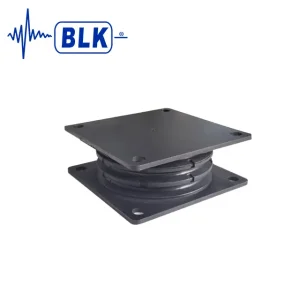
| Cooling Oil Pumps & Radiators | 25 Hz to 75 Hz (Mechanical rotational) | Sub-harmonic structural rattling | Auxiliary Spring & Rubber Isolator Brackets | > 92% Transmissibility Reduction |
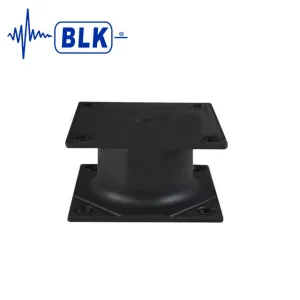
| Forced Ventilation Fans | 15 Hz to 50 Hz (Blade pass frequency) | Mid-frequency fluttering noise | Ceiling-Hung / Base Rubber Buffers | 15 dB to 25 dB Sound Power Cut |
Mission-Critical Application Scenarios: Site-Specific Engineered Isolation
Tailoring mechanical impedance matching and environmental survivability across five high-demand industrial verticals.
Urban Basements
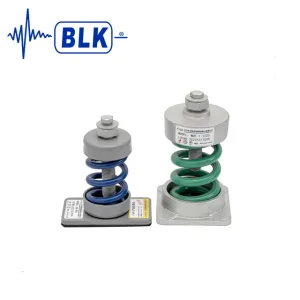
Substations installed within commercial towers or residential complexes demand ultra-strict compliance with nocturnal noise regulations (e.g., DIN 45680 / NC-25 limits). Bellking supplies high-deflection pre-compressed matrix spring mounts paired with high-damping nitrile pads to eliminate the 100 Hz tonal spike completely.
Data Centers (Tier IV)
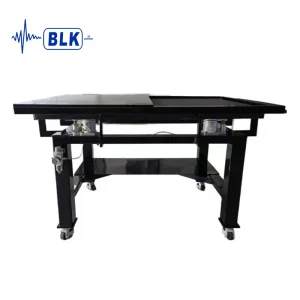
High-density server farms house hundreds of spinning disk arrays and precision lithography verification stations susceptible to acoustic degradation and head-crash phenomena. Our custom transformer anti-vibration systems ensure zero floor vibration feedback into delicate data infrastructure halls.
Offshore Wind Platforms
Step-up transformers in offshore HVDC converter stations face extreme environmental stresses: marine salinity, high-frequency wind buffeting, and structural deck flexing. We utilize C5-M marine-grade Dacromet coatings tested beyond 900 hours in salt fog chambers with high-shear elastomer snubbers.
Heavy Arc Furnaces
Industrial metallurgy facilities feature volatile, rapid short-circuit current surges during scrap melting, producing violent dynamic shock pulses on step-down transformers. Bellking provides dual-restrained seismic spring isolators engineered to absorb 3–5 G lateral and vertical transient shock loads.
Metro Traction Substations
Underground metro traction substations operate in confined tunnel vaults where structural vibration couples straight into historic surrounding architecture. Bellking’s multi-layered composite matrix systems dampen stray return current harmonic excitation, preventing foundation fatigue failure.
China Factory Supply Chain Agility & Scalable Delivery Assurance
Overcoming global transformer supply bottleneck cycles with localized raw material dominance, vertical integration, and rapid automated fabrication.
Vertical Integration
Unlike assembly-only aggregators, Bellking operates a modern 2,000 m² manufacturing facility in Kunshan, Jiangsu. We control steel laser profiling, precision automated robotic MIG/TIG welding, in-house synthetic rubber formulation compounding, vulcanization compression molding, and final CNC machining within a continuous internal loop.
Rapid 1:1 Customization
Custom transformer footprints, non-standard channel beam spacing, and asymmetric center-of-gravity offsets require tailored isolator stiffness. Our specialized engineering group issues complete finite element analysis (FEA) models and parametric fabrication blueprints within 24 hours, delivering prototypes in as few as 3 working days.
Raw Material Buffer
Backed by China's Yangtze River Delta industrial cluster, Bellking maintains strategic inventories of certified 60Si2Mn / 55CrSi alloy spring steels and premium raw virgin neoprene and fluoroelastomers. This insulates global procurement partners from material price volatility and shipping bottlenecks.
Lead-Time Compression
While Western lead times for heavy industrial mounts stretch past 16–24 weeks, Bellking maintains standard models on constant shelf inventory ready for 24-hour dispatch. High-volume project contracts of 500+ units ship reliably within 10 to 14 business days via Shanghai air and sea logistics channels.
International Compliance, Seismic Codes & Grid Modernization
Navigating structural stability, environmental sound directives, and electrical safety standards across North America, Europe, and Asia-Pacific.
IEEE 693 & OSHPD Seismic
Critical electrical substations situated in active seismic zones (California, Japan, Chile, New Zealand) mandate isolators that not only attenuate operating vibrations but also prevent total overturn during severe seismic acceleration events. Bellking’s restrained transformer isolators comply with IEEE 693 High Seismic Level protocols, integrating multi-axis kinematic stops that safely absorb lateral peak ground accelerations up to 2.0g without shearing or structural unseating.
EU 2002/49/EC & NEMA TR-1
Urban electrical installations across the European Union must align with Directive 2002/49/EC regarding environmental acoustic management. In the US, transformers must conform to NEMA TR-1 sound limits. Standard transformer engineering relies on internal acoustic baffling, but without certified mechanical base decoupling mounts, structural acoustic leakage through foundation slabs routinely violates municipal property-line boundaries.
Global Grid Upgrades & Renewable Feeds
The accelerated deployment of multi-gigawatt solar arrays, wind collector substations, and utility-scale battery energy storage systems (BESS) injects high-frequency harmonic distortion (THD) into transformer step-up assets. Inverter pulse-width modulation (PWM) switching induces higher dynamic vibrational stress, demanding broad-band elastomeric spring matrix isolators capable of suppressing high-frequency harmonics up to 3 kHz.
Vibration Isolation Engineering: Mechanics, Formulations & Future Roadmap
Detailed mathematical formulations governing transmissibility, dynamic stiffness ratio controls, and active smart damping telemetry.
Natural Frequency & Deflection
System natural frequency ($f_n$) determines where isolation begins. For linear elastic spring systems, $f_n$ correlates strictly with static deflection ($\delta_{st}$):
Formula: $f_n \approx \frac{1}{2\pi} \sqrt{\frac{g}{\delta_{st}}} \approx \frac{5}{\sqrt{\delta_{st} \text{ (cm)}}}$
To attain high attenuation at 100 Hz hum, an isolator with a natural frequency of 3 Hz to 5 Hz provides a frequency ratio $r = f_d / f_n \approx 20$, achieving isolation efficiencies surpassing 98.5%.
Transmissibility & Damping Ratio
The dynamic transmissibility ($T$) describes the vibrational force ratio transferred into the supporting floor:
Formula: $T = \sqrt{\frac{1 + (2\zeta r)^2}{(1 - r^2)^2 + (2\zeta r)^2}}$
Where $\zeta$ represents the damping ratio. Bellking integrates proprietary visco-elastic polymers ($\zeta \approx 0.08 - 0.15$) to dampen transient surge amplification at resonance while maintaining steep attenuation curves at operating frequencies.
Technology Roadmap • Smart IoT Mounts
The future of transformer isolation combines passive mechanics with edge sensing:
• Integrated Triaxial Telemetry: Piezoresistive accelerometers built into isolator baseplates, streaming real-time FFT spectra over LoRaWAN/Modbus to alert asset managers to winding slackness.
• Semi-Active Magneto-Rheological Dampers: Dynamic viscosity adjustments within 15 milliseconds during grid lightning strikes.
• Bio-Circular Elastomers: Non-petroleum, zero-VOC compounds resistant to synthetic ester dielectric fluids.
Factory Acceptance Testing, On-Site Calibration & Localized Support
End-to-end quality assurance certified by third-party testing, finite element analysis modeling, and factory-supervised installation protocols.
Dynamic FAT Verification
Every production lot undergoes rigorous Factory Acceptance Testing (FAT) utilizing hydraulic multi-axis servo test rigs. We verify static load deflection curves, dynamic spring stiffness ($k_d$), loss factor ($\eta$), and residual permanent set under prolonged mechanical pre-compression before issuing certified inspection documentation.
900-Hour Dacromet Corrosion Resistance
Standard commercial zinc galvanizing rapidly degrades when exposed to coastal sulfur, coastal salt atmospheres, or leaked transformer cooling oils. Bellking applies multi-stage inorganic Dacromet zinc-flake coatings, delivering proven survivability surpassing 900 hours in continuous salt spray testing without red rust emergence.
Site Installation Supervision
Improper installation can create acoustic bridging—such as rigid electrical conduits, un-isolated bus duct connections, or misaligned leveling bolts—that nullifies an isolator's acoustic efficacy. Bellking application engineers provide step-by-step 3D BIM installation walk-throughs and acoustic laser alignment guidance for your EPC contractors.
Frequently Asked Questions: Transformer Anti-Vibration Systems
Direct, mathematically rigorous answers to technical queries asked by consulting acoustic engineers and utility project managers.
Why are standard HVAC elastomeric rubber pads inadequate for heavy power transformers?
How do you calculate the required static deflection for a 100 Hz / 120 Hz transformer?
What happens if an isolator enters resonance with transformer harmonic frequencies?
How do Bellking mounts satisfy seismic restraint requirements (IEEE 693 / IBC)?
Can vibration mounts be retrofitted under energized or existing operational transformers?
What parameters must engineering teams supply to receive a 24-hour custom design plan?
Need a Sized Vibration Isolation Blueprint Within 24 Hours?
Submit your transformer total operating weight, foundation plinth drawings, and acoustic requirements to connect directly with our chief structural dampening engineers.
Heavy-Duty Machinery Mounts & Industrial Damping Systems
Engineered multi-layer anti-vibration dampers, industrial rubber buffers, and precision platforms designed for extreme mechanical resilience and sustained cyclic fatigue resistance.