
High-Precision Pneumatic & Dynamic Damping Units
Engineered to suppress mechanical transmission down to 1.2 Hz – 1.7 Hz natural frequency, designed for sub-micron accuracy, lithography tools, and heavy structural isolation.

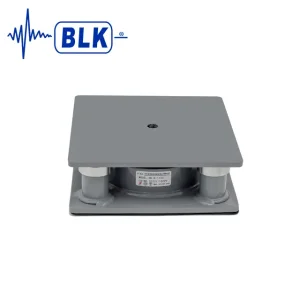






The Physics of Pneumatic Isolation: Achieving Sub-2Hz Resonance
Why modern nanoscale manufacturing, semiconductor metrology, and high-frequency optical microscopy have outpaced mechanical helical springs and standard synthetic elastomeric pads.
Dynamic Transmissibility & Resonance
Mechanical vibration isolation hinges on lowering the natural frequency ($f_n$) of the elastic support system relative to the disturbing ambient frequency ($f_d$). Standard steel coil springs reach an operational natural frequency threshold around 3.0 Hz to 5.0 Hz. Under dynamic excitation below 10 Hz, linear springs often amplify structural motion due to internal coil surge and low intrinsic loss factor ($\eta \approx 0.005$).
Pneumatic vibration isolators utilize the thermodynamic compliance of compressed gas within a sealed elastomeric diaphragm chamber. Gas stiffness does not rely on mechanical shear or flexion fatigue, enabling natural frequencies down to 1.2 Hz – 1.7 Hz, which prevents structural resonance transmission in cleanroom sub-floors, wafer fabrication facilities, and laboratory environments.
Where $r = f_d / f_n$ (frequency ratio) and $\zeta$ is the damping ratio. Effective attenuation begins only when $r > \sqrt{2}$. When $r \ge 3.5$, isolation efficiency exceeds 95%.
Dual-Chamber Damping & Automatic Leveling
Pneumatic isolators integrate an auxiliary reservoir linked via an internal laminar damping orifice. When high-acceleration dynamic stages shift, the differential displacement forces air across precision flow restrictions, instantly generating viscous damping without introducing stiff physical coupling.
Key pneumatic operational mechanisms include:
- Zero Static Sag: Integrated mechanical or non-contact optical leveling valves replenish internal air pressure ($P_0 = 4.0 - 7.0 \text{ bar}$) dynamically, maintaining stage levelness within $\pm 0.05\text{ mm}$ regardless of asymmetric payload loading.
- Broadband Attenuation: Damping covers 1 Hz to 200 Hz, eliminating high-frequency harmonic flutter and acoustically induced micro-tremors.
- Multi-Axis Isolation: Lateral deflection occurs via flexible elastomeric shear lobes, providing balanced vertical and horizontal isolation efficiencies exceeding 98%.
Bellking’s advanced pneumatic series pairs reinforced multi-ply chloroprene diaphragms with DACROMET-treated steel housings to prevent structural creep and air micro-leakage over decades of operation.
Worldwide Industrial Dynamics & Procurement Demands
How the expansion of advanced semiconductor fabs, quantum research, cleanroom automation, and regional industrial policies shape micro-vibration equipment procurement.
Western Lead Time Inflation
Procurement departments across North America and Europe face compounding friction with legacy Tier-1 isolator brands. Supply chain consolidation has inflated standard lead times to 16 to 26 weeks for custom-damped pneumatic units.
High distributor markups impose a 250% to 400% price premium over net manufacturing costs. Cleanroom construction projects face installation delays when waiting for specialized isolation tables or pneumatic retrofits.
Semiconductor & VC Criteria
Advanced 3nm and 2nm lithography, EUV inspection tools, and cryogenic electron microscopy demand compliance with VC-D through VC-G vibration criteria (vibration velocities as low as 1.5 to 3.0 μm/s RMS).
Modern fab layouts locate spinning turbomolecular pumps, reciprocating air compressors, and automated material handling systems (AMHS) overhead, requiring low-frequency pneumatic attenuation at point-of-use tool mounts.
Shift to OEM Direct Partnerships
Multinational equipment builders (OEMs) of CMM, SEM/TEM, laser micromachining, and wafer probers are bypassing multi-tiered third-party trading houses in favor of factory-direct technical collaboration.
Direct factory alignment offers rapid CAD validation, customizable mounting geometries, transparent unit cost pricing, and immediate batch scalability with factory-guaranteed dynamic performance test records.
China Industry 4.0: Supply Chain Resilience & Production Prowess
How localized precision engineering clusters in Jiangsu deliver high isolation performance, verifiable testing, and accelerated turnaround times.
Robotic Precision & Quality Control
Our Kunshan manufacturing hub deploys multi-axis CNC milling centers, robotic gas metal arc welding (GMAW), and automated cleanroom vulcanization presses. Every batch of elastomeric air chambers undergoes 72-hour air pressure drop testing under maximum payload simulation to guarantee zero micro-porosity.
Dimensional tolerances are held within ±0.02 mm, ensuring precision mounting alignment with optical stages, granite surfaces, and high-speed pick-and-place frames.
16 Patents & Engineering R&D
With 37 vibration-reduction patents (including 16 national invention patents), Bellking collaborates with university mechanical acoustics departments to innovate non-linear damping orifices, anti-rebound valves, and composite elastomeric blends resistant to oil and ozone.
Each design is validated via Finite Element Analysis (FEA) and dynamic modal shaker tables to map transmissibility frequency curves across 3 axes.
Agile Delivery: 24h to 3 Days
Integrated supply networks across the Yangtze River Delta allow us to maintain extensive inventories of standard pneumatic air mounts, spring hangers, and inertia platforms—enabling dispatch within 24 hours.
Custom 1:1 non-standard mounting plates, specialized leveling valve brackets, or high-capacity dual-chamber pneumatic isolators are designed, prototyped, and released to production in 3 working days.
Comprehensive Factory Pricing Breakdown & TCO Analysis
A transparent view into unit economics, comparison with Western OEM price structures, and total operational cost efficiency over lifetime usage.
| Isolator Series & Type | Payload Capacity (Per Point) | Natural Frequency ($f_n$) | Cleanroom / Coating Spec | China Direct Factory Price (USD) | Western OEM Benchmark (USD) |
|---|---|---|---|---|---|
| BK-A Series (Desktop Air Mounts) | 15 kg – 180 kg | 1.8 Hz – 2.5 Hz | Anodized Aluminum / Nitrile | $85 – $175 | $450 – $780 |
| BK-R Series (Heavy Industrial Air Mounts) | 200 kg – 3,500 kg | 1.5 Hz – 2.0 Hz | Dacromet 900h / Multi-Ply Diaphragm | $240 – $580 | $1,100 – $2,300 |
| BK-PA Series (Precision Metrology Air Mounts) | 50 kg – 1,200 kg | 1.2 Hz – 1.7 Hz | ISO Class 1 Cleanroom / Auto-Leveling | $420 – $890 | $1,850 – $3,600 |
| BK-PF Series (Low-Profile Auto-Leveling Air Mounts) | 100 kg – 2,500 kg | 1.2 Hz – 1.5 Hz | Zero-Exhaust Leveling / Ultra-Low Stature | $550 – $1,150 | $2,400 – $4,500 |
| Precision Granite Optical Platform System | 500 kg – 8,000 kg | 1.0 Hz – 1.5 Hz | Integrated Honeycomb/Granite + 4-Point Air Base | $2,400 – $6,500 | $9,500 – $24,000 |
Total Cost of Ownership (TCO) Breakdown
When selecting pneumatic isolation solutions, initial capital expenditure (CapEx) represents only 30% of the lifecycle investment equation. The total cost structure includes:
- Zero Maintenance Air Regulators: Bellking auto-leveling valves utilize sapphire-lapped spool mechanisms that eliminate continuous air bleeding. Air consumption is limited strictly to dynamic payload realignment cycles, saving up to $1,400 annually per tool in plant compressed air electricity costs.
- Extended Elastomer Lifespan: High-density molded chloroprene compounds resist ozone oxidation and industrial oil vapor, providing a field-verified service life exceeding 6 to 10 years without diaphragm brittleness or vulcanization decay.
- Elimination of Metrology Downtime: With sub-1.5 Hz cutoff frequencies, product scrap rates caused by ambient traffic or HVAC resonance in precision probing are reduced by up to 92%.
Pricing Variables: What Drives the Cost?
Engineers and buyers frequently ask why unit prices vary between different pneumatic product configurations. The main cost determiners include:
- Leveling Valve Precision: Standard mechanical linkage valves offer ±0.1 mm repeatability, whereas non-contact high-flow laminar valves achieving ±0.01 mm repeatability require micro-machined precision components.
- Surface Metallurgy: Cleanroom installations demand electroless nickel plating or 6061-T6 hard anodization to prevent metallic particulate flaking down to ISO Class 1 specs.
- Custom Structural Geometry: Custom height-constrained brackets, pneumatic tie-bars, and earthquake shear stops represent modest upfront tooling and NRE investments that protect multi-million dollar machinery.
High-Impact Engineering Applications Across 6 Strategic Sectors
Real-world integration of Bellking pneumatic vibration isolation systems from semiconductor cleanrooms to aerospace optical testing suites.
Semiconductor Wafer Probers
Challenge: An automated wafer prober installation in an elevated cleanroom suffered needle-to-pad drift due to overhead air handlers and automated cleanroom vehicle tracks vibrating at 6 Hz to 18 Hz.
Solution: Four Bellking BK-PA Series precision pneumatic mounts with integral 3-point auto-leveling valves. The system dropped the natural frequency to 1.4 Hz, cutting transmitted RMS velocity by 94% and achieving compliance with the VC-E criterion (3.12 μm/s).
Metrology CMM & Electron Microscopy
Challenge: Coordinate Measuring Machines (CMM) in a manufacturing workshop experienced measurement scatter exceeding 2.8 μm whenever nearby 200-ton stamping presses operated.
Solution: A Bellking pneumatic sub-base with BK-R Series air isolators and internal viscous orifice dampers. The solution absorbed shock impulses within 0.18 seconds, reducing CMM positional uncertainty to under 0.4 μm without relocating the machines.
Dynamic Granite Motion Stages
Challenge: High-acceleration linear motor stages (2G acceleration, 1.5 m/s travel) generated reactive forces that induced mechanical rocking and long settling times on passive optical tables.
Solution: Customized BK-PF Low-Profile Air Mounts featuring dual-chamber pneumatic reservoirs paired with rapid-exhaust proportional leveling valves. Settling time dropped from 850 ms to 72 ms, boosting continuous wafer throughput by 34%.
5-Step Engineering Guide: Correct Sizing & Selection
Avoid common engineering pitfalls such as point over-stiffness, center-of-mass rocking coupling, and localized resonance transmission.
1 Define Static Mass & Center of Gravity (CoG)
Begin by calculating total operational mass ($M_{total}$), including the machine frame, dynamic tooling heads, cables, and maximum consumable payloads. Locate the three-dimensional Center of Gravity ($x, y, z$). Asymmetric payload distribution requires isolators with varying load-bearing ratings or differentiated internal chamber pressures ($P_i$) to keep the tool level without asymmetric strain.
2 Map Ambient Vibration Spectrum
Conduct tri-axial baseline acceleration FFT measurements at the installation foundation during peak operating hours. Identify the dominant foundation disturbing frequency ($f_d$). If $f_d$ lies between 4 Hz and 8 Hz (typical of structural floor flexure), selecting a standard 4.5 Hz spring will cause resonance amplification; a sub-1.5 Hz pneumatic isolator is required.
3 Verify Isolation Efficiency Ratio
Ensure that the operating ratio $r = f_d / f_n \ge 3.0$. For an excitation source operating at 15 Hz, a Bellking BK-PA mount ($f_n = 1.4\text{ Hz}$) delivers a ratio of $r = 10.7$. This ensures dynamic isolation attenuation above 98.5%, reducing mechanical jitter and acoustic feedback to negligible levels.
4 Select Leveling System & Air Architecture
For static equipment, a 3-point mechanical spool valve system provides a kinematic plane without over-constraint. For high-speed pick-and-place robotics with shifting centers of gravity, select proportional electro-pneumatic or non-contact rapid-leveling valves to limit dynamic tilt within seconds.
Frequently Asked Questions: Engineering & Sourcing Details
Comprehensive answers addressing natural frequency, compressed air supply requirements, chemical compatibility, and factory direct shipping protocols.
How do pneumatic vibration isolators compare with high-deflection coil springs?
What compressed air parameters are required to run Bellking air mounts?
What happens if plant compressed air pressure fails unexpectedly?
Can Bellking manufacture custom dimensions and mounting interfaces for legacy tools?
How do your products comply with semiconductor cleanroom outgassing standards?
What is the realistic service life of the elastomeric air bladders?
What quality test documentation and verification reports are supplied with each batch?
What are the standard international shipping incoterms and lead times?
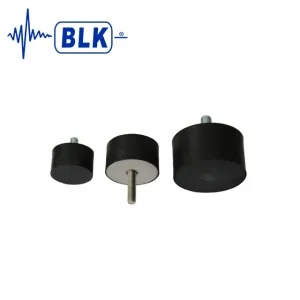
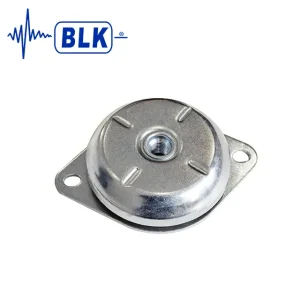
Heavy-Duty Elastomeric, Hanger & Precision Mount Series
Complete your facility vibration isolation plan with companion anti-vibration hangers, polymer damping pads, and industrial machinery mounts.




Need a Custom Sized Pneumatic Isolation Solution?
Share your equipment payload mass, center of gravity location, operating RPM, and ambient site vibration criteria. Bellking's senior application engineers will calculate required dynamic spring rates, air consumption, and return a comprehensive vibration mitigation plan within 24 hours.