
Engineered Ceiling & Pipework Isolation Assemblies
Direct factory-manufactured anti-vibration hangers, spring mounts, air-spring systems, and high-deflection elastomeric suspension units calibrated for critical mechanical acoustic decoupling.

Heavy-gauge steel bracket with calibrated high-deflection steel helical coil, offering 98%+ isolation for axial HVAC piping.
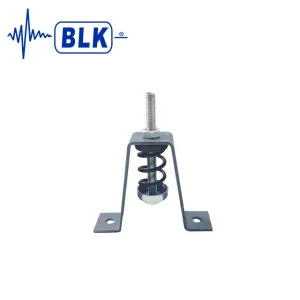
Engineered with dual-rate elastomer cups and zinc-electroplated spring elements to arrest structure-borne resonant noise.

Molded neoprene dynamic element embedded in zinc-plated casing for inline fans, high-velocity exhaust ducts, and suspended conduits.

Heavy-duty compressive shear damping mounts designed for air handlers, compressor frames, and floor-anchored assemblies.

High-deflection open/enclosed helical spring mount incorporating anti-friction guiding channels for low natural frequency (3-5 Hz).
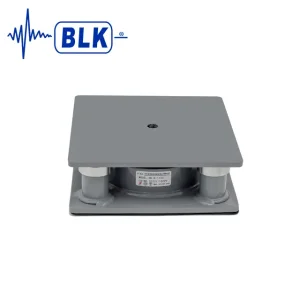
Ultra-low frequency pneumatic isolators hitting natural frequencies down to 1.7 Hz, engineered for metrology and cleanrooms.

Multi-chambered honeycomb pneumatic or tuned viscous damping base designed for laser interferometers and semiconductor probing.

Engineered composite matrix designed for high acoustic loss factors, preventing flanking sound transmission through structural slabs.
The Global Commercial & Industrial Landscape of Vibration Isolation Hangers
Across modern civil infrastructure, high-density semiconductor sub-fabs, pharmaceutical biocontainment suites, and hyperscale cloud data centers, structural acoustic isolation has shifted from a post-commissioning afterthought to a non-negotiable architectural baseline.
Stringent Regulatory & Acoustic Codes
Global acoustic mandates, including ASHRAE Handbook Chapter 49 (Noise and Vibration Control), ISO 10816 vibration severity standards, and European DIN 4109 building acoustic guidelines, now demand verifiable attenuation curves. Mechanical systems suspended directly from slabs transmit energy through structural columns as structure-borne noise (NC criteria < 25-30 in luxury and commercial zones), compelling architects to require certified vibration hanger factories.
Supply Chain Evolution: OEM to Direct Source
Procurement teams are shifting away from intermediate distributors toward direct partnerships with Tier-1 vibration isolation manufacturers. The demand for 1:1 engineering customization, rapid FEA load modeling, full material traceability (mill certifications for steel coils, rheometer cure graphs for elastomers), and documented compliance with salt spray corrosion standards (e.g., Dacromet 900+ hour endurance) has elevated the role of specialized factories.
High-Density Infrastructure Dynamics
With data centers scaling to multi-hundred megawatt loads and chilled-water piping exceeding 24 to 36 inches in diameter, the dynamic physical mass suspended from roof trusses presents immense structural challenges. Vibration hangers must not only isolate dynamic motor/fluid frequencies (15–60 Hz), but also endure water-hammer surges, thermal expansion shifts, and seismic shear loads without fatigue or sudden catastrophic failure.
The Mechanics of Kinetic Decoupling & Sizing Equations
Vibration isolation is governed by rigid mathematical relationships between the disturbing excitation frequency ($f_d$) of rotating or reciprocating machinery and the natural resonance frequency ($f_n$) of the suspended hanger assembly.
The Governing Natural Frequency Equation
For an undamped linear single-degree-of-freedom (SDOF) suspension system, the natural frequency ($f_n$) in Hertz is directly determined by the static deflection ($\delta$) of the spring or elastomeric medium under gravitational load:
Where $g$ is the acceleration due to gravity, and $\delta$ is the static deflection under the supported mass. To isolate lower disturbing frequencies (such as low-speed cooling tower fans or large axial fans running at 300 to 600 RPM / 5 to 10 Hz), the hanger must offer substantial static deflection—often 25mm (1 inch) to 50mm (2 inches)—to bring the system natural frequency down to 2–3 Hz.
Transmissibility & The Frequency Ratio Threshold
The effectiveness of an anti-vibration hanger is measured by its Transmissibility ($T$), which denotes the ratio of dynamic force transmitted through the ceiling anchor relative to the generated oscillating force:
Where $r = f_d / f_n$ (frequency ratio) and $\zeta$ is the damping ratio. Decoupling and isolation strictly begin only when the frequency ratio exceeds √2 (≈1.414). If $r < 1.414$, the hanger enters the resonance amplification zone, worsening vibration transmission. For industrial efficiency exceeding 90–95%, MEP engineering design guidelines require $r \ge 3.0$ to $4.0$.
Critical Acoustic Note: High-Frequency Surge Frequencies in Steel Coils
A bare helical steel spring excels at isolating low-frequency mechanical energy due to its large static deflection. However, at higher frequencies (500 Hz to 2 kHz, typical of pump impeller blade-pass frequencies and fluid turbulence), steel springs suffer from internal standing wave phenomena known as "spring coil surge." These high-frequency acoustic waves bypass the spring's deflection and travel through the steel wire directly into the building structure as audible airborne humming. Hence, industrial-grade vibration isolation hangers (such as Bellking HV-Type) incorporate a vulcanized high-performance neoprene rubber acoustical cup or elastomeric bushing in series with the steel coil to eliminate acoustic bridging.
| Hanger Technology Type | Static Deflection Range | Natural Frequency ($f_n$) | Isolation Efficiency Target | Optimal MEP Application Matrix |
|---|---|---|---|---|
| Pure Elastomeric / Rubber Hanger (HR Series) | 3 mm – 8 mm | 8.0 – 12.0 Hz | 80% – 88% (at >1800 RPM) | High-velocity ductwork, small inline blowers, suspended conduits, non-critical pipework. |
| Calibrated Steel Spring Hanger (HV Series) | 25 mm – 50 mm | 3.0 – 4.5 Hz | 95% – 98.5% | Chilled water piping, condenser lines, heavy fan coil units (FCUs), variable air volume (VAV) boxes. |
| Combination Spring & Rubber (Dual Deflection) | 28 mm – 55 mm | 2.8 – 4.0 Hz | 98% – 99.2% (Full Spectrum) | Reciprocating compressors, high-tonnage AHUs, critical piping near executive rooms/hospitals. |
| Pneumatic Suspension Mount (BK-R Series) | Active Volume Deflection | 1.7 – 2.5 Hz | 99.0% – 99.8% | Sub-fab chemical delivery pipelines, high-precision scanning microscopy, optical tables. |
Technological Roadmap & Advanced Factory Manufacturing
Modern vibration isolation hanger manufacturing has transformed through advanced metallurgy, automated robotic welding cells, and computational multi-physics simulation platforms.
Alloy Metallurgy & Cold Coiling
Leading factories utilize premium 60Si2MnA or ASTM A401 chrome-silicon spring alloys. Springs undergo precision shot-peening to introduce compressive surface stresses, increasing cyclic fatigue endurance to over 10 million cycles. Stress relief annealing in nitrogen atmosphere furnaces guarantees static creep and sag remain under 1.5% over a 15-year operational lifecycle.
Seismic Pre-Compressed Housings
Demands for seismic restraint under ASCE 7-22, IBC (International Building Code), and OSHPD protocols have driven the development of restrained pre-compressed spring hangers. Heavy-gauge ductile iron or laser-welded structural steel housings incorporate lateral limit stops and fail-safe elastomeric snubber grommets that handle 1.5G to 3.0G lateral accelerations without shearing.
Corrosion Shielding: 900h Salt Spray
Plant environments are exposed to corrosive atmospheres—cooling tower plumes, coastal salt air, and chemical off-gassing. Conventional electroplated zinc (5-8 μm) rapidly oxidizes. Bellking utilizes inorganic zinc-flake Dacromet and Geomet thermoset coatings, delivering over 900 hours of continuous ASTM B117 salt spray resistance without red rust, protecting structural integrity.
Localized Industrial Application Scenarios
Different industrial installations require tailored isolation strategies based on load, thermal displacement, fluid turbulence, and cleanroom air velocity requirements.
Hyperscale Data Centers: Chilled Water Suspension
Acoustic & Mechanical Challenge: Chilled water loops suspended above server halls can induce micro-vibrations across structural columns, causing high-density hard disk drives (HDDs) to misalign their read/write heads and reducing throughput. Fluid turbulence in 500mm headers produces continuous low-frequency hum.
Engineered Solution: Installation of pre-compressed HV spring hangers with integral 12mm neoprene cups. The pre-compression feature enables the contractor to install the piping dry at the exact design elevation; when the system is filled with water, the springs gently unlock into dynamic equilibrium without vertical sag or strain on mechanical chiller flanges.
Semiconductor Cleanrooms & Sub-Fab Utility Racks
Acoustic & Mechanical Challenge: Extreme micro-vibration standards (Vibration Criteria VC-D and VC-E, < 3.12 μm/s RMS velocity). High-velocity chemical vapor exhaust ducts and nitrogen supply lines hang directly beneath wafer production floors, threatening lithography tools.
Engineered Solution: Tuned low-stiffness multi-layer elastomeric hangers (HR-Type) alongside multi-chambered air mounts. Hangers decouple duct resonances from the waffle slab, achieving greater than 96% dynamic decoupling at 15–120 Hz excitation spectra.
Commercial High-Rise Rooftop Plantrooms
Acoustic & Mechanical Challenge: Penthouse suites positioned immediately beneath mechanical floors housing high-pressure condenser water pumps, centrifugal chillers, and suspended cooling tower headers. High acoustic energy risks noise complaints and lease concessions.
Engineered Solution: Multi-stage isolation using combination spring-rubber hangers with 50mm static deflection. In-line flex connectors combined with vibration hangers installed for the first 15 meters from pump nozzles eliminate pump excitation transmission into structural shear walls.
Hospitality & Healthcare Surgical Suites
Acoustic & Mechanical Challenge: Ceiling-hung variable air volume (VAV) boxes, surgical suite laminar flow plenums, and fan coil units (FCUs) operating 24/7 above critical care wards where internal acoustic criteria must not exceed NC-25.
Engineered Solution: Rubber-in-shear HR suspension assemblies with vulcanized steel eyelets. The elastomeric matrix is chemically compounded for high internal damping, eliminating low-load mechanical rattles and broadband air turbulence buzz without spring resonance issues.
Turnkey Macro-Engineering Protocols & Sizing Matrix
Implementing suspended vibration isolation requires an end-to-end methodology to prevent acoustic flanking paths, incorrect load distribution, and structural resonance.
1. Mass & Centroid Calculation
Piping point loads are determined using 3D BIM coordination models, calculating pipe weight, fluid mass, thick-walled insulation, valves, and header manifolds. Non-symmetrical mass centroids are mapped to ensure each hanger experiences deflection within its linear rating zone (±10% of rated capacity) to prevent spring bottoming or unseating.
2. Dynamic Deflection Matching
Hanger selection matches static deflection to operating frequency. Near chillers and cooling towers, where dynamic forces are intense, 50mm deflection springs are deployed for the initial 8–12 meters. As the piping runs farther along the building perimeter, 25mm deflection models are utilized to maintain cost-efficiency while providing required acoustic margins.
3. Eliminating Acoustic Flanking
All suspended hangers must maintain an unimpeded dynamic gap. Rigid contact between suspension threaded rods, ceiling hanger brackets, structural steel beams, or drywall partitions will introduce an acoustic short-circuit. Oversized hanger eyelet apertures and elastomeric centering grommets prevent metal-to-metal contact during operational sway.
Technical Roadmap: Next-Gen Suspension Technologies (2025–2035)
The future of vibration isolation hangers involves active structural feedback, digital-twin integration, and bio-based elastomeric damping materials.
High-Deflection Mechanical Precision
Implementation of automated cold-coiled silicon-chrome alloys with multi-stage non-linear elastomeric stops. Full standardization of 900+ hour Dacromet coatings across standard factory catalogs.
IoT Smart-Strain Sensor Integration
Miniaturized piezoelectric and strain sensors embedded into hanger load washers, streaming real-time spring deflection, mass shift, and vibration spectra directly to building BMS platforms via LoRaWAN.
Magneto-Rheological & Semi-Active Dampers
Hangers featuring fluid chambers responsive to magnetic field modulation. The damper alters its dynamic viscosity within milliseconds to suppress sudden fluid shock waves or seismic transients.
Metamaterial Negative-Stiffness Lattices
Additively manufactured mechanical metamaterial lattice structures offering near-zero dynamic stiffness under high static loads, isolating sub-Hertz frequencies without tall helical geometries.
Engineering & Procurement FAQ
In-depth technical answers addressing acoustic physics, structural anchoring, and system sizing criteria for project engineers and procurement managers.
How do I choose between pure elastomeric (rubber) and spring vibration hangers?
Why is an elastomeric cup required in series with a helical steel spring?
What is the risk of selecting a hanger with excessive load capacity (over-sizing)?
How do pre-compressed spring hangers assist piping installation during fluid filling?
What certifications and testing should be requested from a vibration hanger factory?
What causes acoustic short-circuiting in vibration hanger installations?
Industrial Mounts, Buffers & Heavy-Duty Damping Systems
Explore our full line of floor mounts, impact buffers, leveling feet, and multi-layer isolation dampers designed for complex mechanical room and heavy equipment applications.

Double-deflection vulcanized elastomeric element designed for low-profile industrial compressors and generator bases.

Parabolic shock and limit stop buffer built to absorb high-velocity mechanical impact, crane run-outs, and seismic surges.
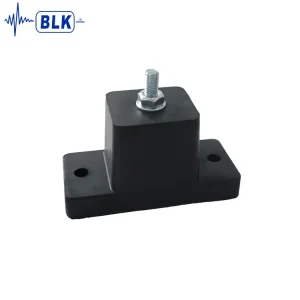
Cross-ribbed elastomeric pad design engineered for rapid placement beneath transformer skids, chillers, and machine footings.

V-shaped directional shear-compression isolator engineered to arrest multidirectional kinetic motion in marine and mobile equipment.

Threaded leveling spindle combined with heavy-duty nitrile anti-slip base for machine tools, electronics racks, and conveyer frames.

Interleaved steel shims and high-damping polymer layers delivering high load capacity with low transmissibility for forging presses.

Heavy-duty elastomeric bell mount with an interlocking cast steel safety cap, engineered for diesel gensets and industrial fans.
Factory-tested suspended dynamic spring hanger featuring large-diameter coils with extra lateral travel for demanding piping systems.