
High-Performance Vibration Isolators & Mounts
Precision-engineered structural support, low-frequency resonance mitigation, and heavy equipment shock absorption catalog.

Global Trends in Heavy Machinery Vibration Control & Structural Mitigation
Analyzing modern mechanical dynamics, ultra-precision manufacturing requirements, structural fatigue compliance, and high-load acoustic attenuation.
High-Frequency Stamping & Dynamic Impact
Modern metal fabrication plants utilize high-tonnage punch presses operating at high cycle rates. Shock energy transferred directly into concrete foundations causes structural micro-cracking, foundation settlement, and severe dimensional inaccuracy in adjacent equipment. Precision-engineered elastomeric and spring damping systems isolate dynamic transient shock energy up to 99%.
Semiconductor & Sub-Nanometer Cleanrooms
In semiconductor photolithography and metrology labs, floor micro-vibrations exceeding VC-E or VC-G criteria lead to wafer alignment failure. Custom active and low-frequency pneumatic air isolators provide sub-Hz horizontal and vertical natural frequencies (down to 1.7 Hz), ensuring stable ambient conditions for yield-critical manufacturing processes.
Power Generation & Grid Reliability
Heavy transformers, switchgears, and turbine-generator sets suffer from magnetostriction and rotational imbalances. Continuous 100Hz/120Hz hum and low-frequency excitation accelerate joint degradation and create severe noise pollution in urban substations. Engineered matrix isolators absorb low-frequency hum, doubling equipment service life.
Mechanics of Industrial Damping & Transmissibility Theory
Understanding the mathematical relationship between forced excitation frequency, system stiffness, and damping ratio for heavy industrial machinery.
1. Dynamic Transmissibility Equation ($T$)
Vibration isolation effectiveness is governed by transmissibility ($T$), defined as the ratio of the force transmitted to the base foundation ($F_t$) to the internal dynamic force generated by the machine ($F_0$). The governing equation in a single-degree-of-freedom (SDOF) model is expressed as:
Where:
- r = f_d / f_n is the frequency ratio (Excitation Frequency $f_d$ divided by Isolator Natural Frequency $f_n$).
- ζ (Zeta) is the structural damping ratio of the isolator material (e.g., Viscoelastic polymer, Neoprene, or Viscous Fluid).
- f_n = (1 / 2π) * √(k / m) represents system natural frequency derived from static deflection ($\delta_{st}$).
Viscoelastic Polymer vs. Helical Steel Springs
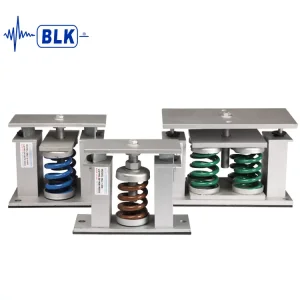
Helical spring mounts excel at delivering ultra-low natural frequencies (3 Hz to 5 Hz), making them ideal for slow-speed equipment like roof-mounted chillers and cooling towers. However, steel springs exhibit minimal intrinsic damping ($\zeta \approx 0.01$), making viscous fluid insertion necessary to control transient surge loads during machine startup and shutdown cycles.
High-Damping Elastomeric Compound Formulations
Custom formulated Neoprene and Nitrile rubber mounts incorporate proprietary carbon black fillers and anti-aging antioxidants. They offer excellent hysteresis damping ($\zeta \approx 0.05 - 0.15$), resisting oils, ozone degradation, and fatigue under cyclic shear stress. Perfect for motor bases, HVAC inline fans, and lightweight industrial pumps.
Macro Industry Vibration Control Solutions Matrix
Comprehensive selection guide tailored for mechanical engineers, structural consultants, procurement leads, and plant operational managers.
| Application Sector | Primary Excitation Source | Recommended Isolation Solution | Target Frequency Range | Isolation Efficiency |
|---|---|---|---|---|
| HVAC & Central Chiller Plants | Centrifugal Compressors, Water Chillers, Cooling Towers | Open/Enclosed Spring Isolators with Viscous Damping & Inertia Bases | 3 Hz – 5 Hz ($f_n$) | 95% – 99% |
| Power Transformers & Substations | Core Magnetostriction, 100Hz/120Hz Low-Frequency Hum | Custom BK-MT Matrix Transformer Mounts, High-Damping Elastomers | 8 Hz – 12 Hz ($f_n$) | 92% – 97% |
| Heavy Stamping & Forging Presses | High-Energy Impact Shock, Reciprocating Transient Dynamics | Heavy-Duty Viscous Damped Springs & Polymer Damping Pads | 2.5 Hz – 4 Hz ($f_n$) | 90% – 96% |
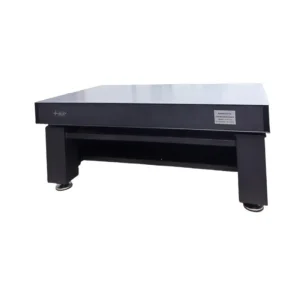
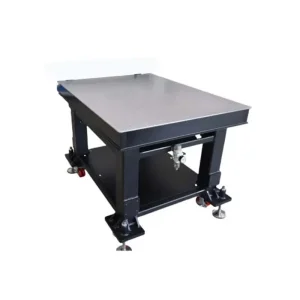
| Semiconductor & Metrology Labs | Subway / Traffic Floor Vibration, Acoustic Air Turbulences | BK-DT/BK-AT Pneumatic Isolation Platforms with Auto-Leveling Valves | 1.7 Hz – 2.5 Hz ($f_n$) | 98% – 99.9% |
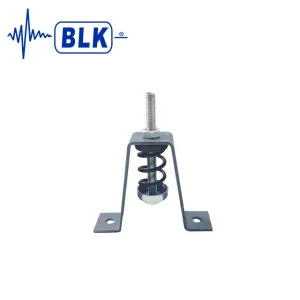
| Suspended Mechanical Piping & AHUs | Fluid Turbulence, Inline Fan Imbalance, Hydraulic Water Hammer | HV & HR Type Combination Spring/Rubber Ceiling Isolation Hangers | 4 Hz – 8 Hz ($f_n$) | 94% – 98% |
Global Procurement Demand & Customization Price Drivers
Understanding direct factory vs OEM cost structures, material specification impact, volume discounts, and total cost of ownership (TCO).
Custom Heavy Damping Pricing Breakdown
Pricing for custom industrial vibration mounts varies based on engineering parameters rather than simple weight. Key cost determinants include:
- Raw Spring Alloy: High-tensile 60Si2Mn spring steel vs standard carbon steel springs.
- Surface Coating Treatment: Standard spray paint vs 900-Hour Salt Spray Resistant Dacromet / Hot-Dip Galvanizing for marine environments.
- Elastomer Material Grade: Natural rubber compounds vs custom Neoprene, EPDM, or high-temperature Fluororubber (FKM).
- Precision CNC Tooling: Custom mounting top-plates, internal viscous fluid dampening chambers, and integrated seismic restraint housings.
Factory-Direct Sourcing vs. Trading Distributors
Procuring directly from specialized original equipment manufacturers (OEMs) like Bellking delivers significant procurement benefits:
- Cost Reduction: Eliminate 25% – 40% distributor markup margins on high-volume construction and machinery projects.
- Fast Engineering Prototyping: Dedicated R&D team delivering custom 3D CAD modeling and finite element analysis (FEA) within 24–48 hours.
- Traceable Material Certification: Direct access to mill test reports (MTR), ISO 9001 quality inspection logs, and load deflection curves.
- Reliable Lead Times: Standard isolators ship within 24 hours; custom OEM production completed in as fast as 3 to 7 working days.
Localization Support, Quality Assurance & Regulatory Compliance
Adhering to strict international building codes, environmental regulations, and structural safety mandates.
International Quality Certifications
All manufacturing facilities maintain certified ISO 9001:2015 quality management systems. Every batch of spring mounts and rubber isolators undergoes rigorous tensile, compression, dynamic stiffness, and fatigue load testing before dispatch.
Seismic & Wind Restraint Standards
Custom heavy machinery mounts are engineered to comply with International Building Code (IBC) seismic provisions and ASCE 7 force requirements. Integrated snubbers withstand multidirectional earthquake shocks and high wind loads up to 3G–5G acceleration.
Environmental Compliance & Anti-Corrosion
Products conform to EU RoHS and REACH environmental guidelines. Elastomeric compounds avoid toxic off-gassing. Heavy-duty metallic housings undergo 900-hour salt spray corrosion testing, ideal for chemical plants, offshore platforms, and humid environments.
Technical Roadmap & Next-Generation Damping Innovations
Exploring the shift from passive isolation systems to AI-driven active controls, smart metamaterials, and IoT condition monitoring.
Smart IoT-Integrated Condition Monitoring
Next-generation vibration mounts are integrating embedded wireless MEMS accelerometers and thermal sensors. By broadcasting real-time FFT frequency spectrum analysis to cloud-based monitoring platforms, plant operators receive instant predictive maintenance alerts before bearing failure or spring fatigue occurs.
Active Piezoelectric Attenuation & Magneto-Rheological Damping
While passive springs cover static frequency ranges, active piezoelectric actuators dynamically counter dynamic displacement in real time. Combined with Magneto-Rheological (MR) fluids that instantly adjust viscosity based on magnetic field variance, future heavy industrial mounts will deliver zero-transmissibility across variable-speed machinery.
Specialized Damping Mounts & Isolation Platforms
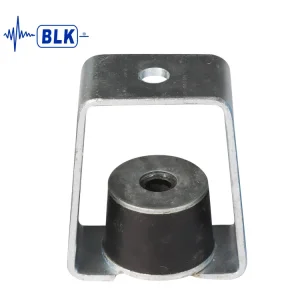
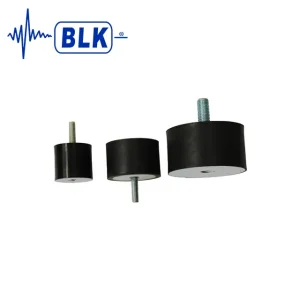
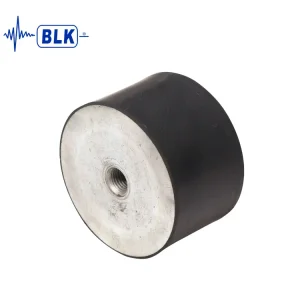
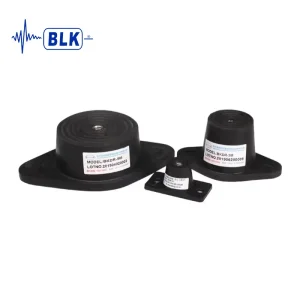
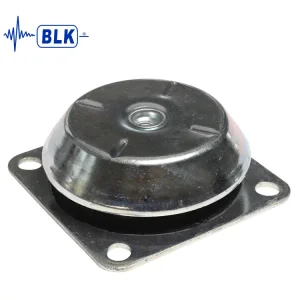
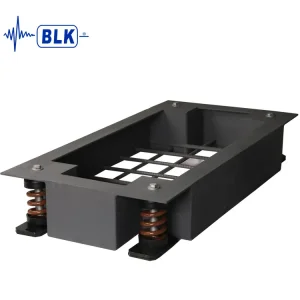
Explore additional OEM isolation platforms, low-frequency polymer pads, high-load matrix supports, and rubber hangers.

Frequently Asked Engineering Questions
Direct technical solutions from Bellking application engineers regarding isolation selection, calculation inputs, pricing, and factory direct lead times.
How do I accurately size a custom heavy machinery vibration isolator?
- Total Operating Weight: Machine dry weight plus fluid payload and temporary working loads.
- Center of Gravity (CG) Location: Ensures asymmetrical weight distribution is compensated by varying spring stiffness at each point.
- Operating Speed (RPM / Hz): The lowest rotational speed or excitation stroke frequency ($f_d$).
- Environmental Conditions: Temperature, ambient oil exposure, and seismic/wind restraint requirements.
What is the difference between rubber mounts and spring vibration isolators?
How does viscous damping work in heavy machinery spring mounts?
What pricing factors influence custom OEM vibration damping manufacturing?
Why are concrete inertia bases required for heavy inline pumps and chillers?
- Lower the combined center of gravity, stabilizing the system against dynamic starting torque.
- Increase overall system mass, reducing dynamic motion amplitude during operation.
- Maintain rigid alignment between driving motors and driven pumps, preventing pipe flange shear fatigue.