
High-Efficiency Air Compressor Vibration Isolators & Mounts
Precision-engineered spring mounts, inertia bases, rubber dampers, and pneumatic isolation platforms manufactured under ISO 9001 certified quality controls.
1. Fundamentals of Air Compressor Vibration Dynamics & Kinetic Damping
Industrial compressed air systems—ranging from rotary screw compressors and high-pressure reciprocating pistons to centrifugal turbo compressors—generate intense kinetic energy during operational cycles. Unmitigated, this mechanical energy converts directly into harmonic vibration, low-frequency structural resonance, and airborne noise. In modern industrial facilities, the challenge extends far beyond basic comfort; unisolated air compressors induce dynamic fatigue stress on connected piping networks, cause premature bearing wear, disrupt adjacent precision metrology equipment, and risk non-compliance with strict occupational safety and noise regulation frameworks such as ISO 10816 and OSHA decibel limits.
Achieving superior vibration isolation requires a deep understanding of harmonic excitation frequencies ($f_e$) and system natural frequencies ($f_n$). When an air compressor operates at a constant shaft speed—for example, a 4-pole motor operating at 1,480 RPM ($24.67\text{ Hz}$)—it emits primary dynamic forces alongside higher-order harmonics. If the natural frequency of the equipment support frame aligns with this excitation frequency, structural resonance occurs, amplifying dynamic forces by up to 500%.
Isolation efficiency ($\eta$) is governed by the frequency ratio $r = f_e / f_n$ and the damping ratio $\zeta$: $$T_r = \sqrt{\frac{1 + (2\zeta r)^2}{(1 - r^2)^2 + (2\zeta r)^2}}, \quad \eta = (1 - T_r) \times 100\%$$ To achieve isolation efficiencies exceeding 95%, the system frequency ratio ($r$) must strictly exceed $\sqrt{2}$, with an optimal operational zone designed around $r \ge 3.0$ to $5.0$.
This fundamental physics dictates why selecting a factory-direct, highly calibrated vibration isolator is critical. Low-cost standard rubber pads frequently suffer from high dynamic stiffness ($K_d / K_s > 2.0$), elevating the system natural frequency and pushing the compressor directly into the resonance amplification zone. Conversely, advanced spring vibration isolators engineered with viscous damping cores achieve natural frequencies as low as $3.0\text{ Hz}$ to $5.0\text{ Hz}$, ensuring effortless attenuation of low-frequency reciprocating pulses.
Macro Trends Driving Air Compressor Isolation Sourcing in 2026
How global industrial automation, ESG compliance, and total cost of ownership (TCO) models are shifting international buyer requirements toward high-precision OEM manufacturing hubs.
1. Decarbonization & Energy Efficiency
Micro-vibrations in screw compressor rotors cause internal clearance degradation over time, reducing volumetric efficiency by up to 7%. Precision isolation preserves mechanical alignment, maintaining optimal specific power consumption (kW/100 CFM).
2. Environmental & Acoustic Compliance
Municipal noise regulations and worker safety standards (OSHA/CE) mandate structural noise attenuation below 65 dB(A) at plant boundaries. Anti-vibration isolators eliminate structure-borne acoustic bridging through building slabs.
3. Semiconductor & Bio-Pharma Integration
Next-generation fabs and bio-pharmaceutical manufacturing facilities locate heavy utility air plant rooms adjacent to ultra-sensitive cleanrooms, requiring pneumatic sub-2Hz isolators and zero-outgassing elastomer compounds.
3. China Industry 4.0: Supply Chain Resilience & Cost Efficiency Advantages
The global industrial sourcing landscape for vibration control equipment has undergone a structural transformation. Procurement directors and EPC engineering teams no longer face a trade-off between premium Western technical performance and competitive Eastern pricing. Specialized Chinese advanced manufacturing hubs—most notably in Kunshan and Jiangsu—have synthesized state-of-the-art robotic production with deep metallurgical science to deliver world-class vibration control solutions at unmatched price-to-performance ratios.
Key Drivers of China’s Factory-Direct Competitive Advantage
Chinese OEM/ODM manufacturing ecosystems leverage an integrated Industry 4.0 supply chain model that eliminates intermediary markups while driving structural quality upwards:
- Automated Precision Coil Winding: CNC multi-axis spring coiling machines ensure 100% uniformity in pitch, rate, and static load deflection capacities across high-stress alloy steel springs.
- Advanced Surface Metallurgy (Dacromet & Powder Coating): Steel components undergo multi-stage Dacromet coating processes, achieving over 900 hours of continuous salt spray corrosion resistance (ASTM B117 standard) for harsh offshore and chemical plant installations.
- In-House Vulcanization & Elastomer Formulation: In-house mixing of custom Nitrile (NBR), Neoprene, EPDM, and silicone compounds ensures consistent durometer hardness (Shore A 40–70) and minimal long-term compression set under high thermal operating conditions.
- Agile Customization Cycles: Utilizing 3D CAD dynamic finite element analysis (FEA) models, custom OEM isolators (such as non-standard mounting height, restraint snubbers, and inertia bases) move from engineering design to prototype within 3 to 5 business days.
| Evaluation Parameter | Traditional Tier-1 European Brand | Standard Commercial Supplier | China Industry 4.0 Direct Factory (Bellking) |
|---|---|---|---|
| Price / Cost Structure | High Premium (300%–500% markup) | Low initial price, high failure rate | Direct Factory Price (30%–50% Cost Savings) |
| Natural Frequency Range | 3.0 Hz – 8.0 Hz | 6.0 Hz – 15.0 Hz (Inadequate damping) | 1.7 Hz – 4.5 Hz (Precision Tuned) |
| Corrosion Protection | Standard Paint / Galvanized | Basic Spray Paint (<100h Salt Spray) | Dacromet / Epoxy Coating (>900h Salt Spray) |
| Design & Lead Time | 8 – 12 Weeks Lead Time | Stock Only, No Customization | 24h Shipping for Stock; 3-Day Custom Prototyping |
| Quality Assurance | ISO 9001 Certified | Variable QA Standards | ISO 9001, 37 Patents, 100% Static Deflection Test |
4. Technical Sizing & Material Selection Framework
A rigorous step-by-step engineering selection matrix to determine the optimal isolator chemistry and mechanical geometry based on operational parameters.
Spring Isolators vs. Rubber Mounts
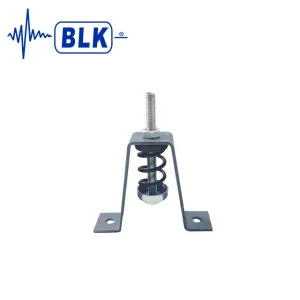
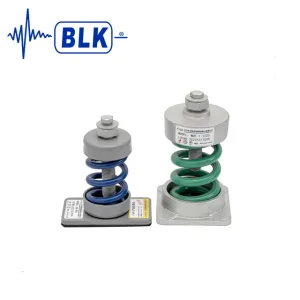
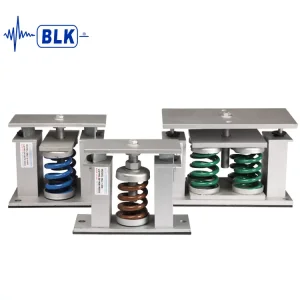
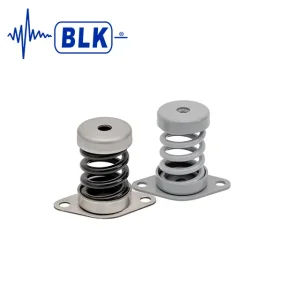
Open Coil Spring Mounts (MD/MA/ME Series): Ideal for low operational RPM (<1,800 RPM) equipment with high dynamic imbalance forces. Offers high static deflection (25mm–50mm) and ultra-low natural frequencies ($3.0\text{ Hz} - 5.0\text{ Hz}$).
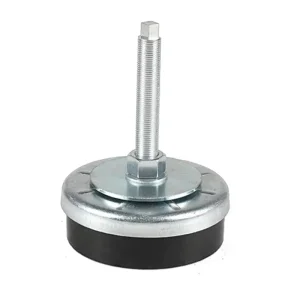
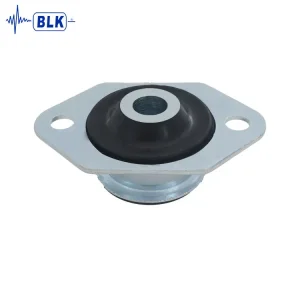
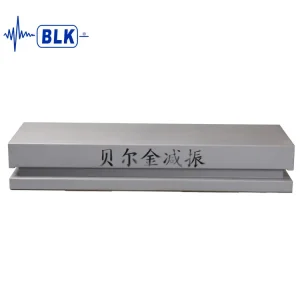
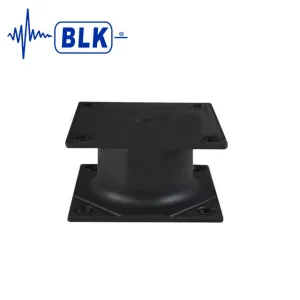
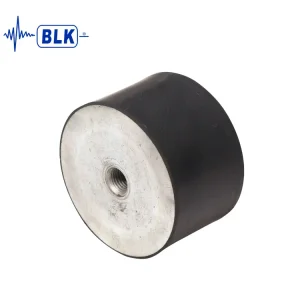
Rubber Mounts & Damping Pads (BKDJ/BKAL Series): Best for high-frequency vibration damping (>2,400 RPM), high dynamic shear forces, and compact mechanical footprints. Provides high internal damping coefficient ($\zeta \approx 0.10 - 0.15$).
Inertia Bases & Pneumatic Isolation
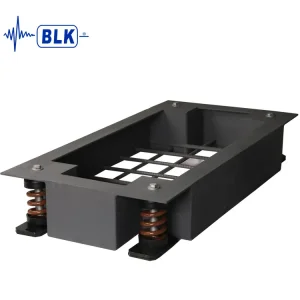
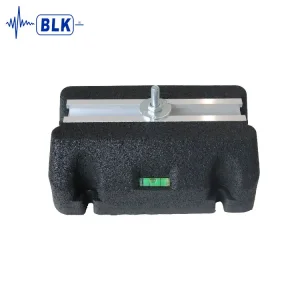
Concrete Inertia Bases (CPB Type): Recommended for heavy reciprocating air compressors and large water pumps. Adds massive structural mass, lowers the center of gravity, reduces equipment motion during start-up/stop transients, and stabilizes pipe connections.
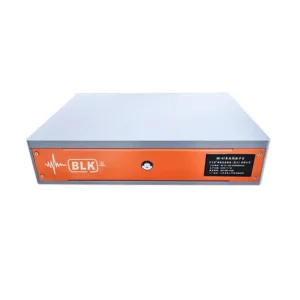
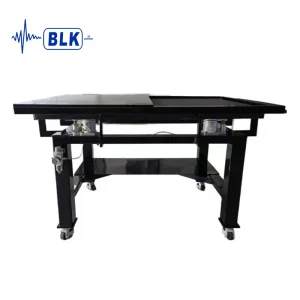
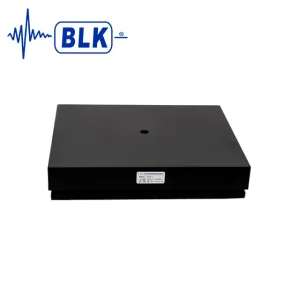
Pneumatic Isolation Platforms (BK-VT/BK-AT): Required for ultra-sensitive applications demanding extreme vibration attenuation down to $1.7\text{ Hz}$, utilizing pressurized air cushions with auto-leveling valves.
5. Real-World Application Scenarios & Engineering Field Case Studies
Vibration isolation demands vary drastically across industrial environments. Below are primary field deployment profiles where factory-engineered vibration isolators resolve critical operational challenges:
A. Rooftop HVAC & Rotary Screw Air Compressor Installations
When air compressors and HVAC chillers are mounted on roof decks or upper-floor mechanical rooms, structural deflection of the concrete slab creates a secondary dynamic spring system. Unrestrained spring isolators can induce resonance with the floor slab's structural natural frequency. Here, Restrained Spring Vibration Isolators equipped with vertical limit snubbers are deployed. They withstand lateral wind loads, prevent equipment surge during liquid carryover or starting torque, and isolate over 97% of dynamic forces from entering the building structure.
B. High-Pressure Reciprocating Piston Compressors in Heavy Industry
Reciprocating compressors generate severe unbalanced horizontal and vertical inertial forces due to piston acceleration. Installing these machines on standard rubber pads quickly results in severe elastomer tear, floor cracking, and high-decibel acoustic radiation. The optimal engineering solution involves bolting the compressor frame to a heavy steel-reinforced Inertia Base (CPB Type) supported by heavy-duty Viscous Damped Spring Mounts (MD Series). The inertia base increases total mass by 1.5 to 2.0 times equipment weight, dampening displacement amplitudes to safe operational tolerances.
C. Cleanroom Micro-Vibration Control for Semiconductor Compressed Air Lines
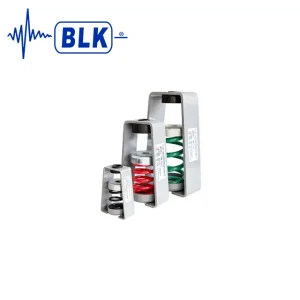
Semiconductor wafer fabrication facilities utilize high-purity compressed air (CDA) lines that route directly adjacent to photolithography scanners and atomic force microscopes. Micro-vibrations transmitted through compressed air pipe hangers can ruin nanometer-scale chip printing. Suspended piping is isolated using HV-Type Spring Hangers combined with high-performance Polymer Damping Pads (BK-PM), ensuring structure-borne noise and fluid flow pulsation are fully attenuated before reaching cleanroom walls.
Engineering Metrics That Guarantee Reliability
Delivering high-performance acoustic and dynamic isolation for over a decade across 1,000+ global industrial projects.
Technical & Procurement Q&A Guide
In-depth technical answers from senior vibration control engineers regarding selection, installation, dynamic load calculations, and OEM customization.
How do I calculate the correct static deflection required for an air compressor isolator?
Why choose factory-direct Chinese manufacturers over regional distributors?
When should an air compressor installation use an Inertia Base versus direct mounting?
What is the expected lifespan and maintenance requirement of spring vibration isolators?
How do you prevent "acoustic bridging" through anchor bolts and pipe fittings?
What custom options are available for specialized OEM air compressor builders?
Precision Damping Pads, Rubber Mounts & Specialized Accessories
Explore our complete inventory of industrial rubber buffers, polymer damping pads, and matrix isolation systems.

Need a Sized Vibration Isolation Scheme for Your Compressor Project?
Submit your equipment operating parameters (total weight, center of gravity, operating RPM, and mounting footprint), and our senior application engineers will issue a tailored vibration isolation proposal within 24 hours.