
High-Temperature Industrial Anti-Vibration Mounts & Systems
Explore our factory-direct heat resistant spring mounts, damped rubber isolators, and precision levelling components engineered for continuous operation under severe thermal loading.








High-Temperature Vibration Control Engineering & Dynamic Physics
Understanding the interplay between thermal stress, dynamic stiffness ratio ($K_d/K_s$), and elastomer degradation mechanisms in heavy industrial applications.
In modern industrial manufacturing, power generation, and high-performance processing facilities, mechanical vibration isolation is rarely a isolated mechanical challenge. Operating machinery such as exhaust gas recirculation blowers, combined-cycle gas turbines, hot-fluid thermal oil pumps, glass tempering ovens, and foundry shakeouts expose vibration isolation mounts to severe thermal loads ranging from +80°C to over +300°C.
Standard commercial-grade vibration mounts utilizing natural rubber (NR) or low-cost Neoprene (CR) experience catastrophic failure when exposed to elevated temperatures. Thermal aging induces rapid chain scission and cross-linking within the polymer matrix, resulting in embrittlement, severe permanent set (creep), dynamic stiffness hardening, and complete loss of isolation capability. When the dynamic stiffness ($K_d$) increases dramatically relative to static stiffness ($K_s$), the natural frequency ($f_n$) of the mounting system shifts upward into the operating frequency zone ($f_d$), converting an anti-vibration mount into a direct structural acoustic bridge.
The Dynamic Transmissibility Equation under Thermal Degradation
The mathematical foundation of vibration isolation is expressed through the dynamic transmissibility ($T_d$) ratio:
Where $\zeta$ represents the damping ratio, $f$ is the forcing frequency generated by the machine, and $f_n$ is the system natural frequency derived from $f_n = \frac{1}{2\pi}\sqrt{\frac{K_d}{m}}$. When elevated heat hardens an unrated rubber matrix, $K_d$ increases exponentially, driving $f_n$ higher and reducing the ratio $f/f_n$ below the critical threshold of $\sqrt{2}$ (1.414). At $f/f_n < \sqrt{2}$, dynamic amplification occurs, creating severe structural resonance that destroys bearings, fatigue-cracks structural steelwork, and violates ISO 10816 acoustic limits.
Heat-Resistant Polymer Science & High-Alloy Metallurgy
How Bellking engineered silicone matrices, fluoroelastomers (FKM), viscous damping fluids, and Dacromet-treated alloy spring steels solve high-temperature vibration challenges.
Fluorosilicone & FKM Matrices
Formulated with specialized cross-linking vulcanization agents, our Fluorosilicone (FVMQ) and Viton (FKM) elastomers sustain continuous thermal exposure from -40°C to +230°C without significant change in Shore A durometer hardness or dynamic shear modulus.
High-Stress Alloy Helical Springs
Utilizing high-tensile 60Si2MnA and 50CrVA alloy spring steel subjected to precise multi-stage oil quenching, shot peening, and stress relieving. Springs maintain linear spring rate ($K$) up to +275°C without thermal relaxation or sag.
Viscous Fluid & Mesh Damping
For high-amplitude transient shock and thermal expansion movement, our hybrid mounts incorporate synthetic high-viscosity silicone fluid (viscosity index >300) combined with 316 stainless steel wire mesh pads operating reliably up to +350°C.
| Elastomer / Material Type | Continuous Temperature Range | Peak Temperature Limit | Oil & Chemical Resistance | Heat Aging Compression Set | Typical Application Field |
|---|---|---|---|---|---|
| Natural Rubber (NR) | -40°C to +70°C | +85°C | Poor | High (>45% at 70°C) | Standard HVAC & General Equipment |
| High-Temp EPDM | -50°C to +130°C | +150°C | Moderate (Poor to Oils) | Medium (25% at 100°C) | Hot Water Pumps, Air Handling Units |
| Specialized Silicone (VMQ) | -60°C to +200°C | +240°C | Fair | Low (15% at 150°C) | Ovens, Food & Pharma Cleanrooms |
| Fluorosilicone / FKM (Viton) | -40°C to +230°C | +280°C | Excellent (Fuels, Solvents, Acids) | Very Low (<12% at 175°C) | Exhaust Blowers, Marine & Chemical Plants |
| All-Metal Mesh & Spring Hybrids | -100°C to +350°C | +450°C | Impervious | Zero Thermal Creep | Turbines, Incinerators, Power Plants |
Macro Industry Dynamics & Global Sourcing Economics
Why leading global EPC contractors, HVAC OEM manufacturers, and industrial plant operators rely on direct-factory procurement for certified heat-resistant vibration control systems.
Power Generation & Energy Transition
Combined Heat and Power (CHP) plants, biomass boilers, and waste-to-energy facilities require high-capacity spring isolators that survive ambient temperatures exceeding +120°C surrounding ductwork, exhaust silencers, and steam turbine skids.
Automotive Testing & Engine Dynamometers
Internal combustion engine (ICE) and hybrid powertrain test cells generate extreme vibration pulses alongside radiant heat up to +250°C. Custom damped mounts prevent floor structure fatigue while maintaining precision alignment.
Semiconductor Thermal Processing
Epitaxial reactors, diffusion furnaces, and thermal oxidation equipment generate ultra-clean micro-vibration profiles in environment enclosures maintained at elevated operating temperatures, demanding zero-outgassing silicone matrices.
Heavy Metallurgy & Glass Manufacturing
Forging presses, rolling mills, and glass tempering blowers impose combined shock loading and continuous radiant thermal stress, necessitating heavy-duty steel-housed spring mounts with viscous dampers.
Localized Engineering Application Scenarios
In-depth technical breakdown of custom vibration isolation installations across demanding high-temperature industrial environments.
Scenario A: High-Temperature Exhaust Fan Isolation in Chemical Processing Plants
In petrochemical processing plants, forced-draft induced exhaust fans transport corrosive, hot vapor streams at temperatures exceeding +180°C. Standard foot-mounted rubber buffers melt or harden within weeks. Bellking engineers deployed custom BK-DS Series High-Temperature Spring Mounts integrated with high-durability fluorosilicone snubber pads. The spring coils were coated with Dacromet anti-corrosion coating (passing 900-hour salt spray testing) to combat chemical fumes. Result: 96.5% vibration transmission reduction and over 5 years of maintenance-free continuous operation.
Scenario B: Hot Thermal Oil Pump Isolation with Concrete Inertia Bases
High-capacity thermal fluid pumps circulating heat-transfer oil at +250°C create strong rotational imbalance and nozzle thermal expansion forces. Installing pumps directly on spring mounts causes severe pipe stress and coupling misalignment. The engineering solution utilizes a CPB Type Concrete Inertia Base supported by heavy-duty MC Type Damped Spring Mounts with high-temperature silicone viscous fluid. The inertia base lowers the overall center of gravity, absorbs pump startup torque, and accommodates thermal pipe expansion without over-stressing pump flanges.
Scenario C: Dry-Type Electrical Transformer Acoustic Mitigation in Commercial High-Rises
Substation transformers operating inside modern high-rise commercial structures generate 100 Hz / 120 Hz core magnetostrictive hum while operating at internal coil temperatures exceeding +115°C. Bellking custom-designed BK-RT Type High-Temperature Transformer Mounts engineered with high-temperature silicone damping pads. The installation suppressed structural noise transmission by 28 dB(A), meeting stringent LEED building acoustics standards without thermal degradation of the isolator element.
Strict International Testing & Quality Standards Assurance
Bellking Vibration Control Manufacturing operates under rigorous ISO 9001 certified quality management protocols, ensuring full compliance with global engineering specifications.
ISO 9001:2015 Certification
Every step from raw steel spectrographic testing, spring wire coiling, heat treatment, and polymer compounding to final assembly is documented and strictly controlled.
ASTM D2000 & Heat Aging
Elastomer compounds undergo accelerated oven heat-aging tests per ASTM D573 and compression set resistance tests under elevated temperatures per ASTM D395 Method B.
900-Hour Corrosion Test
Steel structural components feature Dacromet electro-coating and hot-dip galvanizing, verified via 900+ hour continuous salt spray exposure testing (ASTM B117 / ISO 9227).
Seismic & Wind Restraint
Integrated limit stops and seismic snubbers engineered in compliance with ASCE 7 and IBC (International Building Code) criteria for earthquake zone survivability.
Next-Generation Technology Roadmap: Smart Thermal Vibration Isolation
Pioneering active thermal compensation, embedded micro-sensor diagnostics, and nano-composite damping materials for Industry 4.0 applications.
IoT Real-Time Health Monitoring
Integrating wireless piezoelectric vibration accelerometers and thermal sensors directly into heat-resistant isolator housings. Real-time data streams provide predictive maintenance alerts prior to mechanical failure.
Phase-Change Material (PCM) Integration
Embedding paraffin phase-change microcapsules into elastomer matrices to absorb peak transient thermal spikes, capping peak internal temperatures during intermittent heat blasts.
Active Electromagnetic Compensation
Hybrid isolator units combining passive high-temperature coil springs with active voice-coil actuators, dynamically counteracting residual low-frequency resonances in extreme thermal zones.
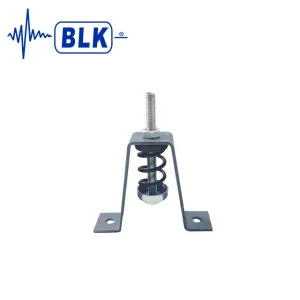
Precision Platforms, Suspended Hangers & Heavy Equipment Supports
Complete your facility vibration isolation architecture with our certified range of platforms, hangers, polymer pads, and custom engineered pump supports.







Frequently Asked Questions: High-Temperature Vibration Control
Direct technical guidance from Bellking application engineers regarding isolator sizing, material performance, and customization.
How do elevated temperatures affect standard vs. specialized rubber isolators?
Standard natural rubber isolators undergo thermal oxidation above +70°C, causing polymer cross-linking hardening, increased dynamic stiffness ($K_d$), and embrittlement. This elevates the mount's natural frequency ($f_n$), drastically reducing isolation efficiency. Specialized heat-resistant mounts utilize fluorosilicone (FVMQ) or fluoroelastomer (FKM) compounds formulated with heat stabilizers, maintaining linear elasticity, low compression set (<15%), and constant damping performance up to +230°C continuous operating temperatures.
When should I specify all-metal spring mounts instead of heat-resistant elastomer mounts?
All-metal alloy spring mounts are recommended when continuous operating temperatures exceed +230°C (up to +350°C+), or when the operating frequency requires an ultra-low natural frequency ($f_n = 3\text{ Hz}$ to $5\text{ Hz}$) that cannot be achieved with elastomeric shear or compression blocks. Spring mounts equipped with high-temperature viscous fluid dampers or stainless steel wire mesh snubbers provide superior thermal resistance while offering up to 99% isolation efficiency for low-RPM blowers, chillers, and turbines.
What parameters are required for Bellking engineers to size custom heat-resistant mounts?
To provide a tailored 1:1 engineering design within 24 hours, we require: (1) Total equipment operating weight and weight distribution, (2) Center of Gravity (CoG) coordinates, (3) Number and spatial layout of mounting points, (4) Forcing frequency / equipment RPM, (5) Ambient and continuous thermal exposure levels, (6) Exposure to oils, solvents, or chemicals, and (7) Any seismic or wind restraint specifications required by local building codes.
How does Bellking achieve "Low Price" while maintaining whitepaper-level quality?
As an established OEM direct factory manufacturer based in Kunshan, China (spanning a 2,000 m² facility with robotic welding, CNC machining, and automated coil winding), we eliminate third-party distributor margins and trading markups. Our high volume production capacity (100,000+ units annually) and optimized supply chain allow us to deliver premium Dacromet-coated alloy mounts and FKM polymers at direct factory-level pricing.
What lead times, warranty, and test documentation are provided with orders?
Standard catalog models ship within 24 hours. Custom engineered solutions (non-standard dimensions, specific spring rates, or custom polymer formulas) are designed and delivered in as fast as 3 to 7 working days. All products come with a 1-year comprehensive manufacturer warranty, ISO 9001 factory inspection certs, material test reports, and 900-hour salt spray corrosion test verification.