
Featured Equipment Vibration Isolators & Mounts
Explore engineered anti-vibration platforms, pneumatic mounts, and spring isolators manufactured to strict ISO 9001 quality criteria.




Technical Mechanics of Custom Vibration Protectors
In high-precision industrial facilities, unmitigated kinetic energy and dynamic disturbance frequencies cause catastrophic equipment wear, structural fatigue, operational noise, and measurement inaccuracies. Custom equipment vibration protectors function by decoupling dynamic energy sources from supporting substructures.
Frequency Ratio Mechanics
Isolation efficiency is governed by the ratio of disturbing frequency ($f_d$) to natural frequency ($f_n$). Effective isolation occurs strictly when $f_d / f_n > \sqrt{2} \approx 1.414$. To achieve $>95\%$ vibration reduction, top-tier engineering targets $f_d / f_n \ge 3.0$.
Damping Factor Optimization
While low damping maximizes isolation at high frequency ratios, adequate viscous or elastomeric damping is crucial to suppress amplitude spikes during equipment startup and shutdown as system speed passes through the resonance zone.
Transmissibility Control
Transmissibility ($T$) measures the fraction of force transmitted through the mount to the subfloor. Custom engineered mounts calibrate stiffness matrices ($k_x, k_y, k_z$) to achieve $T < 0.02$ in sensitive laboratory environments.
Key Design Insight: Selecting off-the-shelf isolators based solely on weight static load often leads to accidental resonance if the mount's natural frequency aligns with the operational RPM or harmonic multiples of the machine. Custom engineering guarantees natural frequencies tailored specifically to your site's spectrum profile.
Custom Vibration Protector Pricing Drivers & Cost Structure
Procurement teams evaluating commercial proposals for industrial anti-vibration systems face a wide variance in unit pricing. Understanding the core engineering variables driving unit price enables informed supplier negotiations and Total Cost of Ownership (TCO) optimization.
| Isolation Type | Typical Load Capacity | Natural Freq. Range | Estimated Unit Price (USD) | Primary Cost Drivers |
|---|---|---|---|---|
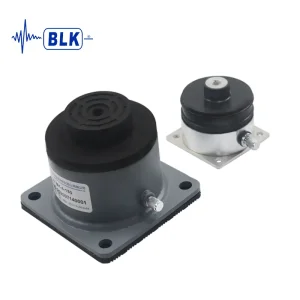
| Spring Vibration Mounts (Open/Housed) | 50 kg – 5,000 kg | 3.0 Hz – 5.0 Hz | $35 – $280 | Spring alloy steel grade, Dacromet/Galvanized finish, viscous damper integration. |
| Pneumatic Air Mounts (Low Freq.) | 100 kg – 10,000 kg | 1.2 Hz – 2.5 Hz | $220 – $1,400 | Automatic leveling valves, reinforced elastomeric diaphragms, air chamber volume. |
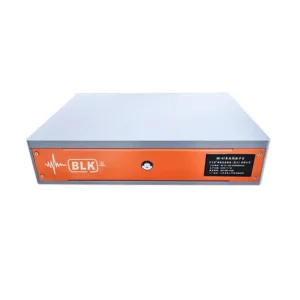
| Precision Desktop Platforms | 20 kg – 300 kg | 1.5 Hz – 3.5 Hz | $450 – $2,800 | Granite/honeycomb core plate, active/passive damping elements, surface planarity. |
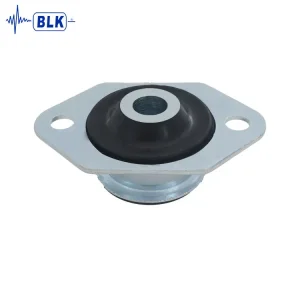
| Custom Molded Rubber Mounts | 5 kg – 1,200 kg | 6.0 Hz – 15.0 Hz | $8 – $85 | Polymer compound selection (Neoprene/EPDM/Silicone), tooling/mold modification fees. |
| Inertia Bases & Heavy Frames | 1,000 kg – 50,000 kg+ | Custom Designed | $800 – $6,500+ | Structural steel tonnage, concrete pour perimeter design, integrated seismic restraints. |
1. Raw Material & Metallurgy Grade
High-performance spring mounts utilize fatigue-resistant chrome-vanadium steel or stainless steel alloys. Surface treatment—such as Dacromet coating tested for 900+ hours in salt spray chambers—adds a minor premium over standard powder coatings but extends operational life by 10 to 15 years in corrosive HVAC outdoor environments.
2. Tooling NRE vs. Production Volume
For custom molded rubber and cone isolators, Non-Recurring Engineering (NRE) tooling charges range between $1,200 and $4,500. Sourcing from experienced Chinese manufacturers dramatically amortizes this cost through flexible low-volume tooling configurations or vast pre-existing mold libraries.
China Factory Supply Chain Advantages for OEM Vibration Control
Global OEMs and EPC contractors increasingly consolidate their vibration isolator procurement within established Chinese manufacturing hubs, most notably in Kunshan and the Yangtze River Delta cluster.
Upstream Metallurgy & Rubber Synthesis
Proximity to Tier-1 raw material suppliers—including high-tensile spring steel wire mills, precision CNC machining shops, and synthetic rubber compounding plants—slashes component lead times by up to 60% compared to Western suppliers.
Automated Production & QA Testing
Modern Chinese production facilities deploy robotic MIG/TIG welding, automated elastomeric vulcanization presses, dynamic stiffness test benches, and spectral vibration verification. This ensures batch-to-batch repeatability within strict $\pm 5\%$ tolerances.
Rapid Prototyping & Expedited Logistics
Engineered custom prototypes move from 3D CAD parameterization to dynamic testing in as few as 3 to 5 business days. Direct sea freight and air express dispatch via Shanghai Port guarantees rapid global delivery to job sites worldwide.
Global Procurement Demands: Quality Assurance & TCO Optimization
When specifying vibration hardware for multi-million-dollar cleanrooms, supertall HVAC infrastructure, or high-voltage transformers, multinational procurement officers require rigorous verification of quality, safety, and supply chain continuity.
Full Lifecycle Traceability
Every lot of steel springs, elastomeric boots, and pneumatic diaphragms undergoes non-destructive testing (NDT), load-deflection verification, and material heat-number tracking. Material Test Reports (MTRs) matching EN 10204 3.1 certification standards are supplied with all shipments to guarantee structural compliance.
Seismic & Wind Restraints Integration
In earthquake-prone regions or high-wind rooftop installations, vibration protectors must perform dual roles: isolating operational vibration while providing all-directional seismic restraint (conforming to IBC and ASCE 7 guidelines). Custom housed spring mounts incorporate heavy-duty ductile iron or structural steel housings designed to withstand 1.0g to 2.0g lateral acceleration loads.
Future Trends in Industrial Vibration Control Systems
Next-generation equipment vibration protection is evolving rapidly through smart sensors, eco-compliant materials, and hybrid dynamic controls.
IoT-Enabled Condition Monitoring
Embedding MEMS tri-axial accelerometers and wireless telemetric nodes directly inside spring housings allows real-time health monitoring of damping degradation, dynamic deflection limits, and pre-failure detection.
Active-Passive Hybrid Systems
Combining passive low-frequency pneumatic air springs with active piezoelectric actuators cancels sub-Hertz micro-vibrations ($0.5\text{ Hz} - 5\text{ Hz}$) dynamically required for next-gen sub-nanometer photolithography equipment.
Bio-Based Elastomer Compounds
Environmental compliance regulations (REACH/RoHS) are accelerating the adoption of zero-VOC, heavy-metal-free, recyclable elastomeric compounds with high oil resistance and non-aging thermal stability across $-40^\circ\text{C}$ to $+120^\circ\text{C}$.
Localized Application Scenarios & Sector Case Matrix
Different industrial sectors exhibit vastly different vibration profiles, requiring tailored dampening strategies.
Semiconductor Fabs & Precision Metrology
In semiconductor manufacturing, ambient floor vibration must comply with strict VC-C through VC-G vibration criterion curves ($1.5\,\mu\text{m/s}$ velocity threshold). Precision pneumatic air mounts with automatic leveling systems isolate scanning electron microscopes (SEMs), atomic force microscopes (AFMs), and wafer steppers from ambient building floor hum.
HVAC Systems in Supertall Commercial Buildings
Roof-mounted chillers, large centrifugal pumps, and air handling units (AHUs) transmit low-frequency hum throughout concrete structures. Heavy-duty inertia bases combined with high-deflection spring isolators absorb dynamic start-up torque and cut low-frequency noise transmission by up to 98%.
Electrical Power Transformers & Substations
Magnetostriction in transformer core laminations produces persistent $100\text{ Hz}/120\text{ Hz}$ humming harmonics. Specialized transformer anti-vibration mounts utilizing dual-elastomer oil-resistant matrices withstand extreme static weights while stopping ground-borne acoustic pollution near residential zones.
Heavy Stamping Presses & Forging Equipment
Transient shock loads generated by industrial stamping presses create severe impact impulses. Multi-layer damped rubber mounts and heavy spring dampening units dissipate $3\text{g} - 5\text{g}$ shock impact energy, protecting nearby sensitive machinery from structural shock waves.
Global Standards Compliance & Localized Engineering Support
Navigating regional building codes, acoustics standards, and safety mandates requires full regulatory alignment.
ISO 9001 & ISO 14001 Certification
Factory production lines operate strictly under certified Quality and Environmental Management Systems, ensuring controlled raw material sourcing, lean manufacturing processes, and minimal environmental footprint.
ASHRAE & DIN 4149 Standards
Isolators engineered for HVAC and mechanical utilities meet or exceed ASHRAE Equipment Vibration Isolation guidelines and DIN 4149 structural vibration damping limits for commercial buildings.
REACH, RoHS & ASTM Testing
All rubber formulations comply with EU REACH and RoHS directive chemical safety limits. Spring steel and coating anti-corrosion performance are verified under ASTM B117 salt spray testing protocols.
Custom Equipment Vibration Protectors FAQ
Key answers to essential engineering, sizing, pricing, and custom order questions.
Damped Rubber Mounts, Pads & Inertia Bases
Browse additional precision-engineered rubber mounts, damping pads, and inertia bases for specialized mechanical applications.







Request a Custom Vibration Isolation Engineering Analysis
Submit your equipment parameters (operating weight, dimensions, operating RPM, support point layout) to our engineering application team. Receive a comprehensive vibration dampening solution and direct OEM price quote within 24 hours.
Consult With An Application Engineer