
Featured Mechanical Isolation & Damping Products
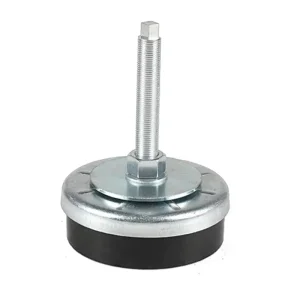
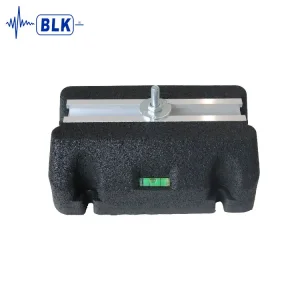
Direct factory-engineered spring, elastomer, and pneumatic damping mounts designed for heavy industrial machinery, pumps, HVAC systems, and high-load structural installations.






Engineering Fundamentals: Viscoelastic Mechanics & Damping Optimization
In modern industrial infrastructure, uncontrolled mechanical vibration compromises operational tolerances, accelerates structural fatigue, and generates severe acoustic contamination. Custom mechanical vibration damping pads serve as critical dynamic decoupling barriers.
Viscoelastic Damping Dynamics
Elastomeric vibration isolation relies on the complex shear modulus ($G^*$) and Young's elastic modulus ($E^*$) of polymer formulations. The fundamental governing equation for vibration transmissibility ($T_d$) through a resilient elastomeric damper pad is defined as:
Where $\beta = f/f_n$ represents the frequency ratio between disturbing excitation frequency ($f$) and isolator natural frequency ($f_n$), and $\zeta$ is the critical damping coefficient. Isolation occurs exclusively when $\beta > \sqrt{2}$. When $\beta < \sqrt{2}$, amplification occurs, demanding precise durometer selection and static deflection calibration.
Internal Hysteresis & Energy Dissipation
Unlike pure steel springs that store kinetic energy and reintroduce resonance peaks, custom vulcanized rubber and elastomeric polymer pads absorb vibration energy via material hysteresis. The loss factor ($\tan \delta = E''/E'$) converts cyclic mechanical deformation into low-grade thermal energy, effectively suppressing amplitude spikes during transient startup and coast-down phases in rotating equipment.
By engineering cross-linking density within Nitrile (NBR), Neoprene (CR), EPDM, and specialized Polyurethane matrices, custom manufacturers adjust static-to-dynamic stiffness ratios ($K_d/K_s$) down to 1.2–1.5, preventing cold-flow creep while maximizing dynamic shock attenuation.
Global Procurement Demands & Industrial Supply Chain Requirements
Procurement officers and chief engineering consultants require stringent compliance, traceable compounding, and standardized dynamic performance metrics when selecting damping pad factories.
Environmental Resistance & Longevity
Creep Dynamics & Deflection Tolerances
Total Cost of Ownership (TCO) Optimization
Macro Industry Solutions & Tailored Sector Applications
Custom damping pads are engineered to meet specific dynamic excitation profiles across critical industrial and commercial environments.
1. HVAC, Refrigeration & Heavy Power Generation
Challenge: Large centrifugal chillers, rooftop cooling towers, diesel generator sets, and transformer substations create high-amplitude low-frequency hum (20–120 Hz), radiating airborne and structure-borne noise throughout commercial and residential buildings.
Solution: Custom multi-layer laminated elastomer pads paired with steel load-spreading plates. Cross-ribbed neoprene patterns provide shear clearance while supporting loads up to 3.5 N/mm², reducing structure-borne noise transmission by over 95% in accordance with ASHRAE standards.
2. Semiconductor Lithography & Metrology Labs
Challenge: Nanometer-scale chip fabrication equipment, Scanning Electron Microscopes (SEMs), and Coordinate Measuring Machines (CMMs) require ultra-quiet environments conforming to VC-A through VC-G micro-vibration criteria curves.
Solution: Low-durometer, high-damping polyurethane elastomer pads and hybrid pneumatic isolation platforms. These pads damp high-frequency ambient floor vibrations while preventing low-frequency transient disturbances from settling during internal motion stage movements.
3. Heavy Stamping Presses, Forging & CNC Machining
Challenge: High-energy impulse shock forces generated by mechanical presses and punching machines induce foundation cracking, tool wear, and dimensional tolerance loss in adjacent precision equipment.
Solution: High-impact microcellular polyurethane pads engineered to withstand instantaneous shock spikes exceeding 300% of nominal static capacity without bottoming out. Built-in elastic recovery prevents physical breakdown under millions of continuous stroke cycles.
4. Marine Propulsion & Offshore Heavy Equipment
Challenge: Marine auxiliary engines, thruster assemblies, and naval pump skids operate under harsh salt-spray, continuous engine roll angles, and strict shock testing standard requirements (e.g., MIL-STD-167-1A).
Solution: Vulcanized NBR/Dacromet-coated composite pad mounts featuring built-in failsafe captive hardware. The structure remains intact even under severe wave slam forces or sudden trim/roll accelerations.
Material Science Roadmap & Engineering Specification Matrix
A comparative technical matrix detailing elastomer properties, durometer ranges, static load ratings, and chemical immunity factors for custom manufacturing selection.
| Elastomer Material | Durometer (Shore A) | Load Range (N/mm²) | Loss Factor ($\tan \delta$) | Temp Range (°C) | Chemical Immunity |
|---|---|---|---|---|---|
| High-Damping Neoprene (CR) | 40 - 70 | 0.2 - 1.8 | 0.15 - 0.25 | -30 to +100 | Moderate oil, excellent ozone & aging resistance |
| Nitrile Rubber (NBR) | 50 - 80 | 0.5 - 2.5 | 0.10 - 0.20 | -25 to +110 | Superior mineral oil, fuel & lubricant resistance |
| Microcellular Polyurethane (MCU) | 35 - 65 | 0.05 - 6.0 | 0.25 - 0.45 | -30 to +80 | High shock absorption, resistant to aliphatic hydrocarbons |
| EPDM Elastomer | 45 - 75 | 0.3 - 1.5 | 0.08 - 0.15 | -40 to +130 | Outstanding steam, hot water, acid & weather defense |
| Fluoroelastomer (FKM / Viton) | 60 - 85 | 0.5 - 3.0 | 0.05 - 0.12 | -20 to +200 | Ultimate chemical, extreme temperature & acid immunity |
Technology Roadmap 2025–2030: Smart Damping & Nanocomposites
The future of mechanical vibration damping is shifting from passive elastomers toward smart, adaptive material systems. Research and development at top manufacturing sites focuses on three primary innovations:
- Nanocomposite Cross-Linking: Integrating functionalized graphene oxide and carbon nanotubes into rubber matrix formulations to boost tensile tear strength while maintaining low dynamic-to-static stiffness ratios ($K_d/K_s \le 1.15$).
- Piezoelectric-Embedded Damping Pads: Embedding micro-thin piezoelectric polymer sensors inside structural isolation pads to provide real-time dynamic load tracking, spectrum analysis, and fatigue life predictions directly to Industry 4.0 predictive maintenance platforms.
- Bio-Based Elastomeric Polymers: Formulating eco-friendly vulcanized compounds that substitute fossil-derived oils with plant-derived bio-resins while meeting flame-retardant requirements (UL94-V0 compliance).
Localized Technical Support, Quality Assurance & Global Standards
Meeting international building codes and industrial machinery standards demands strict compliance verification throughout every phase of engineering and production.
ISO 10816 / ISO 20816 Vibration Severity
DIN 4150-3 Structural Integrity
RoHS, REACH & Fire Standards
Precision Mounts, Air Platforms & Heavy Buffer Systems
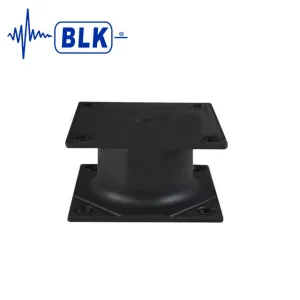
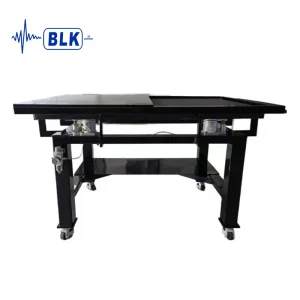
Complete factory lineup including high-deflection spring isolators, precision desktop pneumatic platforms, heavy rubber buffer blocks, and suspended equipment hangers.






Technical Knowledge Base & Procurement FAQ
In-depth technical responses from senior vibration isolation engineers addressing critical selection criteria, structural mechanics, and custom manufacturing processes.
How do engineers determine whether to specify elastomer damping pads, steel spring isolators, or pneumatic air mounts?
• Elastomer Damping Pads: Best suited for medium-to-high frequency excitation (>20 Hz / 1200 RPM) such as high-speed motors, rotary compressors, and small fans. They provide excellent high-frequency acoustic attenuation and structural damping without needing large physical deflections.
• Steel Spring Isolators: Essential for low-frequency excitation (3 Hz to 15 Hz / 180 to 900 RPM) common in slow-speed HVAC chillers, heavy end-suction pumps, and reciprocating generators. Springs deliver large static deflections (25mm to 75mm) achieving lower system natural frequencies ($f_n \approx 3-5 \text{ Hz}$).
• Pneumatic Air Mounts: Required for delicate ultra-low-frequency isolation ($f_n \approx 1.2-2.5 \text{ Hz}$) in semiconductor tools, optical inspection benches, and sub-micron CMM metrology systems.
What precise technical parameters must be supplied to a factory for custom damping pad sizing?
- Total Operating Mass & Weight Distribution: Total weight including equipment, fluids, frames, and attached piping, plus center-of-gravity (CG) coordinates.
- Number & Geometry of Support Points: Footprint dimensions and mounting bolt hole layouts.
- Disturbing Frequency Range: Machine RPM, stroke rate, or variable frequency drive (VFD) min/max operational speeds.
- Environmental Conditions: Exposure to oils, ambient temperature ranges, outdoor UV/ozone exposure, and fire resistance ratings.
- Target Isolation Efficiency: Acoustic limits (dBA reduction) or structural transmissibility targets (e.g., <5% transmitted force).
What is the dynamic-to-static stiffness ratio ($K_d/K_s$), and why is it critical for elastomer selection?
A high $K_d/K_s$ ratio (e.g., 2.0 to 3.0) means that while a pad appears soft under static load, it becomes excessively stiff under dynamic operation, shifting the natural frequency ($f_n$) higher and reducing isolation performance. Our factory engineered compounds maintain low dynamic ratios ($K_d/K_s \approx 1.25-1.40$), ensuring predictable isolation across broad temperature ranges.
How do suction-cup or ribbed surface geometries on damping pads improve isolation compared to flat pads?
Flat rubber sheets bonded tightly between rigid steel plates cannot bulge freely, causing their effective compressive modulus to skyrocket and making them act like rigid solid blocks. Adding surface ribs, suction grids, or waffle patterns provides internal void space into which the elastomer can bulge under load. This maintains lower compressive stiffness, enhances grip coefficients without anchor bolts, and prevents slipping under shear vibrations.
What quality assurance testing procedures are performed during custom vulcanization?
- Rheometer Testing: Verifying vulcanization cure curves and scorch times for every compound batch.
- Physical Property Benchmarking: Testing tensile strength, elongation at break, and Shore A durometer hardness per ASTM D412 and ASTM D2240.
- Compression Set Analysis: Verifying low permanent deformation under high-temperature stress per ASTM D395.
- Dynamic Servo-Hydraulic Deflection Testing: Mapping force-deflection dynamic stiffness hysteresis loops at operational frequencies.
- Salt Spray & Corrosion Testing: Exposing bonded steel plates and hardware to 900-hour salt spray fog per ASTM B117.