
Custom Shock And Vibration Mounts Factories & Manufacturer
Engineering-grade dynamic attenuation systems, custom elastomeric & spring isolators, and sub-Hz pneumatic platforms manufactured to ISO 9001 quality standards for global OEM applications.
Industrial Shock & Vibration Control Solutions
Explore our engineered dampeners, precision isolation platforms, and high-deflection rubber mounts designed for demanding mechanical environments.



Global Shock and Vibration Mounts Landscape: Engineering Mechanics & Supply Dynamics
An authoritative analysis of harmonic attenuation, structural resonance isolation, material hysteresis, and strategic procurement frameworks for global OEM manufacturers.
Mechanical Vibration Dynamics & Isolation Theory
In industrial manufacturing, power generation, semiconductor metrology, and building automation, mechanical vibration poses a catastrophic threat to equipment longevity, operational precision, and structural integrity. Unchecked vibration induces dynamic stress concentration, structural fatigue, precision alignment drift, and acoustic radiation that breaches workplace safety thresholds.
Effective shock and vibration isolation relies on manipulating system natural frequency (fn) relative to forced disturbing frequency (fd). Isolation begins exclusively when the frequency ratio exceeds √2 (≈ 1.414). Maximum attenuation efficiency (>95%) requires a frequency ratio of 3.0 or higher, where transmissibility (T) drops precipitously according to the classical equation:
Achieving optimum isolation performance requires balancing spring rate (stiffness k) and damping ratio (ζ). While excessive damping reduces isolation efficiency at high frequency ratios, adequate internal damping is essential to control resonance amplification during transient startup and shutdown cycles.
Transient Shock Impulse Mitigation
Unlike continuous steady-state harmonic vibrations, shock forces are transient, high-amplitude energy bursts characterized by rapid velocity changes ($Δv$) and extreme peak accelerations ($g$-forces). Industrial equipment like punch presses, drop hammers, forging dies, and shipping containers experience sudden energy transfer that can instantly crack rigid anchor bolts or shatter internal components.
Engineered Shock Mounts store transient kinetic energy elastomeric or mechanical deflection and dissipate it slowly as thermal energy through hysteresis loss. By converting a short-duration, high-force shock pulse into a prolonged, low-amplitude output force, dynamic shock isolators protect surrounding structures from catastrophic shock wave propagation.
Vibration Isolation Engineering Classifications
A side-by-side technical evaluation of core mounting technologies across physical dynamic profiles, material properties, and operational environments.
| Mount Type & Technology | Natural Frequency (fn) | Damping Coefficient (ζ) | Primary Material / Alloy Structure | Optimal Industrial Application |
|---|---|---|---|---|
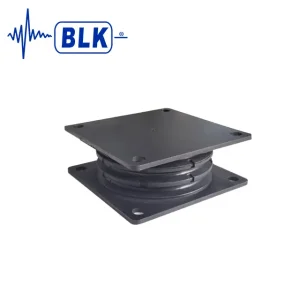
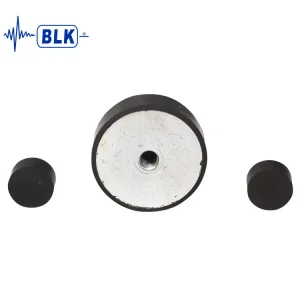
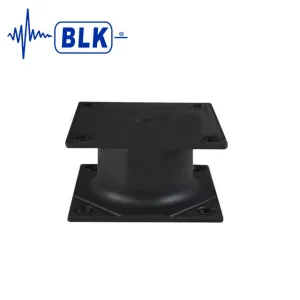
| Custom Damped Rubber Mounts (BK-DSR / BKH) | 8 Hz – 15 Hz | 0.10 – 0.20 (High Internal) | High-Durometer Neoprene, EPDM, NBR Rubber Alloys | Rotating machinery, diesel engines, HVAC fans, high-speed compressors |
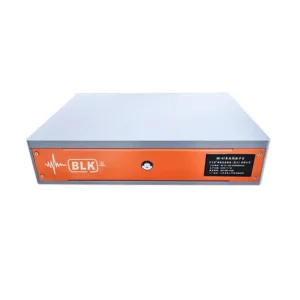
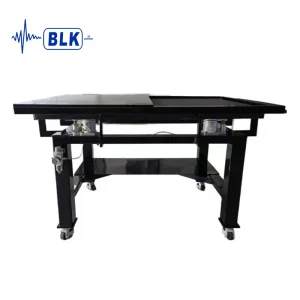
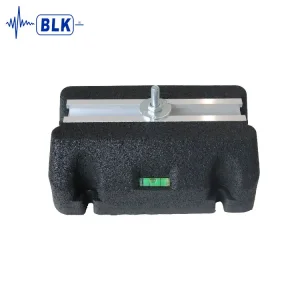
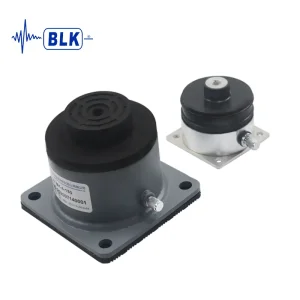
| Pneumatic Air Isolators (BK-A / BK-VT) | 1.7 Hz – 3.0 Hz | 0.05 – 0.12 (Air Flow Orifice) | Reinforced Elastomeric Diaphragm & Anodized Aluminum Base | Semiconductor CMM tools, optical tables, sub-micron precision balances |
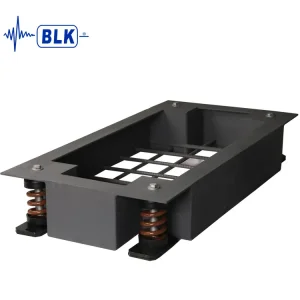
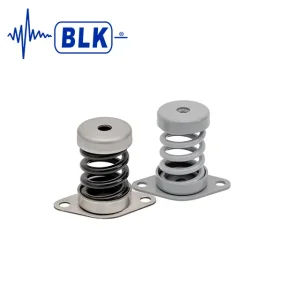
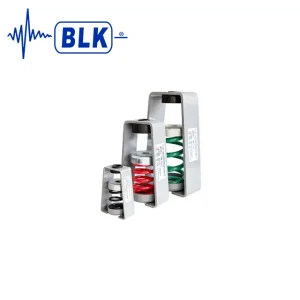
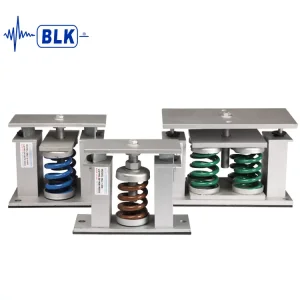
| Open & Housed Spring Mounts (ME / MA Series) | 3.0 Hz – 5.0 Hz | 0.01 – 0.03 (Low Damping) | High-Tensile Alloy Spring Steel with Dacromet Anti-Corrosion Coating | Heavy chillers, cooling towers, power transformers, emergency generators |
| Polymer Damping Pads (BK-PM / BKDJ) | 12 Hz – 25 Hz | 0.15 – 0.35 (Very High) | Cross-linked Viscoelastic Polymer Formulations | Structural impact isolation, foundation slabbing, acoustic wall decoupling |
| Heavy Inertia Bases (CPB Type) | Driven by Spring Isolators | System Mass Dependent | Structural Steel Frame filled with High-Density Reinforced Concrete | End-suction water pumps, reciprocating compressors, high-torque drives |
Elastomer Compound Vulcanization Science
The mechanical properties of rubber mounts depend directly on polymer blend selection and sulfur cross-linking density during vulcanization. Standard Natural Rubber (NR) provides low compression set and superior elastic recovery, making it ideal for general vibration isolation. However, harsh industrial environments require specialized compounding:
- Nitrile Rubber (NBR): Formulated for superior resistance to mineral oils, hydraulic fluids, and petroleum fuels in machine tool sump environments.
- Ethylene Propylene Diene Monomer (EPDM): Designed for outdoor installations, delivering exceptional resistance to UV radiation, ozone degradation, and thermal aging from -40°C to +120°C.
- Silicone Elastomers: Tailored for extreme thermal applications (-60°C to +200°C) and sterile cleanroom processing environments.
Metallurgical Springs & Surface Engineering
Steel spring isolators must withstand millions of stress reversal cycles without structural fatigue or setting drift. Bellking spring isolators use premium 60Si2Mn / 55CrSi spring alloys, shot-peened to relieve tensile stress and achieve infinite fatigue life under rated loading conditions.
To stop corrosion in industrial atmospheres, offshore platforms, and cooling towers, metallic housings undergo multi-stage surface finishing. Our Dacromet Coating process forms a zinc-and-aluminum flake barrier that passes 900-hour neutral salt spray tests (ASTM B117), outperforming conventional galvanizing and powder coating options.
China Manufacturing Efficiency & Kunshan Industrial Cluster Advantage
How Bellking leverages China's premier advanced manufacturing ecosystem in Kunshan, Jiangsu to deliver high-precision customized isolators with unmatched speed and cost performance.
Integrated Supply Chain
Located in Kunshan—the core of the Yangtze River Delta manufacturing hub—Bellking operates within a 15-kilometer radius of specialized precision machining, automated rubber compounding, laser cutting, and electroplating partners. This concentration cuts raw material procurement lead times to hours instead of weeks.
Rapid Custom Tooling
Traditional Western manufacturers require 8 to 12 weeks to fabricate custom vulcanization molds for non-standard rubber mounts. Bellking utilizes multi-axis CNC high-speed machining centers in-house, enabling custom mold manufacturing and prototype validation within 3 to 5 working days.
ISO 9001 Quality Assurance
Every batch of custom shock mounts undergoes rigorous inspection using dynamic dynamic stiffness analyzers, durometer testers, shear endurance rigs, and salt spray chambers. We provide full material traceability, dynamic test certificates, and third-party inspection reports for global compliance.
Field-Tested Application Scenarios
Discover how custom engineered vibration isolators protect mission-critical equipment across diverse industrial fields.
1. Semiconductor Fabrication & Cleanroom Metrology
Challenge: Sub-micron photolithography systems, scanning electron microscopes (SEMs), and wafer inspection tools require complete immunity from floor-borne micro-seismic vibrations caused by foot traffic, HVAC systems, and nearby machinery.
Engineered Solution: Deployment of BK-VT & BK-AT Active/Passive Pneumatic Platforms. Achieving a ultra-low natural frequency of 1.7 Hz, these systems isolate low-frequency floor vibrations down to VC-E cleanroom criterion lines, preserving tool accuracy and yield rates.
2. High-Capacity Power Transformers & Electrical Substations
Challenge: Power transformers generate low-frequency continuous magnetostrictive hum (100 Hz / 120 Hz harmonics). Unisolated transformer feet transmit structure-borne noise into concrete foundations, creating acoustic pollution in nearby commercial buildings.
Engineered Solution: Custom high-load Transformer Anti-Vibration Mounts engineered with high-damping elastomeric matrices. These mounts block harmonic acoustic paths, achieving up to 28 dB structural noise reduction while supporting static loads up to 40 tons per foot.
3. Heavy HVAC Plant Rooms & Mechanical Pent houses
Challenge: Rooftop chillers, cooling towers, and 500 HP water pumps produce severe low-frequency dynamic unbalance during operation, causing noticeable building sway and ductwork noise.
Engineered Solution: Installation of CPB Concrete-Filled Inertia Bases mounted on restrained housed spring isolators (3 Hz natural frequency). The inertia base adds system mass, lowers the center of gravity, limits startup movement, and provides 98%+ dynamic isolation efficiency.
4. Industrial Press Stamping & Shock Forging Equipment
Challenge: Heavy high-speed stamping presses generate violent transient shock pulses (3G to 5G acceleration), causing foundation cracking and premature die wear.
Engineered Solution: Heavy-duty BKSWA Multi-Layer Antivibration Dampers combining high-deflection spring elements with integrated viscous fluid dampeners to safely absorb transient energy burst profiles.
Global Procurement Risk Management & Next-Gen Isolation Trends
Key evaluation factors for B2B procurement officers and engineering managers when sourcing shock mounts globally.
Procurement Risk Mitigation & Quality Audit Protocol
Procuring custom vibration isolators overseas requires rigorous technical vetting beyond simple piece-price comparisons. Procurement teams should evaluate suppliers against these key technical standards:
- Dynamic vs. Static Stiffness Ratio (Kd/Ks): Verify that the manufacturer tests dynamic stiffness at operating frequencies. Elastomer stiffness increases dynamically; relying solely on static load deflection leads to poor isolation performance.
- Elastomer Creep Rate: Ensure long-term strain creep stays under 5% over a 10-year service life to prevent equipment misalignment.
- Environmental Compliance: Verify full compliance with RoHS 3, REACH SVHC, and environmental standards to safeguard your global supply chain against regulatory compliance blocks.
Future Technology Roadmap: Smart Active Isolation
The shock and vibration isolation industry is shifting from passive systems toward intelligent, adaptive hybrid platforms. Key innovations include:
- Embedded IoT Vibration Monitoring: Integrating MEMS tri-axial accelerometers and temperature sensors directly into elastomeric mounts for real-time predictive maintenance alerts.
- Magnetorheological (MR) Fluid Dampers: Dynamic stiffness tuning that adapts dampening coefficients in milliseconds based on varying machine speed profiles.
- High-Damping Polymer Nanocomposites: Graphene-reinforced rubber elastomers engineered for high energy absorption and extended fatigue life in extreme chemical environments.
Frequently Asked Engineering Questions
Get clear answers to common selection, sizing, installation, and custom manufacturing questions from our application engineers.
Additional Engineered Isolation Series
Explore our full line of pneumatic mounts, spring hangers, matrix isolation blocks, and custom rubber buffers.

Request a Customized Vibration Isolation Solution
Send us your equipment parameters (weight, center of gravity, operating speed, support layout), and our application engineers will deliver a customized dynamic calculation report within 24 hours.
Consult With An Engineer Now