
Precision Engineering Product Catalog (Part I)
Factory-direct high-performance vibration isolation components engineered to mitigate low-frequency harmonics, structural resonance, and acoustic vibration transmission.





1. Physics of Building Vibration Isolation & Harmonics Mitigation
Understanding mechanical wave propagation, structural resonance, and mathematical isolation principles in modern civil and industrial structures.
Mechanics of Transmissibility ($T$)
Building vibration isolation relies on altering the natural frequency ($f_n$) of a mechanical support system relative to the disturbing frequency ($f_d$) generated by machinery (e.g., chillers, HVAC air handlers, pumps, transformers). Vibration transmissibility ($T$) is mathematically governed by the classic single-degree-of-freedom equation:
Where r = f_d / f_n represents the frequency ratio, and ζ is the damping ratio. Effective isolation occurs exclusively when r > √2 (1.414). To achieve >95% vibration isolation efficiency in high-rise structures or precision labs, system designers must achieve an r ≥ 3.0 to 5.0, driving down the natural frequency of the mounting system into the 1.5 Hz – 4.5 Hz range.
Structure-Borne Noise (SBN) vs Airborne Sound
Dynamic mechanical equipment imparts cyclic forces directly into concrete structural slabs. These low-frequency physical vibrations travel through steel reinforcement and shear walls with minimal attenuation, re-radiating hundreds of meters away as secondary airborne noise (rumble) in residential units, executive suites, or micro-surgeries.
By placing high-compliance spring mounts, elastomeric pads, or pneumatic isolators at structural support points, mechanical energy is converted into elastic potential energy and heat dissipation, permanently decoupling the dynamic force from the building envelope.
2. Engineering Classification & System Selection Framework
A comprehensive comparison matrix to assist structural engineers, MEP consultants, and global procurement teams in selecting optimal isolation hardware.
| Isolator Type | Natural Frequency ($f_n$) | Damping Ratio ($\zeta$) | Typical Static Deflection | Primary Target Equipment | Key Standard Compliance |
|---|---|---|---|---|---|
| Open & Enclosed Spring Isolators | 2.5 Hz – 5.0 Hz | 0.01 – 0.05 (Steel) | 25 mm – 75 mm (1" – 3") | Cooling towers, chillers, large AHUs, diesel generators | ASHRAE Ch. 48, BS 1726, ISO 2017-1 |
| Viscous Damped Spring Mounts | 2.0 Hz – 4.0 Hz | 0.15 – 0.25 (Viscous) | 50 mm – 100 mm (2" – 4") | Reciprocating compressors, heavy crushers, seismic zones | IBC Seismic Design Category D-F |
| Pneumatic Air Mounts (BK-A Series) | 1.2 Hz – 2.5 Hz | 0.06 – 0.12 (Air) | Pneumatic Auto-Leveling | Photolithography tools, SEM/TEM, optical test beds | ISO 10816, VC-A through VC-E Curves |
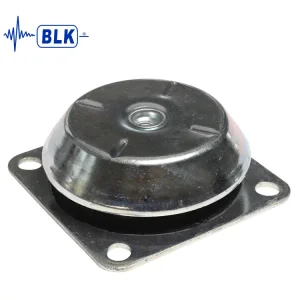
| Elastomeric & Rubber Mounts (BKP/BKH) | 6.0 Hz – 12.0 Hz | 0.05 – 0.15 (Neoprene/NR) | 3 mm – 12 mm (0.12" – 0.5") | Small pumps, motors, transformers, high-speed fans | DIN 53505, ASTM D2240, EN 13938 |
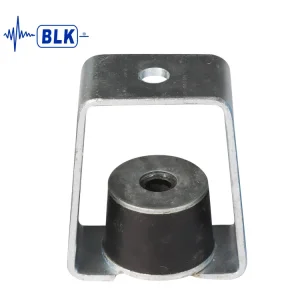
| Acoustic Ceiling Spring Hangers | 3.0 Hz – 6.0 Hz | 0.02 – 0.08 (Hybrid) | 25 mm – 50 mm (1" – 2") | Suspended piping mains, ductwork, fan coil units | ASTM E90, ISO 140-4 (STC/IIC Standards) |
| Concrete-Filled Inertia Bases (CPB) | Matched to Springs | High Mass Damping | N/A (Structural Frame) | High-head centrifugal pumps, open-type compressors | ANSI/HI 9.6.4 (Pump Vibration) |
3. Global Enterprise Procurement Needs & Risk Mitigation Strategy
How tier-1 EPC contractors, MEP consultants, and multinational developers de-risk project execution through rigorous factory auditing and engineering submittals.
Full Engineering Submittal Packages
Global contractors cannot afford site installation delays caused by incomplete documentation. Reliable manufacturers provide comprehensive submittal calculations, including static deflection verified curves, center-of-gravity (CG) alignment reports, Finite Element Analysis (FEA) dynamic stress distribution modelings, and fully stamped CAD/BIM Revit drawings.
Metallurgical & Dynamic Fatigue Assurance
Low-tier spring isolators often suffer from structural sagging, premature permanent set, or catastrophic stress-corrosion cracking. OEM enterprise procurement specifies high-grade spring alloy steel (such as 60Si2Mn or Chrome Vanadium) subjected to shot-peening, hot-coiling, and 2-million-cycle dynamic fatigue testing to guarantee zero load loss over decades of operation.
Total Cost of Ownership (TCO) Optimization
Direct factory procurement eliminates multi-tiered agent markups, reducing upfront capital expenditure by 30% to 45%. More importantly, properly engineered vibration mounts extend equipment mechanical seal and bearing lifespans by up to 300%, preventing multi-million dollar business interruption in data centers and hospitals.
4. China Supply Chain Advantage: The Kunshan Precision Manufacturing Cluster
Leveraging advanced metallurgical ecosystems, automated CNC spring coiling, and rapid custom prototyping in Jiangsu, China.
Unrivaled Industrial Ecosystem & Raw Material Access
Situated in the heart of the Yangtze River Delta manufacturing corridor, our Kunshan production facility operates within a 30-kilometer radius of tier-1 specialty steel mills, synthetic elastomer formulators, and advanced surface treatment plants. This cluster effect provides unmatched competitive advantages:
- Precision Spring Steel Procurement: Immediate access to high-tensile 60Si2Mn and 50CrVA spring steel with strict chemical purity standards.
- Automated CNC Production: Fully automated multi-axis hot and cold CNC coiling machinery capable of producing springs with wire diameters up to 50mm with sub-millimeter pitch consistency.
- Surface Finishing Superiority: In-house Dacromet, electro-galvanizing, and heavy powder-coating lines capable of exceeding 900 hours of neutral salt-spray (ASTM B117) corrosion testing.
Agile Customization & Fast Lead Times
Standard European or North American manufacturing lead times for customized heavy-duty spring mounts or pneumatic platforms routinely span 8 to 12 weeks. Our integrated supply chain dramatically shortens this timeline:
5. Localization Support & Global Compliance Framework
Meeting localized structural engineering codes, seismic restraint mandates, and environmental regulations across North America, Europe, Asia-Pacific, and the Middle East.
North America: IBC & ASHRAE Standards
All building vibration products designed for the US and Canadian markets align with ASHRAE Chapter 48 guidelines for sound and vibration control. Furthermore, integrated seismic restraint housing options comply with IBC (International Building Code) Seismic Design Categories A through F, resisting peak horizontal shear acceleration force exceeding 2.0g.
Europe: Eurocode 8 & DIN 4150-3
For European municipal and commercial developments, products comply with Eurocode 8 (EN 1998) for seismic structural integrity and DIN 4150-3 structural vibration velocity limits (preventing architectural damage to historical and modern reinforced concrete structures).
Environmental Compliance (RoHS, REACH)
Our elastomeric compound formulations (neoprene, natural rubber, nitrile, EPDM, silicone) strictly adhere to EU RoHS 3 Directive 2015/863 and REACH SVHC safety standards. Mounts emit zero hazardous volatile organic compounds (VOCs), making them certified safe for healthcare, cleanroom, and school installations.
6. Localized Multi-Industry Application Scenarios
Proven engineering deployments across critical commercial, industrial, high-tech, and municipal infrastructure projects globally.
A. Rooftop & Plant Room HVAC Systems
Challenge: Large tonnage centrifugal chillers, cooling towers, and multi-stage pumps installed on upper-floor structural slabs create low-frequency harmonic vibrations (10 Hz – 30 Hz) that resonate through the entire building skeleton.
Solution: Installation of High-Quality MD/MB Enclosed Spring Mounts with 50mm static deflection combined with CPB Concrete Inertia Bases. Reduces transmitted dynamic force by >97%, achieving target NC-30 acoustic criteria in executive offices directly below.
B. Semiconductor Cleanrooms & Optical Metrology
Challenge: Sub-nanometer photolithography steppers, Scanning Electron Microscopes (SEM), and laser interferometers are sensitive to ambient micro-vibrations induced by nearby foot traffic or HVAC airflow.
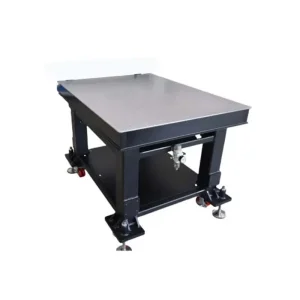
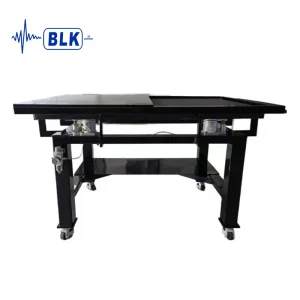
Solution: Implementation of BK-A Series Pneumatic Air Mounts and BK-DT High-Damping Optical Platforms. Achieves low natural frequencies down to 1.2 Hz, successfully meeting stringent VC-D and VC-E micro-vibration curves.
C. Data Center & Hospital Power Substations
Challenge: Dry-type power transformers, standby emergency diesel generators, and high-voltage switchgear emit continuous 100 Hz / 120 Hz magnetostrictive electromagnetic hum and dynamic shock spikes during startup.
Solution: Specifying Anti-Vibration Mounts for Transformers and high-damping BKH/BKHQ Rubber Mounts. Isolates airborne and structure-borne tonal hum while withstanding sudden short-circuit magnetic shock forces.
D. Urban Rail Transition & Floating Floor Slabs
Challenge: Modern luxury residential tall towers constructed over or adjacent to subterranean metro railway tunnels experience continuous ground-transmitted vibration spikes.
Solution: Laying continuous BK-PM Polymer Damping Pads beneath full floating floor slabs and structural foundation footings, dampening ambient rail vibrations prior to entering structural columns.
7. Emerging Trends: Smart IoT Isolation & Hybrid Damping
The evolution of building vibration control from passive mechanical springs to intelligent predictive maintenance networks.
IoT-Enabled Vibration Monitoring
Integration of wireless MEMS tri-axial accelerometers inside heavy spring isolator housings. Real-time spectrum analysis streams vibration RMS velocity data directly to Building Management Systems (BMS), alerting facility managers to motor misalignment or bearing wear before catastrophic isolation failure occurs.
Magnetorheological (MR) Active Damping
Hybrid isolation platforms combining passive coil springs with MR fluid dampers. The system dynamically adjusts fluid viscosity in milliseconds based on real-time sensor feedback, providing optimal damping during extreme wind sway or seismic events while maintaining soft isolation during normal operating conditions.
Bio-Based & Eco-Compliant Elastomers
R&D breakthroughs in fully recyclable thermoplastic elastomers (TPE) and plant-derived natural latex matrix blends, offering superior aging resistance, non-flammability, and reduced carbon footprint across the lifecycle of green building projects.
8. Frequently Asked Questions (Engineering & Procurement FAQ)
Expert technical insights answering critical selection, installation, and compliance inquiries from structural engineers and global buyers.
How do I accurately calculate the required static deflection for building HVAC isolators?
What is the structural difference between open spring mounts and seismic restrained spring mounts?
When should a concrete-filled Inertia Base (CPB Type) be specified instead of direct spring mounting?
How does the Dacromet anti-corrosion coating compare to traditional hot-dip galvanizing for spring isolators?
What technical data must be provided to receive a customized 24-hour vibration isolation proposal?
Can pneumatic air mounts (BK-A Series) operate reliably in cleanroom environments?
How do you prevent 'acoustic bridging' or short-circuiting during installation?
What quality assurance certifications and factory test reports accompany every shipment?
Precision Engineering Product Catalog (Part II)
Heavy-duty anti-vibration spring mounts, polymer damping pads, and industrial inertia bases engineered for long-term structural reliability.





Partner with a World-Class Building Vibration Isolation Manufacturer
Whether you are engineering a supertall skyscraper HVAC system, a zero-vibration semiconductor fab, or a city-center hospital substation, our application engineers stand ready to provide custom sizing calculations, CAD drawings, and factory-direct pricing.