
Featured Precision Isolation Products (Catalog Tier I)
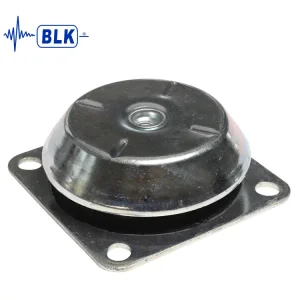
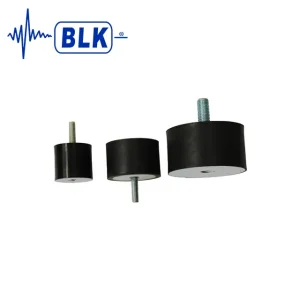
Explore our factory-direct industrial rubber mounts, high-performance elastomeric pads, and anti-vibration structural elements optimized for severe structural dynamic suppression.




1. Macro-Industry Ecosystem & Structural Dynamic Control
An authoritative analysis of mechanical energy dissipation, environmental compliance, and micro-vibration mitigation across high-tech manufacturing ecosystems.
Modern industrial dynamics require precise control over unwanted mechanical energy transmission. As heavy machinery, high-speed automated assembly lines, high-frequency HVAC plant infrastructure, and sub-nanometer semiconductor lithography tools share structural foundations, micro-vibration interference has emerged as a primary bottleneck to process yield, structural longevity, and human occupational safety.
Globally, stringent regulatory frameworks—such as DIN 4150-3 (Structural Vibration in Buildings), ISO 2631 (Human Exposure to Whole-Body Vibration), ASHRAE Equipment Vibration Guidelines, and ISO 10816 (Mechanical Vibration Verification)—mandate rigorous structure-borne noise attenuation. Precision vibration isolation materials act as acoustic breaking mechanisms, preventing energy waves from traveling through reinforced concrete slabs, steel girders, and piping conduits.
As industry standards evolve toward smart manufacturing and urban multi-story vertical factories, selecting an engineered isolation material manufacturer becomes a strategic core requirement. Simple rubber off-cuts or uncalculated spring assemblies often induce destructive structural resonance ($f_d \approx f_n$), amplifying dynamic loads and shortening equipment mean time between failures (MTBF).
2. Chemical Formulations, Elastomeric Science & Dynamic Physics
Deconstructing the mathematical formulas and physical properties governing spring dynamics, elastomeric hystereses, and air spring compression models.
Vibration isolation relies on physical materials converting dynamic kinetic energy into harmless heat energy via hysteresis loss. Selecting the right isolation system depends on dynamic parameters including Durometer Shore Hardness, Static-to-Dynamic Stiffness Ratio ($K_d / K_s$), Transmissibility ($T$), and Damping Ratio ($\zeta$).
Core Engineering Equations Governing Isolation Efficiency
Transmissibility ($T$) describes the ratio of force transmitted to the foundation versus the dynamic force generated by operating machinery:
Where: r = f_d / f_n (Frequency Ratio of Disturbing Frequency to Natural Frequency), and ζ = c / c_c (Damping Ratio). Isolation only occurs when r > √2 (≈ 1.414). For industrial standards, engineering designs aim for r ≥ 3, yielding isolation efficiency ratings higher than 88%–95%.
| Material / Structural System | Natural Frequency Range ($f_n$) | Damping Factor ($\zeta$) | Environmental Durability | Primary Industrial Application |
|---|---|---|---|---|
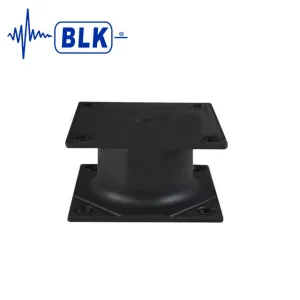
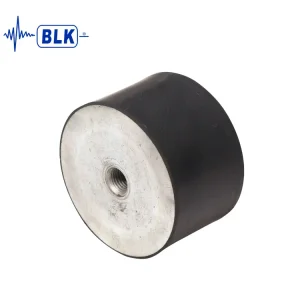
| High-Ductility Nitrile & EPDM Mounts | 7 Hz – 15 Hz | 0.05 – 0.15 | High oil, fuel, and ozone resistance; temp -30°C to 110°C | Compressors, auxiliary marine engines, small motor drives |
| Viscous-Damped Helical Steel Springs | 3 Hz – 5 Hz | 0.01 – 0.08 (Pristine) | Dacromet zinc coating; 900 hr salt spray resistant | Chillers, large cooling towers, heavy reciprocating gensets |
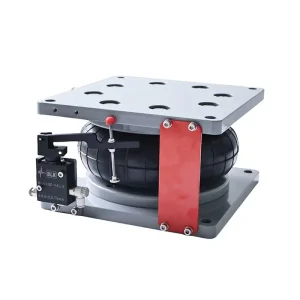
| Precision Pneumatic Elastomeric Air Springs | 1.2 Hz – 2.5 Hz | 0.12 – 0.25 (Level-Regulated) | Cleanroom compliant; requires dry compressed air supply | Semiconductor wafer steppers, CMMs, electron microscopes |
| Engineered Micro-Cellular Polyurethane (BK-PM) | 6 Hz – 12 Hz | 0.15 – 0.30 | High compression-set recovery; chemical splash proof | Inertia block base perimeter isolation, building foundation pads |
3. Commercial Economics & Total Cost of Ownership (TCO) Pricing Matrix
Understanding cost variables, direct OEM manufacturing economics, custom tooling ROI, and lifetime value in global procurement.
When engineering and procurement teams search for "Vibration Isolation Materials Price", evaluating unit acquisition costs against Total Cost of Ownership (TCO) is essential. Low-cost, non-calibrated rubber mounts often lack chemical anti-aging compounds, leading to early hardening, stress cracks, static creep, and loss of isolative capability within 12 to 18 months.
Raw Material Composition & Polymer Purity
Virginal compounding versus recycled scrap vulcanization dramatically affects performance. High-purity natural rubber (NR) and fluoroelastomers cost more per kilogram, but guarantee consistent durometer ratings, uniform deflection curves, and long term creep resistance under static load.
Surface Protection & Environmental Coatings
Standard electro-galvanizing fails rapidly in humid or coastal environments. Bellking isolators utilize advanced multi-stage Dacromet coating processes, passing demanding 900-hour salt spray testing to prevent structural rust and spring fracture.
Custom Engineering & Dynamic Testing Verification
Off-the-shelf catalog products are economical, but critical installations demand custom spring rates, non-standard mounting plates, or built-in seismic restraints. OEM design testing using finite element analysis (FEA) and dynamic spectrographic certification ensures long-term reliability.
4. High-Impact Industry Applications & Case Deployment
Real-world deployment scenarios across cleanroom environments, heavy industrial production, and commercial infrastructure projects.
HVAC & Central Energy Plants
Rooftop chillers, massive centrifugal water pumps, and air handling units (AHUs) transmit low-frequency hums through building structures. Installing open and enclosed spring isolators along with concrete-filled CPB type inertia bases isolates dynamic loads and stabilizes pipe connections.
Substation Power Transformers
Electrical magnetostriction causes transformers to emit persistent, continuous low-frequency hums (100 Hz / 120 Hz harmonics). Bellking engineered Transformer Anti-Vibration Mounts isolate these vibrations, protecting civil foundations and helping facilities meet ambient noise codes.
Semiconductor Fabs & Precision Metrology
Sub-micron lithography systems, optical coordinate measuring machines (CMMs), and electron microscopes require an environment isolated from ambient floor vibrations. BK-PF Precision Air Mounts deliver active leveling and ultra-low natural frequencies to safeguard measurement accuracy.
Heavy Stamping & Forging Presses
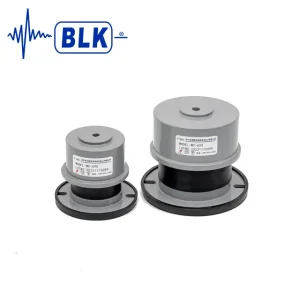
High-impact industrial forging presses generate massive shock loads that damage neighboring computer numerical control (CNC) equipment. Matrix-configured BK-MT & BKVD Series Mounts absorb transient shock energy ($3g - 5g$ forces) and protect industrial concrete floor slabs from fatigue cracking.
5. Global Compliance, Quality Control & Seismic Restraints
Ensuring operational stability, structural safety, and regulatory compliance in coastal, industrial, and high-seismic zones worldwide.
Modern engineering contracts require vibration isolation systems to incorporate dynamic safety restraints. In regions prone to earthquakes or high wind loading (such as rooftop cooling towers), un-restrained isolators can shear or overturn, leading to severe operational risks.
Seismic & Wind Load Restraints
Bellking’s restrained spring mount series feature integrated high-strength steel limit switches and heavy-duty housing pins. Engineered to withstand lateral dynamic forces per ASCE 7 and IBC (International Building Code) specifications, these mounts keep machinery anchored during seismic events.
ISO 9001 Quality Inspection Workflow
From dynamic stiffness spectroscopy to automated coordinate checking and digital tensile-compression verification, every lot of raw elastomeric compounding and finished metalwork undergoes controlled quality validation prior to release.
Global On-Site Technical Engineering
Selecting the right isolator requires accurate dynamic input data. Our field technical application team offers global remote analysis, support-point center of gravity (CG) calculations, mass distribution mapping, and localized installation guidance.
6. Technology Roadmap: Smart IoT Isolators & Sustainable Damping
Pioneering future-ready micro-vibration control through embedded sensor technology, smart magnetorheological damping, and eco-friendly compounding.
IoT-Enabled Predictive Structural Monitoring
Next-generation Bellking isolation systems integrate low-power piezoelectric MEMS accelerometer sensors. Transmitting real-time FFT (Fast Fourier Transform) spectrum data directly to factory SCADA networks enables predictive maintenance and flags degradation before failure occurs.
Active Electrodynamic & Magnetorheological Damping
Addressing unpredictable variable-speed equipment, hybrid active-passive isolators use magnetorheological (MR) fluids to modify damping coefficients ($\zeta$) in milliseconds, neutralizing dynamic transient resonance spikes during motor spin-up.
Bio-Based & Eco-Compliant Elastomers
Advancing corporate sustainability goals, our material development laboratory prioritizes bio-derived elastomers and fully recyclable thermoset materials without compromising high damping capabilities, oil resistance, or long service life.
7. Technical & Procurement Frequently Asked Questions (FAQ)
Detailed answers to essential engineering, material sizing, pricing, and installation inquiries.
Advanced Vibration Control Product Line (Catalog Tier II)
Discover our specialized pneumatic air isolators, high-deflection spring hangers, and structural inertia systems manufactured to exact OEM dimensions.




Request a Customized Vibration Isolation Engineering Proposal
Share your equipment weight distribution, dynamic center of gravity, operating frequencies, and installation constraints. Our engineering application specialists will deliver a comprehensive vibration attenuation specification within 24 hours.