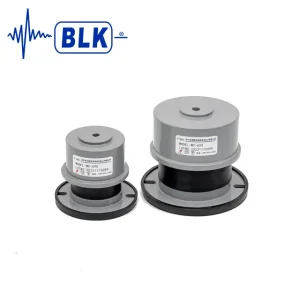
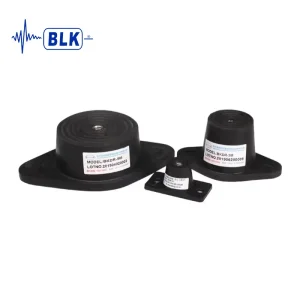
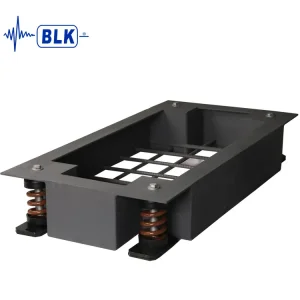
High-Performance Vibration Isolation Series
Explore our factory-direct isolators engineered for superior structure-borne noise attenuation and mechanical vibration damping.
Cylindrical Rubber Isolator Mechanics & Information Gain Analysis
A comprehensive technical investigation into elastomeric static-to-dynamic stiffness ratios, shear vs. compression strain behaviors, and empirical selection modeling.
Elastomeric Damping Fundamentals in Cylindrical Geometries
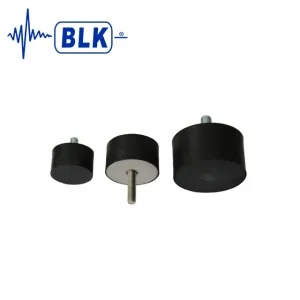
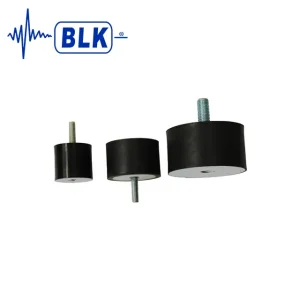
Cylindrical rubber isolators (commonly referred to as spool mounts, bobbin mounts, or rubber-metal bonded buffers) serve as the fundamental workhorse in structural vibration attenuation. Operating on the principle of viscoelastic energy dissipation, these components convert mechanical kinetic energy generated by rotating or reciprocating equipment into localized thermal energy via inner polymer chain friction.
Vibration Transmissibility Formula & Isolation Efficiency
The primary governing equation for vibration transmissibility ($T$) across a single-degree-of-freedom (SDOF) cylindrical rubber isolator is expressed as:
T = √[ (1 + (2ζ(f/fn))^2) / ((1 - (f/fn)^2)^2 + (2ζ(f/fn))^2) ]
Where f is the disturbing excitation frequency, fn is the natural frequency of the isolator assembly, and ζ (zeta) represents the critical damping ratio of the elastomeric matrix (typically 0.05 to 0.15 for high-grade Natural Rubber formulations).
To achieve an isolation efficiency exceeding 90%, the frequency ratio (f/fn) must satisfy f/fn > √2, with optimal industrial target ratios lying between 3.0 and 5.0. Cylindrical mounts engineered by Bellking utilize precision-compounded vulcanized rubber bonded to carbon steel or stainless steel threaded studs, providing dual-mode deflection characteristics across axial (compression) and radial (shear) vector directions.
| Elastomer Compound | Shore Hardness (A) | Tensile Strength (MPa) | Dynamic-to-Static Ratio (Kd/Ks) | Operating Temp Range | Primary Industrial Suitability |
|---|---|---|---|---|---|
| Natural Rubber (NR) | 40 - 75 ±5 | ≥ 18.5 | 1.2 - 1.4 | -40°C to +80°C | HVAC Compressors, Gensets, Pump Skid Isolators |
| Neoprene (CR) | 45 - 70 ±5 | ≥ 14.0 | 1.4 - 1.7 | -35°C to +100°C | Marine Engines, Oil & Gas Auxiliaries, Outdoor Units |
| EPDM Elastomer | 50 - 80 ±5 | ≥ 12.5 | 1.3 - 1.6 | -45°C to +130°C | High-Temp Steam Skids, Chemical Processing Equipment |
| Nitrile (NBR) | 50 - 75 ±5 | ≥ 13.5 | 1.4 - 1.8 | -25°C to +110°C | Hydraulic Power Units, Fuel Pump Subsystems |
| Fluoroelastomer (FKM) | 60 - 85 ±5 | ≥ 10.0 | 1.8 - 2.2 | -20°C to +200°C | Extreme Corrosive/Aerospace & Semiconductor Processing |
Commercial & Industrial Demand Dynamics
Analyzing cross-industry adoption trends of low-cost cylindrical rubber mounts in modern automated facilities and urban infrastructure.
HVAC & Building Services
Rapid urbanization and strict acoustic regulations (such as ASHRAE and ISO 3744) require commercial air handling units (AHUs), chillers, and centrifugal pumps to integrate compact cylindrical rubber buffers to eliminate structure-borne hum in high-density installations.
Automotive & EV Test Rigs
The global surge in Electric Vehicle (EV) battery pack testing, powertrain dynamometers, and chassis shaking tables has escalated demand for low-creep rubber-to-metal isolators capable of enduring dynamic multi-axis shock impulse profiles.
Industrial Robotics & CNC
High-speed pick-and-place gantry systems, automated guided vehicles (AGVs), and 5-axis CNC machinery deploy male-to-female thread cylindrical isolators to protect onboard sensitive control electronics from high G-force harmonic feedback.
Localized Application Scenarios
Implementation guidelines for mechanical engineers installing cylindrical isolators in diverse structural conditions.
1. Rooftop Air Conditioning & Condenser Skids
When positioning heavy rooftop condensing units on lightweight steel building frameworks, wind-shear forces and continuous compression loads can accelerate isolator fatigue. Applying cylindrical rubber mounts (such as the BKVD and BKH Series) with integrated anti-shear washers ensures proper deflection while preventing lateral displacement under stormy environmental conditions.
- Eliminates low-frequency booming noise in upper building levels.
- Dacromet-coated metallic studs resist 900+ hours of continuous salt spray exposure.
- Dual-male threaded geometry enables rapid field installation.
2. Marine Auxiliary Machinery & Engine Rooms
In maritime vessel engine rooms, bilge pumps, small diesel generators, and air compressors are exposed to constant salt spray, lubricant oil splashing, and multi-directional wave motion. Utilizing Neoprene (CR) or Nitrile (NBR) cylindrical isolators provides oil-resistant isolation that maintains elastic memory despite temperature spikes up to 100°C.
- Prevents galvanic corrosion between dissimilar metals.
- Compensates for minor angular misalignments during mounting.
- High tear strength prevents catastrophic detachment under shock wave impacts.
3. Electrical Control Cabinets & Sensitive Instrument Racks
High-voltage power sub-stations and factory floor automation enclosures located adjacent to heavy stamping presses experience severe floor vibration. Installing smaller female-female cylindrical rubber bobbins underneath control enclosure feet absorbs incoming high-frequency shockwaves, protecting microprocessors, relays, and optical sensors.
- Reduces microphonic electrical interference in sensitive signal lines.
- Protects internal solder joints from mechanical stress cracking.
- Provides electrical isolation between floor structures and electronics enclosures.
China Factory Supply Chain Resilience & Efficiency Advantages
Why sourcing direct from Bellking's automated manufacturing plant in Kunshan provides unprecedented cost-to-performance efficiency and order security.
Integrated Kunshan Supply Cluster
Located in the heart of Jiangsu's advanced manufacturing corridor, Bellking benefits from localized raw material sourcing—including high-purity natural rubber imports, specialized chemical additives, and high-precision CNC threaded steel bolt production within a 30-mile radius.
Automated Compression Vulcanization
Our 2,000 m² factory utilizes multi-station automated vacuum rubber injection and compression molding machines. This ensures ultra-consistent elastomer density, eliminates micro-void air inclusions, and achieves metal-to-rubber bond shear strength exceeding 4.5 MPa.
Direct Factory Pricing & High Yield
By eliminating third-party trading markups and optimizing material usage, Bellking delivers factory-direct wholesale pricing. High-volume buyers receive exceptional unit economics without sacrificing raw material compliance or structural longevity.
Technical Roadmap & Future Outlook (2025–2035)
Next-generation vibration isolation breakthroughs driving the future of industrial acoustic control and micro-vibration mitigation.
Phase 1: Graphene & Carbon Nanotube (CNT) Elastomers
Bellking’s R&D team is actively engineering nano-composite enhanced natural rubber matrix formulations. Interdispersing multi-walled carbon nanotubes into the rubber compound improves thermal conductivity, allowing heat generated during high-frequency cyclic damping to dissipate rapidly, increasing service life by over 40%.
Phase 2: Bio-Based Eco-Rubbers & Green Vulcanization
In response to global sustainability initiatives and EU REACH directives, future product lines will transition toward bio-sourced silica reinforcement agents and non-nitrosamine vulcanization accelerators, drastically reducing embodied carbon footprints while eliminating volatile organic compound (VOC) off-gassing.
Phase 3: FEA-Driven Custom Topology Optimization
Deploying advanced Finite Element Analysis (FEA) software allows our engineering team to simulate stress concentration maps under simultaneous axial, shear, and torsional loading vectors. Custom isolators can be designed, molded, and shipped in as little as 3 working days for specialized OEM machinery.
Global Compliance & Localized Technical Support
Ensuring compliance with international engineering standards and providing global buyers with complete verification documentation.
ISO 9001 & Material Traceability
Every manufacturing batch undergoes stringent quality audits. Raw elastomers are batch-tested for durometer hardness (ASTM D2240), tensile strength and elongation (ASTM D412), and compression set resistance (ASTM D395). Certificate of Conformance (CoC) documentation accompanies every shipment.
Dacromet & Electro-Galvanized Plating
Metallic inserts and threaded studs are subjected to surface passivations—including environmental Dacromet coating, zinc-nickel alloy plating, or 304/316 stainless steel construction—ensuring superior resistance against atmospheric corrosion, salt spray, and aggressive industrial fluids.
Rapid Engineer-to-Engineer Consultation
Unsure which rubber Shore hardness or stud thread size fits your machinery skid? Our dedicated application engineers provide complete dynamic sizing reports, load calculation sheets, and 3D CAD step files within 24 hours of receiving equipment specifications.
Frequently Asked Questions (FAQ)
In-depth answers to common technical queries regarding selection, calculation, and installation of cylindrical rubber mounts.
Explore Additional Shock & Damping Mounts
Comprehensive vibration isolation hardware designed for precision machinery, HVAC, and industrial infrastructure.