Precision Anti-Vibration Mounts & Systems (Part 1)

Global Commercial & Industrial Status of Vibration Damping Materials
Evaluating supply chain shifts, cost-performance ratios, and structural demand across semiconductor, automotive NVH, heavy industrial HVAC, and renewable energy sectors.
Market Size & CAGR Trajectory
The global industrial vibration damping material market is projected to expand from USD 4.85 Billion in 2024 to USD 7.21 Billion by 2032, registering a Compound Annual Growth Rate (CAGR) of 5.1%. This expansion is spearheaded by stringent environmental noise regulations (such as EU Directive 2002/49/EC) and the rapid growth of high-precision cleanroom manufacturing facilities globally.
Low-Cost Sourcing vs. Total TCO
Global procurement teams searching for low price vibration damping material manufacturers must evaluate Total Cost of Ownership (TCO) over initial unit purchase price. Sourcing directly from certified OEM factories in manufacturing hubs like Kunshan, China delivers up to 45% unit cost reductions without sacrificing material damping loss factors (η) or fatigue resistance.
Regulatory Driven Demand
Architectural building codes (IBC/ASHRAE 170) and ISO 10816 machinery vibration standard compliance demand verifiable energy absorption. High-damping polymers and constrained layer damping (CLD) sheets are now mandatory components in modern MEP engineering to prevent structure-borne acoustic transmission.
Classification & Mechanical Dynamics of Damping Materials
Understanding how kinetic energy is transformed into thermal energy through molecular friction, shear deformation, and structural hysteresis.
Viscoelastic Polymers & Elastomers
Viscoelastic materials exhibit both viscous and elastic characteristics when undergoing deformation. Formulated using specialized synthetic Rubbers (EPDM, Nitrile, Neoprene, Silicone) and Polyurethanes, these materials convert mechanical shear strain into thermal dissipation. Key parameter: Loss Factor ($\tan \delta = E'' / E'$), where $E''$ is loss modulus and $E'$ is storage modulus.
Constrained Layer Damping (CLD)
CLD technology consists of a thin viscoelastic polymer core sandwiched between two rigid constraining layers (usually galvanized steel or aluminum). When structural bending occurs, the embedded polymer layer is subjected to high dynamic shear stress, yielding exceptionally high loss factors ($\eta > 0.3$) across broad frequency bands (50 Hz – 5,000 Hz).
Helical Steel Springs & Viscous Damping
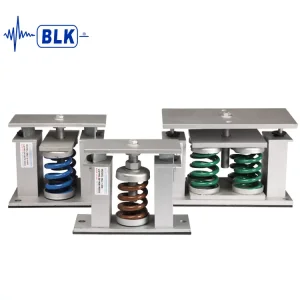
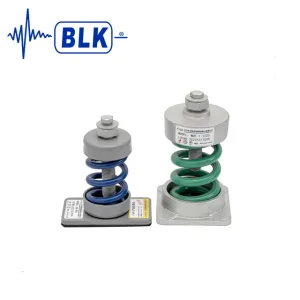
Steel spring isolators deliver exceptionally low natural frequencies ($f_n \approx 3.0 - 5.0 \text{ Hz}$), critical for isolating low-RPM rotating equipment like chillers and pumps. To control surge resonance during equipment start-up and shutdown, high-viscosity silicone fluid dampers are integrated into the housing.
The performance of any vibration damping system is defined by its Displacement Transmissibility ($T_r$), which dictates the fraction of dynamic force transmitted to the supporting structure:
Where: $\beta = f_d / f_n$ (Frequency Ratio of Disturbing Frequency to Natural Frequency), and $\zeta = c / c_c$ (Damping Ratio). Isolation occurs exclusively when $\beta > \sqrt{2}$. For superior performance, industrial engineers design for $\beta \ge 3.0$, yielding an Isolation Efficiency $E = (1 - T_r) \times 100\% > 90\%$.
Localized Application Engineering & Compliance
How vibration damping solutions adapt to regional engineering mandates, seismic zoning, and extreme ambient operating conditions.
North America: Seismic & HVAC (IBC / ASHRAE)
In North America, vibration isolators installed in commercial towers, medical centers, and data centers must dual-function as seismic restraints compliant with the International Building Code (IBC) and ASCE 7. Bellking’s spring isolators integrate seismic snubbers engineered to withstand up to 2.0g lateral spectral acceleration forces without housing structural collapse.
Europe: Precision Metrology & Low NVH (ISO 3744)
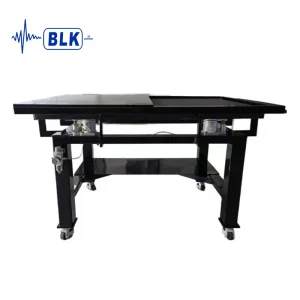
European industrial standards prioritize ultra-low environmental noise and micro-vibration mitigation. In automotive R&D facilities across Germany and Sweden, active air suspension mounts and polymer pads are utilized under test benches to meet strict noise emissions standards while maintaining structural isolation down to 1.7 Hz natural frequencies.
Asia-Pacific: High-Density Semiconductor Fabs
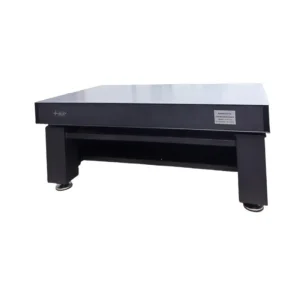
In East Asian semiconductor hubs (Taiwan, South Korea, China), sub-nanometer photolithography equipment requires isolation from VC-E and VC-G vibration criterion curves. Active pneumatic vibration isolation platforms are deployed to attenuate ambient micro-tremors generated by nearby highway traffic and cleanroom recirculation fans.
Selecting Isolators Based on Operational Frequency & Load Profiles
| Damping Solution Type | Natural Frequency ($f_n$) | Isolation Efficiency | Primary Application Profile | Environmental Resilience |
|---|---|---|---|---|
| Pneumatic Air Mounts (BK-PA Series) | 1.5 Hz – 2.5 Hz | 98.5% – 99.5% | Semiconductor Inspection, CMM Machines, Laser Interferometers | Cleanroom Compatible, Oil/Moisture Sensitive |
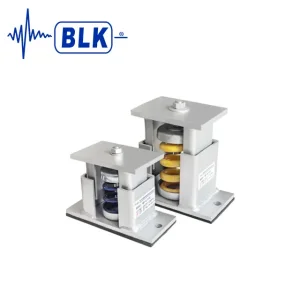
| Viscous Damped Spring Mounts (MD/MA Series) | 3.0 Hz – 5.0 Hz | 92.0% – 98.0% | HVAC Chillers, Large Centrifugal Pumps, Cooling Towers | 900h Salt-Spray Dacromet Coating for Outdoor Use |
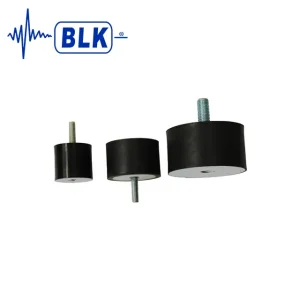
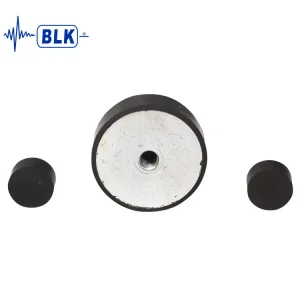
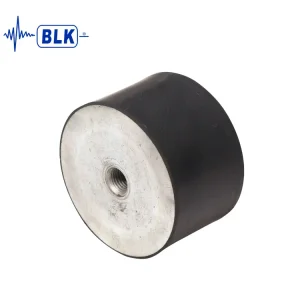
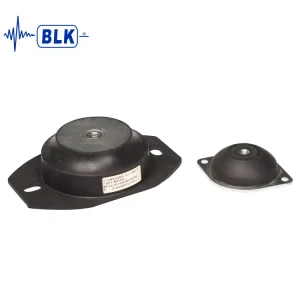
| High-Damping Rubber Isolators (BKH/BKP Series) | 8.0 Hz – 15.0 Hz | 85.0% – 93.0% | High-Speed Electric Motors, Air Compressors, Transformers | High Chemical Resistance, UV & Ozone Resistant Elastomers |
| Polymer Damping Pads (BK-PM Series) | 12.0 Hz – 25.0 Hz | 75.0% – 88.0% | Structural Foundation Decoupling, Heavy Press Base Mats | Extreme Load Capacity (up to 50 kg/cm²), Water-Resistant |
Next-Generation Smart Damping & Sustainable Materials
The technological evolution towards active magnetorheological fluids, bio-based damping polymers, and AI-driven predictive maintenance monitoring.
Sustainable High-Loss Polymer Formulations
Transitioning from pure petroleum-derived Nitrile/Neoprene matrices to bio-based polyurethane elastomeric foams infused with recycled carbon black and graphene nanoplatelets, increasing structural loss factor ($\eta$) by 35% while lowering raw material carbon footprint.
Real-Time Health & Spectrum Monitoring
Integration of MEMS tri-axial accelerometers and piezoelectric energy harvesters directly inside spring housings and elastomer pads. Transmitting real-time FFT spectrum data to factory IoT systems to predict bearing wear and spring fatigue before catastrophic failure.
Millisecond-Response Electromagnetic Attenuation
Deployment of MR fluid dampers capable of adjusting dynamic viscosity in under 5 milliseconds via closed-loop PID control algorithms, eliminating startup resonance spikes in heavy variable-frequency drive (VFD) industrial machinery.
Step-by-Step Sizing Protocol for Industrial Procurement
A systematic methodology for calculating static deflection, dynamic stiffness, and selecting appropriate isolator configurations.
Step 1: Calculate Total Operating Weight & COG
Determine the total static mass ($M$), including liquid fill (e.g., water in chillers/pumps) and auxiliary piping. Calculate the exact Center of Gravity (COG) to distribute point loads unevenly if weight distribution is asymmetrical.
Step 2: Identify Disturbing Frequency ($f_d$)
Obtain the minimum operational RPM of the machinery. Convert RPM to Hertz ($f_d = \text{RPM} / 60$). For example, a pump running at 1,450 RPM has a fundamental disturbing frequency $f_d = 24.16 \text{ Hz}$.
Step 3: Select Deflection & Calculate $f_n$
Target a natural frequency $f_n \le f_d / 3$. Using the static deflection formula $f_n \approx 5 / \sqrt{\delta_{\text{mm}}}$, a required $f_n$ of 4.0 Hz mandates a static spring deflection $\delta \approx 15.6 \text{ mm}$. Choose a standard spring mount rating accordingly.
Why Low-Price Direct OEM Sourcing Matters
Purchasing directly from certified manufacturers like Bellking Vibration Reduction Equipment Manufacturing (Kunshan) Co., Ltd. eliminates intermediary trading markups, lowering component acquisition costs by 30%–50%. More importantly, factory-direct engineering ensures direct access to custom spring constant ($K$) adjustments, specialized powder coatings, and rapid prototype turnarounds (under 72 hours).
Technical & Procurement FAQ
Direct answers to common technical queries from structural engineers, HVAC contractors, and purchasing agents.