
High-Efficiency Transformer Anti-Vibration Solutions for Germany
Engineered for dry-type distribution transformers and large oil-immersed transmission power substations requiring low natural frequencies and superior isolation efficiency.
Transforming the German Power Grid: Acoustic & Vibration Mandates
Germany’s ambitious Energiewende (Energy Transition) has triggered unprecedented infrastructure modernization across its 380 kV, 110 kV, and medium-voltage distribution grids. As offshore wind power from the German Bight is transported southward via massive HVDC links (such as SuedLink and SuedOstLink), high-capacity substations and urban transformer hubs are being deployed closer than ever to commercial parks, data center clusters (notably around the Frankfurt DE-CIX hub), and densely populated residential areas.
In electrical transformers, core vibration is fundamentally generated by magnetostriction in the silicon steel laminations, alongside periodic electromagnetic forces across the windings. Operating under standard European 50 Hz alternating current, this phenomenon generates a distinct, highly penetrative low-frequency structural vibration dominated by a 100 Hz fundamental hum with prominent higher harmonics at 200 Hz, 300 Hz, and 400 Hz.
Without high-performance decoupling, these micro-displacements resonate directly through foundation slabs, oil catch basins, and supporting steel beams, transforming entire concrete transformer pits into massive acoustic sounding boards. Mitigating this issue requires bespoke, calculation-backed anti-vibration mounts engineered specifically to achieve insertion loss figures exceeding 20 to 32 dB.
- Acoustic Compliance: Strict adherence to the German TA Lärm (Technical Instructions on Noise Abatement) with night limits down to 35 dB(A).
- Structural Protection: Full compliance with DIN 4150-2 (Human exposure to structural vibrations) and DIN 4150-3 (Structural integrity prevention).
- Mechanical Longevity: Elimination of fatigue cracking in transformer busbars, cable terminations, and internal tap-changer components.
Vibration Isolation Physics: Overcoming Resonance in Power Transformers
A rigorous analytical approach to transmissibility, dynamic stiffness, and elastomeric damping ratios ensures fail-safe installations under static and electrodynamic shock loads.
Dynamic Transmissibility & Natural Frequency
Isolation only initiates when the ratio of excitation frequency to system natural frequency satisfies the mathematical condition fd / fn > √2. Because magnetostrictive excitation in Germany resides at 100 Hz, Bellking engineers our transformer spring and hybrid elastomeric mounts with a low natural frequency of 3.0 Hz to 5.5 Hz. This ensures a frequency ratio exceeding 18, plunging structural transmissibility below 1% and delivering absolute acoustic isolation across building structures.
Viscous Damping & Transient Control
Uncontrolled resonance during transformer energization, sudden load switching, or external seismic disturbances can cause dangerous displacement spikes. Bellking integrates internal viscous dampers and engineered nitrile-rubber matrix elements that provide an optimal damping ratio (ζ = 0.08 to 0.15). This dampens transient start-up amplitudes without compromising high-frequency acoustic attenuation at 100 Hz and 200 Hz.
Short-Circuit Electrodynamic Resistance
Under severe secondary short circuits, transformer coils experience instantaneous electrodynamic forces that impart acceleration pulses up to 3 G to 5 G into the mounting base. Standard architectural dampers sheer under such stresses. Bellking's custom German-spec transformer mounts feature integral, ductile cast-iron or steel snubber housings that restrict multidirectional travel while completely preventing structural unseating.
| Mount Type | Isolation Media | Natural Frequency (fn) | Load Range per Mount | Target Frequency Ratio (at 100 Hz) | German Compliance Certification |
|---|---|---|---|---|---|
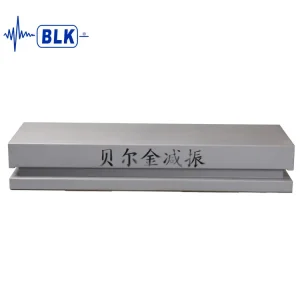
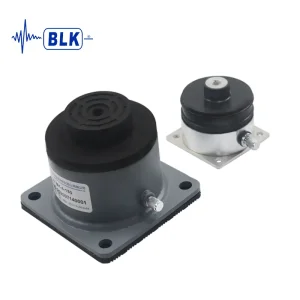
| BK-MT Heavy Matrix Mount | Pre-stressed Alloy Steel + NBR Damping Core | 3.2 Hz – 4.8 Hz | 500 kg – 12,000 kg | > 20 : 1 (High Isolation Zone) | DIN 4150-2, TA Lärm, ISO 9001 |
| BK-DSR Damped Rubber Base | Engineered Polyurethane / Neoprene Matrix | 6.5 Hz – 9.0 Hz | 150 kg – 4,500 kg | > 11 : 1 (Structural Cutoff) | DIN 4150-3, VDI 2056 Group K |
| BK-DS Viscous Spring Isolator | Helical 60Si2Mn Spring + Dacromet Coating | 2.8 Hz – 4.2 Hz | 1,000 kg – 18,000 kg | > 23 : 1 (Ultra-Low Transmission) | CE, DIN EN 60076-10, RoHS |
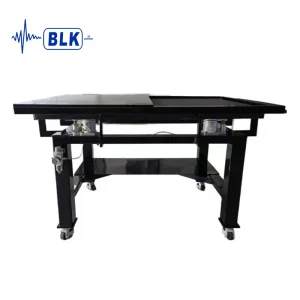
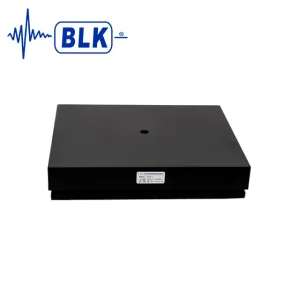
| BK-VT Integrated Base Platform | Composite Steel Base with Multi-Point Mounts | 1.8 Hz – 3.5 Hz | Up to 45,000 kg total | > 28 : 1 (Precision Level) | DIN EN 1993 (Eurocode 3), ISO 9227 |
Engineered to Surpass German DIN, VDI, and Environmental Standards
For German electrical contractors, municipal utilities (Stadtwerke), and industrial EPCs, mechanical component sourcing must satisfy rigorous regional quality mandates. Bellking’s specialized engineering team delivers full project design documentation, FEA simulations, and test certificates aligned with German regulatory criteria.
- TA Lärm & DIN EN 60076-10 Compatibility: Dedicated calculation files for sound power levels and structure-borne sound reduction (Körperschallpegelsenkung) up to 25–35 dB(A).
- DIN 4150-2 (Vibrations in Buildings - Effects on Persons): Guarantees that vibration immissions transmitted to occupied residential spaces remain well below the perception threshold (KB levels).
- Chemical & Environmental Longevity: High-grade chloroprene and nitrile rubber formulations resistant to silicone oil, synthetic esters, and transformer dielectric fluids (MIDEL 7131).
- Fast-Track Local Engineering Support: Complete CAD 2D/3D BIM models (.STEP, .DWG, .Revit) and static/dynamic sizing calculations delivered to your planning team within 24 hours.
Direct Technical Documentation for German Approvals
Every customized anti-vibration mount order destined for Germany includes full technical trace documentation:
• Certified Mill Test Reports (EN 10204 3.1)
• Dynamic Stiffness Calibration Certificates
• 900-Hour Salt Spray Inspection Logs (ISO 9227)
• Finite Element Analysis (FEA) Stress & Deflection Reports
• Fire safety compliance certificates (UL 94 V-0, DIN EN 45545)
Why Leading Global OEMs Source Transformer Mounts from Bellking
Combining world-class production precision, end-to-end metallurgical quality control, and agile customization with unbeatable total-cost-of-ownership advantages.
Advanced Metallurgical & Rubber Manufacturing
Unlike trading entities, Bellking operates a state-of-the-art 2,000 m² production base equipped with CNC five-axis machining centers, robotic precision welding cells, and automated vulcanization presses. From our Kunshan production facility, every batch of high-strength spring steel (60Si2Mn / 55CrSi) undergoes continuous tensile, compression, and cyclic fatigue testing to ensure 15+ years of zero-sag operation under continuous transformer static loading.
1:1 Custom Engineering in Fast Turnaround
European suppliers typically impose 16 to 26 weeks lead time for customized transformer vibration mounts. Bellking bridges the gap with an agile engineering workflow: tailored non-standard solutions based on specific transformer weights, center of gravity offsets, and wheel/rail geometry are completed in as fast as 3 working days. Batch production cycles are compressed to 10–14 days with express sea or air shipment directly to Hamburg or Frankfurt.
Unmatched Total Cost of Ownership (TCO)
Procuring directly from Bellking delivers 35% to 55% CAPEX reductions for transformer OEMs and EPC contractors compared to conventional domestic European suppliers, without compromising metallurgical purity, corrosion longevity, or elastomeric resilience. This substantial cost advantage enables German engineering firms to submit highly competitive bids on major grid and industrial projects.
Localized Application Scenarios in Germany’s Core Sectors
From Frankfurt hyper-scale data centers to North Sea offshore wind substations, our custom mounts protect sensitive equipment and satisfy acoustic codes.
Colocation & Cloud Data Centers
High-density data centers in the Rhine-Main area run dozens of 2,500 kVA to 4,000 kVA step-down cast-resin dry transformers in close proximity to sensitive server racks. BK-MT matrix mounts eliminate 100 Hz hum transmission through floor slabs, preventing structural resonance with magnetic storage and high-speed fiber racks.
Offshore Wind Converter Platforms
Transformers installed on offshore HVAC/HVDC platforms endure aggressive maritime saline environments and constant dynamic wave-induced motion. Bellking supplies custom 316 stainless steel and 900-hour Dacromet-treated spring isolators designed with multi-axis snubbers to withstand extreme sea-state accelerations.
Urban Subterranean Substations
City-center power distribution relies on substations embedded directly beneath residential apartments, historic buildings, or high-rise office towers. Our ultra-low-frequency hybrid mounts deliver over 30 dB sound transmission attenuation, keeping residential immissions safely under the stringent 35 dB(A) TA Lärm night limit.
Heavy Industry & Automotive Plants
Automated manufacturing lines, robotic welding stations, and precision coordinate measuring machines (CMMs) cannot tolerate external vibration. Bellking’s BK-VT and BK-DS mounts isolate massive arc-furnace and press-line transformers, preventing parasitic structural vibration from corrupting precision metrology.
Deutsche Bahn 16.7 Hz Traction Substations
German railway electrification operates on a specialized 16.7 Hz single-phase AC traction system. The resulting 33.4 Hz fundamental vibration frequency is notoriously difficult to isolate. Bellking custom-engineers ultra-compliant spring isolators targeting an ultra-low 2.2 Hz natural frequency to decouple trackside traction substations.
Semiconductor Cleanroom Substations
Advanced silicon fabs demand VC-D and VC-E micro-vibration criteria. Bellking engineers multi-stage inertia bases and tuned pneumatic-spring isolators for facility transformers, completely isolating cleanroom sub-fabs from 100 Hz and 200 Hz electromagnetic ripple.
How to Size & Specify Custom Transformer Mounts for German Sites
Accurate vibration isolation sizing requires rigorous assessment of static load, center of gravity offset, dynamic amplification, and environmental criteria.
The Bellking 5-Step Sizing Protocol
When selecting anti-vibration mounts for transformers, undersizing causes premature rubber creep or spring bottoming out, while oversizing creates an overly stiff suspension that transmits hum directly into the foundation.
- Step 1: Determine Total Operating Weight & Core Eccentricity: Oil-filled and dry-type transformers feature asymmetrical mass distributions due to heavy tap changers, conservator tanks, and radiator banks. Bellking calculates individual point loads for each mount position.
- Step 2: Identify Disturbance Spectrum: For standard 50 Hz European grids, the primary hum occurs at 100 Hz. If variable frequency drive (VFD) converters or solar inverters are present, harmonic excitation up to 2 kHz is verified.
- Step 3: Calculate Required Static Deflection (δst): Using the formula fn ≈ 5 / √δst, a static deflection of 15 mm to 25 mm is targeted to achieve a low natural frequency of 3.2 to 4.0 Hz.
- Step 4: Select Mechanical Interface & Roller Adaptations: Custom brackets designed to bolt directly beneath transformer wheels, UNP channel frames, or flat mounting skids.
- Step 5: Environmental & Chemical Hardening: Dacromet coating for outdoor C4/C5 marine environments or oil-resistant fluoropolymer/nitrile pads for oil retention basins.
Submit Your Project Parameters
Our Kunshan engineering center will calculate point-load deflections, select ideal mount models, and provide a full technical proposal within 24 hours.
• Total transformer operating weight (kg/tons)
• Quantity & layout of support points / wheels
• Transformer type (Dry-Type Cast Resin / Oil Immersed)
• Target acoustic limit or site sensitivity classification
• Indoor vs outdoor installation environment
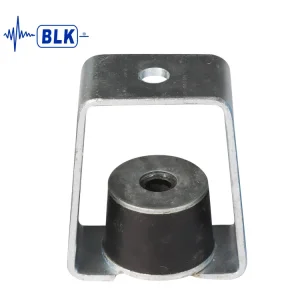
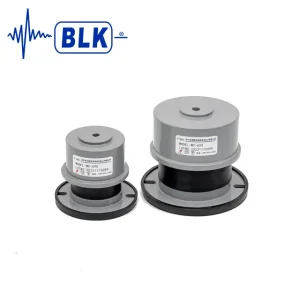
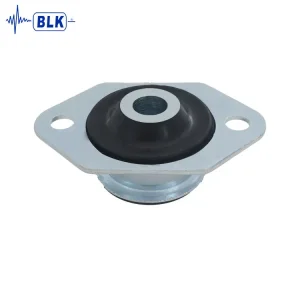
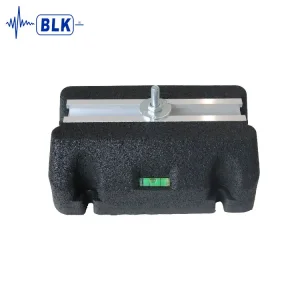
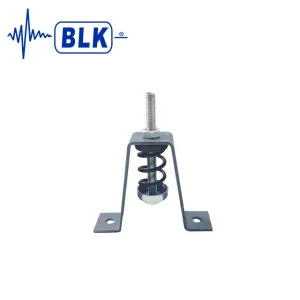
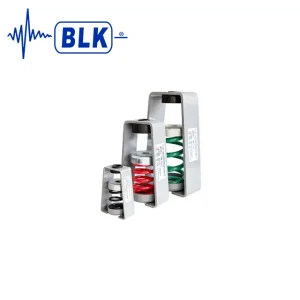
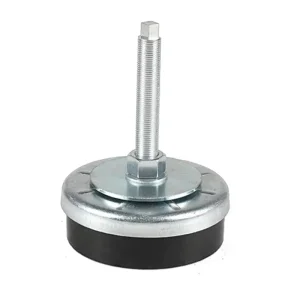
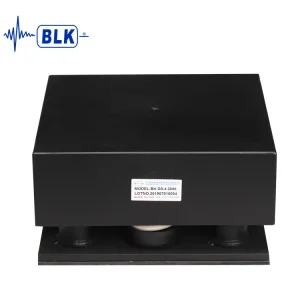
Industrial Anti-Vibration Mounts & Hangers for Transformer Ancillaries
Full suite of spring mounts, rubber dampers, and isolation hangers engineered for secondary piping, cable busducts, switchgear cabinets, and auxiliary HVAC plant systems.
Frequently Asked Questions: Transformer Anti-Vibration Mounts
Comprehensive answers addressing technical selection, regulatory compliance in Germany, dynamic behavior, and direct factory procurement.
Why is 100 Hz hum the primary challenge for transformer vibration isolation in Germany?
How do Bellking mounts guarantee compliance with the German TA Lärm (Technische Anleitung zum Lärmschutz)?
Can standard HVAC spring mounts be used under high-voltage electrical transformers?
How does Bellking adapt anti-vibration mounts for transformers fitted with bidirectional rollers/wheels?
What surface treatment is applied to protect mounts installed in outdoor or offshore German environments?
What is the lead time for custom engineered transformer mounts delivered to Germany?
Eliminate Transformer Structure-Borne Hum on Your German Project
Partner directly with Bellking Vibration Reduction Equipment. Our engineering team provides point-load deflection analyses, dynamic stiffness simulations, and tailored quotation files compliant with DIN 4150-2/3 and TA Lärm within 24 hours.