How do Dutch soft soil conditions (peat and clay) affect the selection of spring vibration isolators?
Unlike bedrock foundations, soft alluvial soil in the Netherlands exhibits low shear wave velocities and very poor attenuation of low-frequency surface waves (Rayleigh waves). If a mechanical unit transmits energy between 8 Hz and 15 Hz into the ground slab, this vibration can resonate through the underlying peat stratum and travel into adjacent pile-supported buildings. To decouple the machine from the foundation, engineers must specify high-deflection spring isolators (25 mm to 50 mm static deflection) that yield a system natural frequency below 3.0 Hz, guaranteeing a frequency ratio $f_d / f_n \ge 3.0$ and blocking transmission into the building piles.
What specific certifications and standards apply to spring isolator installations in the Netherlands?
Mechanical installations in the Netherlands must comply with the Besluit bouwwerken leefomgeving (Bbl / Bouwbesluit) regarding acoustic transmission (≤ 30 dB(A) inside residential/commercial units), NEN-EN 1998 (Eurocode 8) for seismic and dynamic equipment restraints, and ISO 10816 for mechanical vibration velocity criteria. Furthermore, maritime and offshore projects operating out of Rotterdam must conform to DNV-GL Marine Rules or Lloyd's Register specifications, requiring stringent fatigue resistance and salt-spray corrosion protection.
Why is Dacromet or zinc-flake coating critical for spring mounts deployed in the Benelux coastal zone?
The Netherlands possesses a corrosive maritime atmosphere (classified as ISO 12944 C4 to C5-M in coastal regions like Zuid-Holland and Zeeland). Standard painted springs quickly suffer surface pitting, leading to stress corrosion cracking under cyclical load. Bellking's Dacromet and multi-layer zinc-flake surface treatments withstand over 900 hours of continuous neutral salt spray testing (ISO 9227 / ASTM B117) without red rust formation, preventing premature spring fatigue failure without causing hydrogen embrittlement.
What is the difference between open spring mounts (MA series) and restrained spring mounts (MD/ME series)?
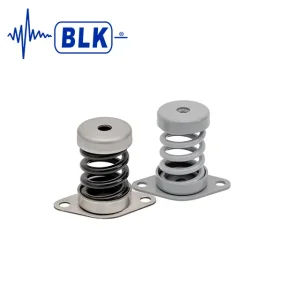
Open spring mounts (MA/MC) provide unconstrained vertical isolation and are ideal for indoor, floor-mounted equipment with constant operating weight. Restrained spring mounts (MD/ME) feature integrated vertical limit snubbers and dynamic limit bolts. These restraints are mandatory for rooftop equipment in coastal Dutch areas to withstand North Sea wind uplift forces, and for fluid-filled equipment (such as boilers or cooling towers) where dynamic weight changes during drainage could cause unrestricted springs to over-extend.
How does viscous damping inside the spring mount improve dynamic equipment stability?
Pure steel springs have very low internal material damping ($\zeta \approx 0.005$). When rotating equipment starts up or coasts down, its rotational frequency temporarily passes through the isolator's natural resonance frequency ($f_n$). Without damping, this resonance condition generates violent displacement peaks. Viscous damped spring mounts (such as the BK-DS series) introduce controlled fluid resistance ($\zeta \approx 0.15\text{--}0.22$), suppressing resonance displacement by up to 75% without compromising high-frequency isolation efficiency.
When should an inertia base be used in conjunction with custom spring isolators?
Inertia bases (concrete-filled structural steel frames) are required when supporting high-center-of-gravity equipment, machines with dynamic reciprocating forces, or end-suction pumps with flexible pipe connections. The heavy mass of the inertia base (typically 1.5 to 2.5 times the machine weight) lowers the center of gravity, resists start-up torque, limits operational rocking motion, and ensures even load distribution across all spring mount points.
What engineering data is required to calculate custom spring isolator parameters?
To provide an exact 1:1 engineering design within 24 hours, our application engineers require: (1) Total equipment operating weight, (2) Center of gravity coordinates, (3) Number and geometric layout of mounting points, (4) Operating rotational speed (RPM) or disturbing excitation frequencies, (5) Installation environment (indoor plant room, rooftop, or marine offshore), and (6) Any wind-load, seismic restraint, or floor slab stiffness constraints.
Request a Custom Vibration Isolation Calculation for Your Project
Connect with our senior dynamic vibration engineers. We deliver tailored load calculations, finite element transmissibility simulations, and custom fabrication drawings within 24 hours.