
Loss Factor η ≥ 0.45

BK-PM Polymer Damping Pad (Barcelona Industrial Grade)
Viscoelastic microcellular polymer pad engineered for heavy equipment foundations, chillers, and CNC presses in Catalonia.
Factory-calibrated isolation pads, pneumatic units, and rubber elastomeric dampers designed to satisfy Barcelona’s stringent Ordenança sobre el medi ambient urban noise protocols.
Viscoelastic microcellular polymer pad engineered for heavy equipment foundations, chillers, and CNC presses in Catalonia.
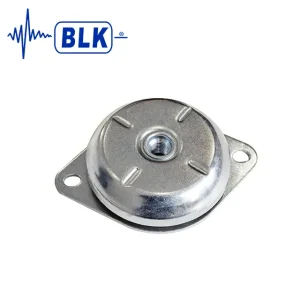
Heavy-duty structural rubber isolator with integrated dynamic load deflection for commercial rooftop chillers and ventilation.

Sub-2Hz active-ready leveling pneumatic isolator for optical metrology, cleanrooms, and coordinate measuring machines (CMM).
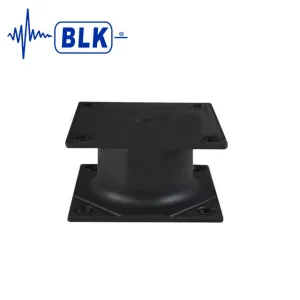
Engineered elastomeric deceleration buffer designed for Port of Barcelona automated crane rails and heavy transfer car stops.
Balancing dense Mediterranean urban architecture with the rigorous noise, vibration, and harshness (NVH) requirements of Catalonia's high-output manufacturing corridors.
The metropolitan area of Barcelona represents one of Southern Europe’s most dynamic industrial epicenters, anchored by the automotive powerhouses of Martorell, the extensive logistics ecosystems of the Zona Franca Industrial Estate, and the bustling maritime operations around the Port de Barcelona. Furthermore, the corridor extending along the Baix Llobregat and Vallès Occidental hosts a dense concentration of global pharmaceutical facilities, precision biotechnology laboratories, and advanced robotic packaging plants. In these advanced manufacturing environments, structural vibration control is not merely a component protection measure; it is a regulatory requirement and an imperative for product precision.
Barcelona operates under one of Europe's most stringent municipal acoustic policies: the Ordenança sobre el medi ambient de Barcelona (specifically the Noise and Vibration Chapter), closely mirrored by Generalitat de Catalunya Decree 176/2009. These regulations mandate strict interior structural vibration limits (often requiring peak vibration velocities $v_{max} < 0.15\text{ mm/s}$ in sensitive healthcare and residential adjacent mixed-use commercial districts such as the 22@ Innovation Hub). Mechanical equipment installed without calibrated polymer vibration damping pads routinely transfers harmonic resonance through reinforced concrete structures, generating low-frequency airborne humming (structure-borne sound) that violates municipal thresholds and halts plant commissioning.
Key Engineering Consideration for Catalan Plants: Equipment installations in Barcelona must demonstrate compliance with UNE-EN ISO 10846 standards for acoustic and vibration transmissibility. Standard vulcanized commercial rubber pads degrade rapidly when exposed to high Mediterranean ambient summer temperatures and coastal airborne chlorides, escalating the requirement for high-density, hydrolytically stable polyurethane elastomer pads.
Bellking vibration solutions bridges this critical engineering gap. By directly designing and manufacturing advanced microcellular polyurethane and viscoelastic composite polymer damping pads in our Kunshan production base, we provide Barcelona mechanical contractors, plant engineers, and MEP specialists with materials certified to maintain their static-to-dynamic stiffness ratio over decades of continuous cyclical operation.
Evaluating energy dissipation across frequency spectra: how internal molecular shearing converts destructive mechanical kinetics into negligible thermal dissipation.
Unlike pure steel coil springs—which excel at low-frequency deflection but exhibit practically zero internal damping, frequently transmitting high-frequency auditory harmonics—viscoelastic polymer damping pads dissipate kinetic energy through long-chain molecular friction. When dynamic excitation from a running motor, industrial compressor, or high-speed press stresses the polymer matrix, the dynamic strain lags behind the applied stress. This phase lag ($\delta$) generates the material's mechanical loss factor ($\eta = \tan \delta$).
Standard industrial rubber pads possess a loss factor ($\eta$) ranging merely from 0.05 to 0.15. Under sudden dynamic impulse or resonant excitation (where forcing frequency $f_d \approx$ system natural frequency $f_n$), standard rubber mounts suffer from violent mechanical amplification. Bellking’s advanced polymer formulations, specifically developed in our BK-PM series, integrate high-molecular-weight viscoelastic polyurethanes achieving loss factors between 0.35 and 0.58. This delivers instantaneous resonant attenuation without requiring bulky secondary viscous dashpots.
| Polymer Substrate / Material Type | Loss Factor (η) | Dynamic / Static Ratio | Working Temperature (°C) | Resistance to Oils & Grease | Creep Rate (10-Yr Est.) |
|---|---|---|---|---|---|
| Commercial Neoprene / Nitrile Blend | 0.08 – 0.14 | 1.60 – 2.20 | -20 to +70 | Moderate | High (>8.5%) |
| Natural SBR Rubber Pad | 0.05 – 0.10 | 1.30 – 1.50 | -30 to +60 | Poor | Severe (>12.0%) |
| Bellking BK-PM High-Damping Polyurethane | 0.38 – 0.58 | 1.18 – 1.35 | -40 to +85 | Exceptional | Ultra-Low (<2.1%) |
| Cross-Linked Expanded Polyethylene (XLPE) | 0.12 – 0.18 | 1.80 – 2.40 | -40 to +65 | Moderate | Moderate (>6.0%) |
| Composite Steel-Polymer Matrix | 0.30 – 0.45 | 1.25 – 1.40 | -30 to +90 | Exceptional | Minimal (<1.5%) |
Another decisive metric for industrial designers in Barcelona is the Dynamic-to-Static Stiffness Ratio ($K_{dyn} / K_{stat}$). In traditional vulcanized elastomer pads, the dynamic stiffness under oscillating machine loads can be twice as high as measured under resting static weight. This severe stiffening shifts the resonant frequency upwards, destroying isolation efficiency precisely when the machine attains operational RPM. Bellking polymer damping formulations retain a remarkably flat dynamic stiffness curve ($K_{dyn} / K_{stat} \le 1.25$), ensuring that isolation models calculated in design phase accurately reflect real-world mechanical isolation on site.
Dramatically eliminates solid-borne noise transmission across building floors and slabs, conforming with strict Catalan indoor environmental decibel ordinances.
Closed-cell microcellular matrices prevent physical settlement over decades. Maintains machine levelness, preventing drive-shaft misalignment and bearing wear.
Formulated to resist synthetic cutting oils, caustic sanitizing washes common in Sant Cugat pharmaceutical plants, and salty sea air in Barcelona's port zone.
Transparent engineering evaluation of raw polymer density, load grading, fabrication options, and international landed logistics to Catalonia.
Industrial buyers and procurement managers in Barcelona frequently encounter massive retail markups when purchasing vibration damping materials through regional distributors in Western Europe. As a specialist manufacturer based in Kunshan, China, Bellking provides a direct supply chain architecture that reduces product acquisition costs by 30% to 55% while delivering certified test data and custom-dimensioned waterjet cut pads.
Pricing for polymer vibration damping pads is not calculated simply by square meter; it is governed by four foundational engineering parameters:
| Product Series | Standard Thickness | Operating Load Range | Target Application in Barcelona | Indicative Price Scale (FOB/Direct) |
|---|---|---|---|---|
| BK-PM 150 Standard Pad | 12.5 mm / 25 mm | 0.015 – 0.08 N/mm² | Air Handlers, Fan Coil Units, Commercial HVAC | €45 – €85 / m² equivalent |
| BK-PM 300 Medium Pad | 12.5 mm / 25 mm | 0.08 – 0.35 N/mm² | Centrifugal Pumps, Chillers, Transformers | €80 – €145 / m² equivalent |
| BK-PM 800 Heavy Pad | 25 mm / 50 mm | 0.35 – 2.20 N/mm² | Automotive Stamping, Heavy Die Machinery | €160 – €280 / m² equivalent |
| BK-PM-C Steel Sandwich Pad | Custom Multi-Layer | 2.00 – 12.0 N/mm² | Port Cranes, High-Impact Forging Presses | Engineered to Order |
Total Cost of Ownership (TCO) Return: Selecting inferior rubber pads in an attempt to minimize upfront CAPEX leads to early embrittlement, creeping, machine re-alignment costs, and eventual municipal noise citations under Catalan law. Bellking's 15+ year operational life cycle offers Barcelona facilities a verified multi-year ROI with zero routine maintenance overhead.
Tailored engineering implementations addressing the specific structural dynamics of regional facilities from Sant Cugat to Martorell.
Location Hub: Sant Cugat del Vallès, Baix Llobregat corridor.
Problem: Centrifuges, high-speed blister pack machines, and lyophilizers transmit high-frequency harmonics that disrupt micro-balances and electron microscopy.
Solution: Custom-cut BK-PM viscoelastic pads beneath equipment skids to decouple vibration, guaranteeing compliance with ASHRAE VC-A and VC-C structural vibration limits.
Location Hub: Martorell, Abrera, Zona Franca.
Problem: Mechanical eccentric presses (400T–1200T) subject concrete foundations to recurring shock cycles, cracking subfloors and affecting neighboring CMM coordinate check fixtures.
Solution: Multi-layer composite BK-PM-C steel-elastomer pads absorbing peak 5G deceleration impulses, doubling concrete foundation longevity.
Location Hub: Barcelona 22@ Tech District, Diagonal Mar.
Problem: Huge roof-mounted chillers and primary circulation pumps inject structural sound into luxury offices and residential lofts directly below.
Solution: Hybrid inertia bases paired with BKTS & BKH elastomeric isolators providing 95%+ isolation at low running RPMs.
Integrating predictive multi-degree-of-freedom computational modeling with next-generation bio-based polyurethanes for a climate-neutral industrial transition.
Modern vibration mitigation is no longer a matter of single-degree-of-freedom (SDOF) static deflection. Industrial machinery behaves as a complex 6-Degree-of-Freedom (6-DOF) dynamic system subjected to translational ($x, y, z$) and rotational (rocking, pitch, yaw) force vectors. When selecting polymer damping pads for high-speed dynamic compressors in Barcelona's petrochemical plants or rail equipment in ZAL Port, Bellking’s application engineering team performs finite element frequency analysis.
The absolute transmissibility ($T$) of the polymer isolation system is modeled using the classical equation of motion:
Where $r = f_d / f_n$ (ratio of disturbing excitation frequency to system natural frequency) and $\zeta$ is the damping ratio ($\zeta \approx \eta / 2$). By precision-tuning the microcellular density of the polymer pad, we ensure that $r \ge \sqrt{2}$ (the threshold of isolation) across all operating harmonic states, driving system transmissibility below 0.05 (delivering >95% attenuation).
Provide your machine static weight, RPM, center-of-gravity coordinates, and installation drawings. Our engineers deliver a complete calculation report and quotation within 24 hours.
Send Inquiry Now for Customized Technical SizingComplementary industrial vibration isolators engineered to integrate directly with polymer pads for total plant-wide structural protection.

Isolates acoustic transfer from suspended fluid piping, exhaust fans, and ducted air handlers in high-density building structures.
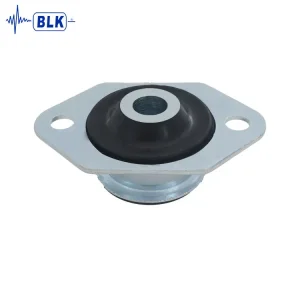
Engineered for mobile marine propulsion and standby power generators at Port of Barcelona maritime facilities.

Compact footprint elastomeric isolators designed for robotic assembly arms, small pumps, and industrial electronic cabinets.

Enhanced compression-shear elastomeric isolators supporting manufacturing machinery with significant lateral shifting.

Dacromet-coated helical steel springs combined with internal polymer snubbers for heavy central HVAC chillers and cooling towers.

Heavy structural load cluster designed for electrical power transformers, primary sub-stations, and heavy industrial stamping.

Rigid concrete-fill structural steel inertia frames that lower equipment center of gravity, preventing pipe flexure and joint fatigue.

Universal anti-slip vibration pad for machine shop lathes, drilling equipment, and general commercial condensing units.
Real engineering answers regarding acoustic compliance, material behavior, sizing methodologies, and international shipping protocols.