
Primary Vibration Mitigation Hardware for Toronto Infrastructure
Engineered for high structural acoustic performance, vibration decoupling, and prolonged service life under Canadian temperature cycles.



Engineering Context: Structural Dynamics & Damping Pad Demand Across the GTA
The Greater Toronto Area (GTA)—comprising the City of Toronto and the regional municipalities of Peel, York, Halton, and Durham—represents Canada's densest concentration of commercial high-rises, institutional healthcare facilities, and manufacturing infrastructure. The aggressive expansion of mixed-use condominium towers in the Financial District, South Core, and Midtown has compressed mechanical plant spaces into rooftop penthouses and intermediate mechanical floors. Consequently, mechanical equipment—including massive centrifugal chillers, induced-draft cooling towers, high-volume air handlers (AHUs), and multi-stage hydronic pumps—operates directly above high-rent residential suites and commercial office floors.
Without high-performance viscoelastic isolation systems, structural-borne vibration travels unimpeded through concrete shear walls and steel columns, transforming into audible low-frequency interior hums (rumble between 16 Hz and 125 Hz). In parallel, the rapid expansion of light-rail transit (Metrolinx Eglinton Crosstown, Ontario Line) and TTC heavy rail networks creates persistent ground-borne vibration issues for adjacent residential developments. Specialized polymer vibration damping pads function as critical mechanical decoupling matrices, arresting energy transfer through high internal material loss factor (η), controlled dynamic stiffness ($K_d$), and minimal compression creep under sustained load.
Local Building Codes & Acoustic Compliance Mandates
Mechanical procurement in Ontario must navigate strict acoustic and vibration standards. The Ontario Building Code (OBC) Supplementary Standard SB-3 and Chapter 5 dictate maximum permissible interior sound transfer levels between demising partitions. Furthermore, the City of Toronto’s Municipal Code Chapter 591 (Noise By-Law) establishes rigorous decibel and continuous noise threshold limits for continuous HVAC installations measured at residential property boundaries.
Consulting acoustical engineers across Ontario frequently specify compliance with ASHRAE Handbook (HVAC Applications, Chapter 48: Noise and Vibration Control). Selecting an inappropriate elastomeric pad that succumbs to compression set or possesses too high a dynamic-to-static stiffness ratio can trigger mechanical resonance, violating acoustic warranties and exposing building operators to tenant dispute litigation and costly structural retrofits.
Viscoelastic Polymer Formulations vs Conventional Elastomers
Standard commercial rubber pads frequently utilize reclaimed styrene-butadiene rubber (SBR) or low-grade natural rubber compounds. While cost-effective initially, these polymers rapidly degrade when exposed to southern Ontario's extreme annual thermal swings (ranging from -30°C in January to +35°C in July with high solar irradiance on dark tar roofs). Low-grade compounds experience polymer chain cross-linking stiffening, elevating the pad’s natural frequency ($f_n$) into the equipment operating frequency zone, effectively destroying isolation.
Bellking's BK-PM series polymer damping pads leverage a bespoke thermoset microcellular polyurethane elastomer engineered with integrated synthetic plasticizers. This yields an exceptionally wide glass transition temperature ($T_g$) envelope, ensuring the material retains its viscous damping characteristics down to -35°C without crystalline hardening, while resisting plastic flow up to +90°C.
| Physical / Dynamic Property | Bellking BK-PM Polymer Matrix | Standard Neoprene (Polychloroprene) | Commercial Nitrile (NBR) | Economy SBR / Reclaimed Rubber |
|---|---|---|---|---|
| Damping Loss Factor (η) at 20°C | 0.18 – 0.28 (Ultra High) | 0.08 – 0.12 | 0.06 – 0.10 | 0.03 – 0.05 (Poor) |
| Dynamic to Static Ratio ($K_d / K_s$) | 1.15 – 1.30 | 1.40 – 1.70 | 1.50 – 1.90 | 2.00 – 2.50 (High Stiffening) |
| Operating Temp Range (Toronto Climate) | -35°C to +85°C | -25°C to +80°C | -20°C to +90°C | -10°C to +60°C (Cracks under freeze) |
| Compression Set (ASTM D395B, 22h @ 70°C) | < 3.5% | 8% – 14% | 10% – 16% | > 25% (Permanent sag) |
| De-icing Salt & Chemical Resistance | Impervious (ASTM D471) | Moderate | Excellent (Fuel/Oil) | Rapid Degradation |
| Structure-Borne Noise Reduction | 18 – 28 dB(A) | 10 – 16 dB(A) | 8 – 14 dB(A) | 3 – 7 dB(A) |
Pricing Breakdown, Import Tariffs, and Total Cost of Ownership (TCO)
Procurement teams and mechanical contractors operating in the Greater Toronto Area frequently experience inflated wholesale pricing when purchasing elastomeric pads and spring mounts through regional tier-1 distributors. Local distribution entities mark up imported materials by 150% to 300% to offset warehouse footprint costs across Mississauga and Concord, catalog marketing overheads, and multi-tiered agent commissions.
By establishing a factory-direct supply line with Bellking, Canadian project developers, general contractors, and MEP specialists acquire industrial-grade vibration isolators at original manufacturing cost points, while maintaining full compliance with CSA standards and mechanical project specifications.
Standard Sheet & Waffle Pad Pricing
Standard 18" × 18" × 3/4" (450mm × 450mm × 20mm) elastomeric waffle pads retail through Ontario supply branches at $65.00 – $115.00 CAD per unit. Bellking direct factory manufacturing lands identical or superior polymer pads at $18.50 – $32.00 USD ($25 – $43 CAD) F.O.B., even after ocean container freight and Canada Border Services Agency (CBSA) customs clearance.
Custom Waterjet & Steel-Interleaved Pads
Multi-layer elastomeric pads with vulcanized internal 11-gauge steel shims for heavy chillers (loads exceeding 500 PSI) cost upwards of $180 – $340 CAD locally. Bellking offers 1:1 CNC-cut steel-composite isolation plates designed per structural drawings at $45.00 – $85.00 USD with verified load-deflection test certificates.
GTA Intermodal Logistics Efficiency
Containerized freight departs Shanghai or Ningbo ports directly to the Port of Vancouver or Prince Rupert, transferring via CN / CP Rail directly to the Brampton Intermodal Terminal. Typical transit cycles span 18 to 24 calendar days. For emergency construction deadlines, air express via Pearson International Airport (YYZ) delivers custom-molded pads within 5-7 business days.
The Kunshan Engineering Center: Scale, Precision, and R&D Capabilities
Headquartered in Kunshan, Jiangsu—one of the world's most sophisticated precision manufacturing belts—Bellking Vibration Reduction Equipment Manufacturing Co., Ltd. operates an advanced 2,000 square meter production facility equipped with high-tonnage vacuum hydraulic vulcanization presses, automated polymer mixing mills, and multi-axis CNC machining stations.
Unlike trading intermediaries, Bellking oversees the entire synthesis and vulcanization lifecycle. Our in-house chemical engineering staff formulates exact elastomer batches to achieve custom dynamic stiffness, Shore A durometer hardness (ranging from 35 to 80), and flame-retardant characteristics conforming to UL 94 V-0 and ASTM E84 Class A fire ratings required for building service mechanical shafts across Canada.
Every production run is validated through our internal metrology laboratory utilizing dynamic servo-hydraulic test frames capable of subjecting dampening materials to multi-frequency sinusoidal excitation (0.5 Hz to 200 Hz). This empirical testing guarantees that the static deflection curves, natural frequency values, and transmissibility data provided on project submittals reflect true mechanical performance on site in Ontario.
Localized Engineering Case Studies Across Southern Ontario
Dynamic vibration control requires precision matching between machine disturbing frequencies ($f_d$) and isolator natural frequencies ($f_n$). Below are four distinct application profiles illustrating how Bellking polymer damping pads and composite isolators solve challenging noise and structural dynamics across Greater Toronto.
1. Downtown Toronto Condominium Rooftops
Challenge: Twin 650-ton centrifugal chillers installed on a 52-story residential tower at Yonge & Bloor generated persistent 29 Hz secondary structure-borne droning into sub-penthouse master bedrooms.
Solution: Installed Bellking BK-PM high-loss viscoelastic pads under inertia base steel channels. Replaced rigid conduit and piping connections with flexible elastomeric connectors. Structure-borne sound pressure levels dropped by 22 dB(A), restoring acoustic compliance under Toronto Municipal Code Chapter 591.
2. Peel Region (Brampton) Automotive Stamping
Challenge: Heavy mechanical stamping presses operating at 90 strokes per minute in an automotive tier-1 supplier facility in Brampton were transmitting impact shock waves through the foundation slab, disrupting nearby coordinate measuring machines (CMM).
Solution: Implemented a tiered foundation pit isolation barrier using high-load BKDD mounts combined with custom 50mm perimeter BK-PM polymer isolation barriers. Peak floor velocity at the metrology station was reduced by 84%.
3. Transit Acoustic Decoupling (Metrolinx Corridors)
Challenge: A new multi-family mid-rise development located within 30 meters of a surface rail corridor experienced low-frequency ground-borne vibration transmission during train passes.
Solution: Specified Bellking continuous structural bearing elastomeric pads beneath footing dowels and perimeter foundation walls, creating a full structural elastomeric break that mitigated ground vibration below human perception thresholds (ISO 2631-2).
Emerging Industry Trends: Green Elastomers & Smart Structural Health Monitoring
The commercial HVAC and structural engineering landscape across Canada is undergoing fundamental shifts driven by building decarbonization, life-cycle material transparency, and digital twin facility management. The Toronto Green Standard (TGS) Version 4 places stringent requirements on embodied carbon, chemical off-gassing, and material circularity for all new planning applications.
In response, Bellking's R&D department has introduced bio-based polyols and halogen-free fire retardants into our polymer synthesis process, eliminating toxic volatile organic compounds (VOCs) and halogen off-gassing. Furthermore, Bellking is pioneering the integration of passive RFID strain-sensing chips into elastomeric damping matrices. This allows building engineers to scan pad bearing points during routine maintenance using handheld RF readers to instantaneously determine cumulative compressive strain, remaining fatigue life, and dynamic load redistribution across mechanical plant skids without taking equipment offline.
Frequently Asked Questions: Toronto Engineering & Procurement
Expert answers covering dynamic stiffness selection, Canadian building codes, shipping logistics, and cold-weather durability.
How do polymer vibration damping pads differ from standard rubber waffle pads?
In contrast, Bellking BK-PM engineered polymer damping pads utilize a formulated viscoelastic microcellular matrix that delivers a high damping loss factor ($\eta \ge 0.20$), stable dynamic stiffness across temperatures down to -35°C, and exceptional resistance to permanent compression set (less than 3.5% under ASTM D395B testing).
What parameters are required to calculate the correct pad sizing and durometer for Toronto mechanical projects?
- Total operating equipment weight (including water operating weights for chillers and piping).
- Equipment center-of-gravity (COG) coordinate locations and footprint support geometry.
- Lowest equipment rotational speed (RPM) or disturbing frequency ($f_d$).
- Site ambient environmental conditions (indoor mechanical penthouse, outdoor rooftop, exposure to chemicals or extreme winter cold).
- Required structural isolation efficiency target (typically 90% to 98% per ASHRAE acoustic criteria).
How does the Ontario Building Code (OBC) regulate structure-borne equipment vibration?
The City of Toronto Noise By-Law (Municipal Code Chapter 591) establishes maximum continuous dBA levels in residential zones. If rooftop chillers or ventilation equipment cause structural resonance that drives indoor sound levels above ambient limits, property owners face non-compliance penalties. Sizing Bellking viscoelastic pads to achieve a minimum frequency ratio ($f_d / f_n \ge 3.0$) effectively prevents structural flanking noise.
Can Bellking provide factory submittals, PE engineering stamps, and test reports for Canadian consultants?
Where project specifications dictate local Ontario Professional Engineer (P.Eng.) review for seismic restraints or wind load restraints, Bellking collaborates with certified structural partners to deliver complete, stamped engineering submittal packages acceptable to Toronto municipal plan examiners.
What are the typical lead times and logistics routes from Kunshan to job sites across the GTA?
For standard sea freight, containerized shipments route via West Coast ports (Vancouver or Prince Rupert) and transfer directly to the Brampton Intermodal Terminal via CN Rail, delivering to GTA job sites in 18 to 24 calendar days. For expedited mechanical emergency retrofits, air freight shipments through Toronto Pearson International (YYZ) deliver within 5 to 7 business days door-to-door.
How do polymer damping pads survive Toronto's severe winter freeze-thaw cycles?
Bellking’s proprietary polyurethane-viscoelastic formulation features non-crystallizing polymer backbone chemistry with a brittle point below -45°C. This allows our damping pads to retain dynamic resilience and material loss factor during freezing January conditions without micro-cracking, crumbling, or permanent hardening.
Comprehensive Vibration Control Portfolio for Canadian Projects
From ceiling suspension spring hangers to heavy industrial cone mounts, Bellking supplies certified vibration hardware for every mechanical interface.
-
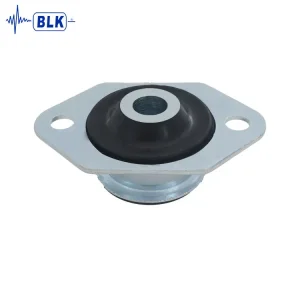
High-Quality BKCN Type Cone Mounts Factory, Manufacturers
-
High-Quality MB Type Anti-vibration Spring Mounts Factory, Manufacturer

-
Low Price HR Type Rubber Hangers Factory, Factories

-
High-Quality BKVE Type Rubber Mounts Factory, Factories

-
Low Price BK-DS Type Damped Spring Mounts Factory, Manufacturers

-
High-Quality MA Type Anti-vibration Spring Mounts Factory, Factories

-
Custom BKSW Type Rubber Buffer Factory, Manufacturers

-
Low Price BKVV Type Rubber Mounts Factories, Manufacturers

Connect Directly with Bellking's Applications Engineering Team
Eliminate high distributor markups on your next Greater Toronto Area project. Submit your equipment operating weights, RPM schedules, and acoustic specifications to receive an engineered vibration isolation schedule, CAD submittal files, and factory-direct pricing within 24 hours.