
Los Angeles High-Deflection Suspended Hanger Series
Precision-calibrated spring, elastomer, and hybrid hanging assemblies designed to decouple structural acoustic flanking paths and mitigate high-displacement seismic harmonic forces.

Los Angeles Grade Custom Anti-Vibration Spring Hangers
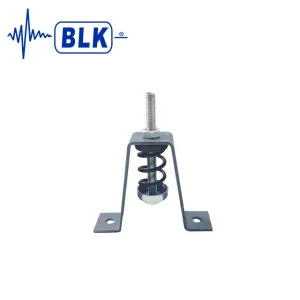
High-Performance HV Type Spring Hangers for Riser Systems
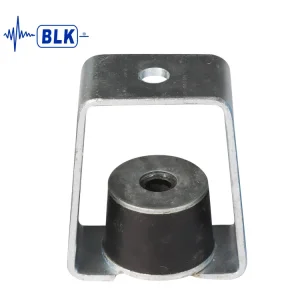
HR Type Elastomer Sound & Vibration Ceiling Hangers
Medical & Cleanroom Anti-Vibration Spring Hanger Units
Vibration Isolation in the Los Angeles Industrial & Built Fabric
Los Angeles County represents one of the most mechanically and acoustically rigorous environments on the globe, blending hyper-active seismic design criteria with uncompromising architectural acoustic demands.
The Greater Los Angeles metropolitan area—spanning Downtown LA, Century City, Silicon Beach, Burbank, and Long Beach—presents mechanical contractors and structural engineers with extreme engineering constraints. Positioned directly within the Pacific Rim’s Ring of Fire and traversed by major fault lines (including the San Andreas, Newport-Inglewood, and Elysian Park thrust faults), every overhead MEP (Mechanical, Electrical, and Plumbing) utility must comply with rigorous dynamic restraint mandates.
Under the current California Building Code (CBC Title 24, Part 2), integrated with ASCE 7-22 Chapter 13, suspended piping, air handling units (AHUs), variable refrigerant flow (VRF) lines, and variable air volume (VAV) boxes cannot simply be hung from generic all-thread rods. Overhead dynamic equipment requires dual-stage vibration isolation hangers capable of delivering both static deflection for low-frequency acoustic decoupling and multi-directional kinetic restraint against lateral spectral accelerations ($S_{DS}$ values routinely exceeding 1.5g in LA County).
Simultaneously, the region functions as the global capital of entertainment production and advanced aerospace manufacturing. In studios across Hollywood, Burbank, and Culver City, the background noise criteria for Dolby Atmos, virtual production XR stages, and ADR rooms demand Noise Criteria as stringent as NC-15 to NC-20. Suspended ductwork and hydronic lines carrying fluid velocities above 6 feet per second induce structure-borne rumble that easily penetrates lightweight California dry-construction ceiling diaphragms without calibrated vibration isolation hangers.
In aerospace clusters throughout El Segundo, Hawthorne, and Long Beach, dynamic vibration isolation hangers are indispensable for stabilizing fluid test loops, high-vacuum cryo-pumps, and overhead cleanroom HEPA fan filter units (FFUs), where even micro-inch mechanical amplitudes can skew precision laser interferometry and composite curing tolerances.
Acoustic Attenuation Physics & Dynamic Transmissibility Equations
Mechanical engineers evaluating vibration isolation hangers must look past arbitrary static load ratings and analyze natural frequency ratios, dynamic stiffness, and high-frequency sound transmission pathways.
Frequency Ratio Optimization ($f_d / f_n$)
True isolation only occurs when the disturbing frequency of the suspended equipment ($f_d$) exceeds $\sqrt{2} \times f_n$ (the natural frequency of the hanger). Bellking spring hangers provide calibrated static deflections from 25mm to 50mm, driving system natural frequencies down to 2.2–3.5 Hz. For a standard 1,750 RPM chiller pump ($f_d \approx 29.2\text{ Hz}$), this yields a frequency ratio exceeding 8.3, placing the installation well inside the 98%+ isolation zone.
Acoustic Bridging & High-Frequency Surging
Steel helical springs, while exceptional at isolating low frequencies, are susceptible to high-frequency wave surging. Acoustic energy travels along the spring coils like a solid acoustic conduit, transmitting motor hum (120 Hz to 2 kHz) directly to the floor slab. Bellking’s hybrid hanger design integrates a precision-molded neoprene/elastomer cup in series with the spring, severing audible bridging and satisfying Title 24 acoustic mandates.
California Dynamic Restraint Compatibility
Unlike standard generic non-seismic hangers, Bellking’s seismic-capable suspensions are built with oversized steel housings capable of accommodating up to a 30-degree swing swing angle without housing contact. This prevents premature shear failures during seismic dynamic cycles and seamlessly pairs with rigid strut or pre-stretched aircraft cable sway bracing kits required under SMACNA seismic guidelines.
Acoustician’s Rule of Thumb: Transmissibility is governed by $T = \left| \frac{1}{1 - (f_d / f_n)^2} \right|$. When operating near resonance ($f_d / f_n \approx 1$), structural amplification occurs, magnifying kinetic forces by up to 500%. In Los Angeles commercial developments with open-plenum concrete ceilings, specifying improper 10mm deflection hangers frequently generates severe 15–20 Hz airborne low-frequency drone that results in costly tenant acoustic litigation.
Southern California HVAC Electrification & Acoustic Modernization
How regulatory shifts toward building decarbonization and rooftop hydronics are reshaping vibration isolation hanger specifications across the LA Basin.
Driven by the aggressive decarbonization roadmaps established by the California Energy Commission (CEC) and the City of Los Angeles Green New Deal (pLAn 2019), commercial building designers are systematically phasing out centralized gas boilers and replacing them with electric air-source heat pumps (ASHPs) and modular chiller arrays. In urban infill zones such as Koreatown, West Hollywood, and Downtown LA, these massive mechanical units are frequently relocated from sub-grade basements to structural rooftops or suspended mechanical mezzanines directly above occupied luxury condominiums or corporate suites.
This spatial realignment concentrates enormous oscillating kinetic masses onto dynamic, lightweight structural steel or post-tensioned slab decks. Any vibration transmitted into the building envelope radiates as low-frequency airborne sound. Mechanical piping connected to these upper-level systems expands and contracts under severe thermal differentials, while generating dynamic hydraulic surges during peak compressor staging. In response, modern engineering specifications require pre-compressed, seismically rated spring hangers equipped with vertical scale indicators to permit immediate visual inspection of static load deflection during commissioning.
Furthermore, the rapid expansion of life-science incubators and multi-tenant lab spaces in the San Gabriel Valley and Thousand Oaks corridor has accelerated demand for clean-room compatible vibration suspension. Standard zinc electroplated coatings deteriorate rapidly when exposed to routine chemical sterilization or marine mist drawn in by rooftop make-up air units (MAUs). As a result, Tier-1 MEP engineering firms in Southern California now mandate non-corrosive Dacromet or multi-stage thermoset polymer powder coatings capable of exceeding 900 hours of ASTM B117 salt spray exposure without cosmetic or structural degradation.
Bellking’s Kunshan manufacturing complex directly addresses this market shift through fully automated robotic electrostatic powder lines and automated load-deflection verification protocols, guaranteeing that each hanger arriving at the Port of Los Angeles is pre-calibrated to project deflection tolerances.
China Industry 4.0: Bellking’s Advanced Manufacturing Engine
By combining intelligent automated fabrication with end-to-end supply chain integration in Kunshan, Bellking delivers high-tier vibration isolation hardware at scalable factory-direct velocity.
Robotic CNC Spring Coiling & Shot Peening
Our Kunshan manufacturing floor utilizes multi-axis CNC cold-coiling machines handling high-silicon chrome spring steel wire (60Si2MnA). Post-coiling shot peening introduces compressive residual surface stress, elevating fatigue endurance beyond 2,000,000 continuous compression cycles under full dynamic load without micro-fracturing or height loss.
Automated Robotic Welding & Housing Form
Hanger housings are cold-stamped from heavy-gauge structural steel sheet and joined via multi-axis robotic MAG welding stations. Every weld seam undergoes 100% automated vision inspection to eliminate slag inclusions and porosity, guaranteeing ultimate tensile capacity ratings of 300% to 500% over nominal design loads.
Integrated Dynamic Load & Spectrum Testing
Bellking maintains an in-house R&D laboratory housing 50 kN servo-hydraulic high-speed fatigue testing rigs, dynamic transmissibility analyzer benches, and 900-hour salt spray chambers. Every batch produced is mapped to batch mill test certificates (MTCs), ensuring rigorous quality traceability for international compliance audits.
In contrast to fragmented tier-three workshops that outsource spring winding or rubber molding to disparate sub-vendors, Bellking’s self-contained production ecosystem controls rubber compounding, vulcanization, metal stamping, spring tempering, and surface finishing under a single unified ISO 9001:2015 quality management protocol. This vertical consolidation enables rapid-turnaround custom engineering: when a Los Angeles engineering firm requests non-standard hanger brackets or custom load ratings for high-tonnage exhaust systems, Bellking provides detailed CAD shop drawings and FEA stress modeling within 24 hours, followed by prototype fabrication in as few as 3 working days.
Los Angeles Project Scenarios & Mechanical Case Blueprints
From Hollywood soundstage acoustic decoupling to high-rise condenser water risers, see how Bellking’s vibration isolation solutions solve severe structural challenges.
Hollywood & Burbank Soundstage Acoustic HVAC Decoupling
The Challenge: A major streaming production facility in Burbank required an expansive overhead ductwork installation suspended directly beneath open-web steel joists. Structural transmission of air-turbulence rumble from large supply fans was threatening to breach the client’s mandatory NC-20 studio acoustic ceiling threshold.
The Solution: Bellking delivered custom-engineered hybrid HV and HR Type Isolation Hangers utilizing high-damping elastomer cups paired with low-rate 35mm deflection steel springs. The dual-element assembly eliminated high-frequency mechanical motor whistle while decoupling low-frequency aerodynamic thumping, lowering measured acoustic sound pressure levels in the soundstage by 18 dB(A).
Downtown LA (DTLA) 42-Story High-Rise Riser Hydronic Isolation
The Challenge: A premier mixed-use tower in DTLA experienced structural hum propagating through luxury residential floors adjacent to the main vertical chilled and condenser water risers (12-inch diameter schedule 40 piping operating at varying thermal loops).
The Solution: Bellking’s engineering team performed structural thermal-growth and kinetic calculations, supplying pre-compressed, heavy-duty HV Spring Hangers featuring integrated lateral limiters and Dacromet corrosion protection. The hangers absorbed more than 38mm of vertical thermal pipe displacement while maintaining steady load distribution, completely halting structure-borne vibration transfer to adjacent partition walls.
Vibration Isolation Suspension Matrix for Mechanical Engineers
Compare mechanical characteristics across our suspended hanger product families to identify the optimal configuration for your MEP specifications.
| Hanger Series | Isolation Media | Static Deflection | Natural Frequency | Primary Los Angeles Application | Seismic & Compliance |
|---|---|---|---|---|---|
| HV Type Series | Oil-Tempered Spring + Elastomer | 25mm – 50mm (1.0" – 2.0") | 2.2 Hz – 3.2 Hz | Chilled water risers, primary AHUs, cooling tower suspended headers | CBC Title 24 / Seismic Ready |
| HR Type Series | High-Damping Neoprene Pad | 6mm – 12mm (0.25" – 0.5") | 6.0 Hz – 9.0 Hz | Acoustic drop ceilings, studio drywall framing, high-RPM fan coils | ASTM E90 Acoustic Rated |
| Custom Spring Type | Parametric Helical Spring | Up to 75mm (3.0") | Down to 1.8 Hz | Critical low-speed reciprocating equipment, hospital surgical suite HVAC | HCAI / OSHPD Compatible |
| BK-R Series Air Mounts | Reinforced Elastomeric Air Bag | Variable Pneumatic | 1.5 Hz – 2.0 Hz | Aerospace vibration calibration, metrology labs, CMM suspended platforms | Ultra-Precision Grade |
| BKSW Buffer Elements | Engineered Solid Rubber | Impact Compression | Dynamic Snubbing | Seismic sway bracing stops, crane rail end-stops, seismic snubber limits | 3-5G Shock Rated |
Complete Dynamic Vibration Control Suite for Industrial Infrastructure
Complement your suspended vibration hanger installations with factory-direct inertia bases, elastomeric pads, cone mounts, and pneumatic isolation platforms.

CPB Type Concrete Inertia Bases & Pump Supports
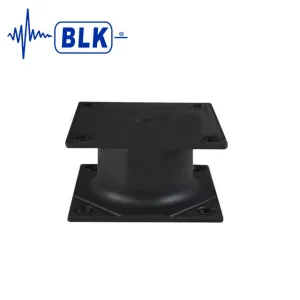
BKSW Type High-Energy Rubber Buffers & Snubbers
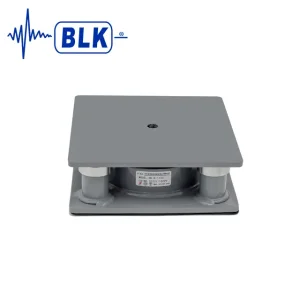
BK-R Type Industrial Pneumatic Air Mounts

BKDJ Type Heavy-Duty Ribbed Rubber Damping Pads
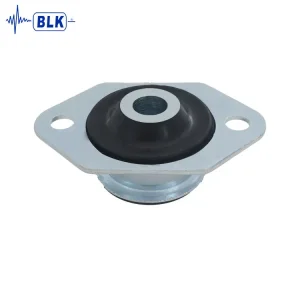
BKCN Type Heavy Industrial Elastomeric Cone Mounts

BKP Type Precision Industrial Rubber Compression Mounts

BK-RT Type Granular-Damped Vibration Isolation Platforms
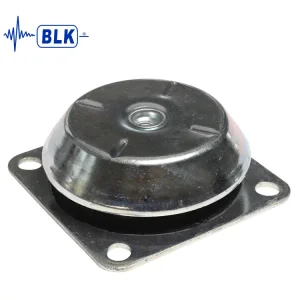
BKHQ Heavy Equipment Rubber-to-Steel Vibration Mounts
Frequently Asked Questions: Vibration Isolation Hangers in Los Angeles
Detailed answers to complex compliance, structural acoustic, and international procurement questions posed by California engineering contractors.
What are the key seismic compliance criteria for suspended vibration hangers under California Building Code (CBC)?
Why is spring static deflection (1-inch vs. 2-inch) so critical for Los Angeles lightweight floor slabs?
How does Bellking prevent acoustic bridging through suspended steel springs in studio applications?
What surface treatment ensures survival in coastal areas like Long Beach, Santa Monica, and San Pedro?
How does Bellking’s direct Kunshan factory support rapid lead times for Southern California jobsites?
Request a Customized Vibration Isolation Engineering Plan
Send our senior mechanical and acoustic applications team your project schedule, equipment operating weights, RPMs, and seismic design criteria. We return a fully sized hanger schedule and deflection calculation sheet within 24 hours.