
Engineered Industrial Isolation Platforms & Mounts
Verified static-to-dynamic load ratings, anti-fatigue metallurgy, and field-tested vibration attenuation exceeding 98% efficiency across low to ultra-high excitation frequencies.
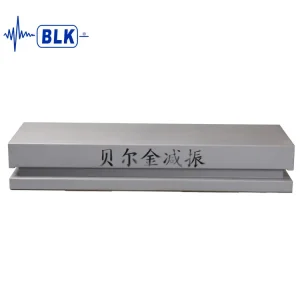
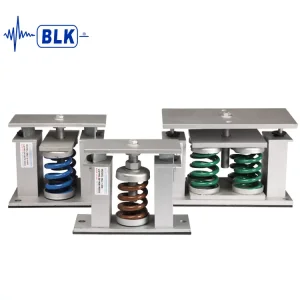

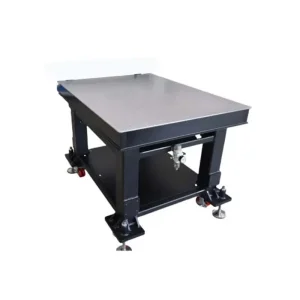
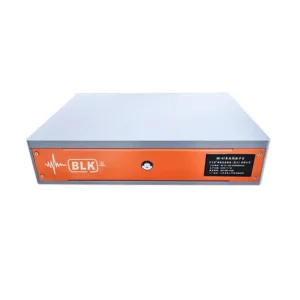
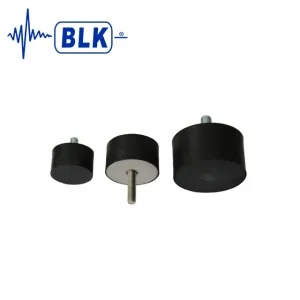
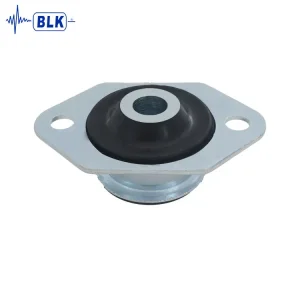
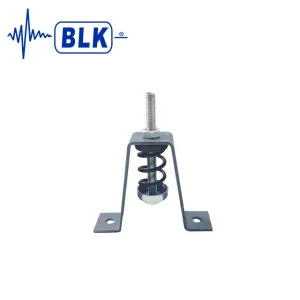
Industrial Damping Mount Industry Trends & Dynamic Frontiers
The migration from uncalibrated commercial rubber pads toward mathematically modeled, multi-degree-of-freedom (MDOF) harmonic isolators.
Sub-Hertz Micro-Vibration Isolation
Modern lithography, atomic force microscopy (AFM), and 3nm wafer metrology cannot tolerate structural floor tremors greater than 0.5 μm/s RMS. Industry focus has shifted drastically toward zero-resonance pneumatic chambers incorporating integrated viscous negative-stiffness mechanisms capable of natural resonance thresholds down to 1.2 Hz - 1.7 Hz.
Predictive Condition Monitoring & IoT
Passive elastomeric fatigue and spring creep are no longer monitored via visual plant inspection. Smart damping mounts now integrate tri-axial piezoelectric MEMS sensors, communicating continuous transmissibility curves, static sag degradation, and peak shock excursions over wireless LoRaWAN directly to SCADA systems.
Harmonic Structural Acoustics (NVH)
Urbanization around hyperscale data centers, mega-watt hospital chillers, and district energy substations demands stringent structural-borne decibel cuts. Next-generation mounts target low-frequency hum (50 Hz/60 Hz and 100 Hz/120 Hz electrical magnetostriction) using composite matrix damping layers to achieve >35 dB(A) insertion loss.
Seismic & Wind Snubbing Integration
Global building codes (IBC 2024, California OSHPD, Eurocode 8) mandate that industrial mounts resist sudden catastrophic lateral and vertical accelerations. Engineers are phasing out unhoused open-coil springs in favor of all-directional seismically-rated ductile iron housings rated for up to 3.0g to 5.0g dynamic shock.
What Determines Custom Industrial Damping Mount Price?
A granular engineering breakdown of capital allocation, cost-per-unit tiers, raw material compounding, and manufacturing life-cycle economics.
Procurement specialists and EPC (Engineering, Procurement, Construction) contractors frequently encounter pricing variations ranging from $15.00 for basic molded rubber isolators up to $4,500.00+ for large multi-chamber active pneumatic platforms. Understanding the specific cost drivers ensures plant managers avoid the dual risks of underspecified catastrophic structural resonance or excessive capital over-expenditure.
1. Metallurgy & Elastic Matrix Compounding
The underlying spring alloy determines non-linear deflection rates and fatigue life:
- 60Si2Mn / 55CrSi Spring Steel: Shot-peened and oil-quenched to guarantee >3,000,000 cycles without yield sagging (+15-25% price vs standard carbon steel).
- Specialty Elastomers: Natural Rubber (NR) offers optimal low-cost viscoelastic response, whereas synthetic Fluorocarbon (FKM), Hydrogenated Nitrile (HNBR), and cross-linked EPDM provide resistance against hydraulic fluids, ozone, and operating temperatures from -40°C to +150°C (+40-80% material cost).
2. Surface Metallurgy & Anti-Corrosion
Environmental protection dictates total life-cycle maintenance cycles:
- Standard Zinc Electroplating: 72-hour salt spray resistance (ASTM B117), optimal for enclosed, climate-controlled commercial equipment rooms.
- Dacromet / Geomet Non-Electrolytic Zinc Flake: Passes rigorous 900-hour to 1,500-hour neutral salt spray without hydrogen embrittlement. Critical for offshore rigs, coastal HVAC rooftop chillers, and chemical scrubbers (+12-18% unit premium).
- 316L Stainless Steel Hardware: Used in pharmaceutical cleanrooms and semiconductor processing.
3. Precision Tooling & 1:1 Custom Geometry
Non-standard center-of-gravity offsets require tailor-made engineering:
- FEA Resonance Simulations: Pre-production simulation of 6-DOF modal dynamics eliminates unexpected rocking modes ($500-$2,000 NRE, waived on volume runs).
- Custom Mold Machining: Dedicated mold production for custom rubber durometer inserts or CNC machined cast iron housings typically amortizes over batches of 500+ units.
- Variable Spring Rate Arrays: Asymmetrical equipment weight distributions require mixed spring stiffness indices within the same platform base.
Indicative Industrial Damping Mount Factory-Direct Price Matrix
| Mount Category | Standard Load Capacity | Natural Frequency (fn) | Target Applications | MOQ Bracket | Estimated Unit Price (FOB, USD) |
|---|---|---|---|---|---|
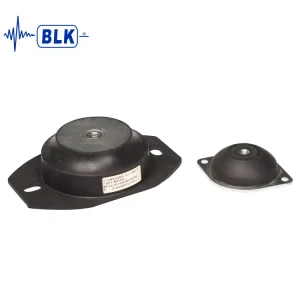
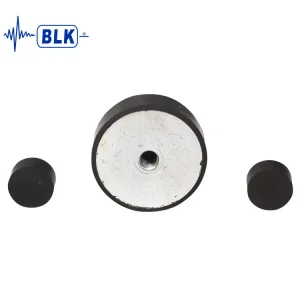
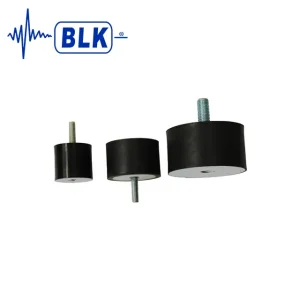
| Industrial Rubber Pad / Elastomer (BK-PM / BKVE) | 50 kg - 1,200 kg | 8.0 Hz - 15.0 Hz | Small compressors, electric motors, CNC lathes | 100 pcs | $8.50 - $35.00 |
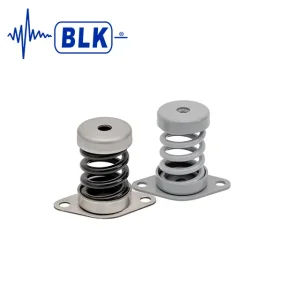
| Freestanding Open Spring Isolator (MB / ME Type) | 150 kg - 4,500 kg | 3.2 Hz - 5.0 Hz | Chillers, cooling towers, heavy exhaust fans | 20 pcs | $28.00 - $145.00 |
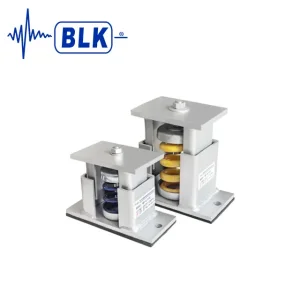
| Restrained / Seismic Spring Mount (MA / BKCN) | 250 kg - 8,000 kg | 2.8 Hz - 4.5 Hz | Critical data center gensets, rooftop chillers | 10 pcs | $65.00 - $380.00 |
| Transformer Anti-Vibration Mounts | 500 kg - 15,000 kg | 4.0 Hz - 6.5 Hz | Dry-type/oil transformers, substations | 8 pcs | $85.00 - $450.00 |
| Suspended Vibration Isolation Hangers (HV Type) | 20 kg - 800 kg | 3.5 Hz - 8.0 Hz | Piping networks, suspended fan coil units, ducting | 50 pcs | $12.50 - $68.00 |
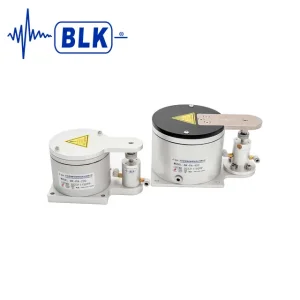
| Precision Optical / Pneumatic Mount (BK-PA / BK-DT) | 100 kg - 2,500 kg | 1.2 Hz - 2.2 Hz | Semiconductor probing, CMMs, laser interferometers | 1 set | $450.00 - $3,200.00 |
*Note: Prices vary according to custom deflection ranges (25mm, 50mm, 75mm), seismic zone categorization (ASCE 7-16 Ss parameters), alloy metallurgy, and actual procurement volumes.
China Industry 4.0: The Advanced Manufacturing Edge
How automated robotic fabrication, complete metallurgical integration, and rapid prototyping deliver engineered damping mounts with 35-50% TCO savings and sub-3-day rapid customization.
Full Value-Chain Vertical Integration
Based in the advanced manufacturing hub of Kunshan, China, the entire manufacturing cluster—from computerized spring coiling, ductile iron casting foundries, and automated elastomer vulcanization to robotic laser cutting—operates within a 30-kilometer radius. This eliminates multi-tier sub-tier markups and guarantees rapid raw-material availability.
Automated Robotic Welding & CNC Machining
Housing fabrication utilizes 6-axis robotic MIG/TIG welding cells and high-precision horizontal CNC machining centers. Weld seam penetration is verified through ultrasonic non-destructive testing (NDT), ensuring that earthquake-rated restraining brackets maintain structural integrity during critical 3g to 5g dynamic impulse surges.
3-Day Custom Prototyping vs. 8-Week Global Averages
While Western boutique manufacturers require 6 to 10 weeks to formulate non-catalog spring rates or custom mounting top-plates, our Industry 4.0 digitized workflow completes 3D parametric CAD modeling, mold simulation, CNC fixture fabrication, and physical test validation in as fast as 72 hours. Standard high-volume models ship within 24 hours.
Rigorous ISO 9001 Metrological Auditing
Quality control is backed by in-house high-tonnage servo-hydraulic dynamic test benches, cyclic axial-to-shear fatigue machines, vibration spectrum analyzers, and 900-hour Dacromet salt spray chambers. Every production lot includes full traceability certificates, material composition heat reports, and dynamic load-deflection test charts.
Engineering Calculation Guide for Damping Mount Selection
The exact mechanical physics governing spring stiffness, dynamic transmissibility, static deflection, and resonance avoidance.
Vibration isolation is governed by the relationship between the disturbing excitation frequency generated by rotating or reciprocating equipment ($f_d$) and the undamped natural frequency of the selected damping system ($f_n$). Isolation begins strictly when the frequency ratio exceeds √2 (≈ 1.414). Sizing an isolator where $f_d / f_n \approx 1$ leads to catastrophic mechanical resonance, accelerating machinery wear and causing severe structural fatigue.
1. System Undamped Natural Frequency ($f_n$) as a function of static deflection ($\delta_{st}$ in mm):
Where $g$ = 9,810 mm/s², and $\delta_{st}$ is the vertical spring deflection under static machine deadweight.
2. Frequency Ratio ($r$) and Transmissibility ($T_r$):
Where $\zeta$ is the system damping ratio (typically 0.01-0.05 for steel springs, 0.08-0.15 for synthetic elastomers, 0.25+ for viscous dashpots).
3. Vibration Isolation Efficiency (η):
Target engineering design standard for critical industrial plants requires η ≥ 90% to 98%, requiring a minimum frequency ratio $r \ge 3.0$ to $5.0$.
Low RPM Equipment (300 - 900 RPM)
Disturbing frequency $f_d$ ranges between 5.0 Hz and 15.0 Hz. Conventional rubber pads provide zero isolation and amplify resonance. Requires large-deflection steel spring mounts (25mm to 50mm static deflection) achieving $f_n$ around 2.2 Hz - 3.2 Hz.
Medium RPM Equipment (1,200 - 1,800 RPM)
Disturbing frequency $f_d$ sits between 20 Hz and 30 Hz (standard 4-pole electric motors, centrifugal water pumps, screw chillers). Enclosed spring mounts (MA Type) with 20mm deflection yield $f_n \approx 3.5\text{ Hz}$, delivering over 96% isolation efficiency.
High RPM & Acoustic Hum (>3,000 RPM / 50-100 Hz)
High-speed centrifugal compressors, turbines, and electrical transformers. While spring coils transmit high-frequency structure-borne audio, composite matrix elastomeric mounts (BK-MT, BK-PM) eliminate acoustic bridge flutter and structure-borne humming.
Localized Industrial Solutions: Field-Proven Applications
Real-world implementations across semiconductor fabs, commercial HVAC networks, high-voltage transformers, and heavy forging lines.
Cleanroom Wafer Metrology
Challenge: Micro-vibrations from nearby cleanroom recirculating fans caused image blurring on sub-micron semiconductor wafer probers.
Solution: Installed Bellking BK-PA Precision Air Mounts paired with optical breadboards. Yielded a 1.7 Hz resonance point, lowering floor vibration from VC-B curve to VC-E threshold, completely recovering wafer yields.
Emergency Gensets & Chillers
Challenge: 2.5 MW diesel backup generators located on a building roof transmitted excessive low-frequency shear vibration into structural slabs during grid-failure testing.
Solution: Implemented seismic-restrained MA series spring isolators coupled with custom poured-concrete inertia bases. Attenuated 98.4% of vibratory energy and satisfied seismic shear requirements without snubber binding.
High-Voltage Dry Transformer
Challenge: 100 Hz magnetostrictive core hum from a 35 kV transformer penetrated through steel framing into surrounding commercial office quarters.
Solution: Deployed dedicated Bellking high-temperature transformer damping pads with integrated elastomeric stops, reducing ambient sound levels in adjacent suites by 19 dB(A).
400-Ton High-Speed Stamping Press
Challenge: Massive transient cyclic shock pulses (up to 4.5g dynamic acceleration) induced cracking in concrete foundation floor slabs.
Solution: Custom-designed BK-MT Matrix shock isolators incorporating viscous fluid dampers. Dissipated impact kinetic energy within 1.5 cycles, tripling foundation lifetime.
Frequently Asked Technical Questions
Direct, comprehensive answers from factory acoustic engineers regarding dynamic load parameters, lifespan, selection pitfalls, and custom tooling.
How do I select between pure elastomer (rubber) mounts and steel spring isolators?
What specific operating parameters are required to calculate a custom 1:1 vibration isolation plan?
What prevents structural spring mounts from corroding in outdoor or marine environments?
What is the operational lifespan of industrial damping mounts under continuous duty?
Why is an inertia base recommended alongside spring mounts for pump and piping networks?
Can Bellking engineer drop-in replacements for obsolete or international brand mounts?
Custom Damped Mounts & Precision Air Isolators
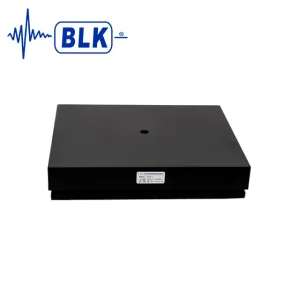
Complete original inventory series for high-shock machinery, sub-frame decoupling, and compact equipment dampening.

Need Direct Technical Sizing or a Bulk Quotation?
Send your equipment load data, center of gravity dimensions, and operating frequencies. Our licensed acoustic applications team returns a complete vibration isolation calculation sheet and factory-direct price schedule within 24 hours.
Request Custom Isolation Calculation & Price Quote