
Standard & Custom Vibration Mount Series
Engineered anti-vibration solutions designed for power transformers, heavy industrial HVAC, and high-precision machinery.

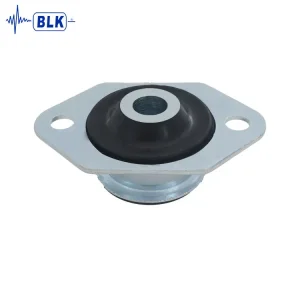
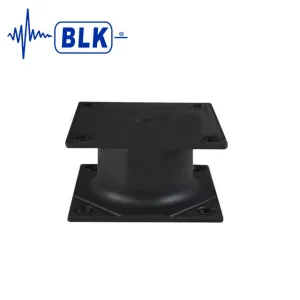


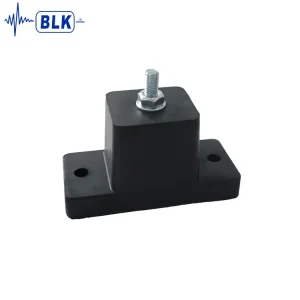


Understanding Transformer Vibration & The Engineering Necessity of Isolation Springs
Power transformers—ranging from dry-type distribution units in commercial basements to massive oil-immersed step-down transformers in high-voltage substations—generate continuous, low-frequency acoustic noise and structural vibrations. The primary root cause of this physical phenomenon is magnetostriction within the laminated silicon steel core, supplemented by electromagnetic forces within the winding coils and cooling fan dynamics.
Because magnetostriction causes the core metal to contract and expand twice per AC cycle, the fundamental excitation frequency is twice the grid operating frequency: 100 Hz in 50 Hz power networks (common across Europe, Asia, and South America) and 120 Hz in 60 Hz power networks (North America). Higher-order harmonics (200 Hz, 300 Hz, 360 Hz, 480 Hz) also propagate outward through the transformer chassis, mounting feet, and structural floor slabs.
Key Engineering Insight: Unmitigated transformer hum travels through rigid structural foundations as structure-borne noise. Without custom isolation springs calculated for precise static deflection, structural flanking noise can elevate sound pressure levels in adjacent residential, commercial, or cleanroom spaces by 15 dB(A) to 30 dB(A), violating municipal acoustic standards and causing long-term structural fatigue.
Custom transformer isolation springs solve this systemic issue by decoupling the rigid mass of the active transformer from the mounting substrate. By tuning the natural frequency ($f_n$) of the spring isolator system below 3.5 Hz to 5 Hz, the forced frequency ratio ($f/f_n$) exceeds 20:1, achieving structural isolation efficiency ratings of up to 99%.
Why Sourcing Custom Transformer Isolation Springs from China Scale Factories Offers Maximum ROI
The global shift toward high-capacity power distribution requires heavy-duty, certified vibration mounts. China's advanced manufacturing hubs lead the global market in metallurgical quality, cost containment, and rapid OEM customization.
High-Tensile Alloy Metallurgy
Chinese spring manufacturing utilizes high-grade silicon-manganese alloy steels such as 60Si2MnA, SAE 9254, and 50CrVA. These materials exhibit exceptional yield strength, high elastic limits, and superior fatigue endurance, preventing spring sag over decades of heavy transformer loading.
Automated CNC Coiling & Shot Peening
Modern Chinese factories leverage 5-axis CNC cold and hot spring coiling machinery capable of handling wire diameters up to 50mm. Integrated shot peening treatments introduce compressive residual stresses, raising the mechanical fatigue life beyond 10,000,000 continuous stress cycles.
Advanced Surface Anti-Corrosion (Dacromet)
To withstand outdoor substations and marine environments, Chinese production facilities deploy multi-layer surface protection: hot-dip galvanizing, electrostatic powder coating, and specialized Dacromet coatings proven to withstand 900+ hours of continuous salt spray testing (ISO 9227 compliant).
Unmatched Supply Chain Cost Efficiency
By co-locating steel rolling mills, rubber vulcanization plants, CNC machining shops, and acoustic testing laboratories within dense industrial clusters (such as Jiangsu and Zhejiang), Chinese factories offer 30% to 50% lower total procurement costs compared to Western counterparts without compromising technical tolerances.
Custom Transformer Isolation Springs Price Factors & Cost Breakdown
Understanding the commercial variables behind factory pricing enables EPC buyers and electrical engineers to optimize budget allocations while ensuring structural safety compliance.
When requesting quotes for custom transformer isolation springs, pricing is not based purely on weight. Engineering complexity, load capacity, dynamic response requirements, and environmental coatings dictate unit costs. Below is an engineering evaluation of key pricing drivers:
| Cost Component / Variable | Technical Specification Range | Impact on Unit Price | Engineering Justification |
|---|---|---|---|
| Static Load Rating per Mount | 50 kg to 10,000+ kg (0.5 kN to 100 kN) | High (+30% to +120%) | Larger wire diameters (e.g., >25mm) require hot coiling production lines, larger top/bottom housing plates, and reinforced base steelwork. |
| Rated Static Deflection | 25 mm (1"), 50 mm (2"), 75 mm (3") | Moderate (+20% to +50%) | Greater deflection yields lower natural frequency (higher isolation efficiency), but requires taller spring coils, anti-buckling internal guides, and increased raw material volume. |
| Damping Mechanism | Viscous Fluid Damping vs. Elastomeric Pads | Moderate (+15% to +40%) | Integrating internal viscous dampers controls transient surge resonance during transformer energization and short-circuit faults, adding hydraulic chamber complexity. |
| Seismic & Wind Restraints | Zone 1 to Zone 4 Seismic Snubbers (All-Directional) | High (+35% to +75%) | Requires heavy-duty cast steel or welded steel housing with elastomeric limits to capture vertical and horizontal shear forces without short-circuiting vibration isolation during normal operation. |
| Corrosion Resistance Class | Standard Paint vs. C4/C5 Marine Dacromet Coating | Moderate (+10% to +30%) | Specialized surface treatments pass 900+ hour salt spray testing for offshore wind platforms, coastal substations, and chemical plants. |
| Order Volume & Batch Customization | 1–20 units vs. 500+ unit OEM Runs | Significant (-25% to -50% per unit) | High-volume factory production amortizes CNC setup costs, tooling initialization, and finite element analysis (FEA) engineering fees. |
Pricing Benchmark Summary: Standard low-capacity dry-type transformer spring mounts (100–500 kg rating) typically range from $25 to $75 USD per unit from China factories. Custom, heavy-duty seismic-restrained transformer isolators rated for 5,000+ kg with integrated viscous damping range from $180 to $650+ USD per unit based on exact specifications.
Global Industry Trends & Technological Drivers for Transformer Isolation
The rapid evolution of modern power grids, urban expansion, and green technology has transformed acoustic isolation from an afterthought into a critical engineering requirement.
Urban Substation Enclosure & Undergrounding
Due to soaring urban land values and strict municipal noise ordinances (e.g., <45 dB(A) night limits in residential zones), electrical utilities are constructing substations underground or inside commercial complexes. Custom spring isolators prevent transformer vibrations from energizing entire concrete building structures.
High-Density AI Data Center Infrastructure
Modern Hyperscale AI data centers draw mega-watts of continuous power, requiring large medium-voltage transformers located adjacent to server rooms. Uncontrolled micro-vibrations from transformers can degrade sensitive solid-state drives (SSDs), optical storage, and server mounting racks, mandating ultra-low frequency spring mounts.
Renewable Energy Integration & Offshore Wind Farms
Offshore wind farm sub-stations and solar inverter stations operate under severe wave motion, wind shear, and saline exposure. Transformer spring isolators engineered for renewables must combine high dynamic damping with extreme C5-M anti-corrosion finishes to guarantee uninterrupted operation.
Localized Application Scenarios & Mathematical Selection Guide
1. Primary Application Scenarios
Transformer isolation springs are customized based on the installation environment and mechanical interface:
- Indoor Basement Vaults: Requires open-spring or housed-spring isolators with top adjusting bolts to level the transformer unit against uneven floor concrete. Often paired with high-damping polymer pads to attenuate ultra-high harmonic frequencies (>500 Hz).
- Rooftop & Upper Floor Substations: Requires heavy deflection springs (50mm deflection) fitted with multi-directional seismic limiters to restrict lateral motion during wind load or seismic acceleration.
- Industrial Manufacturing Plants: Requires heavy-duty spring mounts capable of absorbing both internal transformer hum and external transient impact shocks from nearby stamping presses or forging machinery.
2. Mathematical Selection Formula
To properly size a transformer isolation spring system, calculation of system static deflection ($x_s$) and forced excitation frequency ($f$) is required:
Natural Frequency Formula:
$$f_n = \frac{1}{2\pi} \sqrt{\frac{g}{x_s}} \approx \frac{5}{\sqrt{x_s \text{ (in cm)}}}$$
Where $g$ is gravitational acceleration ($9.81 \text{ m/s}^2$) and $x_s$ is static deflection under full transformer weight.
For a transformer operating on a 50 Hz grid, fundamental excitation is $100 \text{ Hz}$. If a spring mount with $25 \text{ mm}$ ($2.5 \text{ cm}$) static deflection is specified:
$$f_n = \frac{5}{\sqrt{2.5}} \approx 3.16 \text{ Hz}$$
The frequency ratio $r = f / f_n = 100 / 3.16 \approx 31.6$.
Transmissibility ($T$) is calculated as:
$$T = \left| \frac{1}{r^2 - 1} \right| = \left| \frac{1}{31.6^2 - 1} \right| \approx 0.001 \quad (\text{Isolation Efficiency } > 99.9\%)$$
This mathematically proves that proper spring selection virtually eliminates structural vibration transmission.
Bellking Vibration Reduction Equipment: Manufacturing & R&D Power
Founded in 2013 in Kunshan, Jiangsu, Bellking is a National High-Tech Enterprise specializing in precision vibration control systems for international markets.
37 National Patents
Backed by 16 national invention patents and a dedicated 10+ member R&D team continuously advancing low-frequency isolation materials, fatigue resilience, and active damping technologies.
100,000 Units Annual Capacity
Operating a 2,000 m² state-of-the-art facility equipped with robotic welding cells, automatic powder coating lines, CNC machining centers, and strict ISO 9001 quality assurance workflows.
3-Day Rapid OEM Customization
From initial structural CAD modeling and FEA load analysis to final prototype fabrication, custom non-standard isolators can be produced and delivered in as fast as 3 working days.
Frequently Asked Questions: Custom Transformer Isolation Springs
Direct technical and commercial answers from our senior vibration control engineers.
Why are standard rubber pads often insufficient for power transformer isolation?
How do custom spring mounts prevent dynamic surge during short-circuit transformer events?
What technical parameters are required to generate a factory quote and CAD drawing?
What is the typical service life and maintenance requirement of Bellking spring isolators?
How does China manufacturing guarantee quality control for overseas procurement?
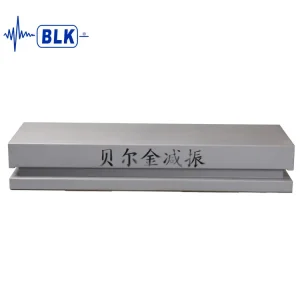
Specialized Isolation Platforms & Hangers
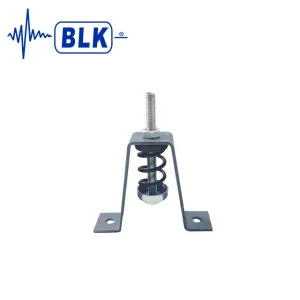
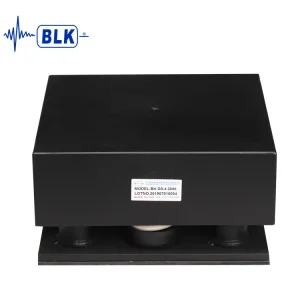
Explore our full range of industrial dampening mounts, high-deflection spring hangers, and precision optical platforms.





Request a Custom Isolation Calculation & Quotation
Send our application engineering team your transformer weight, dimensions, and operational target frequency. We will deliver a complete vibration control scheme within 24 hours.
Contact Engineering Team