
Featured Industrial Shock & Vibration Isolators (Top Tier)
Explore factory-direct anti-vibration spring mounts, pneumatic isolators, and heavy-duty rubber buffers distributed across North America with certified compliance and engineering support.




1. North American Industrial Shock Absorber & Vibration Control Market Dynamics
Analyzing macroeconomic shifts, USMCA supply chain re-shoring, infrastructure expansions, and distributor channel evolution across the United States, Canada, and Mexico.
USMCA Supply Chain Restructuring
North American manufacturing hubs in Texas, the Midwest industrial corridor, Ontario (Canada), and Monterrey (Mexico) demand nearshore component fulfillment. Distributors are shifting from standard stocking models to regional engineering application hubs capable of delivering dynamic load testing within 48 hours.
High-Frequency Vibration Challenges
Modern high-speed CNC machinery, automated warehouse sorters, and heavy-duty HVAC installations generate dual-frequency excitation. standard elastomeric isolators often fail under cyclic fatigue, necessitating hybrid spring-viscous shock absorbers with low natural frequencies down to 1.7 Hz.
Regulatory & Environmental Strain
North American building codes (ANSI/ASHRAE Standard 170, IBC Seismic Restraint Regulations) require structural anti-vibration hardware to withstand lateral shock loads up to 3–5 G acceleration. Compliance requires rigorous corrosion testing, such as 900-hour Dacromet salt spray resistance.
2. Mechanical Engineering Physics & Technical Roadmap
Understanding the mathematical mechanics of shock absorption, transmissibility damping equations, dynamic stiffness ratios, and advanced polymer metallurgy.
To select an optimal shock absorber or anti-vibration mount for industrial equipment, North American mechanical consultants and distribution engineers rely on fundamental vibration theory. The dynamic transmissibility ($T$) of a single-degree-of-freedom system governed by excitation frequency ($f$) and isolator natural frequency ($f_n$) is defined by:
Where $\zeta$ represents the damping ratio. Effective vibration isolation requires $f / f_n > \sqrt{2} \approx 1.41$. Below this threshold, amplification occurs. Bellking’s engineering target for North American industrial distributors is maintaining $f / f_n \ge 3$, yielding system isolation efficiencies exceeding 92% to 99% across variable operating speeds (RPM).
| Isolator Technology Type | Natural Frequency ($f_n$) Range | Damping Ratio ($\zeta$) | Primary Industrial Application Scenario | Corrosion & Environmental Durability |
|---|---|---|---|---|
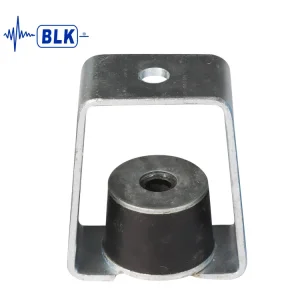
| Spring Mounts (MD Series) | 3.0 Hz – 5.0 Hz | 0.01 – 0.05 (Viscous optional) | Chillers, Large Pumps, Cooling Towers, Gensets | Hot-Dip Galvanized / Dacromet (900h) |
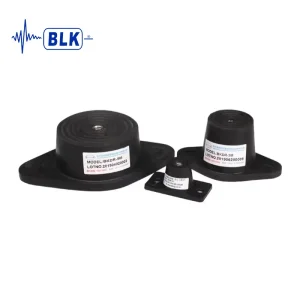
| Pneumatic Air Mounts (BK-A / BK-PF) | 1.7 Hz – 2.5 Hz | 0.06 – 0.12 (Self-leveling) | Semiconductor Probing, Optical Benches, CMMs | Anodized High-Strength Aluminum / CR |
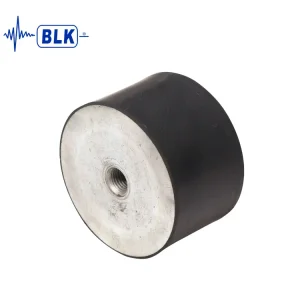
| Rubber Mounts (BKDD / BKVV / BKM) | 6.0 Hz – 12.0 Hz | 0.10 – 0.15 | Air Compressors, Motors, Small HVAC Units | High-Grade Synthetic Nitrile/NR (Oil resistant) |
| Inertia Base Supports (CPB Type) | 2.5 Hz – 4.0 Hz | 0.05 – 0.10 | End-Suction Pumps, Reciprocating Compressors | Structural Steel Frame with Concrete Infill |
| Damped Isolation Platforms (BK-RT) | 2.0 Hz – 3.5 Hz | 0.08 – 0.15 | Laboratory Metrology, Marble Stages | Powder-Coated Industrial Steel Plates |
Material Science Innovation in Modern Shock Absorbers
Standard commercial rubber degrades when exposed to industrial synthetic lubricants, ozone, and thermal variations common in North American manufacturing plants. Bellking’s proprietary elastomer compounding uses high-density Neoprene and Nitrile blends with specialized anti-aging agents, yielding a dynamic-to-static stiffness ratio ($K_d/K_s$) between 1.2 and 1.4. This prevents hard bounce transitions during startup resonance spikes.
3. Localized Application Scenarios Across North American Sectors
Examining precise engineering implementations in semiconductor cleanrooms, automotive stamping facilities, and commercial skyscraper HVAC networks.
Semiconductor Fabs (Silicon Hills, Austin & Phoenix Hubs)
Challenge: Wafer inspection tools and electron microscopes require VC-E or VC-F vibration criterion ratings. Ambient floor vibrations caused by adjacent cleanroom air handlers disrupt nanometer-scale lithography.
Solution: Implementation of BK-PF Type Precision Air Mounts featuring active pneumatic level control. With a natural frequency of 1.7 Hz, floor transmissibility above 10 Hz is cut by over 98.5%, maintaining micro-step stability.
Automotive Stamping & Heavy Presses (Detroit & Monterrey)
Challenge: High-energy kinetic impacts from 500-ton stamping presses send destructive impulse waves through factory foundations, causing cracking in nearby concrete slabs and disturbing precision CNC lathes.
Solution: Installation of heavy-duty BKSW Rubber Buffers combined with MD Type Spring Mounts with viscous dampers. The dynamic energy dissipation structure absorbs 3–5 G impact spikes, protecting surrounding capital equipment.
Rooftop HVAC & Power Plants (Pacific Northwest & Toronto)
Challenge: Large chillers and cooling towers installed on lightweight roof trusses transmit low-frequency hums throughout commercial high-rises, failing local municipal noise ordinances.
Solution: Deployment of CPB Inertia Bases backed by MD Type Anti-vibration Spring Mounts with Dacromet anti-corrosion coating. Lowering the center of gravity eliminates rocking motions and structure-borne acoustic resonance.
4. Procurement Price Analysis & Total Cost of Ownership (TCO) Model
A transparent breakdown of direct factory pricing versus landed North American stocking distributor costs, tariffs, tooling amortizations, and long-term maintenance economics.
B2B procurement managers and North American engineering distributors face complex financial choices when sourcing industrial vibration isolation hardware. Comparing upfront unit cost against total life-cycle expense reveals significant margin advantages when opting for direct factory distributor partnerships.
| Product Category | Factory Direct FOB Unit Price (USD) | NA Landed Cost (Tariff + Freight) | NA Distributor Wholesale Price | Avg. Service Life |
|---|---|---|---|---|
| Standard Rubber Mounts (BKDD / BKVV) | $4.50 – $18.00 | $6.20 – $23.50 | $35.00 – $65.00 | 5 – 8 Years |
| Industrial Spring Mounts (MD Series) | $28.00 – $140.00 | $36.00 – $175.00 | $120.00 – $380.00 | 15+ Years |
| Pneumatic Air Mounts (BK-A / BK-PF) | $120.00 – $450.00 | $150.00 – $540.00 | $450.00 – $1,200.00 | 6 – 10 Years |
| Inertia Base Steel Framing (CPB Type) | $210.00 – $850.00 | $280.00 – $1,080.00 | $750.00 – $2,600.00 | 20+ Years |
5. Technical FAQ: Frequently Asked Procurement & Engineering Questions
Detailed technical answers derived from real-world site consultations with North American distributors, HVAC contractors, and plant engineers.
Precision Engineering Product Portfolio (Bottom Tier)
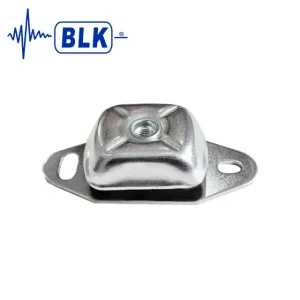
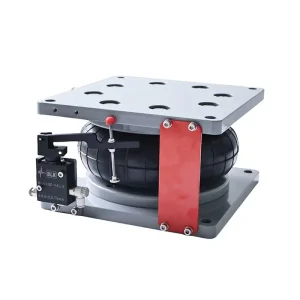
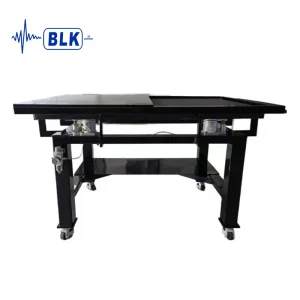
Select specialized vibration damping pads, desktop metrology platforms, and heavy inertia base supports with direct distributor pricing.





6. Future Industry Outlook & North American Partnership Engineering
Integrating Industry 4.0 IoT micro-sensors, self-tuning active electromagnetic isolation, and sustainable green manufacturing for global supply chains.
Smart IoT-Enabled Shock Mounts
Future vibration control solutions incorporate embedded MEMS accelerometers into spring and air mounts. North American plant managers can monitor real-time transmissibility shifts, dynamic load drift, and structural fatigue via cloud telemetry, moving from scheduled maintenance to predictive AI diagnostics.
Active Electromagnetic Attenuation
As semiconductor nodes shrink past 2nm, passive isolation reaches mechanical limits. Next-generation hybrid systems combine pneumatic air mounts with active Lorenz force actuators, canceling low-frequency micro-seismic noise (0.5 Hz to 5 Hz) in sub-millisecond response loops.
ISO 14001 Green Rubber Vulcanization
Meeting strict North American ESG mandates, factory production lines are adopting bio-based elastomer formulas and zero-VOC bonding agents. Recyclable steel spring housings and non-toxic zinc-nickel plating ensure full compliance with international environmental directives.
Looking to optimize your North American equipment distribution network or request custom dynamic modeling for complex machinery installations? Connect with our senior engineering team today.