
High-Demand Industrial Isolators & Precision Mounts
Engineered vibration dampening platforms, multi-layer shock absorbers, and tuned spring mounts sourced directly from ISO 9001 certified manufacturing facilities.

Custom BKSWA Type Multi-Layer Antivibration Dampers

High-Quality MA Type Anti-vibration Spring Mounts

Low Price BK-DS Type Damped Spring Mounts

High-Quality BKDD Type Rubber Mounts

Custom BK-VT Type Vibration Isolation Platform

Custom BKDR Type Rubber Mounts

High-Quality BKDJ Type Rubber Pad

High-Quality MD Type Anti-vibration Spring Mounts
Global Commercial & Industrial State of Vibration Isolation Systems
An in-depth evaluation of mechanical energy dissipation, structural dynamics, and macroeconomic sourcing factors shaping the global vibration isolation equipment market.
Mechanical vibration is an inevitable byproduct of rotational, reciprocating, and transient kinetic forces within industrial machinery. In modern manufacturing, high-rise building infrastructure, energy grids, and semiconductor fabrication facilities, unmitigated vibration leads to premature mechanical wear, structural fatigue, operational downtime, acoustic pollution, and catastrophic yield losses. Consequently, the selection and procurement of high-performance vibration isolation equipment—ranging from open-coil helical spring mounts to active pneumatic platforms—has evolved from a secondary HVAC consideration into a core structural engineering mandate.
The global vibration isolation market is undergoing rapid expansion, propelled by the convergence of stringent urban noise pollution standards (such as ISO 3744 and ASHRAE equipment guidelines), the miniaturization of semiconductor node architectures (where sub-nanometer floor motion disrupts photolithography), and the aggressive growth of heavy industrial infrastructure across emerging manufacturing hubs. Industrial plants are increasingly transitioning from passive, low-cost elastomeric pads to sophisticated multi-layer hybrid dampers, viscous-damped helical spring isolators, and active electromagnetic positioning platforms.
E-E-A-T Engineering Metric: Modern high-speed HVAC chillers, power transformers, and rotating compressors transmit up to 85% of their dynamic forces into building structures if unisolated. Properly calculated isolators operating at a frequency ratio (f_d / f_n) greater than 3.0 reduce force transmissibility to under 3%, isolating more than 97% of disturbing energy.
From an international trade perspective, global procurement directors face complex trade-offs between initial unit pricing, material longevity, compliance documentation, and long-term total cost of ownership (TCO). Standardized factory-direct manufacturing from established hubs like Kunshan, China provides global engineering teams with high-grade, Dacromet-coated spring isolators and eco-compliant elastomeric mounts that deliver structural performance matching Western OEM equivalents at 30% to 50% lower capital expenditure.
Engineering Fundamentals: Transmissibility, Natural Frequency & Damping
Understanding the mathematical frameworks required to specify optimal vibration control systems for dynamic industrial loads.
To achieve high-efficiency vibration isolation, mechanical engineers must balance three core physical parameters: system mass ($m$), dynamic stiffness ($k$), and damping ratio ($\zeta$). The fundamental natural frequency ($f_n$) of an isolation mount is governed by the classical single-degree-of-freedom (SDOF) harmonic equation:
Where δ_st represents the static deflection of the isolation spring or elastomeric element measured in centimeters. This physics-driven relationship demonstrates that lower natural frequencies require larger static deflections. For instance, achieving a natural frequency of 3.0 Hz demands a static spring deflection of approximately 27.5 mm. High-capacity chillers and large centrifugal fans operating at 1,200 RPM (20 Hz disturbing frequency) require isolators with $f_n \le 5.0\text{ Hz}$ to avoid resonance amplification and achieve isolation efficiencies exceeding 90%.
Transmissibility Dynamics (T)
Force Transmissibility ($T$) defines the fraction of dynamic force transmitted through the isolator into the supporting foundation. It is mathematically calculated as:
Where r = f_d / f_n is the frequency ratio (disturbing frequency divided by natural frequency). When $r < \sqrt{2}$, $T > 1.0$, resulting in vibration amplification—a critical failure state in engineered systems. True isolation occurs strictly when $r > \sqrt{2}$. Optimum performance is typically achieved when $r$ ranges between 3.0 and 5.0, where transmissibility drops below 0.05 (95%+ attenuation).
| Isolator Material / Mechanism | Typical Deflection (mm) | Natural Frequency (f_n) | Internal Damping Ratio (ζ) | Primary Industrial Application |
|---|---|---|---|---|
| Helical Steel Springs (Open/Enclosed) | 25 – 100 mm | 2.5 – 5.0 Hz | 0.005 – 0.01 (Very Low) | Chillers, AHUs, Cooling Towers, Gensets |
| Viscous-Damped Spring Isolators | 25 – 75 mm | 3.0 – 4.5 Hz | 0.10 – 0.20 (Controlled) | Heavy Forging Presses, Punch Presses, Wind Turbines |
| Neoprene / Natural Rubber Mounts | 3 – 12 mm | 7.0 – 15.0 Hz | 0.05 – 0.10 (Moderate) | High-Speed Motors, Compressors, Pumps (>1800 RPM) |
| Polymer Matrix Damping Pads | 1 – 5 mm | 12.0 – 25.0 Hz | 0.15 – 0.30 (High) | Precision Machinery Bases, Impact Buffer Layers |
| Pneumatic Air Spring Assemblies | Active Leveling | 1.2 – 2.5 Hz | 0.06 – 0.12 (Pneumatic) | Semiconductor Probing, Electron Microscopes, Metrology |
Global Industrial Dynamics & Sourcing Trends (2025–2035)
Emerging technology vectors, ESG mandates, and advanced material science shaping the next decade of structural shock mitigation.
Sub-Nanometer Micro-Vibration Control
As semiconductor fabrication transitions to 2nm and EUV lithography nodes, ambient facility floor vibration must be suppressed down to VC-G and VC-H vibration criterion curves. Demand for active pneumatic mounts with piezoelectric velocity sensors is surging worldwide.
Dacromet & Eco-Compliant Coatings
Traditional hot-dip galvanizing and electro-zinc plating are being phased out in favor of eco-compliant Dacromet and chromium-free zinc-aluminum flake coatings. These deliver 900+ hours of salt-spray corrosion resistance without hydrogen embrittlement risks in ultra-high-tensile steel springs.
Data Center & Transformer Isolation
Rapid AI expansion demands high-density data centers colocated near power transformers and modular substations. Low-frequency 100 Hz magnetostrictive hum from power transformers requires specialized multi-stage elastomer-spring isolators to pass municipal acoustic zoning audits.
Seismic Restrained Spring Isolators
International building codes (IBC) now routinely mandate all rooftop HVAC equipment to feature seismic and wind-restraint housings. Heavy-duty cast iron and steel housings with internal limit stops prevent equipment overturn during extreme weather or 1.0G seismic acceleration events.
Macro Engineering Solutions & Localized Applications
Customized shock absorption strategies deployed across critical commercial, municipal, and industrial infrastructure.
1. Commercial HVAC & High-Rise Mechanical Rooms
In modern high-rise commercial structures, rooftop cooling towers, central water chillers, and large air-handling units (AHUs) represent primary sources of structural acoustic vibration. Unisolated 120 Hz motor frequencies travel through concrete floor slabs, causing objectionable hum in executive suites and residential spaces below. The macro engineering solution involves supporting heavy chillers on concrete inertia bases isolated by heavy-deflection spring mounts (e.g., Bellking MA or BK-DS types) with 50 mm static deflection. Suspended chilled water piping utilizes elastomeric-spring combination ceiling hangers (e.g., HR Type) to isolate hydraulic turbulence.
2. Precision Metrology Laboratories & Optics Benches
Coordinate Measuring Machines (CMMs), laser interferometers, and optical inspection stages require near-total decoupling from ambient floor motion caused by nearby foot traffic, elevator shafts, and highway traffic. Deploying multi-layered BK-VT Precision Vibration Isolation Platforms featuring active or passive pneumatic air mounts attenuates floor vibration down to 1.7 Hz, ensuring sub-micron dimensional repeatability and zero optical drift.
3. Heavy Industrial Stamping & Forging Plants
Metal stamping presses and forging hammers generate intense transient impact shocks exceeding 5G to 10G. These localized impact spikes cause rapid cracking of concrete foundations and damage delicate PLC control electronics in adjacent machinery. Heavy-duty BKWA Multi-Layer Antivibration Dampers and viscous-damped spring assemblies absorb dynamic kinetic energy, extending foundation service life by over 15 years while maintaining tight machine alignment.
Factory Pricing Structure & Total Cost of Ownership (TCO)
Transparent evaluation of material grades, factory cost drivers, customization economics, and international supplier selection criteria.
When procuring vibration isolation equipment, buyers frequently encounter wide price variations between Western regional distributors and direct OEM manufacturers in China. Understanding the underlying cost breakdown allows procurement managers to negotiate competitive unit prices without compromising dynamic safety margins or structural longevity.
Primary Factory Cost Drivers
- Raw Material Selection: High-grade oil-tempered spring steel (such as 60Si2Mn or 50CrVA) provides superior fatigue life over standard carbon steel, but incurs a 20-30% premium. Similarly, natural rubber compounds compliant with RoHS and REACH standards cost more than recycled rubber blends but prevent hardening, cracking, and premature compression set.
- Surface Treatment & Corrosion Protection: Standard spray paint coating provides limited protection. Advanced Dacromet zinc-flake coatings, capable of passing 900-hour salt spray testing for outdoor HVAC or offshore applications, add roughly 8-12% to the manufacturing unit cost while tripling outdoor operational lifespan.
- Customization & Engineering Testing: Off-the-shelf standard spring mounts carry lower unit prices due to automated batch production. Non-standard 1:1 customized platforms (such as specific footprint dimensions, non-symmetric center-of-gravity load balancing, or specialized damping ratios) require custom FEA modeling, CAD validation, and specialized tooling, which are amortized over production volumes.
| Equipment Tier / Type | Estimated Unit Price Range (USD) | Target Load Capacity Range | Cost-to-Performance Value Proposition |
|---|---|---|---|
| Industrial Rubber Mounts & Buffers | $3.50 – $25.00 / pc | 20 kg – 800 kg | High economy; optimal for high-speed small machinery & electrical cabinets. |
| Open-Coil Spring Mounts (Standard) | $15.00 – $85.00 / pc | 50 kg – 2,500 kg | Industry workhorse for HVAC chillers, pumps, and fans. Maximum cost efficiency. |
| Heavy-Duty Damped & Viscous Mounts | $95.00 – $450.00 / pc | 1,000 kg – 10,000 kg | Engineered for extreme impact, heavy gensets, and high-dynamic presses. |
| Precision Air / Pneumatic Platforms | $350.00 – $2,800.00 / set | 100 kg – 3,000 kg | Ultra-low frequency isolation (1.7 Hz) for laboratory & semiconductor tools. |
Technical Roadmap & Future Outlook: Smart Active Isolation
Next-generation vibration suppression technologies integrating IoT sensing, magnetorheological fluid, and nano-elastomer chemistry.
The field of vibration control is transitioning from purely passive mechanical damping to intelligent, adaptive isolation ecosystems. Key developmental milestones over the coming decade include:
1. IoT-Enabled Smart Vibration Mounts
Embedding wireless MEMS tri-axial accelerometers and strain gauges directly into spring baseplates and elastomeric pads allows continuous monitoring of machine health, rotational unbalance, and dynamic deflection. Real-time vibration spectrum data fed into cloud-based predictive maintenance systems alerts factory engineers before bearing failure or spring fatigue occurs.
2. Magnetorheological (MR) Viscous Dampers
MR dampening systems utilize synthetic oils embedded with micron-sized iron particles. By applying a real-time magnetic field, the fluid's viscosity changes in milliseconds, dynamically shifting the damper's damping ratio ($\zeta$) from 0.05 to 0.35. This enables optimal resonance suppression during transient equipment startup while maintaining soft isolation during steady-state operation.
3. Graphene-Enhanced Elastomeric Composites
Incorporating functionalized graphene nanoflakes into natural neoprene rubber compounds increases tensile strength by over 40% and drastically reduces hysteresis heat buildup under continuous high-amplitude cyclic loading. This polymer breakthrough doubles the service life of rubber vibration pads in extreme desert or high-temperature engine bays.
Specialized Rubber Mounts, Damping Pads & Hangers
Precision-molded rubber buffers, ceiling isolation hangers, and polymer pads engineered for targeted dynamic load profiles.

Custom BKSW Type Rubber Buffer

Low Price BK-PM Type Polymer Damping Pad

Low Price BKVV Type Rubber Mounts
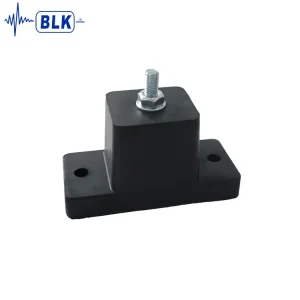
Low Price BKTS Type Rubber Pad

Low Price HR Type Rubber Hangers

High-Quality BKH Type Rubber Mounts

High-Quality BKHQ Type Rubber Mounts

High-Quality BKVE Type Rubber Mounts
Frequently Asked Questions on Vibration Control Sourcing
Clear, engineering-backed answers addressing isolator selection, load metrics, customization lead times, and factory quality assurance.
How do I choose between spring isolators, rubber mounts, and pneumatic platforms?
Selection depends primarily on the operating frequency (RPM) of your equipment and the required natural frequency of the isolator. Helical spring isolators (3.0 – 5.0 Hz natural frequency) are required for low-speed machinery operating under 1,800 RPM, such as HVAC chillers, large pumps, and cooling towers. Rubber mounts (7.0 – 15.0 Hz natural frequency) are ideal for higher-speed equipment (>1,800 RPM) like small motors, high-speed fans, and compressors where small static deflections suffice. Pneumatic platforms (1.2 – 2.5 Hz natural frequency) are strictly reserved for ultra-sensitive micro-vibration environments like semiconductor probing, electron microscopes, and optical benches.
What precise technical data is required to request a custom factory engineering sizing?
To receive a fully verified 24-hour sizing proposal, provide our engineering team with: (1) Total equipment operating weight, (2) Center of gravity (CG) coordinates, (3) Number and spatial arrangement of mounting support points, (4) Operating speed (RPM) or forcing frequency range, (5) Environmental constraints (indoor, outdoor, marine corrosive, or chemical exposure), and (6) Any regional seismic or wind-restraint regulatory mandates.
What is the expected operational lifespan of industrial vibration isolators?
Under normal operating conditions within specified load capacity ratings, steel spring isolators and transformer mounts coated with Dacromet zinc-flake protection perform efficiently for 15+ years. Industrial rubber mounts typically last between 7 and 10 years before natural elastomeric aging requires inspection. Pneumatic air spring bladders generally carry a service life of 6+ years depending on air supply cleanliness and ambient temperature conditions.
How does direct factory sourcing from Kunshan, China compare in quality and lead time?
Kunshan manufacturing facilities operate under strict ISO 9001 certified quality control systems. Utilizing robotic spring coiling, CNC machining centers, and automated salt-spray testing equipment ensures products meet or exceed international standards (such as ASHRAE and ISO 20816). Standard off-the-shelf isolator models ship within 24 hours, while customized 1:1 engineered mounts transition from CAD design to final production in as fast as 3 to 5 working days.