
Featured Air Compressor Vibration Mounts & Pads
Factory-direct vibration isolation products designed for heavy-duty industrial machinery, pressure vessels, and HVAC compression systems.



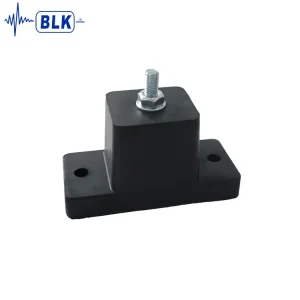




1. Executive Engineering Summary: Physics of Air Compressor Isolation
Industrial air compressors are among the most persistent sources of destructive low-frequency vibration and structure-borne noise in modern manufacturing plants, processing facilities, and commercial buildings.
When rotary screw, reciprocating piston, or centrifugal compressors operate, they generate violent harmonic forces caused by internal gas compression cycles, unbalance in rotating masses, and drive motor torque oscillations. Left unmitigated, these dynamic forces transmit directly into the structural foundation, causing severe micro-cracking in concrete flooring, premature fatigue failure of connected piping and electrical conduits, and structural resonance that amplifies ambient noise beyond legal OSHA and ISO compliance limits.
The efficiency of an air compressor isolation mounting pad depends on the ratio of disturbing frequency ($f_d$) to the isolator's natural frequency ($f_n$). Isolation begins only when $f_d / f_n > \sqrt{2} \approx 1.41$. To achieve >92% isolation efficiency, engineering guidelines mandate a frequency ratio where $f_d / f_n \ge 3.0$.
Our factory-engineered air compressor isolation pads utilize custom-compounded elastomers (Nitrile, Neoprene, and High-Damping Natural Rubber) alongside internal matrix damping geometry. This converts kinetic mechanical energy into thermal energy through elastomeric hysteresis, reducing force transmissibility ($T$) to under 0.05 in demanding industrial environments.
2. Global Market Dynamics & Technological Evolution
The global air compressor isolation mounting pad market is undergoing a rapid transition driven by stricter environmental acoustic mandates, energy efficiency initiatives, and Smart Factory (Industry 4.0) integration. Procurement managers and plant engineers no longer view anti-vibration pads as simple commodity rubber sheets; they are mission-critical mechanical components evaluated on Total Cost of Ownership (TCO) and dynamic damping stability.
High-Damping Polymer Blends
Traditional single-layer rubber pads suffer from high permanent compression set and environmental degradation under synthetic compressor oil exposure. Next-generation pads feature multi-layered elastomer-polymer matrices reinforced with internal high-tensile steel plates, preventing swelling and maintaining constant stiffness ($K$) across -20°C to +120°C temperature ranges.
FEA-Driven Geometric Profiles
Using Finite Element Analysis (FEA), modern isolator designs incorporate suction-cup waffle patterns, cross-ribbed channels, and engineered air pockets. These geometric innovations optimize shear and compressive strain distribution, enabling low-profile pads to absorb severe shock loading during compressor startup and shutdown transient cycles.
Acoustic Retrofitting Mandates
With urban encroachment around industrial zones, regulatory agencies in Europe, North America, and East Asia enforce stringent noise level thresholds (<65 dB at factory boundaries). High-efficiency isolation pads prevent low-frequency noise (20 Hz - 200 Hz) from energizing building structures and radiating as airborne noise.
3. China Factory 4.0: Supply Chain Resilience & Cost Advantages
Why global OEMs and enterprise buyers choose direct procurement from our Kunshan, China manufacturing base.
In the global B2B procurement landscape, balancing strict mechanical engineering standards with aggressive cost targets is a constant challenge. Our state-of-the-art production complex in Kunshan, Jiangsu represents the pinnacle of China’s Industry 4.0 manufacturing transformation.
Automated Vulcanization & Precision Compounding
Our facility integrates automated internal mixers, high-precision hydraulic vulcanizing presses, and robotic trimming cells. By controlling compound formulation, Shore A hardness tolerance ($\pm 3$ Durometer), and curing temperatures digitally, we eliminate human error and achieve batch-to-batch consistency that meets stringent aerospace and OEM compressor specifications.
Vertical Supply Chain Integration & Direct Pricing
By controlling the entire value chain—from raw rubber polymer synthesis and laser-cut internal steel plate fabrication to in-house Dacromet surface coating and dynamic fatigue testing—we bypass middle-tier distributor markups. This vertical integration allows us to offer 30% to 50% cost reductions compared to Western branded equivalents without compromising elastomer quality or load ratings.
4. Technical Selection Guide & Material Engineering Matrix
Choosing the correct isolation pad requires analyzing compressor operating weight, motor speed (RPM), stroke force direction, and environmental factors. Use the matrix below to select the ideal mounting technology for your installation.
| Compressor Type | Operating Speed (RPM) | Primary Excitation Frequency | Recommended Mounting Pad / Isolator Type | Target Shore Hardness / Deflection | Isolation Efficiency |
|---|---|---|---|---|---|
| Small Reciprocating (1 - 10 HP) | 700 - 1,200 RPM | 11.6 - 20.0 Hz | BKTS / BKP Type Cross-Ribbed Nitrile Rubber Pads | 50 - 60 Shore A (3-5mm Deflection) | 88% - 93% |
| Rotary Screw (15 - 150 HP) | 1,800 - 3,600 RPM | 30.0 - 60.0 Hz | BKDD / BKVE Heavy-Duty Elastomeric Mounts | 60 - 70 Shore A (5-8mm Deflection) | 92% - 97% |
| Large Reciprocating / Process | 300 - 750 RPM | 5.0 - 12.5 Hz | ME / MA Heavy Spring Mounts with Viscous Damping | 25mm - 50mm Static Deflection Spring | 95% - 99% |
| Centrifugal High-Pressure Turbos | > 10,000 RPM | High Frequency Harmonic | BK-PM Polymer Damping Pad + Inertia Base | 70 Shore A High Damping Elastomer | > 98% |
| Variable Speed Drive (VSD) Screw | 900 - 3,600 RPM Range | Variable (15 - 60 Hz) | BK-VT / BKSWA Multi-Layer Composite Dampers | Progressive Stiffness Hybrid Matrix | 90% - 96% Across Range |
Key Installation Engineering Guidelines
- Center of Gravity Alignment: Ensure air compressor weight is evenly distributed across all support feet. Off-center loads require custom-calibrated pads with varied durometer ratings to maintain level operation.
- Flexible Piping Connections: Always install flexible expansion joints on air discharge lines and cooling water pipes. Rigid piping short-circuits the isolation pad, transmitting vibrations downstream.
- Surface Levelling: Baseplates must be level within 0.5mm/m. Use BKAL Type Leveling Feet where concrete housekeeping pads are uneven.
5. Localized Industrial Application Scenarios
Real-world deployment profiles demonstrating performance across diverse operational environments.
Semiconductor Cleanrooms & Precision Facilities
In microelectronics manufacturing, background ambient vibration must remain below VC-C (12.5 µm/s) thresholds to prevent wafer alignment errors in photolithography. Installing BK-PF Precision Air Mounts under cleanroom supply air compressors eliminates micro-vibration transfer through floor slabs.
High-Rise Rooftop HVAC & Refrigeration
Roof-mounted rotary compressors in commercial buildings create acoustic rumble that disturbs top-floor occupants. Our spring isolators equipped with BKTS sound-stopping rubber cups decouple low-frequency motor hum, ensuring compliance with strict residential night noise codes.
Offshore Oil Platforms & Coastal Plants
Harsh marine environments accelerate steel corrosion and elastomer degradation. Bellking’s Dacromet 900-hour salt-spray coated mounts combined with oil-resistant Nitrile (NBR) rubber pads withstand saltwater spray, hydraulic oil spills, and continuous 24/7 compressor operation.
Automotive Assembly Lines & Heavy Stamping
Centralized pneumatic compressor stations subject mounting pads to massive pressure fluctuations and severe transient shock loads. Multi-layer BKSWA dampers isolate both continuous running vibration and heavy shock pulses, preventing foundation settling.
Specialized Isolation Dampers & Industrial Platforms
Explore our complete catalog of spring hangers, polymer damping pads, and precision platforms for OEM air compressor integration.








6. Frequently Asked Questions (Engineering FAQ)
Direct technical answers from our vibration isolation design engineers.
How do I calculate the required pad area and thickness for my air compressor?
Should I choose rubber mounting pads or open spring isolators for a screw compressor?
How does compressor oil exposure affect anti-vibration pad longevity?
Can Bellking provide custom OEM pad dimensions and bolt-hole configurations?
What is the lead time for export bulk shipments from your China facility?
Need a Custom Vibration Calculation & Sizing Report?
Send us your air compressor brand, model, operating weight, and motor RPM. Our application engineering team will deliver a comprehensive isolation calculation report and factory-direct quotation within 24 hours.