
Primary Anti-Vibration Spring & Platform Systems
Factory-direct isolated mounting series certified for industrial HVAC, heavy machinery, power generation, and high-precision semiconductor processing.




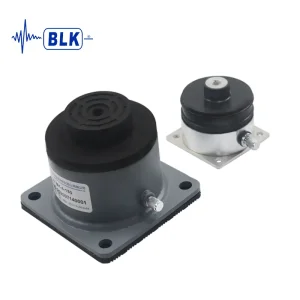



Global Industry Trends & Technological Evolution in Anti-Vibration Spring Mounts
Analyzing macro-shifts in mechanical isolation engineering, strict acoustic retrofitting codes, and low-frequency vibration mitigation.
The global industrial vibration isolation market is undergoing a paradigm shift driven by stringent municipal noise control regulations, the rapid expansion of semiconductor fabrication plants, ultra-precise metrology labs, and modern mega-HVAC mechanical rooms. Industrial machinery operating at variable speeds presents dynamic harmonic frequencies that traditional elastomeric pads can no longer fully damp. Consequently, high-deflection anti-vibration spring mounts have emerged as the foundational standard for critical equipment isolation.
Micro-Vibration Control for Tech Fabs
Modern semiconductor foundries and optical research platforms require VC-E and VC-G vibration criteria compliance. Advanced spring mounts with integrated elastomeric dampening elements eliminate low-frequency floor resonances down to 3 Hz.
Total Cost of Ownership (TCO) Focus
Procurement teams are moving away from low-initial-cost unrated mounts. Premature fatigue and equipment bearing failures cost up to 20x the price of premium, corrosion-resistant spring mounts engineered with 15+ year operational lifespans.
Seismic & Wind Restraint Integration
Global building codes (ASCE 7, IBC, Eurocode 8) mandate that anti-vibration spring mounts provide multi-axis seismic containment without compromising vibration isolation during normal operating cycles.
Modern industrial equipment—ranging from 500-ton centrifugal chillers to emergency diesel generators—exerts substantial static loads combined with dynamic forces. Factory engineers and industrial buyers now demand rigorous compliance with international standards such as ISO 2017-1, EN 1299, and ASHRAE equipment mounting recommendations to prevent structural sound transmission into occupied building spaces.
Engineering Fundamentals: Vibration Isolation Physics & Selection Mechanics
Rigorous physical models, natural frequency calculations, and dynamic transmissibility ratios governing effective isolation design.
Achieving structural isolation efficiency above 95% requires a deep evaluation of forcing frequencies, static deflection, and system stiffness. The natural frequency ($f_n$) of an open or housed anti-vibration spring mount is primarily governed by its static deflection ($\delta$) under load, expressed by the fundamental formula:
Where $g$ represents gravitational acceleration (9.81 m/s²) and $\delta$ represents the static deflection in centimeters. For equipment running at a disturbing frequency ($f_d$), the dynamic transmissibility ($T$)—the ratio of force transmitted to the building structure versus the force generated—is defined as:
To avoid resonance conditions where $f_d / f_n = 1$ (which leads to catastrophic force amplification), the frequency ratio $f_d / f_n$ must exceed √2 (1.414). For true industrial-grade isolation efficiency ($E = (1 - T) \times 100\% \ge 95\%$), the frequency ratio should be engineered between 3.0 and 5.0.
Comparative Matrix of Isolation Mount Technologies
| Mount Type Category | Natural Frequency Range | Static Deflection Range | Primary Industrial Applications | Corrosion & Fatigue Rating |
|---|---|---|---|---|
| Open Spring Mounts (MD/MC Series) | 2.5 Hz – 5.0 Hz | 25 mm – 75 mm | Chillers, AHUs, Compressors, Pumps | Hot-Dip Galvanized / Dacromet (900h Salt Spray) |
| Housed Seismic Spring Mounts | 3.0 Hz – 4.5 Hz | 25 mm – 50 mm | Cooling Towers, Generators, Rooftop Units | Ductile Cast Iron Housed / Heavy Structural Steel |
| Pneumatic Air Mounts (BK-A Series) | 1.2 Hz – 2.5 Hz | N/A (Variable Air Deflection) | Semiconductor Probers, CMMs, Laser Microscopes | Anodized Aluminum / High-Grade Elastomer Bladder |
| Polymer Damping Pads (BK-PM Series) | 8.0 Hz – 15.0 Hz | 2 mm – 8 mm | High-Speed Motors, Transformers, Punch Presses | Oil-Resistant Synthetic Nitrile Polymers |
Global Enterprise Procurement Demands: Pricing vs. Quality Engineering
Strategic guidelines for OEM buyers, EPC contractors, and global supply chain managers seeking low unit cost without sacrificing metallurgical integrity.
When evaluating "Low Price Anti Vibration Spring Mounts Manufacturers & Price," procurement departments must look beyond the initial unit quote. Low-quality spring mounts manufactured from unverified steel alloys suffer from rapid spring settling (loss of free height), hydrogen embrittlement during galvanizing, and premature cracking under cyclic stress. These defects result in expensive equipment downtime and structural damage.
Metallurgical & Spring Coiling Integrity
High-performance spring isolators utilize EN 10270-2 silicon-chromium steel wire subjected to dynamic shot-peening and stress-relieving heat treatments. This guarantees zero permanent set under 150% overload conditions, maintaining designed natural frequency across decades of service.
ISO 9001 Factory Quality Audits
Leading Chinese spring mount manufacturers like Bellking implement 100% stiffness sorting, automated robotic welding, and digital load-deflection testing. Procurement teams receive full batch traceability, mill test certificates (MTC), and 900-hour salt spray test reports.
Direct factory sourcing from certified manufacturing hubs eliminates intermediate distributor markups (often 40% to 70%), allowing global contractors to secure tier-1 quality spring mounts at competitive direct-factory pricing.
Macro Industrial Solutions: Sector-Specific System Blueprints
Tailored mounting architectures designed for demanding operational environments across diverse industries.
1. Power Substation & Transformer Vibration Mitigation
Large dry-type and oil-immersed transformers emit low-frequency magnetic hum (100 Hz / 120 Hz harmonics). Bellking matrix anti-vibration mounts (BK-MT Series) incorporate high-damping polymer cores sandwiched between steel spring coils, blocking magnetostrictive vibration transfer into concrete foundations by up to 98%.
2. HVAC Plant Room Inertia Bases & Spring Hangers
End-suction pumps, centrifugal chillers, and large air handling units (AHUs) require concrete-filled inertia bases supported by low-frequency spring mounts. This configuration lowers the equipment center of gravity, reduces transient start-up motion, and prevents strain on connected piping systems.
3. Heavy Stamping Presses & Metalworking Automation
High-tonnage mechanical presses deliver intense transient impact shocks. Multi-layer viscous damped spring mounts absorb energy quickly, reducing impact dynamics transmitted to adjacent precision CNC equipment and preventing floor slab micro-fracturing.
4. Semiconductor Cleanroom Micro-Vibration Platforms
Granite motion stages and semiconductor inspection tools require sub-micron level stability. Bellking active pneumatic and hybrid spring platforms create an isolated island within cleanroom facilities, isolating ambient building vibration.
Bellking Factory Production & Engineering Benchmarks
Quantitative proofs of quality, durability, and global delivery capabilities.
Global Compliance Support & Technology Roadmap
Navigating international building regulations, material safety standards, and smart industrial mounting innovations.
Regulatory Compliance & International Standards
Exporting vibration isolators into global markets requires adherence to stringent environmental, structural, and fire safety standards. Bellking ensures complete documentation compliance across all product lines:
- REACH & RoHS Compliance: All elastomeric pads, natural rubber buffers, and anti-corrosion coatings are free of restricted heavy metals and hazardous phthalates.
- ASTM E84 Flame & Smoke Ratings: Damping materials used in plenum spaces meet low flame-spread and smoke-density requirements.
- Seismic Restraint Certification: Housed spring mounts are engineered to withstand multi-directional seismic G-forces compliant with California OSHPD and international building codes.
Technology Roadmap: Smart IoT-Enabled Isolation Mounts
As Industry 4.0 expands, mechanical vibration monitoring is moving from passive isolation to real-time predictive health diagnostics. Bellking's R&D team is actively engineering smart spring isolators equipped with integrated wireless piezoelectric sensors. These sensors detect initial spring dynamic sag, structural imbalance, and harmonic shifts before catastrophic machinery failure occurs, streamlining facility management in automated smart factories.
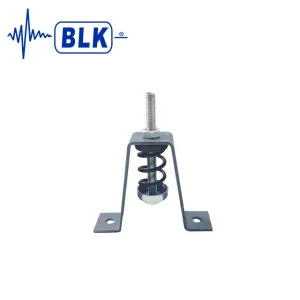
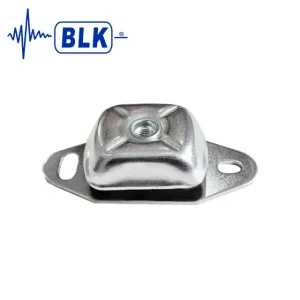
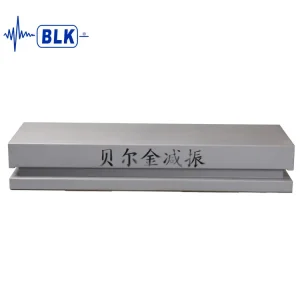
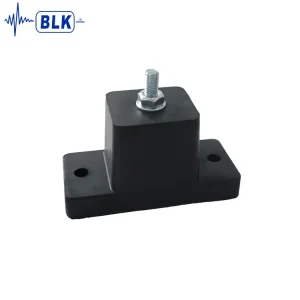
Rubber Mounts, Hangers & Specialized Isolation Platforms
Precision engineered elastomeric isolators, spring hangers, matrix dampers, and high-deflection damping pads.




Frequently Asked Questions (FAQ) - Sourcing & Technical Calculations
Direct answers from our application engineering team regarding selection, sizing, and pricing models.