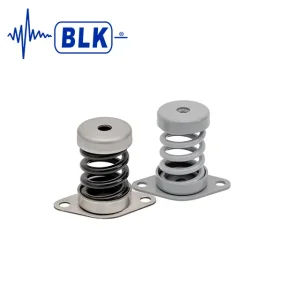
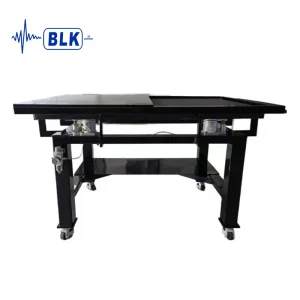
Featured Anti-Vibration Isolation Series (Top Catalog)
Engineered spring mounts, precision rubber dampeners, and air isolation platforms direct from our ISO 9001:2015 certified manufacturing facility.
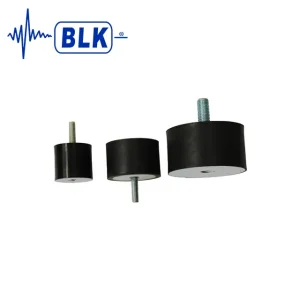


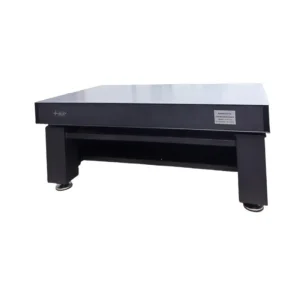




Physics & Mechanics of Anti-Vibration Systems
How modern dynamic isolation decouples mechanical excitation from load-bearing structures to maximize machine lifespan, operating accuracy, and acoustic control.
Resonance & Transmissibility
Vibration control is governed by the frequency ratio ($r = f_d / f_n$), where $f_d$ is the disturbing frequency and $f_n$ is the natural frequency of the isolator. Effective isolation ($T < 1$) requires $r > \sqrt{2}$. For optimal damping, engineered spring and pneumatic systems target $r \ge 3$, isolating over 90–99% of dynamic kinetic energy.
Elastomeric Damping Mechanics
Industrial rubber and polymer mounts utilize internal viscoelastic hysteresis to convert kinetic vibrational amplitude into negligible micro-thermal energy. Polymer damping matrices eliminate high-frequency harmonics and structure-borne noise in mechanical plants and rotating machinery.
Pneumatic Air Mount Tech
Achieving low natural frequencies down to 1.7 Hz, pneumatic vibration isolation platforms utilize air-chamber compliance combined with level-sensing auto-throttling valves. Designed specifically for sub-micron optical benches, CMMs, and semiconductor probing tools.
Why Direct Factory Pricing Does Not Mean Quality Compromise
In global industrial procurement, searching for a "low price anti vibration technology factory" often raises concerns about structural reliability, metal fatigue, and material compliance. However, modern automated manufacturing in established industrial clusters like Kunshan, China has rewritten the cost-performance equation.
By leveraging vertically integrated spring coiling, robotic welding, automated Dacromet surface coating, and in-house elastomer rubber vulcanization, Chinese manufacturers eliminate intermediary markups while upholding rigorous ISO 9001 quality assurance standards. Procurement officers and mechanical engineering leads achieve 30% to 50% cost savings compared to European or North American catalog suppliers while securing equal or superior dynamic performance metrics.
Technical Insighter: True cost-efficiency in anti-vibration systems stems from optimized material chemistry—such as high-stress oil-tempered spring steel alloys and fatigue-resistant EPDM/Neoprene blends—coupled with automated precision manufacturing that reduces waste and guarantees uniform spring constants ($k$).
China Factory Advantages in Anti-Vibration Engineering
How the Kunshan Industrial Cluster combines metallurgical advanced processing, supply chain agility, and rigorous OEM/ODM customization capability.
Advanced Metallurgical & Elastomeric Material Science
Chinese manufacturers utilize high-grade spring steel (such as 60Si2MnA and 50CrVA) treated through computer-controlled continuous quenching and tempering. This prevents long-term load sag and stress relaxation. Simultaneously, custom synthetic elastomers are formulated to resist ozone, hydraulic oil exposure, and extreme operating temperatures (-40°C to +120°C).
Surface Coating & Harsh Environment Anti-Corrosion
Industrial equipment operated in coastal areas, chemical processing plants, or outdoor HVAC roofs demands high anti-corrosion protection. China factories lead in applying non-electrolytic Dacromet and Geomet coatings, passing 900+ hour salt spray corrosion tests without hydrogen embrittlement—surpassing conventional electro-galvanizing by 500%.
Rapid Prototyping & 1:1 Customization Capabilities
Equipped with 3D finite element analysis (FEA) software and automated multi-axis CNC spring-coiling machinery, Kunshan Bellking translates customer mechanical blueprints, center-of-gravity (COG) calculations, and weight distributions into custom dampener prototypes within 3 to 5 business days.
Economies of Scale & Global OEM Integration
With annual output capacities exceeding hundreds of thousands of damping units, Chinese anti-vibration technology factories pass significant volume efficiencies directly to global buyers, enabling competitive wholesale unit pricing for EPC contractors and OEM equipment brands worldwide.
Future Directions in Anti-Vibration Engineering
How automation, semiconductor miniaturization, green building acoustics, and AI data infrastructure are transforming hardware requirements.
The global vibration isolation market is undergoing a structural transition driven by four key industrial mega-trends:
| Industry Sector | Primary Vibration Source | Isolation Technology Applied | Target Performance Standard |
|---|---|---|---|
| Semiconductor & Photonics | Pedestrian footfalls, cleanroom HVAC, stepper motor recoil | Precision Pneumatic Air Mounts (BK-PF, BK-A Series) | Sub-micron stability, VC-E / VC-G curve compliance, $f_n < 2.0 \text{ Hz}$ |
| AI Data Centers & Supercomputing | High-volume chillers, liquid cooling pumps, cooling towers | Viscous-Damped Spring Isolators & Inertia Bases (MA, MB, CPB) | 95%+ low-frequency vibration elimination, zero structural hum transfer |
| Power Grid & Electrical Substations | Transformer core magnetostriction (100Hz / 120Hz harmonics) | Specialized Transformer Anti-Vibration Mounts & Pad Matrices | Structure-borne acoustic reduction by 15–25 dB(A) |
| Heavy Manufacturing & Stamping | High-G impact presses, hydraulic shears, forging hammers | Multi-Layer Antivibration Dampers (BKSWA Type) & Heavy Rubber Mounts | Surge impact absorption up to 3–5G acceleration load |
| Commercial Building HVAC | Centrifugal chillers, rooftop AHUs, suspended piping networks | Spring Hangers (HV Type) & Floor Mounts (MD, MA) | ASHRAE HVAC Noise and Vibration Control Chapter Guidelines compliance |
Micro-Vibration Control in the Era of High-Density Chips
As semiconductor lithography nodes push below 2 nanometers, environmental micro-vibrations invisible to human touch can render sub-micron inspection tools unusable. Traditional rubber mounts cannot attenuate frequencies below 10 Hz. Precision air mounts with active or passive pneumatic leveling chambers provide an essential barrier, isolating sensitive optical benches from building floor vibrations.
AI Supercomputing Facilities and Structural Acoustic Resonance
Modern AI server racks demand enormous cooling capacities, requiring liquid-to-air cooling systems, high-pressure pumps, and massive rooftop chillers running 24/7. Left unisolated, these mechanical units transmit low-frequency vibration into the facility floor structure, creating resonance issues that affect sensitive electronic connections and neighboring office spaces. The deployment of high-deflection spring isolators paired with concrete inertia bases stabilizes fluid dynamic pressures and dampens acoustic resonance.
Engineered Applications Across Critical Infrastructure
Tailored vibration attenuation systems for mechanical, power, cleanroom, and structural engineering projects.
HVAC Plant Rooms & Pumping Stations
Integrating concrete-filled steel inertia bases (CPB Type) beneath end-suction and split-case pumps lowers the overall center of gravity, resists rotational torque start-up kick, and reduces stress on connected piping manifolds when isolated by open or enclosed spring mounts.
Power Transformers & Electrical Substations
Dry-type and oil-immersed transformers produce magnetostrictive hum at fundamental frequencies of 100 Hz and 120 Hz. Custom transformer anti-vibration mounts engineered with composite high-damping rubber cores effectively decouple power units from concrete foundations.
Metrology Laboratories & Optical Benches
High-magnification electron microscopes (SEM/TEM), laser interferometers, and coordinate measuring machines (CMMs) require complete decoupling from environmental floor motion via damped vibration isolation platforms (BK-RT / BK-VT Type).
Isolator Selection Sizing & Specification Protocol
A 4-step engineering method for sizing vibration isolators to guarantee optimal static deflection and isolation efficiency.
Step 1: Total Operating Load & COG
Calculate the total operating weight including equipment dry weight, liquid volume (in pumps/chillers), and dynamic load distribution across all mounting points to identify individual point loads.
Step 2: Excitation Frequency ($f_d$)
Determine the lowest operating speed (RPM) of the equipment. Convert RPM to Hertz ($f_d = \text{RPM} / 60$). For a 1750 RPM chiller motor, $f_d = 29.16 \text{ Hz}$.
Step 3: Target Static Deflection
Select a spring or air isolator that provides adequate static deflection ($\delta$) using $f_n = 5 / \sqrt{\delta \text{ (cm)}}$. For 90%+ isolation efficiency at low RPMs, aim for 25mm to 50mm static spring deflection.
Step 4: Environmental & Seismic Check
Verify site environmental conditions (coastal salt mist, acid ambient air, outdoor UV) to specify housing finishes (Dacromet, 304/316 Stainless Steel) and seismic restraint requirements.
Anti-Vibration Sourcing & Technical FAQ
Direct answers to common procurement, engineering specification, and OEM supply chain queries.
Why choose a direct factory in China over local industrial distributor catalog suppliers?
What is the difference between spring vibration isolators and rubber vibration mounts?
How do Dacromet and Geomet coatings compare to conventional electro-galvanizing for anti-vibration mounts?
Can your factory supply custom non-standard vibration dampeners from OEM CAD files?
What lead times and quality certifications are guaranteed for global export shipments?
Complete Anti-Vibration Systems (Bottom Catalog)
Heavy-duty inertia pump supports, sub-frequency pneumatic platforms, and specialized HVAC spring hangers for global procurement requirements.