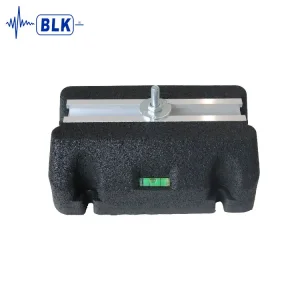
Primary Building Services Isolation Components
Direct factory-manufactured spring hangers, inertia bases, and specialized rubber mounts engineered to meet stringent ISO and ASHRAE acoustic vibration specs.








Engineering Fundamentals of Building Services Vibration Isolation
In modern high-density commercial, industrial, and residential building services (MEP—Mechanical, Electrical, and Plumbing), mechanical equipment such as heavy chillers, cooling towers, air handling units (AHUs), hydronic pumps, and emergency diesel generators generate substantial kinetic energy. If unmitigated, this energy translates into low-frequency structure-borne vibration, propagating through concrete slabs, steel columns, and joists into occupied tenant spaces as disruptive noise and physical vibration.
To achieve compliance with acoustic standards like NC-30 to NC-35 sound criteria, modern MEP engineering demands precision-engineered isolation systems. Finding a low price building services vibration isolation factory does not mean sacrificing mechanical integrity; rather, it entails sourcing direct-from-manufacturer components designed around rigorous mechanical principles.
T = √[ (1 + (2 · ζ · r)²) / ((1 - r²)² + (2 · ζ · r)²) ]
Where:
• r = Frequency Ratio (fd / fn)
• fd = Equipment Disturbing Frequency (Hz = RPM / 60)
• fn = Isolator Natural Frequency (Hz)
• ζ = Damping Ratio of the Isolator Material
Vibration isolation only occurs when the frequency ratio r > √2 (1.414). To achieve isolation efficiencies exceeding 95% to 99%, building services engineers target a frequency ratio of r ≥ 3 to 5. For low-speed equipment operating at 300 to 600 RPM (5 to 10 Hz), achieving this ratio requires isolators with an exceptionally low natural frequency (fn ≤ 2 to 3 Hz), which can only be safely accommodated by open or restrained helical steel spring isolators with high static deflection (25mm to 75mm).
Global Enterprise Sourcing & Factory Price Optimization
Understanding the cost drivers behind building services vibration isolation hardware enables EPC contractors and MEP specifiers to minimize Total Cost of Ownership (TCO) while securing certified performance.
Steel Grade & Deflection
The cost of spring isolators scales with steel wire alloy quality (e.g., high-tensile 60Si2Mn spring steel) and static deflection requirements (25mm, 50mm, or 75mm). Factory-direct sourcing ensures raw material traceability without distributor markups.
Corrosion Finishes
Standard zinc plating is low-cost but fails in outdoor HVAC or coastal environments. Factories offering advanced Dacromet or hot-dip galvanizing extend service lifecycles past 15 years, providing massive cost-to-value benefits.
Seismic & Wind Restraints
Buildings in seismic zones demand snubbed, multi-directional restrained spring mounts (IBC / ASCE 7 compliant). Buying pre-engineered seismic mounts directly from specialized factories lowers procurement costs by 30-40% compared to local resellers.
| Isolator Type | Typical Deflection | Target Equipment | Factory Cost Range (USD/Unit) | Key Value Factor |
|---|---|---|---|---|
| Spring Vibration Hangers (HV Type) | 25mm – 50mm | Suspended Piping, Exhaust Fans, AHUs | $12.00 – $45.00 | Prevents noise bridging through ceiling joists |
| Enclosed / Restrained Spring Mounts | 25mm – 75mm | Chillers, Cooling Towers, Gensets | $35.00 – $180.00 | Seismic & wind load restraint integrated |
| Inertia Bases & Pump Supports | N/A (Structural Frame) | End-Suction & Split-Case Pumps | $150.00 – $650.00 | Lowers CG, stabilizes hydronic connections |
| Industrial Elastomeric / Rubber Mounts | 3mm – 12mm | High-Speed Motors, Compressors, Transformers | $3.50 – $22.00 | High internal damping for high frequency (≥1200 RPM) |
| Pneumatic Air Mount Systems | Active Air Chamber | Cleanroom Scanners, CMMs, Micro-Electronics | $280.00 – $1,200.00 | Ultra-low natural frequency down to 1.7 Hz |
Macro Building Services Isolation Solutions
Comprehensive engineering strategies tailored to complex mechanical environments across modern commercial and industrial facilities.
HVAC Plant Room Isolation
Central plant rooms situated on upper floors or basements require comprehensive isolation. Heavy centrifugal chillers and rooftop cooling towers demand restrained spring mounts with viscous dampers to absorb transitional resonance during motor startup and shutdown phases.
Hydronic Pump Inertia Bases
Water pumps exhibit significant rotational torque and fluid turbulence. Mounting pumps directly to structural floors causes pipe stress and severe sound transmission. CPB-Type Concrete Inertia Bases equalize mass distribution, lower the center of gravity, and maintain rigid alignment between pump and motor shafts.
Data Centers & Critical Power
Uninterruptible power supplies (UPS), backup diesel generator sets, and dry-type electrical transformers release constant electromagnetic hum and mechanical vibration. Specialized transformer mounts and heavy-duty spring mounts prevent structural fatigue in data center floor grids.
High-Rise Duct & Pipe Risers
Thermal expansion combined with high fluid velocity causes substantial vertical movement and vibration along vertical pipe risers and large air ducts. HV and BKSWA multi-layer isolation hangers absorb dynamic axial movement while maintaining acoustic isolation from the building superstructure.
Cleanroom Micro-Vibration Isolation
Modern semiconductor fabrication facilities and hospital imaging rooms (MRI/CT) demand sub-micron vibration control (VC-D to VC-G curves). Pneumatic air isolators (BK-A / BK-DT Type) provide passive self-leveling resonance attenuation down to 1.7 Hz.
Acoustic Floor & Floating Slab Systems
To isolate sensitive auditoriums, bowling alleys, or high-end mechanical penthouses, polymer damping pads (BK-PM Type) are deployed underneath floated reinforced concrete slabs, decoupling airborne and impact sound pathways completely.
Regulatory Standards, FEA Simulation & Compliance
Direct factory engineering partnerships ensure your project submittals satisfy stringent international building codes and environmental certifications.
Procuring low-cost vibration isolators without certified structural submittals creates massive financial liabilities during building commissioning. Leading factories bridge this gap by offering full technical validation, including Finite Element Analysis (FEA) stress modeling, point-load distribution calculations, and third-party laboratory dynamic testing.
ASHRAE Chapter 48 Standards
Factory-supplied selection software guarantees that minimum static deflection values match ASHRAE guidelines based on floor span, equipment power (HP), and equipment operating speeds.
IBC & ASCE 7 Seismic Restraint
Restrained spring isolators undergo rigorous lateral and vertical force calculations (G-force acceleration up to 3.0g - 5.0g) to prevent equipment overturn during seismic events or severe wind uplift conditions.
ISO 9001 & RoHS Environmental Certs
Elastomeric compounds and polymer damping pads comply with international green building standards (LEED v4), ensuring zero toxic off-gassing, high ozone resistance, and audited batch manufacturing.
Technical Roadmap: Smart Isolation & Advanced Damping (2025–2035)
The convergence of IoT condition monitoring, active magnetic suspension, and advanced polymer synthesis is reshaping the building services landscape.
IoT-Enabled Smart Isolators
Integration of wireless MEMS strain gauges and piezoelectric sensors directly into spring mounts. Real-time telemetry detects coil fatigue, uneven settlement, and unexpected bearing wear before failure occurs.
Active-Passive Hybrid Damping
Combines high-load passive helical springs with micro-actuators that output anti-phase force waveforms. This neutralizes low-frequency transient spikes during heavy equipment motor starting sequences.
Nano-Engineered Elastomers
Next-generation synthetic polymers incorporating graphene and carbon nanotubes exhibit non-linear stiffness profiles—delivering high damping ratios without suffering long-term compressive creep strain.
Frequently Asked Technical & Procurement Questions
In-depth responses from expert structural acoustic engineers regarding building services vibration control.
How do I accurately calculate the required static deflection for an HVAC spring isolator?
Why are factory direct prices for vibration isolators significantly lower than local distributor quotes?
When should I specify an Inertia Base (CPB-Type) instead of mounting pumps directly on spring isolators?
What surface coating protection is required for outdoor cooling tower spring mounts in marine environments?
How do restrained spring isolators work during seismic and high-wind conditions?
What documentation is required from a vibration isolation factory before issuing project approval?
Specialized Polymer, Damping, & Precision Mount Series
Explore custom multi-layer dampers, optical isolation platforms, and polymer pads engineered for specialized industrial and building service applications.