
⚙️ Standard & Custom Anti-Vibration Solutions (Series I)
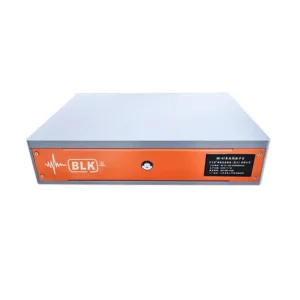
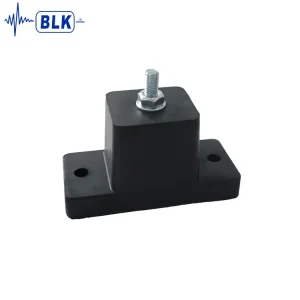
Direct factory supply engineered for diesel generators, gas gensets, pumps, and heavy industrial machinery requiring precision vibration isolation.






📐 Technical Whitepaper: Dynamics of Generator Anti-Vibration Mounts
Understanding internal combustion forces, mechanical resonance mitigation, and transmissibility optics in modern power generation installations.
Diesel and natural gas generator sets operate under complex dynamic forces caused by reciprocating piston motion, crankshaft unbalanced moments, and transient electromagnetic torque spikes. These disturbances produce primary harmonic frequencies corresponding to engine operating speed (1500 RPM = 25 Hz; 1800 RPM = 30 Hz) along with high-frequency structural firing harmonics.
Without specialized anti-vibration mounts, these cyclic forces propagate through building foundations, triggering structure-borne acoustic noise, pipe joint shearing, electrical panel contact chatter, and accelerated fatigue of nearby civil structures.
The primary efficiency indicator for any generator mount is its vibration transmissibility (T). Isolation occurs only when the ratio of excitation frequency ($f_d$) to system natural frequency ($f_n$) exceeds $\sqrt{2} \approx 1.414$.
To achieve superior isolation (>95%), high-performance spring and elastomeric mounts target a frequency ratio $f_d / f_n \ge 3.0$ to 4.0, forcing the system's natural frequency down to 3–5 Hz for standard industrial gensets.
While undamped steel springs offer ultra-low natural frequencies, they exhibit severe transient amplification during engine startup and shutdown resonance cross-over. High-viscosity viscous dampers, synthetic rubber pads, or internal friction inserts introduce a controlled damping ratio ($\zeta \approx 0.05 - 0.15$).
This controlled damping dampens resonance amplitudes during start/stop transient cycles while maintaining exceptional high-frequency isolation performance during continuous full-load operations.
🌐 Global Commercial & Industrial Market Landscape
Market requirements, international vibration standards, and economic cost-benefit drivers shaping modern power generation infrastructure.
International regulatory frameworks increasingly mandate strict vibration limits. ISO 8528-9 defines acceptable mechanical vibration limits for engine-driven AC generator sets, while ISO 10816 establishes severity ratings for structural health. Factory compliance with these standards guarantees that vibration amplitudes stay below $V_{rms} = 4.5\text{ mm/s}$ for smooth, continuous industrial operation.
Hyperscale data centers, financial server hubs, and emergency healthcare facilities demand 100% uptime with zero structural noise transmission. Rooftop and upper-floor emergency generator installations cannot allow vibrations to compromise optical fiber networks, delicate medical imaging tools, or tenant comfort, accelerating the shift toward seismic-restrained spring mounts.
Engineers and EPC contractors are restructuring procurement pipelines. Procuring low-price, high-quality mounts directly from specialized Chinese manufacturing hubs cuts intermediary margins by up to 45%, while delivering identical material performance, Dacromet 900-hour salt-spray durability, and ISO 9001 quality compliance.
| Application Category | Primary Excitation (RPM) | Target Natural Freq. ($f_n$) | Recommended Isolation Type | Isolation Efficiency Target |
|---|---|---|---|---|
| Emergency Standby Gensets (Rooftop) | 1800 RPM (30 Hz) | 3.0 - 4.5 Hz | Restrained Spring Mounts with Viscous Damping | 96% - 99% |
| Basement Power Plant Gensets | 1500 RPM (25 Hz) | 4.5 - 6.0 Hz | Heavy Duty MD Spring Isolators + Inertia Base | 92% - 97% |
| Marine Diesel Auxiliary Generators | 1200 - 1800 RPM | 5.0 - 7.5 Hz | High-Damping Elastomeric / Cone Mounts | 88% - 94% |
| Mobile Microgrid / Containerized Power | 1800 RPM (30 Hz) | 6.0 - 8.0 Hz | Shock-Rated BKDD Rubber Mounts | 85% - 92% |
🏢 Localized Application Scenarios & Engineering Field Integration
Tailored isolation architectures tailored to site-specific civil engineering and environmental requirements.
Rooftop installations on flexible steel frame or post-tensioned concrete slabs present severe deflection risks. Standard un-restrained springs can destabilize during wind gusts or sudden full-load engine torque spikes. Restrained spring mounts (such as MB and MD series) utilize high-strength steel housings with vertical limit stops, maintaining uniform equipment elevation and restricting lateral displacement within $\pm 3\text{ mm}$.
Offshore vessel power generators experience pitch, roll, and extreme salt fog exposure. Cast-iron or high-tensile steel mounts treated with Dacromet surface anti-corrosion coatings endure 900+ hours of continuous salt spray testing without surface oxidation. Multi-directional conical elastomeric isolators provide multi-axis shock attenuation during heavy seas.
In critical care medical centers, generator vibration can disrupt ultra-sensitive micro-imaging devices, surgical microscopes, and acoustic hospital quiet zones (DIN 4150 compliance). Utilizing dual-stage isolation—combining concrete inertia bases with low-frequency spring mounts and elastomeric pads—delivers over 98% attenuation across all structural octave bands.
Off-grid mining operations depend on heavy-duty prime power diesel generators running 24/7 in extreme dust, high thermal range, and high-shock environments. Reinforced rubber buffers and heavy spring mounts engineered with high fatigue life prevent structural frame cracking and alignment errors between engine flywheels and alternator shafts.
Telecom back-up generators situated near dense residential quarters must satisfy tight local noise and vibration ordinances. Rubber hangers and elastomeric damping pads installed under exhaust piping, intake ducts, and generator baseframes suppress low-frequency hum and structure-borne vibration through adjoining urban infrastructure.
Transformers exhibit continuous 100 Hz / 120 Hz magnetostrictive core hum. Specialized anti-vibration transformer mounts isolate continuous high-frequency micro-vibrations, safeguarding substation floor slabs and preventing structural acoustic resonance in surrounding civil works.
🏭 China Supply Chain Resilience & Factory Efficiency Advantages
Why sourcing generator anti-vibration mounts directly from Kunshan industrial manufacturing hubs ensures top quality at competitive prices.
Situated in Kunshan, Jiangsu Province, our advanced manufacturing park benefits from an integrated supply chain ecosystem. High-tensile spring steel wire sourcing, precision vulcanization factories, CNC machine centers, and automated Dacromet coating facilities operate within a 30-minute radius, minimizing supply chain lead times and freight costs.
By employing automated robotic welding work-cells, CNC lathe machining, and automated coil spring winding technologies, factory yield exceeds 100,000 units annually. Economies of scale lower per-unit manufacturing costs while guaranteeing precise spring rate tolerances ($\pm 5\%$) across every batch.
Every batch undergoes rigorous dynamic fatigue testing, salt spray chamber testing, and load-deflection calibration under ISO 9001 certified protocols. Custom non-standard mount prototypes can be engineered via dynamic Finite Element Analysis (FEA) and delivered in as fast as 3 working days.
🚀 Technological Roadmap & Future Innovations in Vibration Control
Pioneering smart dynamic damping, IoT condition monitoring, and advanced composite elastomeric materials.
Integration of embedded tri-axial MEMS accelerometers, strain gauges, and wireless LoRaWAN telemetry inside heavy generator spring mounts. Real-time vibration spectrum FFT data is transmitted to predictive maintenance dashboards to detect misfires, bearing wear, and unbalance prior to equipment failure.
Next-generation adaptive mounts using magnetorheological (MR) fluids and piezoelectric actuators. The dynamic stiffness and damping coefficient alter in milliseconds in response to instantaneous electrical load changes, eliminating transient resonance spikes completely.
R&D into graphene-reinforced nitrile and fluoroelastomers that exhibit zero chemical degradation when exposed to diesel oil, hydraulic fluids, and severe ozone, while expanding effective operating temperatures from -40°C to +150°C.
📋 Engineering Sizing Protocol & Compliance Assurance
Step-by-step guidance for calculating load distribution and selecting certified vibration isolators.
Determine total wet operating weight ($W_{total}$), including engine oil, coolant, generator housing, and base fuel tank (if mounted). Identify asymmetric mass distribution to compute specific load reactions ($W_1, W_2, \dots, W_n$) at each support leg.
Identify lowest engine operating speed ($RPM$). Calculate required static deflection ($\delta$) using the formula $\delta = \frac{980}{(f_n)^2}$ in mm. For 25 Hz engines requiring $f_n = 4.5\text{ Hz}$, minimum static deflection is $\approx 24.2\text{ mm}$.
Select appropriate enclosure type: open spring for low-risk basements, restrained spring (MB/MD) for rooftop or high-wind/seismic zones (IBC code compliant), or heavy elastomeric pads for high-frequency acoustic isolation.
⚡ Advanced Vibration Control Product Range (Series II)
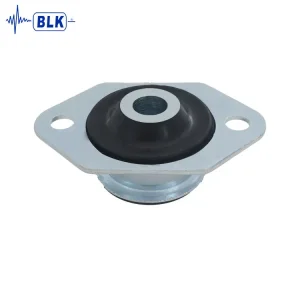
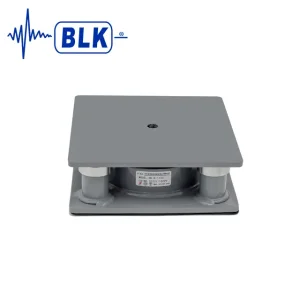
Explore our specialized rubber mounts, multi-layer dampers, air mounts, and spring hangers engineered for power plants and heavy equipment.





❓ Frequently Asked Questions (FAQ)
In-depth technical answers from our vibration isolation application engineers.