Low Price Restrained Spring Isolators Manufacturers & Supplier Analysis
Comprehensive technical handbook on kinematic uplift restraint, seismic dynamics, cost-optimized sourcing in China, and high-efficiency mechanical isolation for global industrial engineering.
Precision Anti-Vibration Mounts & Restrained Spring Series
Factory-direct engineering components engineered for heavy HVAC, industrial equipment, and structural resonance attenuation.

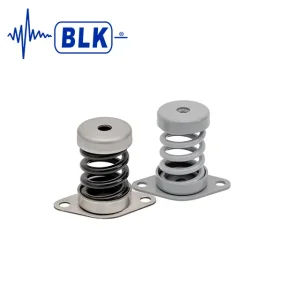
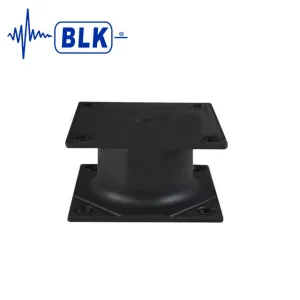



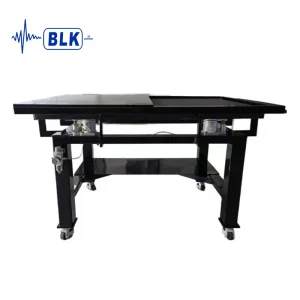
High-Quality BK-RT Type Damped Vibration Isolation Platform Factories, Manufacturers
View Product Details

Understanding Restrained Spring Isolators: Mechanics, Uplift Control, & Design Kinematics
Why modern structural engineering demands constrained spring assemblies over open coil mounts for heavy mechanical infrastructure.
In modern industrial facility design, mechanical equipment controls—such as chillers, large cooling towers, high-pressure centrifugal pumps, and emergency generators—are subject to complex dynamic loading. While open spring isolators provide excellent low-frequency vibration isolation, they possess a severe operational limitation: the lack of vertical motion restraint. When fluid is drained from a large water chiller during seasonal maintenance, or when wind forces exert severe overturning moments on rooftop cooling towers, an open coil spring expands rapidly. This unrestricted movement causes excessive pipe stress, flange misalignment, structural damage, and potential catastrophic equipment tip-over.
This is where Restrained Spring Isolators become essential. Designed with integrated heavy-duty steel housings, vertical limit stops, and elastomeric snubbers, restrained spring isolators limit total vertical travel during weight changes or dynamic seismic/wind thrusts while preserving high isolation efficiency (>95% to 99%) during normal operation.
Core Engineering Insight: Kinematic Vertical Limit Control
Restrained spring isolators engineered by leading manufacturers incorporate all-directional limit stops. Steel vertical restraint pins or housing side-plates are equipped with neoprene or elastomeric isolation pads to eliminate metal-to-metal contact during temporary uplift or lateral shear events.
This guarantees that whether a vessel is fully charged with liquid or operating dry, the height of the mounting system remains constant (within a tight ±3mm clearance margin), avoiding rigid piping shear failures.
Anatomy of a Heavy-Duty Restrained Spring Isolator
A high-performance restrained spring isolator engineered for commercial HVAC and heavy industrial installations consists of several precision-machined elements:
- Ductile Iron or Carbon Steel Housing: Outer structural enclosure designed to withstand lateral shear forces and vertical uplift tensions up to 1.0g to 2.0g seismic loadings.
- High-Stress Alloy Steel Springs: Coiled from high-tensile spring steel (such as 60Si2MnA or SAE 9254), color-coded for distinct load ratings, shot-peened, and stress-relieved for infinite fatigue life under rated deflections (typically 25mm, 50mm, or 75mm static deflection).
- Vertical Restraint Adjustment Bolts: Top-mounted leveling and adjustment screws that double as height-positioning mechanisms during equipment installation and fluid charging.
- Neoprene Friction & Cushion Pads: Integrated top pads and bottom base pads providing high-frequency acoustic attenuation and preventing high-frequency noise transmission through structural steel sub-bases.
- Limit Stops with Elastomeric Snubbers: Internal or external vertical limit bolts lined with high-durometer rubber to absorb transient impact energy during startup, shutdown, or seismic shock waves.
Global Demand Trends & Regional Procurement Dynamics
How regulatory codes, seismic standards, and HVAC acoustic retrofits drive the market for restrained spring mounts globally.
North America (ASCE 7 / IBC Compliance)
Strict building codes like IBC (International Building Code) and ASHRAE guidelines mandate restrained, seismic-rated spring isolators for all mechanical systems in high-rise buildings and seismic zones (Zone 3 & 4). Equipment must remain secured under overturning wind loads reaching up to 150 mph on exposed roof decks.
European Union (Eurocode 8 & EN Standards)
European markets prioritize low structure-borne noise levels (DIN 4109 acoustic standards) and strict environmental sustainability. Demand focuses on hot-dip galvanized or stainless-steel restrained mounts capable of resisting aggressive chemical environments in pharmaceutical and marine facilities.
Asia-Pacific & Middle East Infrastructure
Rapid urbanization, mega-data-center construction, and district cooling projects in the UAE, Saudi Arabia, Singapore, and China have created unprecedented demand for high-capacity restrained spring mounts supporting mega-chillers weighing over 30 tons.
Demystifying "Low Price": The Manufacturing & Efficiency Advantage of Chinese Factories
How advanced industrial clusters like Kunshan achieve low unit costs without sacrificing material standards or ISO structural reliability.
When global procurement managers search for "Low Price Restrained Spring Isolators Manufacturers", a key concern often arises: Does lower cost mean lower safety margins or inferior raw materials? In the context of tier-1 Chinese manufacturers (such as Bellking in Kunshan), "low price" is not achieved by reducing steel thickness or removing snubbers. Instead, it is the direct result of industrial cluster concentration, advanced process automation, and vertical integration.
1. Complete Local Raw Material & Component Ecosystem
In manufacturing hubs like Kunshan (Jiangsu Province), all critical inputs—from high-grade spring steel wire rods to ductile iron castings, rubber compounding, and CNC precision machining—are located within a 30-minute supply chain radius. This localized ecosystem eliminates costly overseas component shipping, reduces raw material inventory holding costs, and allows for rapid prototype-to-mass-production iteration cycles.
2. Automated CNC Coiling & Robotic Surface Treatment
Modern Chinese factories utilize fully automated cold and hot coilers capable of winding spring wire diameters up to 50mm with pinpoint pitch accuracy. Combined with continuous automated Dacromet and powder-coating lines, labor hours per unit are reduced by up to 65% compared to semi-manual Western production lines. These savings are directly passed to global buyers in the form of lower unit FOB/CIF pricing.
3. In-House Testing and Certification Efficiency
Equipped with internal 100-ton hydraulic load-deflection test rigs, dynamic fatigue testing stations, and environmental salt spray chambers, qualified Chinese manufacturers can execute complete ISO 9001 factory inspection protocols in-house. This avoids expensive third-party testing overheads while guaranteeing that every batch meets rigorous dynamic stiffness and static load tolerances.
Engineering Dynamics: Selecting & Sizing Restrained Isolators
The mathematical framework for calculating natural frequency, static deflection, and force transmissibility ratios.
To ensure optimal vibration attenuation while guaranteeing structural stability under wind or equipment startup loads, application engineers must follow a precise calculation procedure:
Key Mathematical Formulas for Vibration Isolation
1. Natural Frequency ($f_n$): The fundamental frequency of the isolator is governed by static deflection ($\delta_s$ in inches or mm):
$$f_n = \frac{1}{2\pi} \sqrt{\frac{g}{\delta_s}} \approx \frac{5}{\sqrt{\delta_s \text{ (cm)}}} \text{ Hz}$$
2. Transmissibility Ratio ($T_r$): The ratio of force transmitted to the building structure relative to the dynamic force generated by the machine:
$$T_r = \left| \frac{1}{\left(\frac{f_d}{f_n}\right)^2 - 1} \right|$$
Where $f_d$ is the operating disturbance frequency of the machine (RPM / 60). For high isolation efficiency (>90%), the frequency ratio $f_d / f_n$ must be greater than 3.0.
Step-by-Step Sizing Protocol for Engineers
- Determine Operating Weight & Center of Gravity (CG): Calculate total weight including equipment dry weight, internal fluid weight (water/refrigerant), and associated piping loads. Identify asymmetric CG shifts.
- Calculate Load Distribution per Support Point: Divide total weight across support legs. If weight distribution is uneven, select different spring constant ($k$) isolators for corner vs. center points to ensure level equipment installation.
- Determine Disturbing Frequency ($f_d$): Identify lowest operational speed (e.g., a 1,450 RPM motor yields $f_d = 24.16 \text{ Hz}$).
- Target Required Static Deflection: For a 24.16 Hz disturbing frequency, choosing a 25mm static deflection spring ($f_n \approx 3.18 \text{ Hz}$) yields a ratio of $f_d / f_n = 7.6$, resulting in over 98% vibration isolation efficiency.
- Verify Restraint & Wind Overturning Limits: Calculate maximum overturning moments ($M_o = F_{wind} \times H_{cg}$) and verify that the restrained isolator housing tension limit ($F_{uplift}$) exceeds the calculated lift forces with a safety factor $\ge 1.5$.
Isolator Technology Comparison: Restrained vs. Alternative Mounts
A direct side-by-side engineering evaluation across performance, cost, and safety dimensions.
| Performance / Feature Metric | Restrained Spring Isolators | Open Coil Spring Mounts | Elastomeric / Rubber Mounts | Pneumatic Air Mounts |
|---|---|---|---|---|
| Natural Frequency Range | Low (2.5 Hz – 5.0 Hz) | Low (2.5 Hz – 5.0 Hz) | Medium (8.0 Hz – 15.0 Hz) | Ultra-Low (1.0 Hz – 2.5 Hz) |
| Uplift & Limit Control | Integrated Hardware (High) | None (Dangerous under drain) | Moderate (Shear dependent) | Leveling Valve Limited |
| Seismic / Wind Resistance | Built-In (Up to 2.0g) | Poor (Requires extra snubbers) | Moderate | Poor (Requires external restraints) |
| Static Deflection Range | 25mm to 75mm+ | 25mm to 75mm+ | 5mm to 12mm | Variable Air Volume |
| Acoustic High-Freq Attenuation | Excellent (Neoprene Pad Base) | Fair to Poor (Steel path) | Good | Superior |
| Cost-to-Performance Ratio | Optimal (Best TCO) | Low Initial Cost | Very Low Initial Cost | High Initial & Maintenance Cost |
Global Procurement Framework: How to Vet Restrained Isolator Suppliers
A step-by-step evaluation guide for EPC contractors, MEP consultants, and industrial OEM buyers.
When sourcing restrained spring isolators internationally, procurement managers must evaluate suppliers beyond initial unit pricing. Substandard spring steel, poor welding, or uncalibrated rubber snubbers can lead to catastrophic equipment damage and costly site downtime. Use this 4-step auditing checklist:
1. Material & Coating Specs
Verify spring material grade (e.g., SAE 9254 or 60Si2MnA). Ensure anti-corrosion finishes match installation exposure: powder coating for indoor HVAC, hot-dip galvanizing or Dacromet (passing 900+ hr salt spray tests) for outdoor cooling towers and coastal areas.
2. Housing Weld Integrity
Restrained housings withstand tensile dynamic forces. Confirm that structural welding utilizes robotic MIG processes or certified structural welds according to AWS D1.1 / ISO 3834 standards.
3. Snubber Rubber Compound
Limit bolts must be fitted with high-durability neoprene or EPDM elastomeric rings with a shore hardness of 50–60 Durometer. Inferior recycled rubber degrades rapidly under UV exposure and ozone stress.
4. Factory Load Testing
Request batch mill test certificates (MTC) and factory load-deflection curve reports. Reputable factories provide 100% spring rate verification and certified seismic restraint test data.
Restrained Spring Isolators: Engineering & Sourcing FAQ
Expert technical responses to common questions encountered during specification, installation, and procurement.
What is the main difference between an open spring isolator and a restrained spring isolator?
How do restrained spring isolators handle seismic dynamic forces?
Why are Chinese manufacturers able to offer low prices on restrained spring mounts without sacrificing quality?
How do I adjust and level a restrained spring isolator during equipment installation?
What coating finish should be specified for outdoor or coastal installations?
Complete Vibration Control Solutions Catalog
Explore our full engineering portfolio of damped spring mounts, inertia bases, and polymer pads.