
Precision Elastomeric Mounts & Damping Solutions
Explore our engineered range of high-efficiency rubber pads, spring hangers, and vibration mounts optimized for global HVAC, power generation, and industrial machinery.





1. Global Industrial & Commercial Landscape of Rubber Anti-Vibration Pads
Understanding market demand, regulatory compliance, and total cost of ownership (TCO) in structural dynamic isolation.
The Shift Toward Dynamic Structural Protection
In modern industrial manufacturing and commercial architecture, uncontrolled mechanical vibration represents one of the leading drivers of premature machinery degradation, acoustic pollution, and structural fatigue. The global market for rubber anti-vibration pads and isolation mounts has expanded rapidly, projected to surpass $3.2 Billion by 2030.
Driven by strict environmental noise regulations (such as ISO 10816 for mechanical vibration severity and ASHRAE guidelines for building equipment), engineering procurement teams are no longer evaluating elastomeric damping pads purely on initial purchase price. Instead, focus has shifted toward dynamic stiffness stability, hysteresis performance, and longevity in chemically harsh environments.
Deconstructing the "Low Price" Procurement Paradox
When searching for "low price rubber pad anti vibration manufacturers," B2B buyers must navigate a complex trade-off between upfront material costs and long-term operating risk. Off-the-shelf low-cost pads often utilize recycled rubber crumb blended with high proportions of clay fillers and low-grade plasticizers.
Leading ISO 9001 certified manufacturers like Bellking Vibration Reduction Equipment Manufacturing (Kunshan) Co., Ltd. optimize the supply chain via raw polymer synthetic blending (NR, NBR, CR, EPDM) to achieve genuine low manufacturing costs without sacrificing dynamic performance.
2. Technical Roadmap & Polymer Damping Mechanics
A deep dive into elastomeric damping physics, dynamic-to-static stiffness ratios, durometer selection, and frequency excitation tuning.
Elastomer Polymer Physics
Anti-vibration rubber pads operate on the principle of viscoelasticity. When subjected to cyclic shear or compressive dynamic forces, the polymer chains convert kinetic mechanical energy into thermal friction loss energy.
- Natural Rubber (NR): High tensile strength, superior resilience, excellent tear resistance; ideal for low-frequency isolation (3–10 Hz).
- Neoprene (CR): Flame-retardant, high oil and weather resistance; optimized for outdoor HVAC units.
- Nitrile (NBR): Superior resistance to petroleum-based oils and fuels; vital for heavy machine tool foundations.
Dynamic Stiffness ($K_d$) vs. Static ($K_s$)
The performance of an anti-vibration pad is governed by its dynamic-to-static stiffness ratio ($K_d / K_s$). Lower ratios prevent the isolator from hardening under operating frequencies.
- Standard Rubber Compound: $K_d / K_s = 1.8 - 2.5$ (Higher transmission of high-frequency harmonics).
- Bellking Engineered Compound: $K_d / K_s = 1.2 - 1.4$ (Ultra-flat dynamic response curve).
- Durometer Hardness: Calibrated precisely between Shore A 40 to Shore A 70 based on equipment loading.
Multi-Layer Matrix Geometry
Single solid rubber sheets suffer from shape-factor limitations. High performance relies on surface profiling (waffle, rib grid, cross-hatch, or cellular matrix patterns).
- Shape Factor Optimization: Unrestricted lateral expansion under vertical compressive loading.
- Interlayer Steel Plates: Used in multi-layer dampers (e.g., BKSWA series) to increase vertical loading load capacity without increasing lateral bulging.
- Damping Loss Factor ($\eta$): Reaching $0.15 - 0.25$ for maximum kinetic energy absorption at resonance.
Technical Roadmap Matrix: Comparing Anti-Vibration Isolator Architectures
This engineering matrix evaluates key technical attributes across common elastomeric and hybrid vibration isolation designs manufactured by Bellking.
| Isolator Architecture | Material Construction | Natural Frequency ($f_n$) | Max Load Capacity | Primary Application Profile | Corrosion / Chemical Rating |
|---|---|---|---|---|---|
| BKTS Series Rubber Pad | High-density NR / CR Waffle Pattern | 8 Hz – 15 Hz | up to 15 kg/cm² | Air handling units, chillers, small pumps | ASTM D1149 Ozone resistant |
| BKDJ Series Rubber Pad | Cross-Ribbed Nitrile Matrix Polymer | 6 Hz – 12 Hz | up to 25 kg/cm² | Stamping presses, industrial CNC equipment | High oil/petroleum slurry proof |
| BK-PM Damping Pad | Composite Polymer Viscoelastic Layer | 5 Hz – 10 Hz | up to 40 kg/cm² | Heavy transformers, rail substations | Dacromet treated / Weatherproof |
| BKSWA Multi-Layer Pad | Steel Plate Sandwich Elastomer | 4 Hz – 8 Hz | up to 80 kg/cm² | Heavy inertia bases, turbine supports | 900-Hr Salt Spray certified |
| BK-RT Precision Platform | Pneumatic & Rubber Active Damped | 1.7 Hz – 3.5 Hz | up to 2,000 kg/platform | Semiconductor metrology, cleanroom stages | Cleanroom ISO Class 4 compliant |
3. Field Application Scenarios & Engineering Implementations
Real-world integration protocols across commercial HVAC, power infrastructure, semiconductor cleanrooms, and heavy industrial plant setups.
Commercial HVAC & Building Services Retrofit
Rooftop air handlers, centrifugal chillers, and inline circulation pumps transmit significant structure-borne noise into floor slabs. When installing rubber pads under HVAC equipment:
- Deflection Engineering: Ensure static deflection exceeds 5mm to achieve at least 80% isolation against 1,450 RPM disturbing frequencies ($f_d \approx 24.1 \text{ Hz}$).
- Inertia Base Coupling: Combine CPB type inertia bases with BKTS/BKDJ rubber pads to lower equipment center of gravity and counteract dynamic fluid thrust forces.
- Acoustic Decoupling: Eliminate flanking paths by utilizing HR/HV rubber hanging mounts on all connected piping headers.
Electrical Power Transformers & Substation Noise Suppression
Power transformers emit low-frequency magnetostrictive hum centered at 100 Hz / 120 Hz harmonics. Standard rubber pads degrade rapidly due to elevated thermal radiation and transformer oil drips.
- Polymer Matrix Selection: Bellking BK-PM series utilizes oil-resistant synthetic blends engineered for continuous $120^\circ\text{C}$ operation.
- Hum Reduction: Reduces structure-borne sound power level by up to $18 \text{ dB(A)}$, shielding neighboring residential zones from transformer buzz.
- Dacromet Anti-Corrosion Coating: Provides 900+ hours of continuous salt-spray protection for coastal substations.
4. Rubber Pad Anti Vibration Pricing Matrix & Sourcing Architecture
A transparent breakdown of cost variables, custom OEM/ODM rapid engineering workflows, and direct factory pricing mechanisms.
Primary Price Drivers
Anti-vibration pad unit costs are governed by raw elastomer compounding quality, virgin rubber ratio, mold precision, and testing compliance.
- Low Tier ($1 - $5 / pad): Recycled crumb, high creep deformation, unverified durometer.
- Mid Tier ($5 - $20 / pad): Standard virgin NR/CR, uniform waffle/rib geometry, certified load ratings.
- High Tier ($20 - $100+ / set): Multi-layer bonded steel-rubber composites (BKSWA) with high load capacity and custom durometer tuning.
1:1 Custom Engineering (3-Day Prototyping)
Every industrial project presents unique weight distribution and frequency spectrum requirements. Bellking provides direct engineering consultation within 24 hours.
- Requirement Analysis: Input total machine weight, center of gravity (CoG), support point locations, and operating RPM.
- FEA Simulation: Finite Element Analysis modeling to predict static deflection and shear stress concentration.
- Rapid Production: Custom mold formulation and physical prototype dispatch in as fast as 3 working days.
The Bellking Factory Advantage
Operating a dedicated 2,000 m² modern manufacturing campus in Kunshan, China, Bellking eliminates trading middleman markups to provide factory-direct wholesale pricing.
- High Annual Output: 100,000+ pieces capacity ensures uninterrupted global OEM supply chains.
- R&D Excellence: 37 national patents, including 16 invention patents for dynamic isolation technologies.
- Strict Quality Control: Integrated testing with digital tension-compression machines and vibration spectrum analyzers.
5. Frequently Asked Questions (FAQ)
Expert engineering insights regarding selection, installation, frequency ratios, and service life calculation for anti-vibration rubber pads.
How do I calculate the correct rubber pad thickness and surface area for my equipment?
What is the minimum ratio required between disturbing frequency and isolator natural frequency?
Why should I choose rubber vibration pads over steel spring isolators?
How does environmental exposure (oil, ozone, outdoor UV) affect rubber pad service life?
What documentation and testing standards support Bellking anti-vibration products?
What is the standard lead time for factory-direct wholesale orders?
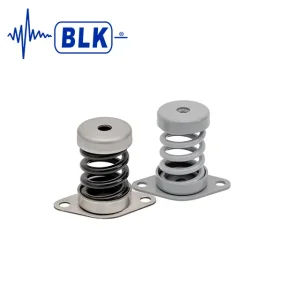
Advanced Damping Platforms & Matrix Systems
Explore specialized polymer pads, matrix mounts, high-capacity spring isolators, and micro-vibration damping platforms.





Need an Engineered Anti-Vibration Solution for Your Equipment?
Contact Bellking's technical engineering team today for instant equipment sizing, Finite Element Analysis (FEA) dynamic simulations, and factory-direct pricing tailored to your application.
Request Technical Consultation