
Industrial Anti-Vibration Mounts & Spring Isolators
Direct factory supply with certified attenuation efficiencies exceeding 95%. Engineered for pumps, cooling towers, heavy machinery, and structural suspension.



Global Procurement Demand for Low Price Vibration Isolation Platforms
Navigating the tension between stringent sub-micron stability parameters and capital expenditure optimization in modern factory deployments.
Semiconductor & Nanotech Metrology
As microchip fabrication scales down past 2nm process nodes, background floor dynamics (VC-A through VC-G criteria) directly govern lithography yield rates. Industrial buyers demand cost-efficient optical vibration platforms capable of dampening seismic ground noise to preserve multi-million dollar EUV and scanning electron microscope (SEM) investments without incurring exorbitant overheads.
HVAC & High-Rise Infrastructure
Modern architectural standards enforce aggressive acoustic isolation. Heavy centrifugal chillers, rooftop cooling towers, and variable speed pump skids induce low-frequency mechanical energy into building slabs. Industrial buyers seek factory-direct spring mounts and inertia bases to achieve >98% transmissibility loss while satisfying localized noise ordinances.
Power Transmission & Substation Transformers
Electrical grid modernizations require low-frequency transformer anti-vibration mounts to eliminate 100Hz/120Hz magnetostrictive hum. By deploying specialized elastomer-dampened steel platforms, facility directors prevent structural fatigue in adjacent concrete walls while mitigating transformer oil line shear stress.
Information Gain Insight: Unlocking Price Efficiency via Factory-Direct Sourcing
Procuring "low price" vibration isolation platforms does not require compromising structural integrity or damping capacity. By sourcing directly from integrated OEM manufacturers in established industrial hubs (such as Kunshan, China), enterprise procurement teams eliminate 30% to 50% distributor markups. Furthermore, automated robotic welding, CNC laser top-plate machining, and standardized rubber vulcanization allow high-precision performance at baseline production costs.
Physics of Vibration Isolation & Structural Selection Criteria
Understanding transmissibility, resonance phase shifts, and material hysteresis to specify the exact isolation matrix for industrial equipment.
1. The Transmissibility Equation ($T$)
Vibration isolation functions by creating a structural mismatch between the excitation frequency ($f_d$) generated by machinery and the natural frequency ($f_n$) of the isolator mount. Transmissibility ($T$) is defined mathematically as:
Where r = f_d / f_n represents the frequency ratio, and ζ (zeta) denotes the damping ratio. Isolation occurs only when r > √2 (approx 1.414). To achieve higher than 90% vibration reduction, engineers target an operating ratio of r ≥ 3 to r = 5.
2. Natural Frequency Selection Matrix
Selecting the ideal platform medium depends on required static deflection ($\delta_s$) and disturbing rotational speed (RPM):
- Pneumatic Air Platforms (f_n = 1.2 Hz - 2.5 Hz): Essential for nanometer-scale metrology, optical interferometry, and semiconductor inspection.
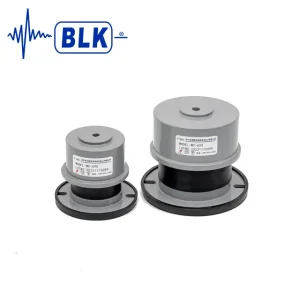
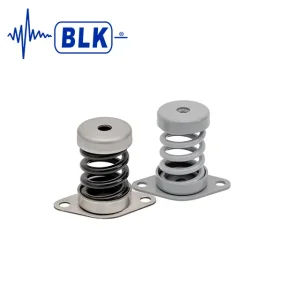
- Steel Spring Mounts (f_n = 3.0 Hz - 5.0 Hz): Best for low-speed HVAC equipment (chillers, pumps, fans running at 300 - 1800 RPM).
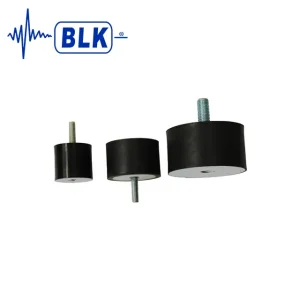
- Elastomeric Rubber Mounts (f_n = 6.0 Hz - 12.0 Hz): Optimal for high-speed machinery, small motors, and impact dampening (>1800 RPM).
| Platform / Mount Type | Natural Frequency (f_n) | Damping Ratio (ζ) | Primary Industrial Application | Relative Cost Factor |
|---|---|---|---|---|
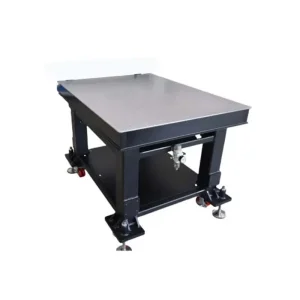
| Pneumatic Optical Isolation Platform (BK-DT) | 1.5 Hz – 2.0 Hz | 0.06 – 0.09 | Sub-nanometer metrology, CMM, laser optics | Premium Precision |
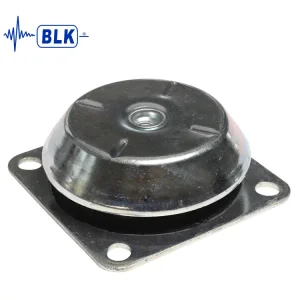
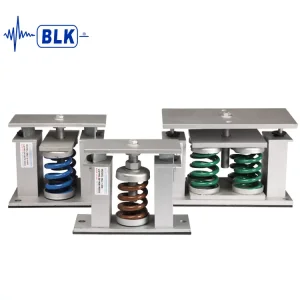
| High-Damping Spring Mount (MC / MA) | 3.0 Hz – 4.5 Hz | 0.02 – 0.05 | Centrifugal chillers, cooling towers, heavy gensets | Factory Economical |
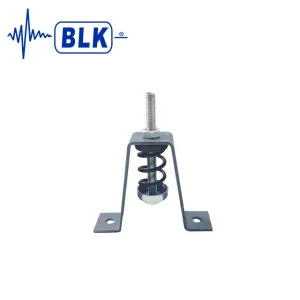
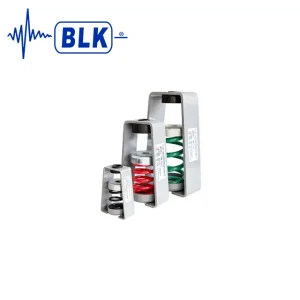
| Spring & Elastomer Hangers (HV) | 3.5 Hz – 5.0 Hz | 0.03 – 0.06 | Suspended piping, inline HVAC fans, ceiling ducts | Low Price Leader |
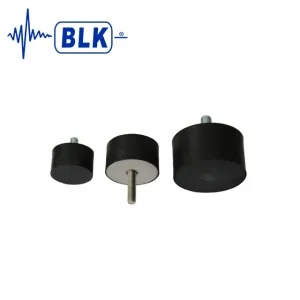
| Custom Rubber Mounts (BKVD / BKHQ / BKP) | 7.0 Hz – 12.0 Hz | 0.10 – 0.15 | Small pumps, compressors, electrical switchgear | Ultra Low Price |
| Polymer Damping Pads (BK-PM) | 8.0 Hz – 15.0 Hz | 0.15 – 0.25 | Foundation slabs, heavy press bases, acoustics | Bulk Material Value |
Turnkey Vibration Isolation Architecture by Sector
Proven engineering blueprints designed to resolve high-amplitude shock, resonance drift, and structure-borne acoustic transmission.
HVAC Plant Room & Water Pump Systems
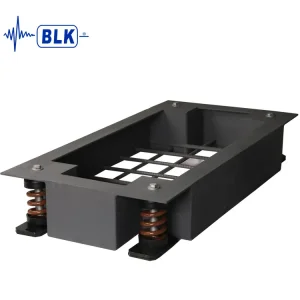
Water hammer and fluid turbulence in industrial pump skids generate severe dynamic instability. The ideal solution pairs CPB Type Inertia Bases with concrete ballast fill and MA/MC Anti-vibration Spring Mounts. This configuration lowers the mass center of gravity, absorbs starting torque, and guarantees >95% isolation from the building slab.
Cleanroom Optical & Metrology Workstations
Micro-vibrations caused by foot traffic and cleanroom laminar airflow ruin micro-inspection accuracy. Installing BK-DT Low-Frequency High-Damping Optical Vibration Platforms provides a self-leveling, pneumatic boundary that dampens sub-micron ambient oscillations, ensuring reliable automated optical inspection (AOI).
Transformers & Power Substation Isolation
Grid transformers emit continuous, low-frequency airborne and structure-borne hum. Utilizing customized high-load rubber isolators (BKVD / BKHQ Series) combined with polymer damping pads (BK-PM) absorbs shear stress, dampens electromagnetic harmonics, and guarantees long-term durability in outdoor switchyards.
The Future of Smart Vibration Control & Passive-Active Platforms
How next-generation material science, IoT structural monitoring, and hybrid dynamic control are redefining baseline industry standards.
1. Integrated IoT Sensor Networks
Embedding piezo-resistive MEMS sensors directly into spring caps and air mount bases allows continuous, real-time vibration telemetry. Maintenance teams receive automated alerts regarding spring settlement, mechanical resonance shifts, or seal degradation prior to equipment failure.
2. Advanced Nanocomposite Elastomers
Synthetic elastomeric polymers infused with graphene oxide and fluoroelastomer additives deliver ultra-high chemical resilience, zero gas outgassing in vacuum cleanrooms, and extended thermal stability across operating ranges from -40°C to +150°C.
3. Hybrid Active-Passive Damping
Bridging low-cost passive mechanical spring platforms with electromagnetic voice-coil actuators allows facilities to dampen high-frequency steady-state harmonics mechanically while actively counteracting transient inertial forces during high-speed motion stage slews.
Factory Infrastructure, Quality Control & Global Logistics
How rigorous metallurgical testing, ISO quality management, and localized technical support ensure reliable field execution.
ISO 9001 & 14001 Certification
Every batch of spring steel, rubber matrix compound, and cast iron housing undergoes strict incoming material verification and complete trace-code logging from raw billet to finished assembly.
900-Hour Salt Spray Testing
Steel hardware components are subjected to advanced Dacromet, electro-galvanized, or powder-coated surface treatments to withstand aggressive coastal, marine, and chemical plant atmospheres.
Full Spectrum Shake-Table Testing
Random vibration testing, dynamic load deflections, and ultimate dynamic tensile shear evaluations are conducted using calibrated tri-axial dynamic shaker systems to guarantee specification compliance.
24-48 Hour Rapid Dispatch
Standard MC, MA, HV, and BK series inventory items are maintained in automated warehousing centers, supporting rapid air and ocean dispatch to over 60 countries with customs compliance documentation.
Vibration Isolation Platform Selection & Procurement Q&A
Detailed technical answers from factory engineering leads to assist enterprise procurement officers and mechanical designers.
How do I calculate the correct spring isolator capacity for an industrial pump or chiller?
Why are factory-direct low price vibration isolation platforms equal or superior to high-cost distributor brands?
When should an engineer specify an Inertia Base (CPB Type) instead of direct mounting?
What is the expected service life of elastomeric rubber mounts versus steel spring mounts in harsh factory environments?
Can custom vibration platforms be manufactured to meet non-standard dimensions or seismic restraint codes?
Precision Optical Platforms, Inertia Bases & Heavy Rubber Mounts
High-damping optical tables, low-frequency rubber isolators, pump inertia supports, and spring mounts tailored to high-precision equipment specifications.



Request Engineering Assistance & Customized Pricing Today
Partner directly with factory application specialists to review your machinery CAD files, dynamic load calculations, and vibration isolation target parameters. Fast response guaranteed within 24 hours.
Request Technical Proposal