

Substation Deployment Units
High-Performance Mounts for Polish Utility & Power Generation
Pre-engineered isolators configured for medium to ultra-high-voltage power transformers, cast-resin indoor substations, and critical acoustic envelope damping.



Market Specifics • Central & Eastern Europe
Transformer Dynamics in Poland: Grid Modernization & Acoustic Strictures
A strategic overview of Polish utility infrastructure demands, PSE investment programs, and stringent EU regulatory frameworks controlling structural vibrations.
As Poland undergoes one of the most substantial electrical infrastructure overhauls in Central Europe—driven by PSE’s (Polskie Sieci Elektroenergetyczne) 10-year Network Development Plan (Plan Rozwoju Sieci Przesyłowej 2023–2032)—the demand for custom transformer anti-vibration mounting systems has transitioned from an ancillary consideration into a critical engineering prerequisite.
Poland's transmission system transformation involves the extensive construction and modernization of 400 kV and 220 kV extra-high voltage substations. Crucially, the landfall of massive Baltic Sea offshore wind farms (such as Baltic Power, Baltica 2 & 3) in the Pomeranian region (Pomorskie / Słupsk / Choczewo) necessitates ultra-reliable step-up transformers (ranging from 160 MVA to over 500 MVA). These massive inductive assets operate continuously under variable dynamic wind loads, inducing strong harmonic excitation into foundations, control rooms, and surrounding transmission corridors.
PSE Compliance & Harmonic Hum
Under Polish standard PN-EN 60076-10 and national environmental directives (Rozporządzenie Ministra Środowiska w sprawie dopuszczalnych poziomów hałasu), low-frequency noise (100 Hz core hum) cannot exceed 40 dB(A) at night near residential zones. Isolators must decouple structure-borne paths before energy enters ground strata.
Industrial Hub Electrification
From automotive gigafactories in Lower Silesia (Wrocław, Wałbrzych) to heavy metallurgical foundries in Upper Silesia (Katowice, Dąbrowa Górnicza), high-load step-down transformers operate in dense complexes where machinery-induced micro-vibrations compound transformer core resonance, risking bushing fatigue.
Baltic Climate Harshness
Northern Poland coastal installations suffer severe marine salinity, sub-zero continental winters (-25°C), and summer peaks (+35°C). Mounts must feature certified C5-M ISO 12944 corrosion resistance and low glass-transition elastomers that prevent embrittlement and catastrophic damping loss.
Regulatory & Engineering Thresholds for Poland Projects:
- PN-B-02151-2: Building acoustics standards requiring total transmission isolation of low-frequency rumble into administrative and nearby multi-story residential floors.
- PN-EN 1998-1 (Eurocode 8): Seismic and operational shear resistance parameters governing anti-tipping, captive spring configurations for substations in mining tremor zones (e.g., Upper Silesia coal basin and Polkowice-Sieroszowice copper basin).
- Directive 2002/49/EC: Assessment and management of environmental noise, enforcing strict punitive actions for continuous transformer tonal peaks at 100 Hz, 200 Hz, and 300 Hz.
Engineering Mechanics Whitepaper
Dynamic Physics: Magnetostriction & Isolation Transfer Mechanics
An in-depth analysis of core-induced 100 Hz harmonic vibration, dynamic stiffness matrices, and isolation transmissibility optimization.
The primary excitation mechanism in power and distribution transformers stems from magnetostriction in grain-oriented electrical steel (GOES) laminations within the transformer core, coupled with electromagnetic Lorentz forces acting across the primary and secondary copper/aluminum windings. Because magnetic flux alternates at Poland's AC grid frequency of $f_0 = 50\text{ Hz}$, the dimensional contraction and expansion of the core occurs symmetrically twice per electrical cycle, creating a fundamental disturbing vibration frequency of:
f_d = 2 \times f_0 = 2 \times 50\text{ Hz} = 100\text{ Hz} \quad (\text{with primary harmonics at } 200\text{ Hz}, 300\text{ Hz}, 400\text{ Hz})
Without engineered mechanical isolation, this multi-ton kinetic force couples directly through the transformer base wheels or rigid steel mounting plates into the concrete foundation. The foundation then behaves as an acoustic radiator, propagating Rayleigh and shear waves deep into the subsoil, which resonate through bedrock into surrounding masonry and commercial buildings as intrusive "tonal drone".
Mathematical Modeling of Transmissibility ($T$)
The isolation efficiency ($\eta$) is governed by the frequency ratio $r = f_d / f_n$, where $f_n$ represents the natural frequency of the anti-vibration mount assembly. The transmissibility formula, taking into account the system damping ratio ($\zeta$), is formulated as:
T = \sqrt{\frac{1 + (2\zeta r)^2}{(1 - r^2)^2 + (2\zeta r)^2}} \quad \text{where} \quad \eta = (1 - T) \times 100\%
To secure isolation efficiencies exceeding 96% to 99% at 100 Hz, the frequency ratio $r$ must strictly satisfy $r \ge 3.5$. This mandates that the natural frequency ($f_n$) of the installed mounting assembly must be engineered between 3.0 Hz and 5.0 Hz under full static operational mass (including core, windings, tank body, radiators, and dielectric transformer oil volume):
| Mounting Solution | Static Deflection ($\delta_{st}$) | System Natural Freq ($f_n$) | 100 Hz Transmissibility ($T$) | Isolation Efficiency ($\eta$) |
|---|---|---|---|---|
| Rigid Base (Bare Grout/Steel) | < 0.1 mm | > 50 Hz | 0.98 – 1.05 (Resonance Risk) | < 2% (Ineffective) |
| Standard Cork / Neoprene Pad | 1.0 – 2.0 mm | 12.0 – 16.0 Hz | 0.18 – 0.25 | 75.0% – 82.0% |
| High-Damping Elastomeric Pad (BKTS) | 3.0 – 5.0 mm | 7.0 – 9.0 Hz | 0.06 – 0.09 | 91.0% – 94.0% |
| Matrix Steel Spring Assembly (BK-MT) | 16.0 – 25.0 mm | 3.2 – 4.0 Hz | 0.01 – 0.02 | 98.0% – 99.0% |
| Viscous-Damped Spring System (BK-DS) | 20.0 – 30.0 mm | 2.8 – 3.5 Hz | 0.008 – 0.015 | 98.5% – 99.2% |
Dynamic Stiffness Ratio ($K_d / K_s$): Unlike plain elastomeric pads where dynamic stiffness can spike by 200% under high operating frequencies (causing $f_n$ to drift upwards into resonant territory), Bellking’s specialized matrix spring mounts and viscous-damped units maintain a dynamic-to-static stiffness ratio of $K_d / K_s \approx 1.05 - 1.15$, ensuring stable, mathematically predictable attenuation throughout the entire life of the transformer.
Global Procurement Intelligence
Macro Industry Trends & Enterprise Procurement Benchmarks
Navigating the paradigm shift toward decarbonization, mega-datacenter substations, and technical requirements across global engineering EPCs.
Trend 1: Dense Urban Indoor Substations
Rising land costs in Polish metropolitan areas (Warsaw, Kraków, Poznań) force utility substations into basement levels or adjacent mixed-use commercial buildings. Dry-type cast resin and gas-insulated (GIS) transformers demand total elimination of vibration transmission to avoid legal injunctions by building tenants.
Trend 2: Hyperscale AI Datacenters
Poland has emerged as the premier cloud datacenter cluster for CEE. Substations powering Tier IV data campuses require resilient mounts that withstand sudden transient load step changes and short-circuit electrodynamic shocks without bottoming out or destabilizing high-voltage busbar connections.
Trend 3: Seismic & Mining Subsidence
Substations located in Poland's southern industrial corridors face induced seismic activity from deep underground coal and copper mining. EPCs are systematically moving away from unconstrained pads toward captive, snubbed spring isolators that offer omnidirectional seismic limit stops.
Global EPC & Procurement Specification Protocol
When global EPCs (such as ABB, Siemens Energy, GE Grid, Polimex Mostostal, and Budimex) issue international tenders for anti-vibration transformer mountings, engineering documentation is subject to rigorous evaluation. Procurement managers evaluate suppliers using four foundational criteria:
Essential RFP Documentation Checklist for Polish & EU Grid Integration:
- Factory Acceptance Test (FAT) Dynamic Load Verification: Every batch must have certified servo-hydraulic force-deflection load curves showing verified spring rate ($k_s$) and dynamic damping coefficients.
- Comprehensive Finite Element Analysis (FEA): Digital stress simulation demonstrating safety factors $\ge 3.0$ against yield point during full seismic acceleration ($a_g = 0.25g - 0.40g$).
- Metallurgical & Corrosion Traceability: EN 10204 3.1 material certificates for spring steel (60Si2Mn / 55CrSi) and Dacromet / hot-dip galvanization reports passing 900-hour neutral salt spray (ISO 9227).
- Fire Retardancy & Oil Immersion: Elastomeric damping interlayers tested in compliance with DIN 4102 B1/EN 45545 fire smoke classifications and ISO 1817 compatibility under ASTM #1 and synthetic ester transformer oils (Midel 7131).
Smart Manufacturing Ecosystem
China Factory 4.0: Supply Chain Agility, Engineering Depth & Reliability
How Bellking’s dedicated Kunshan manufacturing plant combines German-standard engineering precision with Chinese industrial supply chain velocity.
Direct Manufacturer Advantage: Zero Intermediary Drag
Bellking is not a trading broker or distributor. Operating from our 2,000 m² state-of-the-art facility in Kunshan, Jiangsu Province, we execute 100% of product development in-house—from cold and hot helical coil winding, robotic laser cutting, and multi-axis CNC machining, to automated electrostatic spraying and automated elastomeric vulcanization.
For European and Polish engineering clients, this vertical integration eliminates markups from regional trading firms, reduces design revision cycles from weeks to hours, and guarantees absolute traceability across every welded seam and spring coil.
Factory 4.0 Operational Capabilities:
- ✓ 100,000+ Units Annual Manufacturing Capacity
- ✓ 37 Patents (Including 16 National Invention Patents)
- ✓ 1:1 Rapid Customization Prototype Dispatch in 3 to 5 Days
- ✓ 24-Hour Dispatch on Standard Heavy Springs & Rubber Mounts
- ✓ Direct Rail Freight Access via China-Europe Railway Express (Yiwu/Chengdu to Małaszewicze / Łódź, Poland in 12–14 days)
Advanced QA and Laboratory Instrumentation: Our plant hosts continuous cycle fatigue-testing machines capable of subjecting isolators to 5,000,000 cycles under simulated high-frequency load. In-house salt spray test chambers, digital durometers, spectrophotometers, and triaxial vibration test benches ensure every shipment headed for Gdansk, Gdynia, or Katowice arrives with unassailable quality certification.
Field Engineering Deployments
Tailored Application Scenarios Across Poland's Key Industrial Sectors
Proven mechanical vibration reduction strategies configured for specific territorial operating conditions.
Warsaw & Kraków Urban Substations
Challenge: Indoor 110/15 kV distribution transformers positioned adjacent to luxury residential lofts and commercial banks, generating 100 Hz tonal rumble propagating through concrete pillar frames.
Solution: Custom-engineered BK-MT matrix damped spring mounts with secondary BKTS elastomeric base pads, creating a dual-stage acoustic barrier achieving >97% transmission loss and dropping noise by 14 dB(A).
Baltic Wind Onshore Substation (Choczewo)
Challenge: High-capacity 400 kV step-up transformers exposed to coastal salt fog and relentless wind gusts causing structural rocking.
Solution: BK-DS viscous-damped spring assemblies with integrated Dacromet 900-hour C5-M anti-corrosion coating, reinforced with captive lateral seismic snubbers to resist dynamic shear while maintaining 3.2 Hz natural frequency.
Silesian Heavy Foundry & Mining Plants
Challenge: 20 MVA industrial furnace step-down transformers situated near drop forging hammers and mining seismic tremors in Upper Silesia.
Solution: Heavy-duty shock-rated spring mount arrays designed to endure 3G to 5G acceleration impacts, mitigating foundation cracking and eliminating resonance spikes across the transformer radiator cooling banks.
Complete Industrial Catalog
Precision Vibration Damping Catalog for Infrastructure & Power
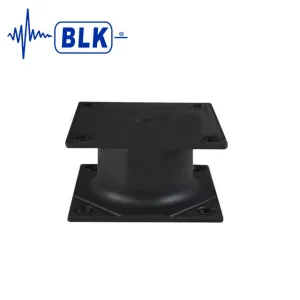
Explore Bellking's auxiliary damping series: from pneumatic mounts and elastomeric buffers to seismic spring hangers.







Expert Technical Q&A
Frequently Asked Engineering & Procurement Questions
Specific guidance on sizing, installation, compliance, and logistics for Polish transformer installations.
Why is a 3–5 Hz natural frequency mount critical for 50 Hz transformers in Poland?
Poland operates on a 50 Hz electrical alternating grid, which generates a fundamental magnetostrictive vibration hum at exactly 100 Hz (twice the line frequency), alongside strong harmonics at 200 Hz, 300 Hz, and 400 Hz. For vibration isolation to begin, the disturbing frequency ratio must exceed $\sqrt{2} \approx 1.41$. To achieve high-efficiency acoustic attenuation (>95%), the frequency ratio $r = f_d / f_n$ should be at least 3.0 or higher. A mounting system with a natural frequency of 3.5 Hz yields a ratio of $r = 100 / 3.5 \approx 28.5$, driving transmissibility below 1% and stopping structure-borne hum before it enters building foundations.
How do Bellking mounts resist Poland's extreme winter temperatures and Baltic coastal corrosion?
All steel components undergo advanced Dacromet coating or hot-dip galvanization verified by over 900 hours of neutral salt spray testing according to ISO 9227 (equivalent to coastal C5-M high-durability atmospheric conditions). For elastomeric pads and internal damping components, we utilize specially formulated polychloroprene (CR) or nitrile elastomers with low glass-transition temperatures (operative down to -40°C), preventing the cold embrittlement and hardening typical of standard commercial rubber in Polish winters.
What specific input data is required to calculate and design custom transformer mounts?
To provide a fully verified dynamic isolation proposal within 24 hours, Bellking application engineers require: (1) Total operational mass (including core, windings, tank body, and complete dielectric oil volume); (2) Exact Center of Gravity (CoG) coordinates, as transformers are asymmetrical due to radiator and conservator tank placements; (3) Number, location, and dimensions of support footpads or wheel track profiles; (4) Operating line frequency (50 Hz for Poland) and target acoustic decibel criteria (e.g., meeting PN-B-02151-2 thresholds); (5) Ambient environmental conditions (indoor cast-resin vs. outdoor substation pad).
How are oil leaks, synthetic esters, and fire safety managed in your transformer mounts?
Mineral transformer oil and modern synthetic esters (such as Midel 7131) can severely degrade standard commercial elastomeric mounts. Bellking uses oil-immersion-certified polymers tested in accordance with ISO 1817 (volume swelling < 3% over continuous exposure). Additionally, our matrix mounts utilize full steel containment springs and fire-retardant damping matrices conforming to DIN 4102 B1 flame spread standards, preventing fuel feeding in the event of an electrical substation arc incident.
What are the shipping timelines, documentation, and customs clearance procedures for Poland?
Standard models ship from our Kunshan factory within 24–48 hours. Custom engineering solutions take 3 to 5 business days for final tooling and assembly. Freight to Poland is streamlined through two channels: (1) Fast sea freight arriving at the Port of Gdańsk or Gdynia (approx. 28–32 days); (2) Direct China-Europe Railway Express (Yiwu/Chengdu to Małaszewicze / Łódź dry port terminals) in only 12 to 14 days. We supply full documentation packages: CE Declaration of Conformity, ISO 9001 factory test reports, EN 10204 3.1 material certificates, and EUR.1 origin documentation for seamless customs clearance.
Do your mounts accommodate seismic and dynamic short-circuit electrodynamic forces?
Yes. During an external grid short circuit, electrodynamic forces within transformer coils create extreme dynamic surge reactions. Furthermore, in Poland's southern mining areas (Upper Silesian Industrial Basin), ground tremors require structural restraint. Bellking manufactures captive, restrained spring mounts (such as the MD and BK-DS series) with integrated 3D multi-directional snubbing limiters, resisting accelerations up to 3G–5G without shearing or tipping.
Empower Your Polish Substation Project with Precision Isolation
Get a comprehensive engineering calculation report, dynamic stiffness model, and direct-from-manufacturer quotation tailored to your transformer weight and PSE compliance targets within 24 hours.
Send Inquiry Now