
Featured Industrial Vibration Dampers for Nigerian Power Grids
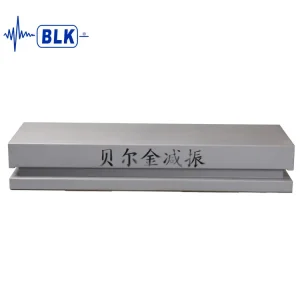
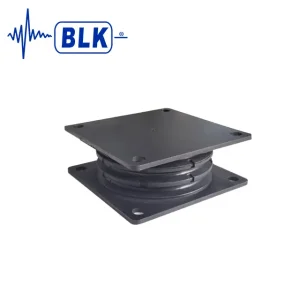
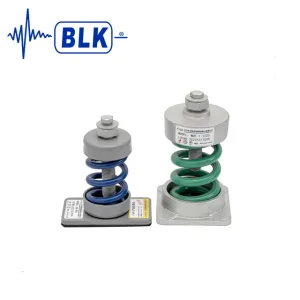
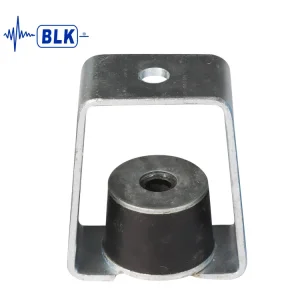
Deploying high-deflection matrix pads, dual-stage spring isolators, and heavy-duty suspension brackets to decouple structural core hum (100 Hz / 120 Hz) and harmonic resonance in demanding African substation environments.
Navigating Nigeria's Extreme Electrical Infrastructure Landscape
The Nigerian electrical landscape presents unique electro-mechanical challenges rarely encountered in temperate western power distribution networks. Industrial power users—spanning the Ikeja and Ilupeju industrial corridors in Lagos, the Trans-Amadi cluster in Port Harcourt, and the manufacturing belts of Ogun State—operate within a volatile operational ecosystem characterized by frequent voltage transients, erratic load shedding, and heavy reliance on captive diesel/gas generation sets.
When step-up and step-down transformers run alongside large reciprocating gen-sets or fluctuating industrial loads (such as induction furnaces and injection molders), severe harmonic distortions are injected into the core. This non-linear magnetostrictive excitation triggers extreme 100 Hz structural hum, harmonic resonance peaks (up to 400 Hz), and intense micro-vibrations that fracture rigid mounting anchors, degrade winding insulation, rupture radiator fin welds, and induce premature oil leaks.
The Cost of Unmitigated Transformer Vibration
- Catastrophic Core Delamination: High vibration accelerates the loosening of clamping bolts, causing silicon steel laminations to chatter, driving up eddy current core losses by 14–22%.
- Oil Tank Fatigue Leaks: Continuous cyclical stress induces stress corrosion cracking along tank weld seams and bushing gaskets, leading to insulation fluid fires or dielectric breakdown.
- Acoustic Non-Compliance: Low-frequency hum easily crosses 75 dB(A), violating NESREA (National Environmental Standards and Regulations Enforcement Agency) urban noise abatement guidelines.
- Severe Structural Resonance: Unisolated kinetic energy transfers directly through plinths into commercial multi-story structural concrete slabs, generating unbearable structural reverberations.
Physics of Magnetostriction & Advanced Mechanical Isolation
Overcoming the low-frequency acoustic dilemma through tailored dynamic stiffness ($K_d$), natural frequency suppression ($f_n$), and high loss-factor elastomer matrix formulations.
Magnetostriction Mechanics
Under an alternating 50 Hz electromagnetic field (the standard Nigerian grid frequency), ferromagnetic core sheets expand and contract twice per cycle, establishing a fundamental excitation frequency of 100 Hz, supplemented by harmonic overtones at 200 Hz, 300 Hz, and 400 Hz. Without customized isolation mounts, this kinetic energy transforms building foundations into massive resonant loudspeakers.
Transmissibility & Deflection
Dynamic isolation occurs only when the disturbance frequency ratio ($r = f_d / f_n$) strictly exceeds $\sqrt{2} \approx 1.414$. To achieve an attenuation rate exceeding 90% at 100 Hz, Bellking isolators are engineered to achieve an in-situ natural frequency ($f_n$) between 4.5 Hz and 8.0 Hz under static load deflection, maintaining safe separation from any fundamental rotational frequencies.
Tropicalized Anti-Aging Polymer
Standard commercial rubber becomes brittle and cracks when exposed to high ambient heat (exceeding 40°C in Northern Nigeria) combined with hot transformer mineral oil leaks. Bellking mounts employ custom vulcanized chloroprene, nitrile, and fluoro-elastomeric matrix compounds that preserve consistent damping properties ($\eta \ge 0.22$) across a continuous temperature spectrum of -20°C to +120°C.
| Transformer Type / Capacity | Dynamic Forcing Freq. | Recommended Mount Type | Static Deflection | Target Transmissibility ($T$) |
|---|---|---|---|---|
| 500 kVA – 2,500 kVA Dry Type (Commercial / Indoor) | 100 Hz / 200 Hz | BK-MT Matrix / BKSWA Damped Mount | 6 – 12 mm | < 0.05 (95% Isolation Efficiency) |
| 2.5 MVA – 15 MVA Oil-Immersed (Industrial Distribution) | 100 Hz / 150 Hz / 300 Hz | MD Damped Spring / BK-DS Composite | 15 – 25 mm | < 0.02 (98% Isolation Efficiency) |
| 20 MVA – 60 MVA Power Grid (TCN 132/33kV Substation) | 100 Hz Harmonics + Shock Loading | Heavy-Duty Custom BKSWA Multi-Layer Base | 20 – 35 mm | < 0.015 (98.5% Isolation Efficiency) |
| Captive Genset Step-Up Transformers (Mining / Oil Terminals) | 25 Hz (Genset) + 100 Hz (Core) | Dual-Stage Spring Mount with Viscous Restraint | 25 – 40 mm | < 0.01 (99% Combined Isolation) |
Engineering Solutions Tailored for Nigerian Key Sectors
From coastal marine salt-fog in the Niger Delta to critical high-density data hubs in Victoria Island, Bellking delivers field-proven performance.
Data Centers, Financial Institutions & Luxury High-Rises
High-density multi-story commercial buildings in Eko Atlantic, Victoria Island, and Ikoyi house primary step-down substations inside basement vaults or mid-level mechanical rooms. Structural acoustic flanking transmits the constant 100 Hz transformer rumble upward through reinforced concrete columns into boardrooms, trading floors, and executive suites. Bellking’s BK-MT Matrix and BK-DSR mounts eliminate airborne and structure-borne re-radiation, capping indoor ambient noise well within NC-30 acoustic requirements.
Heavy Manufacturing, Steel Mills & Processing Facilities
Industrial plants operating continuous heavy equipment subject step-down transformers to both self-generated core vibrations and incoming plant foundation shocks (stamping presses, shredders, ball mills). Our BKSWA Multi-Layer Dampers feature bi-directional horizontal shear restraint and high vertical loading capacity (up to 400 kN per point), protecting sensitive transformer internal winding tap-changers against transient floor movement.
Offshore Floating Platforms, Refineries & Marine Terminals
Coastal oil terminals and petrochemical processing units in Rivers, Delta, and Bayelsa States require extreme environmental resilience against Class C5-M marine atmospheric corrosion. Bellking transformer mounts engineered for the Niger Delta combine AISI 316 stainless steel housings or 900-hour salt-spray tested Dacromet coatings with specialized synthetic elastomer pads impervious to marine humidity, sour gas vapors, and crude oil residue.
Extreme Thermal Cycling, Harmattan Dust & IPP Plants
Substations in Northern Nigeria endure massive diurnal temperature swings (daytime peaks of 42°C dropping sharply at night) paired with abrasive silica-laden Harmattan winds. Bellking's MD Type Spring Isolators incorporate sealed acoustic cups and self-cleaning telescopic guides that prevent dust ingress from binding spring coils, ensuring steady static deflection year-round without thermal drift.
Full Compliance with Nigerian & International Standards
Meeting and exceeding the stringent quality prerequisites established by local oversight bodies and global engineering institutes.
SONCAP & NEMSA Compliance
Bellking mounts satisfy all entry and installation requirements dictated by the Standards Organisation of Nigeria Conformity Assessment Programme (SONCAP) and align with technical guidelines issued by the Nigerian Electricity Management Services Agency (NEMSA) regarding electrical grounding continuity and mechanical mounting safety.
IEC 60076-10 Acoustic Standard
Tested in full compliance with IEC 60076-10 (Power Transformers – Determination of Sound Levels) and IEEE C57.12.90, confirming verifiable attenuation of A-weighted sound power levels ($L_{WA}$) by up to 24 dB(A) across fundamental and primary harmonic frequencies.
Factory Traceability & FAT
Every delivery for Nigerian projects includes comprehensive QA documentation: Material Test Certificates (EN 10204 3.1), Shore A durometer hardness verification, static load-versus-deflection curves, and 900-hour salt spray corrosion reports certified by third-party inspection bodies.
Technology Roadmap: Next-Gen Vibration & Health Monitoring
Bridging mechanical damping with smart predictive grid maintenance for the next era of African industrial electrification.
1. IoT Predictive Monitoring Mounts
Development of intelligent mounts featuring embedded MEMS tri-axial accelerometers and thermistors. These smart sensors transmit live vibration spectral shifts via LoRaWAN/cellular uplinks to plant SCADA systems, alerting engineers in Lagos or Port Harcourt to early core bolt loosening or winding movement weeks before acoustic alarms trigger.
2. Nano-Composite Viscoelastic Elastomers
Synthesizing graphene-reinforced elastomer matrices to deliver temperature-invariant loss factors across a wider thermal range (-30°C to +140°C). This breakthrough prevents elastomer stiffening under heavy desert heat cycles and guarantees sustained low-frequency isolation efficiency throughout multi-decade operating horizons.
3. Seismic-Acoustic Dual Stage Restraints
Unified snubbers engineered to withstand seismic shear vectors, short-circuit electro-dynamic shockwaves, and wind load overturning moments without sacrificing acoustic isolation. These mounts meet stringent IEEE 693 high-seismic requirements while preventing metal-to-metal shorting through patented elastomeric buffer rings.
Full Industrial Range: Heavy Dampers, Bases & Isolation Systems
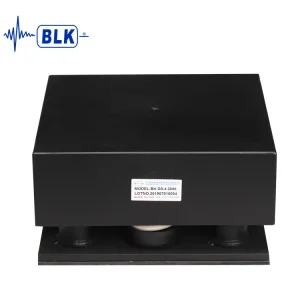
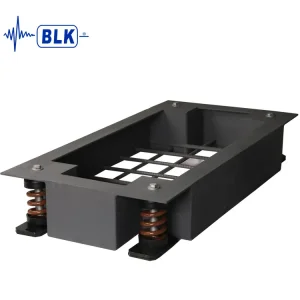
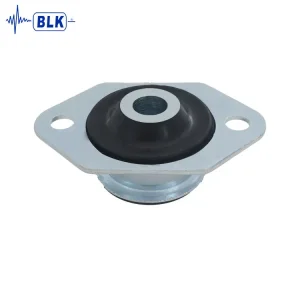
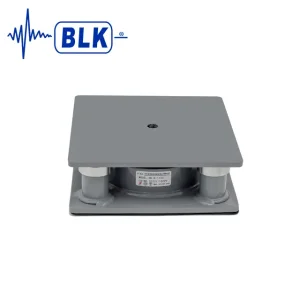
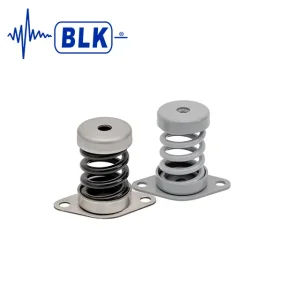
Discover our comprehensive portfolio of factory-engineered spring isolators, damped rubber pads, inertia bases, and precision cone mounts serving the Nigerian market.



Frequently Asked Engineering & Procurement Questions
Detailed answers for EPC contractors, electrical consultants, and procurement managers deploying substation assets in Nigeria.