
Primary Industrial Rubber Mount Series for Australia
Heavy-duty, factory-direct cylindrical and captive elastomeric dampers certified for Australian heavy industrial applications.
-
 Low Price BKVV Type Rubber Mounts Factories, Manufacturers
Australia-Spec BKVV Cylindrical Vibration Isolator
Designed for high-frequency industrial slurry pumps, vibratory screens, and mineral process motors across WA and QLD sites.
-
 Custom BKVD Type Rubber Mounts Factories, Manufacturer
BKVD Anti-Vibration Isolator Mount
Equipped with Dacromet anti-corrosion studs tailored for Australian coastal commercial rooftop HVAC chillers and fan units.
-
 High-Quality BKDD Type Rubber Mounts Factories, Manufacturers
BKDD Dual-Threaded Vibration Damper
Flush-mount internal threading ideal for naval auxiliary generators, transport chassis, and electrical control cubicles.
-
 Custom BKDE Type Rubber Mounts Factory, Manufacturer
BKDE Multi-Axis Dynamic Isolator
Engineered to attenuate high shear and compressive vectors in Australian regional agricultural processing and milling machinery.
The Australian Vibration Isolation Landscape: Engineering for Extreme Operational Stress
From the iron ore conveyor systems of the Pilbara to high-density commercial towers across Sydney and Melbourne, elastomeric isolation in Australia demands distinct metallurgical and polymer resilience.
Heavy Mining & Resource Corridor Realities
The Australian resource sector—concentrated in Western Australia's Pilbara and Queensland's Bowen Basin—imposes mechanical stresses seldom observed in standard manufacturing. Slurry pumps, flotation agitators, and vibrating screens operate non-stop under ambient temperatures frequently exceeding 50°C. Standard natural rubber degrades rapidly under intense solar radiation and cyclical dynamic strain, precipitating premature elasticity collapse, misaligned drive shafts, and unplanned site shutdowns costing up to AUD $120,000 per hour.
Urban Acoustic Standards (NCC & AS/NZS)
Under the National Construction Code (NCC) Section F5 and building acoustic standard AS/NZS 2107, multi-residential and commercial Class 2 to 9 buildings enforce rigorous structure-borne noise limits. High-capacity centrifugal rooftop chillers, air handling units (AHUs), and variable refrigerant flow (VRF) condensing systems located directly above premium penthouses or healthcare facilities must achieve vibration transmissibility lower than 3%, mitigating mechanical humming in the critical 10 Hz to 120 Hz octave bands.
Marine & Hyper-Saline Coastal Atmospheric Degradation
Over 85% of Australia’s population and heavy industrial fabrication facilities operate within 50 km of the coastline. Environmental corrosivity ratings regularly hit C4 and C5-M under AS 4312. Traditional zinc-electroplated vibration isolators corrode within 18 months due to airborne sodium chloride and cyclical marine moisture. Australian plant operators require high-grade bonding agents (Chemlok), Dacromet-treated studs rated for over 900 hours salt-spray resistance, or Grade 316 stainless steel endplates.
Engineering Fundamentals: Mathematical Sizing & Elastomer Formulation
Vibration isolation relies on carefully tuned dynamic-to-static stiffness ratios, shear-strain linearities, and high internal polymer hysteresis.
Dynamic Transmissibility & The √2 Frequency Barrier
Effective elastomeric vibration mitigation is governed by the frequency ratio $r = f_d / f_n$, where $f_d$ is the operating disturbance frequency of the rotating machinery and $f_n$ is the natural frequency of the mounted assembly. Damping occurs strictly when $r > \sqrt{2} \approx 1.414$.
Transmissibility ($T$) is quantified using the classical Voigt-Kelvin mechanical representation:
Where $\zeta$ represents the damping ratio. For Australian high-speed motors operating at 1450 RPM ($f_d \approx 24.17\text{ Hz}$) or 2950 RPM ($f_d \approx 49.17\text{ Hz}$), engineered rubber isolators with natural frequencies tailored between 6 Hz and 9 Hz deliver theoretical isolation efficiencies from 88% to over 96%, stopping mechanical resonance from transferring into concrete structural slabs.
Vulcanizate Formulation Matrix for Harsh Local Environments
Selecting rubber for industrial isolation requires assessing cross-link density, carbon black grading (N220 vs N330), and antiozonant systems. In Australia’s sun-drenched industrial centers, compounding chemistry dictates lifecycle performance:
- Natural Rubber (NR - Polyisoprene): Exceptional mechanical resilience, high tensile strength (>22 MPa), superior tear propagation resistance, and lowest dynamic-to-static ratio ($K_d/K_s \approx 1.15 - 1.30$). Ideal for heavy mining screens, though vulnerable to hydrocarbon oils.
- Polychloroprene (Neoprene - CR): Inherent resistance to flame, hydraulic oil spillage, ozone, and thermal breakdown. The premier choice for marine engine rooms and Australian commercial HVAC equipment compliant with AS 1668.
- Nitrile (NBR): Engineered specifically for transformer oil sumps, diesel genset fuel spill zones, and hydraulic power unit dampening.
- EPDM Formulations: Essential for continuous outdoor installations across Queensland and Northern Territory with high UV and ozone exposure up to 120°C.
| Elastomer Compound | Hardness (Shore A) | Dynamic Loss Factor (η) | Operating Temp Range | UV & Ozone Resistance | Australian Application Focus |
|---|---|---|---|---|---|
| High-Purity Natural Rubber (NR) | 40 to 75 ±5 | 0.05 – 0.12 | -40°C to +75°C | Moderate (Requires Wax Inhibitors) | Mining vibrating screens, crushers, aggregate conveyors (WA/QLD) |
| Engineering Neoprene (CR) | 45 to 70 ±5 | 0.12 – 0.25 | -30°C to +100°C | Excellent (NCC Fire / UV Rated) | Commercial HVAC chillers, AHUs, inertia bases in CBD developments |
| Hydrogenated Nitrile (HNBR / NBR) | 50 to 80 ±5 | 0.15 – 0.30 | -25°C to +125°C | Good (Resistant to Mineral Oils) | Electrical distribution transformers, power substations, oil & gas rigs |
| High-Grade EPDM | 40 to 65 ±5 | 0.10 – 0.18 | -45°C to +140°C | Superior (Unmatched Solar Stability) | Remote outback telecommunication cabinets & BESS solar plant mounts |
Engineered Vibration Isolation Solutions for Australia's Core Sectors
Custom-engineered damping systems solving critical operational bottlenecks across resource extraction, built environment, transport, and naval infrastructure.
1. Mineral Processing & Ore Extraction Plant
Ore handling operations require robust, shock-tolerant isolators under ball mills, cone crushers, and dewatering screens. Bellking designs custom multi-layer elastomeric sandwich pads and high-capacity conical mounts engineered to withstand sudden dynamic peak shock loads up to 5G. By isolating structural foundations from destructive low-frequency harmonic resonance, plant operators reduce concrete foundation micro-fissuring and extend bearing service lives by over 40%.
2. Commercial Buildings & Data Centers (CBD)
High-density urban infrastructure requires strict compliance with AS/NZS 2107 acoustic comfort criteria. In mission-critical data centers in Western Sydney and Melbourne's Docklands, heavy diesel backup generators and water-cooled chillers produce pervasive low-frequency hums. Our factory-engineered BKVD and captive shear-compression mounts provide 95%+ isolation transmissibility, ensuring zero transmission into sensitive server racks and tenant work environments.
3. Marine Propulsion & Offshore Vessels
Operating in corrosive maritime environments like the Henderson Maritime Precinct (WA) or Osborne Naval Shipyard (SA), marine engine mounts must satisfy dual demands: attenuating vessel hull acoustic signatures and surviving 360-degree multi-directional thrust vectors. Our captive marine-grade rubber isolators feature fail-safe interlocks, Dacromet and 316 stainless steel housings, protecting naval gensets and auxiliary propulsion units from hydrodynamic shock loads.
Regulatory Compliance, NATA Equivalency & Quality Verification
Stringent production controls, batch traceability, and full alignment with Australian Standards safeguard procurement teams against costly downtime.
AS ISO 10816 Mechanical Vibration Compliance
Our manufacturing plant delivers isolation solutions calibrated to suppress vibration velocities within the "Zone A/B" acceptable limits of AS ISO 10816-3 for non-reciprocating machines rated between 15 kW and 50 MW.
AS 1170.4 Seismic Restraint Certification Capability
To satisfy Section 8 of AS 1170.4 (Earthquake actions in Australia for non-structural building components), captive housing designs incorporate ductile cast iron housings capable of resisting specified horizontal and vertical G-forces without mechanical disengagement.
ASTM D429 Adhesion & Tensile Verification
The critical failure point of rubber isolators is the rubber-to-metal bonding interface. We employ automated grit blasting, multi-coat organosilane chemlok adhesives, and thermal press curing, with 100% batch proof testing under ASTM D429 Method B (90° peel test) and ASTM D395 compression set standards.
Procurement Assurance & Documentation Package
Australian engineering contractors and Tier-1 EPCMs require comprehensive documentation before approving equipment for site delivery. Bellking provides complete project compliance packs:
- EN 10204 3.1 Mill Test Certificates verifying metal chemistry and tensile yield strength.
- Rheometer Curing Charts & Compound Certificates detailing durometer, elongation at break, and carbon black dispersion.
- Finite Element Analysis (FEA) Deflection Reports verifying natural frequency and static deflection curves under operational load.
- 900-Hour Dacromet Salt Spray Test Certification under ASTM B117 / AS 2331.3.1.
- Inspection and Test Plan (ITP) & Manufacturing Data Report (MDR) customized for resource infrastructure projects.
Engineering Roadmap: Smart Materials & Sustainable Elastomers
Innovating the next generation of vibration isolation technology to support green building targets and AI-enabled industrial predictive maintenance.
Embedded IIoT Vibration Diagnostics
Integrating micro-piezoelectric sensors within elastomeric mounts to provide real-time dynamic stiffness and frequency drift data directly to Australian plant SCADA networks, enabling predictive maintenance before catastrophic bearing failure.
Circular, Bio-Based Elastomers
Developing bio-polyisoprene matrices and devulcanized circular rubber blends that lower Scope 3 embodied carbon by 35%, helping Australian projects meet stringent Green Star and Climate Active decarbonization targets.
Sub-Zero to Extreme Heat Compounds
Engineering advanced fluoroelastomer-silicone hybrid mounts capable of maintaining linear elasticity from -50°C in high-altitude Snowy Hydro assets up to 160°C in continuous heavy-haul locomotive engine bays.
Topology-Optimized FEA Geometry
Employing AI generative algorithms to optimize the internal void geometry of multi-layer isolators, reducing physical weight while maximizing tri-axial shear energy dissipation by up to 28%.
Specialized Vibration Isolators & Damping Mounts
Explore our heavy-duty elastomeric product catalog, ready for custom dimensional and durometer configuration.
-
 High-Quality BKVE Type Rubber Mounts Factory, Factories
Australia-Ready BKVE Conical Vibration Mount
Features a waisted geometry providing progressive stiffness under heavy dynamic shock loads, suitable for mining screens and crushing plants.
-
 High-Quality BKH Type Rubber Mounts Factory, Price
BKH Encapsulated Bell Isolator
Metal top canopy protects the internal elastomer from UV degradation and hydraulic oil contamination on open commercial rooftops.
-
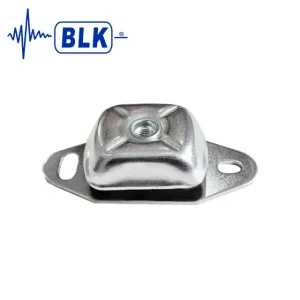 Custom BKM Type Rubber Mounts Factories, Manufacturers
BKM Marine Captive Propulsion Mount
Engineered with a fail-safe mechanical snubber to handle dynamic rebound during rough marine crossings in Bass Strait and coastal trade routes.
-
 High-Quality BKHQ Type Rubber Mounts Factory, Manufacturers
BKHQ Heavy Load Dynamic Isolator
Engineered for heavy diesel generator sets, air compressors, and transformer stations requiring up to 5,000 kg capacity per support point.
-
 Low Price BKP Type Rubber Mounts Manufacturers, Manufacturer
BKP Compact Leveling Mount
Cost-effective, highly reliable vibration damping foot for CNC machinery, laboratory cabinets, and localized pharmaceutical conveyors.
-
 Custom BKDR Type Rubber Mounts Factories, Price
BKDR Ring Type Torsional Damper
Specialized annular elastomer dampening ring attenuating both axial and torsional vibration across high-speed rotating drive systems.
-
 Custom BK-DSR Type Damped Rubber Mounts Factories, Manufacturer
BK-DSR High-Damping Structural Mount
Incorporates custom viscoelastic polymer matrices to deliver elevated loss factors (η > 0.28) for rapid transient resonance attenuation.
-
 Custom BKSWA Type Multi-Layer Antivibration Dampers Factory, Price
BKSWA Multi-Layer Structural Bearing
Interleaved steel-plate laminated elastomeric bearing built for massive civil infrastructure, structural bridge expansion, and rail trackbeds.
Engineering Questions Procurement & Specifiers Ask Us Most
Comprehensive technical guidance based on real-world test data and Australian regulatory project specifications.
How do rubber vibration isolators compare with steel coil spring mounts in Australian applications?
By contrast, rubber vibration isolators provide internal material hysteresis (loss factor $\eta = 0.10 - 0.25$), attenuating acoustic structure-borne noise in the audible 60 Hz to 2000 Hz spectrum. Rubber isolators resist extreme dust abrasion and moisture typical of mining sites, and eliminate the sudden brittle shear failures possible with steel springs under cyclical fatigue.
How do Bellking isolators resist severe UV, ozone, and heat degradation in Northern Australia?
These protective agents migrate continuously to the component surface, creating a renewing barrier against photo-oxidation. For high-radiation rooftop installations, our BKH bell-series mounts feature a heavy-gauge stamped steel cover that blocks direct UV rays and prevents surface fluid contamination.
What parameters are required to size custom rubber mounts for Australian mining equipment?
1. Total Operating Weight: Base machine, drive motors, fluid capacity, and dynamic payload.
2. Center of Gravity (CoG) Coordinates: Symmetrical or asymmetrical weight distribution to calculate individual load points.
3. Number & Geometry of Support Points: Available bolt hole diameters and footprint dimensions.
4. Excitation Frequencies: Motor RPM (running speeds), variable frequency drive (VFD) operating ranges, or gear mesh frequencies.
5. Environmental Conditions: Outdoor ambient temperature ranges, presence of hydraulic fluids or diesel, coastal saline proximity, and any seismic shear restraint mandates under AS 1170.4.
Can Bellking manufacture custom non-standard mounts to match existing legacy Australian footprints?
How does Bellking prevent galvanic corrosion between metal inserts and supporting steelwork in marine zones?
What are typical production lead times and shipping schedules to Australian ports?
Need Custom Vibration Isolators Sized for Your Equipment?
Connect with our senior vibration engineering specialists. Send us your equipment weights, operational RPM, and environmental criteria to receive an engineering calculation pack, FEA transmissibility report, and competitive factory pricing within 24 hours.