Industrial Dynamics & Anti-Vibration Paradigms in the Milan Metropolitan Area
Lombardy accounts for over 22% of Italy’s national GDP, acting as the undisputed engine of Southern Europe’s advanced mechatronics, precision packaging, heavy HVAC systems, and chemical processing equipment. In such a high-density, tight-tolerance manufacturing ecosystem, elastomeric vibration isolation is no longer a secondary accessory—it is an indispensable factor determining equipment MTBF, acoustic footprint, and CE compliance.
Brianza & Bergamo Mechatronics
High-speed packaging robotics, textile looms, and automated multi-axis milling machines operating around Monza, Bergamo, and Brescia require low-profile cylindrical and sandwich isolators with exact Shore A durometer tolerances (±3 Shore A) to eliminate cyclic harmonic amplification and prevent frame fatigue.
Milan Metropolitan HVAC & Data Centers
From modern data facilities in Caldera Park to historic residential retrofits across Central Milan (Zona 1), centrifugal chillers, heat pumps, and AHUs must comply with strict Italian environmental noise ceilings (D.P.C.M. 14/11/1997). Isolators must deliver over 92% structure-borne transmissibility loss down to 10 Hz.
Chemical, Petrochemical & Rail
Industrial corridors stretching along Sesto San Giovanni and the Po Valley subject rubber mounts to aromatic hydrocarbons, ozone exposure, and aggressive temperature cycling (-30°C to +110°C). Formulations demand custom NBR, EPDM, and Chloroprene (Neoprene) compounds with high dynamic loss factors.
≤ 8 Hz
Low Natural Frequency
Up to 98%
Isolation Efficiency
900+ Hrs
Salt Spray Resistance
35% - 50%
Factory Price Advantage
High-Demand Precision Mounts
Standard & Custom Isolator Configurations for Milan Applications
These four core elastomeric mount architectures serve high-volume Italian OEM equipment lines, combining precision-turned metric steel studs with vulcanized elastomer bodies engineered for shear, compression, and combined loading vectors.
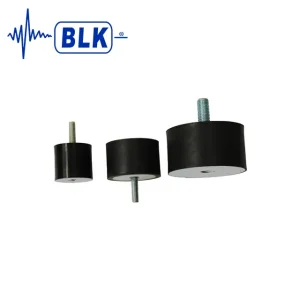
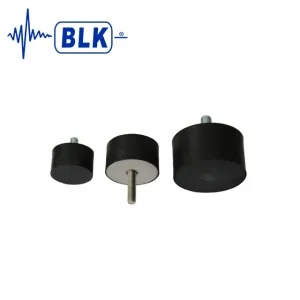
Double Stud
Milan Mechanical Machining Series: BKVV Double-Stud Isolators
Designed for Lombardy's CNC machine enclosures, electric motor pedestals, and compact gear pumps requiring symmetric male-to-male metric thread fastening.
Vibration isolator selection requires moving beyond basic static durometer ratings. Sizing an isolator for high-precision European equipment requires managing the dynamic-to-static stiffness ratio ($K_d / K_s$), mechanical loss factor ($\eta$), and continuous creep behavior under long-term compressive stress.
Dynamic vs. Static Stiffness: The Sizing Factor
When calculating natural frequency ($f_n$), European engineers frequently rely on the static spring deflection $\delta_{st} = mg / K_s$. However, vulcanized elastomers exhibit viscoelastic non-linearity: under dynamic oscillating forces, the dynamic stiffness $K_d$ is consistently higher than the static stiffness $K_s$.
Depending on polymer crosslink density and carbon black filler grading (such as N330 vs N774), the ratio $K_d / K_s$ typically ranges from 1.2 to 2.2. Overlooking this factor shifts the calculated natural frequency upward into the machine’s excitation band, causing unexpected resonance rather than isolation.
Natural Rubber (NR): Lowest $K_d / K_s$ ratio (1.2–1.4), exceptional resilience, minimal creep, best for high-frequency isolation where oil contact is absent.
Nitrile (NBR): Superior hydrocarbon, fuel, and coolant resistance; ideal for Lombardy machinery tools, though exhibiting a higher dynamic stiffening ratio (1.5–1.9).
EPDM: Excellent resistance to weather, ozone, UV, and hot water/steam; the preferred baseline for Milan outdoor HVAC and heat pump condenser racks.
Neoprene (CR): Balanced flammability rating, moderate chemical resistance, and predictable dynamic properties across moderate thermal swings.
Dynamic Transmissibility & Resonance Equation
T = √[ (1 + (2ζr)²) / ( (1 - r²)² + (2ζr)² ) ]
Where:
• r = fd / fn (Ratio of driving frequency to natural frequency)
• ζ = C / Cc = η / 2 (Elastomer internal damping ratio)
• T (Transmissibility: T < 1 indicates isolation; T > 1 indicates resonance amplification)
"To achieve an isolation efficiency of ≥ 90% (Transmissibility T ≤ 0.10) in Milan plant environments, the frequency ratio $r$ must consistently exceed 3.3. Our technical team calculates these parameters directly from your machine operational data."
Polymer Formulation
Hardness Range
Dynamic/Static Ratio (Kd/Ks)
Loss Factor (η)
Operating Temp
Oil / Fuel Resistance
Ozone / Weather
High-Grade Natural Rubber (NR)
40 - 75 Shore A
1.20 - 1.35
0.05 - 0.10
-40°C to +75°C
Poor (Not Recommended)
Moderate (Requires Anti-Ozonant)
Nitrile Butadiene (NBR)
45 - 80 Shore A
1.45 - 1.85
0.15 - 0.28
-30°C to +105°C
Excellent (Hydraulic Oils/Coolants)
Moderate
Ethylene Propylene (EPDM)
45 - 75 Shore A
1.30 - 1.50
0.10 - 0.18
-45°C to +130°C
Poor (Hydrocarbons)
Outstanding (Outdoor UV/Ozone)
Chloroprene (Neoprene / CR)
40 - 75 Shore A
1.35 - 1.60
0.12 - 0.20
-35°C to +95°C
Good (Splash & Mist Resistant)
Very Good
Fluorosilicone / Silicone (VMQ)
35 - 70 Shore A
1.15 - 1.30
0.08 - 0.14
-60°C to +200°C
Good to Excellent
Exceptional
Supply Chain Competitiveness
Factory-Direct Efficiency: Kunshan Engineering Serving Milan
European OEMs frequently face inflated procurement costs and extended 8–12 week lead times when sourcing elastomeric dampers through domestic trade intermediaries. Our Kunshan production facility balances strict ISO-controlled precision with rapid mass vulcanization economies of scale.
In-House Tooling & Mold Production
CNC machining centers and multi-cavity injection mold tooling built in-house reduce non-standard prototype tooling turnaround from weeks to just 3–5 working days, eliminating intermediary engineering surcharges.
Landed Cost Advantage
High-yield compression molding and continuous vulcanization lines reduce unit costs by 35% to 55% compared to Western European catalog distributors—even after factoring in sea or air freight to Milan Interporto/Malpensa.
Full Batch Traceability & Testing
Every export lot includes rheometer cure curves, Shore A verification, dynamic compression tests, and automated 900-hour Dacromet salt spray certificates complying with EU RoHS and REACH regulations.
Transparent Price Architecture for Milan Procurement Teams
Procurement teams in Milan, Monza, and Como typically inquire: "What parameters dictate the unit pricing of non-standard rubber isolators when shipped from China?" Commercial pricing is calculated systematically through four distinct drivers:
1. Elastomer ChemistryStandard NR / SBR < Oil-grade NBR < Outdoor EPDM < Fluorosilicone / Viton (×3–5 price delta based on polymer index).
2. Hardware & CoatingStandard zinc plate < Dacromet 900h salt spray < Marine-grade AISI 304/316 stainless steel inserts for corrosive chemical environments.
3. Mold Cavity LayoutPilot tooling (single-cavity, low initial mold cost) vs. high-volume multi-cavity tooling (amortizes mold cost across 50,000+ pieces).
4. Incoterms & LogisticsFOB Shanghai, CIF Genoa/La Spezia, or DDP Milan via consolidated air freight (5–7 days) or maritime rail container (22–26 days).
Application Engineering
Localized Case Studies: Where Our Isolators Serve Lombardy
From mechanical engineering workshops in Brianza to high-density commercial real estate in Porta Nuova, vibration and structure-borne sound control challenges require tailored solutions.
Case 01: High-Speed Rotary Packaging Lines in Monza
Challenge: An automated food and pharmaceutical cartoning line operating at 300 cycles/min generated high-frequency vibrations that disrupted delicate optical barcode scanning sensors mounted nearby.
Solution: Custom BKVD male-female cylindrical isolators molded from 55 Shore A high-damping nitrile compound were deployed under the drive motors and conveyor transfer points.
Result: Floor vibration acceleration dropped by 18 dB(μm/s²), eliminating vision-sensor misreads and extending continuous conveyor bearing lifespan past 24,000 service hours.
Case 02: Rooftop Heat Pump Acoustic Retrofit in Milan Center
Challenge: A commercial boutique hotel near Corso Buenos Aires installed twin 90 kW variable-refrigerant chillers. Low-frequency compressor hum (50 Hz and harmonics) transferred through the historic masonry structure into guest suites below, exceeding Italian nighttime noise statutes.
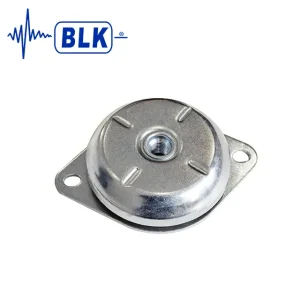
Solution: Engineers implemented a double-deflection system pairing high-damping BKHQ bell mounts with multi-layer BKSWA polymer pads directly under the structural skid base.
Result: Noise in the top-floor residential rooms was reduced from 43 dBA to below 27 dBA, comfortably meeting municipal acoustic thresholds without requiring structural modifications to the heritage roof.
Engineering Calculations
Engineering Step-by-Step: Sizing Isolators for 1,450 RPM Pumps
Four-pole electric motors and centrifugal water pumps running at 1,450 RPM (operating excitation frequency $f_d \approx 24.17\text{ Hz}$) are standard across Lombardy industrial fluid circuits. Here is the verified procedure to achieve > 90% vibration isolation.
Step 1: Calculate Static Deflection
Determine total operating weight (pump, motor, fluid, baseplate) and divide by the number of mounting points (minimum 4). Calculate the required natural frequency:
fn ≤ fd / 3 = 24.17 / 3 ≈ 8.05 Hz
Step 2: Derive Static Deflection (δ)
Using the simplified natural frequency relationship for elastomeric springs:
δst ≈ 25 / (fn)² = 25 / (8.05)² ≈ 3.86 mm
Account for the dynamic stiffening ratio ($K_d/K_s \approx 1.4$) by targeting a static deflection of ~5.4 mm.
Step 3: Select Mount Hardness
Select a mount rating where target static load falls within 60%–75% of maximum rated compressive capacity.
Heavy-Duty & High-Deflection Elastomeric Mounts for Milan Industry
From fail-safe shear mounts for rail transit systems to multi-layer composite damping plates for hydraulic stamping presses, explore our full catalog of factory-direct vibration isolators.
Delivers large axial deflection under modest loading to achieve ultra-low natural frequencies down to 6–8 Hz without the need for unconstrained steel coil springs.
Designed for train auxiliary compressors, subway undercarriage equipment, and railway signaling cabinets subject to dynamic multidirectional acceleration.
Interlocking CoreEN 45545 Fire SpecHigh Shock (5G)
Shock Control Dampers: BK-DSR High-Damping Elastomer Mounts
Formulated with specialized butyl or synthetic compound matrices providing loss factors up to η = 0.35 to rapidly absorb shock impacts from stamping presses.
High Loss FactorTransient DampingCold-Forging Ready
Technological Evolutions in Industrial Elastomeric Isolation
Vibration control is evolving from passive hardware to integrated smart mechanical components that support predictive maintenance and meet modern sustainability standards.
FEA Non-Linear Constitutive Modeling
Traditional linear Hookean spring models fail to capture large-strain elastomeric deformations. Our engineering department uses Mooney-Rivlin and Ogden hyperelastic strain energy potentials in ANSYS/Abaqus to model 3D non-linear stiffness curves before cutting mold steel, guaranteeing performance compliance.
Green Bio-Fillers & Low-VOC Vulcanization
Strict European environmental frameworks—including the EU Ecodesign Directive and chemical handling standards—demand the reduction of polycyclic aromatic hydrocarbons (PAH) in imported rubber goods. We formulate with low-odor, zinc-oxide reduced green vulcanization packages that pass strict European audits.
Sensor-Integrated Damped Mounts
As Milanese equipment builders shift toward IIoT servitization models, our R&D center is testing custom rubber mount cavities designed to house tri-axial MEMS vibration transmitters, enabling continuous real-time spectrum tracking directly beneath the damping core.
Procurement & Technical FAQ
Frequently Asked Questions: Milan OEM & Plant Sourcing
Answers to common engineering and commercial questions from Italian plant managers, equipment designers, and procurement professionals.
When should an engineer specify a rubber vibration isolator versus a steel spring isolator?
Rubber vibration isolators are optimal for equipment with excitation frequencies above 15–20 Hz (900–1,200+ RPM), including multi-cylinder engines, compressors, centrifugal pumps, and hydraulic power units. Steel spring isolators provide larger deflections (25–50 mm) and achieve lower natural frequencies (2–4 Hz), making them the choice for low-speed fans, slow reciprocating machinery, or extreme acoustic sensitivity. However, unconstrained steel springs transmit high-frequency structure-borne noise (acoustic surging); pairing springs with a series elastomeric pad or selecting pure elastomeric mounts eliminates this high-frequency noise bridge.
What documentation and compliance certificates accompany shipments to Italy?
Every shipment exported to the European Union includes an EN 10204 3.1 Inspection Certificate, raw material polymer tensile/elongation test reports, Shore A durometer batch logs, 900-hour salt spray test reports for Dacromet-plated metal hardware, and full RoHS / REACH chemical compliance declarations. Third-party testing through SGS or TÜV can be arranged upon request.
How does Bellking manage non-standard dimension and thread customization?
We provide full 1:1 engineering customization. Our production center handles metric thread pitches (M4 through M36), specialized UNC/UNF threads, custom stud lengths, stainless steel (AISI 304 or 316) inserts, and custom polymer compounding. If a project requires custom geometry, our in-house CNC toolroom can deliver custom single-cavity prototype molds within 3–5 working days of CAD drawing sign-off.
What are the typical lead times and shipping routes to Milan and Lombardy?
Standard catalog models (such as BKVV, BKVD, BKDD) ship within 24–48 hours for stocked configurations. Custom production runs require 10–18 calendar days depending on order quantity. For transit to Northern Italy, we offer air express to Milan Malpensa (MXP) in 4–6 business days for critical assembly lines, or maritime ocean container delivery via the Port of Genoa or La Spezia in 24–28 days, including customs clearance and direct delivery to your Lombardy facility.
How do industrial chemicals, cutting coolants, and ozone affect isolator service life?
Standard Natural Rubber (NR) degrades rapidly if exposed to petroleum oils, synthetic lubricants, or cutting fluids, causing swelling, softening, and loss of tensile integrity. In machinery environments throughout Milan where oil mist or fluid splash is present, we formulate isolators with Nitrile (NBR) or Neoprene (CR). For outdoor HVAC equipment subject to summer ozone concentrations in the Po Valley, EPDM elastomers provide optimal resistance against surface embrittlement and cracking.
What is the expected working lifespan of your rubber vibration isolators?
When sized properly within nominal load limits (static strain ≤ 15%) and shielded from thermal extremes or incompatible chemicals, Bellking rubber isolators typically achieve a continuous working life of 8 to 12 years. We recommend visual inspections every 24 months to check for surface checking, permanent set (creep exceeding 20% of original height), or chemical contamination.
Fast Technical Support
Partner with an ISO 9001 Vibration Isolator Factory
Get a comprehensive vibration isolation proposal, non-linear dynamic FEA verification, and direct factory pricing within 24 hours. Reduce your sub-assembly costs without sacrificing technical performance.