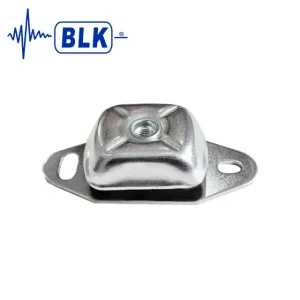
The choice between rubber isolators and steel springs is governed primarily by the disturbing frequency (fd) of the equipment. Rubber vibration isolators typically offer static deflections between 2 mm to 12 mm, resulting in natural frequencies in the range of 6 Hz to 15 Hz. They are exceptionally effective for medium-to-high speed equipment operating above 1,200 RPM (20 Hz), such as high-speed centrifugal pumps, screw compressors, 4-pole electric motors, and small fans.
Furthermore, rubber mounts provide essential viscoelastic damping that attenuates structure-borne high-frequency noise and prevents acoustic bridging. For low-speed equipment operating below 900 RPM (e.g., slow cooling tower fans, reciprocating chillers) where larger static deflections (25 mm to 50 mm) and natural frequencies below 3.5 Hz are required, steel spring isolators are recommended.