
Heavy-Duty Floor Spring Mounts for Pakistan Critical Facilities
Engineered to isolate disruptive low-frequency resonance from chillers, cooling towers, heavy reciprocating compressors, and industrial gensets in demanding tropical and sub-tropical operation conditions.
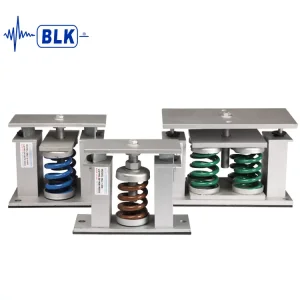
MA Type Anti-Vibration Spring Mounts (Pakistan Karachi Commercial Grade)
- Rated Deflection: 25 mm – 50 mm
- Natural Frequency: 3.2 Hz – 4.5 Hz
- Dacromet 900-Hr Salt Spray Tested
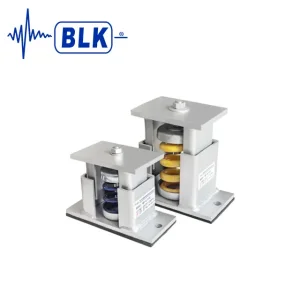
MB Type Enclosed Spring Isolators (Lahore Industrial Estate Certified)
- Lateral Snubbing Protection
- Load Range: 50 kg to 3,500 kg
- Ductile Iron Housing Protection
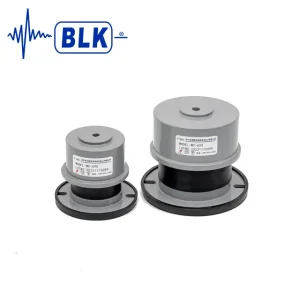
MC Type Heavy-Duty Spring Dampers (Faisalabad Textile Hub Spec)
- High Harmonic Damping Factor
- Eliminates Floor Resonance Sag
- Up to 98.4% Vibration Isolation
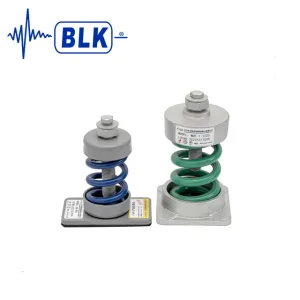
MD Type Seismic Restrained Spring Mounts (BCP-SP 2007 Compliant)
- Withstands 3G - 5G Seismic Acceleration
- Islamabad & Northern Zone 3/4 Rated
- Built-in Vertical & Lateral Limiters
Vibration Isolation Engineering in Pakistan’s Industrial & Infrastructure Ecosystem
Accelerated development under the China-Pakistan Economic Corridor (CPEC), urban high-rise densification, and severe power-grid stabilization requirements have elevated vibration control from an afterthought to a core civil and mechanical engineering mandate.
Pakistan’s industrial sectors are undergoing a massive transition toward automated machinery, high-capacity centralized HVAC plants, and independent captive power plants. From the massive textile processing clusters in Faisalabad and Multan to the cement manufacturing belts in Hattar, Pezu, and Hub, dynamic machinery operates under harsh environmental profiles characterized by ambient temperatures exceeding 45°C, high particulate loads, and intermittent electrical supply that induces violent start-stop cycle shocks. In these operating scenarios, standard solid rubber pads fail prematurely due to thermal vulcanization and mechanical fatigue, making engineered spring vibration isolators the sole dependable technology for long-term acoustic and structural mitigation.
Textile Weaving & Spinning Dynamics
In facilities operating hundreds of high-speed air-jet and rapier looms (e.g., Toyota, Picanol, Tsudakoma) across Faisalabad, Lahore, and Karachi, synchronized harmonic frequencies often coincide with the natural frequency of concrete floor slabs. Left untreated, harmonic excitation causes severe concrete fatigue, misaligns sensitive warp beams, and degrades product weave quality. Sizing spring isolators with high-viscous damping prevents resonant building sway and increases loom bearing longevity by 35%.
Captive Power & Standby Gensets
Due to persistent grid instability and peak-load tariff management, industrial complexes in SITE Karachi, Sundar Industrial Estate Lahore, and Gadoon rely extensively on heavy continuous-duty diesel and gas gensets (Cummins, Caterpillar, Perkins, Wärtsilä). Operating at 1,000 to 1,500 RPM, these reciprocating masses produce destructive low-frequency vertical and lateral forces. Unenclosed and housed spring mounts prevent foundation cracking and protect sensitive instrumentation in adjoining plant rooms.
Karachi Marine & Chemical Corrosion
Coastal industrial zones such as Port Qasim, Korangi Creek, and Clifton face corrosive marine air characterized by high saline moisture and industrial sulfur dioxide. Standard electro-galvanized springs corrode and snap within 12 to 18 months under these conditions. Bellking utilizes multi-stage zinc-flake Dacromet coatings exceeding 900 hours of continuous salt-spray exposure (ASTM B117), guaranteeing 15+ years of maintenance-free service.
Mathematical Principles & Design Criteria for Spring Vibration Isolation
Understanding the physics of transmissibility, dynamic stiffness, and harmonic damping allows MEP consultants and plant directors to avoid catastrophic resonance and sub-optimal component sizing.
The Mechanics of Transmissibility ($T$)
Vibration isolation efficiency ($E = 1 - T$) is directly governed by the ratio of the disturbing frequency ($f_d$) of the operating machinery to the undamped natural frequency ($f_n$) of the spring suspension system:
T = √[ (1 + (2ζr)²) / ((1 - r²)² + (2ζr)²) ]
Isolation only commences when the frequency ratio $r > \sqrt{2} \approx 1.414$. When $r < 1.414$, the system enters the dangerous amplification zone, compounding destructive vibrational forces into the host structure. For high-efficiency isolation exceeding 95% to 98%, mechanical consulting engineers targeting the Pakistan market specify $r \ge 3.0$ to $4.0$.
Because standard centrifugal chillers and heavy AHUs in Lahore and Islamabad run at 1,450 RPM (disturbance frequency $f_d \approx 24.2\text{ Hz}$), a spring mount with a natural frequency of $3.5\text{ Hz}$ yields a frequency ratio $r \approx 6.9$. This achieves an extraordinary theoretical isolation efficiency of $97.9\%$, dampening structural noise transmission down to near-imperceptible decibel ratings.
Static Deflection vs. Natural Frequency
The static deflection ($\delta$) of a steel helical spring under equipment dead load directly defines the system’s natural frequency:
- • 10 mm Deflection: $f_n \approx 5.0\text{ Hz}$ → Baseline industrial isolation
- • 25 mm Deflection: $f_n \approx 3.1\text{ Hz}$ → Premium commercial HVAC standard
- • 50 mm Deflection: $f_n \approx 2.2\text{ Hz}$ → Critical hospital, studio & roof applications
- • 75 mm Deflection: $f_n \approx 1.8\text{ Hz}$ → Ultra-sensitive metrology & micro-electronics
Spring Vibration Isolators Price Matrix for the Pakistan Market
Clear, factory-direct price transparency categorized by static deflection, housing metallurgy, load capacities, and seismic restraint ratings for CIF Karachi and inland dry port deliveries.
Procurement teams in Pakistan navigating imports across Karachi Port (KICT / PICT / QICT) must weigh initial landed costs against long-term operational resilience. Local substandard fabrications in Gujranwala or Lahore frequently use non-heat-treated carbon wire that sags within weeks, losing static deflection and transmitting vibrations directly into civil foundations. In contrast, Bellking’s factory-direct spring isolators utilize premium 60Si2Mn oil-quenched spring steel with robotic CNC winding and automated shot-peening. Below is the representative commercial pricing benchmark for 2026/2027 project cycles:
| Model Series | Structural Type & Housing | Static Deflection | Load Capacity (kg/unit) | Indicative Price (USD FOB) | Estimated CIF Karachi (PKR Eqv.)* | Typical Target Application |
|---|---|---|---|---|---|---|
| MA Series | Open Helical Spring / Neoprene Base Cup | 25 mm (1.0") | 50 – 1,200 kg | $14.00 – $42.00 | Rs. 4,200 – 12,600 | Inline HVAC pumps, small exhaust fans, air handling units |
| MB Series | Enclosed Cast Housing / Telescopic Guides | 25 mm – 35 mm | 150 – 2,500 kg | $28.00 – $78.00 | Rs. 8,400 – 23,400 | Water-cooled chillers, cooling towers, industrial blowers |
| MC Series | Heavy Cast Steel / Multi-Spring Bank | 35 mm – 50 mm | 800 – 6,000 kg | $58.00 – $165.00 | Rs. 17,400 – 49,500 | Large power gensets (1,000kVA+), textile looms, cement fans |
| MD Series | Seismic-Restrained / All-Direction Snubber | 25 mm – 50 mm | 200 – 4,500 kg | $72.00 – $210.00 | Rs. 21,600 – 63,000 | Rooftop chillers in Islamabad, Quetta, Northern Zone 3/4 areas |
| BK-DS Series | Viscous Damped / Dual Harmonic Springs | 50 mm (2.0") | 100 – 3,200 kg | $45.00 – $135.00 | Rs. 13,500 – 40,500 | Reciprocating compressors, high-speed stamping presses |
| Custom Base | Concrete-Filled Steel Inertia Frame Assembly | Custom 25–75mm | 1,000 – 25,000 kg | $350.00 – $1,800.00 | Rs. 105,000 – 540,000 | End-suction slurry pumps, multi-stage boiler feed systems |
*Note: PKR estimates are based on indicative foreign exchange rates and exclude local inland customs clearing tariffs, federal excise duties, and provincial sales taxes. Contact Bellking engineering sales for tailored DDP/CIF project quotations.
Key Price Driver 1: Deflection Depth
A 50 mm deflection spring requires more than double the active coiled steel wire length and specialized heat-treatment compared to a 25 mm spring. This increases manufacturing raw-material expenditure by roughly 40% but doubles structural isolation efficiency against low-frequency machine rumble.
Key Price Driver 2: Housing Metallurgy
Open spring isolators are the most economical. Housed ductile iron (QT450) and heavy-duty welded structural steel housings incorporate lateral limiters, internal leveling bolts, and elastomeric guide inserts that elevate baseline unit cost while delivering essential safety containment.
Key Price Driver 3: Anticorrosion Treatment
Standard painted finishes represent minimal cost but degrade rapidly in chemical and saline environments. High-performance Dacromet, hot-dip galvanizing, or specialized PTFE coating layers provide lasting protection against Karachi coastal salt and industrial vapors with a 15–20% premium.
Supply Chain Resilience: From Kunshan Precision Manufacturing to Pakistan Delivery
Leveraging intelligent CNC production, ISO 9001 quality audits, and streamlined multi-modal shipping under the China-Pakistan Economic Corridor framework.
Smart Manufacturing in Kunshan, Jiangsu
Bellking’s advanced manufacturing facility in Kunshan, China, integrates Industry 4.0 automation across every fabrication step. High-speed CNC cold-coiling machines wind oil-tempered alloy spring steel with sub-millimeter precision. Springs undergo induction hardening, computerized stress-relief tempering, shot-peening to eliminate surface micro-cracks, and 100% pre-compression testing to permanent solid height to guarantee zero static sag over decades of service.
Our in-house metrology center is equipped with universal tensile-compression testing frames (up to 300 kN), dynamic servohydraulic vibration exciters, salt spray corrosion chambers, and digital optical coordinate measuring machines. Each production batch is serialized and accompanied by EN 10204 3.1 inspection certificates, giving Pakistani engineering consultants absolute traceability.
Logistics Corridors to Pakistan
- Maritime Express Route: Direct sea-freight container shipping from Shanghai / Ningbo to Karachi Port (KICT / QICT) with transit times averaging 14 to 18 days. Ideal for bulk project orders, chiller mounts, and inertia base frames.
- CPEC Land Route Option: During operational overland windows, high-priority shipments can traverse the Karakoram Highway (KKH) via Khunjerab Pass down to Islamabad and Rawalpindi, cutting transit delays for fast-track shutdowns.
- Airfreight Express: Emergency replacements and specialized air-mount calibrators dispatched via direct air routes to Karachi (KHI), Lahore (LHE), or Islamabad (ISB) within 72 hours.
Need Sizing Verification for an Active Pakistan Tender?
Share equipment operating weights, RPM, static slab thickness, and center of gravity data with our technical team. We return a comprehensive finite-element vibration analysis and customized proposal within 24 hours.
Meeting Pakistan Engineering Council (PEC) & Global MEP Specifications
How Bellking’s vibration isolation solutions conform to national building codes, international ASHRAE HVAC guidelines, and structural safety frameworks.
Building Code of Pakistan (BCP 2007)
Our MD and seismic series comply strictly with BCP Chapter 6 provisions for non-structural building components. Equipment mounted in earthquake hazard zones 2B, 3, and 4 is secured using heavy ductile iron snubber housings with resilient elastomeric bush limiters to prevent shear disconnection during seismic accelerations.
ASHRAE Handbook Applications
ASHRAE Chapter 48 establishes definitive deflection recommendations based on equipment horse-power, RPM, and slab span distance (e.g., 20 ft vs. 30 ft spans). Bellking isolators provide exact compliance charts, ensuring MEP consultants (such as NESPAK, EA Consulting, and Meinhardt Pakistan) can specify our hardware with total confidence.
PSQCA & International Approvals
Recognized by the Pakistan Standards and Quality Control Authority (PSQCA) framework for imported mechanical apparatus, our products carry ISO 9001:2015 certification, CE marking, and comprehensive mechanical destructive test dossiers that satisfy international EPC tender requirements.
Technology Roadmap: Smart Damping & IoT Vibration Intelligence
The convergence of wireless edge-computing sensors, magnetorheological (MR) fluids, and high-performance damping alloys is shaping the next era of industrial vibration control.
Vibration-as-a-Sensor: Real-Time IoT Monitoring
Modern textile production plants and Tier-3 data centers in Pakistan are adopting predictive asset management. Bellking is pioneering integrated MEMS tri-axial accelerometer mounts that monitor real-time vibration spectra directly at the baseplate. By tracking subtle shifts in dominant frequency peaks ($f_d$), plant engineers receive automated LoRaWAN or Modbus alerts notifying them of motor unbalance, bearing spalling, or spring deflection loss before catastrophic equipment seizure occurs.
Semi-Active Damping & Composite Metallurgy
For critical high-speed applications where machinery must pass through destructive resonant frequencies during startup and spin-down, passive springs can exhibit excessive displacement. Bellking’s R&D roadmap integrates multi-viscous orifice dampers and semi-active magnetorheological fluid systems. These responsive systems instantaneously harden damping during resonance crossing and soften damping during steady-state cruising, delivering isolation efficiencies up to 99.4%.
Complete Anti-Vibration Isolator & Precision Mount Portfolio
From heavy multi-layer industrial dampers to sub-2.0 Hz precision pneumatic mounts, explore our specialized solutions engineered for severe environments across Pakistan.
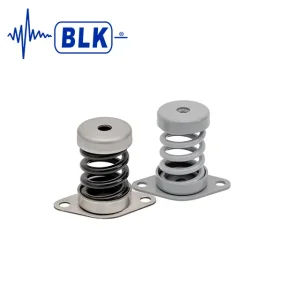
ME Type Anti-Vibration Spring Mounts (Pakistan CPEC Heavy Plant)
- High Vertical & Lateral Rigidity
- Heavy Chiller & Turbine Bases
- Built-in Snubbing Pads
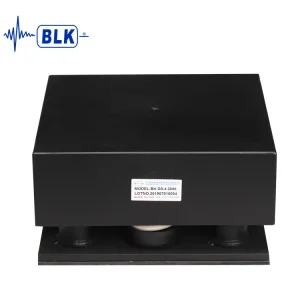
BK-DS Type Damped Spring Mounts (Compressors & Presses Spec)
- High Damping Ratio ζ = 0.15
- Suppresses Transient Resonance
- Extended High-Cycle Fatigue Life

BKH Type Rubber Vibration Mounts (Electric Motors & Transformers)
- Natural Rubber / Neoprene Options
- Dampens Audible Structure Hum
- Compact Footprint Installation
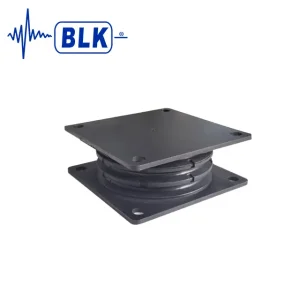
BKSWA Multi-Layer Dampers (Cement & Heavy Mill Plants)
- Interleaved Steel & Elastomer
- Extremely High Dynamic Load Capacity
- High Resistance to Oils & Solvents
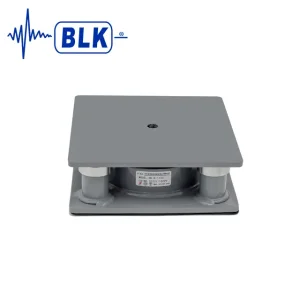
BK-R Type Pneumatic Air Mounts (CMM & Semiconductor Cleanrooms)
- Natural Frequency Down to 1.7 Hz
- Precision Auto-Leveling Air Valves
- Isolates Sub-Micron Floor Shakes
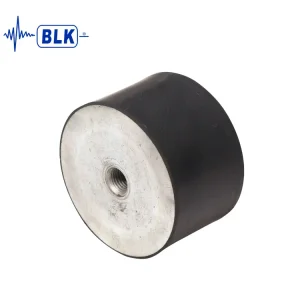
BKDD Type Double-Deflection Rubber Mounts (Air Handling Units)
- Dual Elastomeric Chambers
- Superior Noise Absorption Ratio
- Resists UV & Outdoor Aging
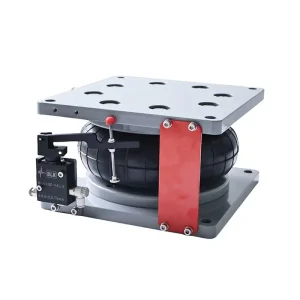
BK-PF Type Precision Air Mounts (Islamabad National Lab Series)
- Integrated Hydraulic Leveling Sockets
- Nanometer Damping Capability
- High Repeatability & Stability
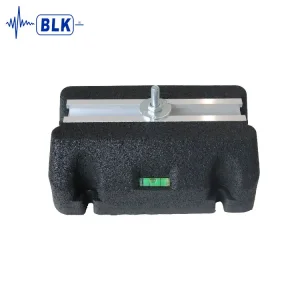
BKDJ Waffle Damping Pads (Karachi & Lahore Commercial Slabs)
- Cross-Ribbed Neoprene Texture
- Eliminates High-Frequency Chatter
- Flexible On-Site Field Slicing
Frequently Asked Questions by Pakistan Engineering & Procurement Teams
Authoritative answers addressing import logistics, seismic calculations, sizing for textile and power infrastructure, and anti-corrosion metallurgy.
Why are spring vibration isolators preferred over standard rubber pads for rooftop HVAC installations in Karachi and Lahore?
Standard commercial chillers, cooling towers, and large air handling units operate at relatively low rotational speeds (typically 750 to 1,480 RPM, corresponding to 12.5 Hz to 24.6 Hz disturbance frequencies). Solid rubber pads generally provide only 2 mm to 5 mm of static deflection, resulting in high natural frequencies of 8 Hz to 12 Hz. This yields a dangerously narrow frequency ratio ($r < 2.0$), offering less than 50% to 60% isolation efficiency, and risking acoustic resonance through the concrete roof slab.
In contrast, steel helical spring vibration isolators provide 25 mm to 50 mm of static deflection, lowering system natural frequency down to 2.2 Hz to 3.2 Hz. This elevates the frequency ratio well above 4.0, delivering proven isolation efficiency exceeding 95% to 98% and preventing structural structure-borne acoustic vibration across executive offices and hotel guestrooms below.
How does Bellking address coastal corrosion risks in Karachi industrial zones (Port Qasim, Korangi, Landhi)?
Karachi’s coastal climate combines high relative humidity (often exceeding 80%), saline marine breezes, and corrosive airborne industrial emissions. Standard enamel spray paints and thin zinc galvanizing (5–8 μm) break down rapidly, causing stress corrosion cracking (SCC) in springs under tension.
Bellking incorporates Dacromet multi-layer zinc and aluminum flake coatings across all our industrial helical springs and hardware. Dacromet provides non-electrolytic passive protection that undergoes salt-spray chamber testing (ASTM B117) exceeding 900 hours without red rust initiation. For extreme chemical exposure, ductile iron housings are further protected with thermoset epoxy powder coatings.
What parameters are required to size a spring isolator for high-speed textile looms in Faisalabad?
To provide an engineered 1:1 vibration isolation schedule for textile looms (e.g., air-jet, water-jet, or rapier models), our application engineers require:
- Total operating mass of the machine including full yarn warp beams and active accessories.
- Number and exact coordinates of mounting anchor footings.
- Operational beat frequency (Picks Per Minute / RPM) and dynamic reciprocating mass data.
- Installation floor level (Ground slab-on-grade vs. elevated suspended reinforced concrete slab).
- Slab thickness and structural span distance between supporting pillars.
How do Bellking seismic spring isolators comply with the Building Code of Pakistan (BCP 2007)?
Under BCP 2007 seismic provisions, Islamabad, Rawalpindi, Peshawar, Quetta, and Northern Pakistan are classified in moderate-to-severe seismic hazard categories (Zones 2B, 3, and 4). Mechanical equipment placed on structural rooftops must be restrained against seismic overturning and lateral displacement forces.
Bellking’s MD series features heavy-duty ductile iron (QT450) or fabricated structural steel containment housings engineered with internal 3-way omnidirectional elastomeric snubber bushings. These mounts are finite-element tested to withstand horizontal and vertical shock accelerations between 3.0g and 5.0g without physical cleavage, ensuring continuous life-safety compliance.
What are the typical lead times and shipping procedures for industrial deliveries into Pakistan?
Standard spring mounts (such as MA, MB, and BKH models with 25 mm deflection) are stocked at our Kunshan production base and can ship within 24 to 48 hours of purchase confirmation. Custom-engineered multi-spring assemblies or concrete inertia frames require approximately 7 to 10 working days for design and precision manufacture.
Shipments move via direct ocean freight from Shanghai or Ningbo ports to Karachi (KICT / QICT) with a typical ocean transit time of 14 to 18 days. We supply full documentation sets including original Bills of Lading, Certificate of Origin (Form FTA for preferential China-Pakistan tariffs), commercial invoices, packing lists, and ISO 9001 mill test certificates to ensure swift customs clearance.
Can Bellking replace obsolete vibration isolators from European or American brands?
Yes. We regularly supply direct dimensional and performance retrofits for major international brands (including Mason Industries, Kinetics Noise Control, Enidine, and Gerb) installed in older power facilities, textile mills, and commercial towers. Simply share the existing mount’s dimensions, top bolt diameter, installed height, and current equipment weight for an identical drop-in replacement.
Empower Your Next Pakistan Infrastructure Project with Bellking
From high-rise commercial chillers in Karachi to massive captive power plants and textile spinning floors in Punjab, our engineers are ready to size, model, and supply high-performance vibration isolators customized to your exact operational parameters.