
High-Demand Anti-Vibration Mounts Ready for Victoria Projects
Pre-engineered cylindrical and flanged elastomeric dampers suited for immediate deployment in Greater Melbourne's HVAC, infrastructure, and heavy plant operations.




Vibration Isolation in Melbourne’s Industrial Transformation
How rapid infrastructure development, clean-energy mandates, and Victoria’s stringent environmental noise laws necessitate factory-direct, highly resilient elastomeric isolation.
The Victorian Commercial & Infrastructure Landscape
The Greater Melbourne metropolitan area and surrounding industrial corridors—spanning from the manufacturing strongholds of Dandenong and Campbellfield to the biomedical cluster in Parkville and logistics epicenters near the Port of Melbourne—are undergoing unprecedented structural modernization. Key projects such as the Melbourne Metro Tunnel, the West Gate Tunnel, and high-density urban residential towers along Southbank demand uncompromising control over structure-borne acoustics and vibrational transfer.
In Victoria, the Environment Protection Authority (EPA Victoria) enforces strict commercial and industrial noise guidelines under the Environment Protection Regulations 2021. Unmitigated mechanical vibration generated by chillers, cooling towers, industrial centrifuges, and hydraulic presses easily couples into building concrete slabs, generating low-frequency airborne rumble. For structural engineers and MEP consultants, choosing the right elastomeric vibration isolator is no longer just a mechanical longevity decision—it is a legal and regulatory requirement for project handover.
By bypassing multi-tiered local distribution networks and partnering directly with an ISO 9001 certified manufacturing plant, Melbourne engineering firms secure factory-grade vulcanized rubber mounts engineered precisely to load deflection tolerances, achieving significant procurement cost reductions without sacrificing acoustic performance.
Global Trends: High-Performance Polymers & Supply Resilience
Globally, the vibration control market is shifting rapidly from archaic, generic rubber pads toward engineered poly-elastomers and custom-formulated synthetic nitriles. Modern industrial machinery operates at variable speeds governed by frequency inverters (VFDs). As motors cycle through wide RPM spectrums, they repeatedly pass through critical resonance zones, causing traditional single-stiffness rubber mounts to overheat, stress-crack, and fail prematurely due to high mechanical hysteresis.
To counter this, leading tier-1 manufacturers implement precise vulcanization chemistry, pairing high-tensile natural rubber (NR) blends with polybutadiene or neoprene (CR) matrices. This delivers an optimal ratio of dynamic stiffness to static stiffness ($K_d / K_s$), preventing low-frequency drift while preserving high-frequency isolation.
Furthermore, global supply chain volatility has compelled Australian EPC contractors to seek transparent, factory-direct original equipment manufacturers (OEMs). Direct engineering dialogue ensures that mold tooling, durometer ratings (Shore A 40 to 70), and seismic shear-stops are customized according to Australian Standards (AS ISO 10816 and AS 1170.4) rather than settling for off-the-shelf distributor compromises.
Engineered Elastomer Polymers: The Science of Kinetic Attenuation
A rigorous examination of polymer compounding, dynamic shear modulus, dynamic-to-static stiffness ratios, and bonding mechanics under Australian operating conditions.
Polymer Compounding Integrity
We utilize prime Malaysian Grade 1 ribbed smoked sheets (RSS) crosslinked via sulfur donor acceleration systems. This creates a high-purity natural rubber vulcanizate with superior tensile strength (>22 MPa) and low compression set (<18% after 72h at 70°C), preventing long-term creep under stationary HVAC compressors.
Dynamic Loss Factor (tan δ)
By optimizing carbon black filler distribution (N330/N550 morphology), our rubber mounts deliver a loss factor ($\tan \delta$) between 0.12 and 0.28. This provides intrinsic damping that suppresses amplitude amplification at resonance without degrading high-frequency structure-borne noise attenuation.
Corrosion & Bond Vulcanization
Elastomer-to-steel bonding is executed via automated silane-phenolic chemlok adhesive priming, exceeding 12 MPa peel strength (ASTM D429 Method B). Structural hardware is shielded with Dacromet or Zinc-Nickel coatings rated for 900+ hours salt spray, resisting Port Phillip Bay marine moisture.
| Elastomer Polymer Base | Hardness Range (Shore A) | Dynamic-to-Static Ratio ($K_d / K_s$) | Operating Temp Range (°C) | Environmental Resistance Profile | Primary Melbourne Application |
|---|---|---|---|---|---|
| Natural Rubber (NR) | 40 - 70 ±5 | 1.2 - 1.4 | -40 to +75 | Exceptional fatigue life, moderate ozone susceptibility | Indoor chillers, air handling units, inertial pump blocks |
| Neoprene / Chloroprene (CR) | 45 - 75 ±5 | 1.4 - 1.8 | -30 to +95 | High oil, fuel, flame, and coastal saline ozone resistance | Rooftop package units, Port of Melbourne cranes, marine plant |
| Nitrile Butadiene (NBR) | 50 - 80 ±5 | 1.5 - 2.1 | -25 to +110 | Superior petroleum hydrocarbon & hydraulic fluid endurance | Dandenong industrial power packs, stamping presses, gearboxes |
| Ethylene Propylene (EPDM) | 40 - 70 ±5 | 1.3 - 1.6 | -45 to +130 | Immune to atmospheric ozone oxidation and extreme UV radiation | Outdoor solar inverters, substation transformers, rooftop fans |
Custom Engineering Solutions for Victorian Sector Challenges
From rooftop HVAC plant rooms in Southbank to heavy fabrication plants in Altona, our rubber vibration isolators resolve critical mechanical isolation challenges.
1. High-Density CBD Towers & Green Star Acoustics
Melbourne’s central skyline features slender high-rises where rooftop cooling towers and plant rooms sit immediately above premium penthouses or office spaces. Our shear-and-compression rubber mounts decouple structure-borne excitation frequencies (>15 Hz), achieving NC-30 acoustic ratings and securing credits for Green Star building certification.
2. Advanced Manufacturing in Dandenong & Clayton
Victoria's automotive component specialists, aerospace precision machinists, and composite fabricators rely on our high-damping BKDD and BKVD series. By isolating CNC machine beds, plastic extrusion heads, and stamping presses from the concrete sub-slab, tool life increases by 28% and surface finish tolerances remain stable within microns.
3. Data Centers & Telecommunication Hubs
With mega data center facilities expanding through Tullamarine and Truganina, uninterruptible power supply (UPS) diesel backup generators and rotary transformers produce massive harmonic pulses. Bellking engineered rubber cushions absorb extreme shock loads and prevent low-frequency electrical hum from migrating into sensitive server racks.
How to Size and Specify Rubber Vibration Isolators
A step-by-step mathematical framework for consulting acousticians, MEP specifiers, and plant maintenance managers.
The Fundamental Frequency Ratio Rule
Effective vibration isolation occurs only when the excitation frequency ($f_d$) of the driving equipment is significantly higher than the natural frequency ($f_n$) of the resilient mounting system:
When $r < 1.414$, the system operates in the amplification zone, generating dangerous dynamic magnification. For industrial and HVAC systems in Melbourne, our engineering guideline dictates a target ratio:
Static deflection ($\delta_{st}$) directly dictates natural frequency via the gravitational formula:
$f_n = \frac{1}{2\pi} \sqrt{\frac{g}{\delta_{st}}} \approx \frac{5}{\sqrt{\delta_{st} \text{ (cm)}}}$.
Rubber mounts typically target 3 to 12 mm static deflection, yielding natural frequencies in the 6 Hz to 12 Hz band—ideal for equipment operating at 1,200 RPM and above.
5-Step Engineer Sizing Checklist
- Determine Total Operating Weight ($W_t$): Sum equipment wet weight, including fluids, piping weight, and dynamic inertia base.
- Calculate Center of Gravity (CoG) & Support Reactions: Non-symmetrical machinery creates uneven corner loads. Select distinct durometer mounts (e.g., 45 ShA rear, 60 ShA front) to ensure uniform static deflection across all points.
- Identify Lowest Disturbing Frequency ($f_d$): Find the minimum shaft RPM or motor pole frequency. E.g., a 4-pole motor running at 50 Hz equals 1,450 RPM ($f_d = 24.16 \text{ Hz}$).
- Verify Environmental & Chemical Exposure: Specify Chloroprene (Neoprene) or Nitrile (NBR) compounds if oils, greases, or direct atmospheric sunlight are present on rooftop installations.
- Evaluate Seismic Snubbing (AS 1170.4): In earthquake-designated regions across Victoria, incorporate captive housings to prevent shear tearing under lateral acceleration forces.
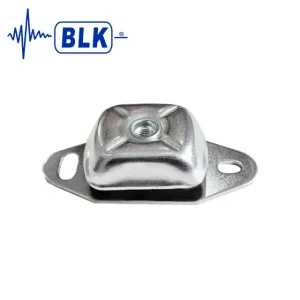
Comprehensive Elastomeric Mounts & Dampers for Victoria
Engineered for high-durability vibration isolation, acoustic attenuation, and dynamic impact suppression across demanding mechanical installations.







Next-Generation Elastomer Technology & Smart Isolation Systems
Pioneering advancements in nano-composite polymers, real-time sensory elastomeric monitoring, and circular sustainable compounding.
IoT-Enabled Sensory Rubber Mounts
Integrating piezoresistive graphene thin films within the rubber matrix allows mounts to continuously measure static drift, dynamic deflection, and operating temperature. Data feeds directly into Victorian plant SCADA and building management systems (BMS), signaling bearing wear and cavitation before catastrophic mechanical failure.
Thermally Stable Fluoro-Silicone Hybrids
For applications adjacent to geothermal infrastructure, smelting furnaces, or marine exhaust systems across Victoria's coast, our R&D roadmap introduces fluoro-elastomer alloys capable of sustained 200°C exposure while maintaining a linear shear spring constant and low compression set.
Circular & Bio-Based Formulations
Targeting Australia’s 2030 net-zero targets, we are actively replacing petroleum-derived aromatic oils with vegetable-derived plasticizers and incorporating devulcanized ultra-fine rubber micro-powders without compromising fatigue endurance or ASTM mechanical shear thresholds.
Frequently Asked Questions by Melbourne Engineering Teams
Direct answers from senior vibration engineers covering Australian standard compliance, logistics, shear capacities, and replacement cycles.
Why choose rubber vibration isolators over metal steel springs for HVAC equipment in Melbourne?
While helical steel springs provide large static deflections required for ultra-low frequency excitation (<6 Hz), they suffer from high-frequency acoustic wave bridging: sound waves travel directly through the steel coils, radiating audible structure-borne buzzing into the concrete ceiling or floor slab. Rubber mounts, with their internal viscoelastic damping matrix, act as an acoustic barrier across higher audio frequencies (>100 Hz). In addition, rubber isolators provide multi-directional stability—handling shear, compression, and angular moments simultaneously without external guide rods—making them far more compact and economical for 1,200+ RPM pumps, fans, and indoor package units across Melbourne commercial buildings.
How do Bellking rubber mounts comply with Australian Seismic Standard AS 1170.4?
Under AS 1170.4 (Structural design actions - Earthquake actions in Australia), non-structural building components such as MEP machinery must remain restrained during seismic events. Standard elastomeric bobbins provide minimal horizontal shear restraint. For seismic zones, Bellking supplies specialized captive or enclosed rubber mounts featuring high-strength ductile iron or structural steel outer housings. These housings permit free vibration isolation under normal operational deflections (2 to 5 mm) but engage heavy-duty mechanical limit stops during seismic lateral acceleration up to 2.0g, preventing equipment dislodgement.
What is the realistic operating lifespan of elastomeric mounts under Victoria’s climate?
In standard indoor plant rooms (chillers, pumps, AHUs), Bellking natural rubber formulations deliver an active service life of 12 to 18 years before static creep exceeds allowable limits (typically >15% thickness loss). For outdoor rooftop installations exposed to Melbourne’s intense UV radiation, wide diurnal temperature swings, and coastal winds from Port Phillip Bay, we formulate isolators with Chloroprene (Neoprene) or EPDM enriched with anti-ozonant microcrystalline waxes. These compounds resist surface crazing and oxidation, reliably maintaining designed dynamic properties for 10+ years outdoors.
Can Bellking manufacture custom non-standard mounts according to non-metric threads or bespoke drawings?
Yes. As a direct manufacturer with in-house mold machining and CNC tool-making capabilities, we routinely manufacture custom mounting configurations for retrofit projects where legacy equipment bolt-hole patterns cannot be altered. We can customize stud dimensions (including imperial BSW, UNC, or metric standard threads), modify baseplate flanging, engineer dual-durometer compounds, and supply complete CAD/BIM models (.STEP, .DWG, .Revit) within 48 to 72 hours for client engineering sign-off.
What are the lead times and shipping logistics from factory direct to Melbourne sites?
Standard catalog models (such as BKVV, BKVD, BKDD) are produced in high batch volumes and can ship from our facility within 24 to 48 hours. For standard sea freight deliveries directly into the Port of Melbourne (Swanson or Webb Docks), typical transit time is 14 to 18 days. For urgent construction breakdowns or fast-track retrofit deadlines across Victoria, air freight delivery (door-to-door via Melbourne Tullamarine Airport) can be coordinated within 4 to 6 business days.
Connect Directly with Vibration Control Application Engineers
Submit your equipment mass, RPM, center of gravity, and installation layout. Our engineering department will return a mathematically verified dynamic vibration isolation plan within 24 hours.