
Shear & Compression

Direct-to-project cylindrical, shear, and compression rubber isolators custom-calibrated for Kendall Square life-science facilities, urban hospital infrastructure, and Cambridge tech workshops.
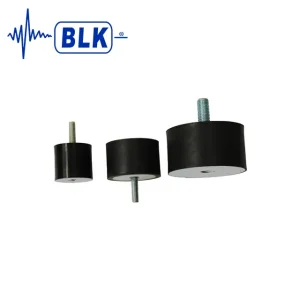
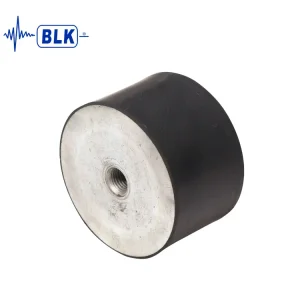
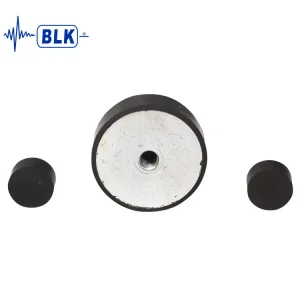
The commercial and industrial landscape of the Greater Boston metropolitan area presents an extraordinary convergence of micro-precision demands and severe spatial constraints. As the undisputed global epicenter of biotechnology, life sciences, and university-incubated hardware engineering, Boston—spanning from Cambridge’s Kendall Square to the Route 128 tech corridor and the Longwood Medical Area—operates under stringent micro-vibration tolerances that render generic, catalog-commodity isolation mounts completely inadequate.
In life science laboratories, high-resolution Transmission Electron Microscopes (TEM), Confocal Scanning Microscopes, and automated patch-clamp electrophysiology workstations demand ambient structural vibration limits conforming to Vibration Criterion (VC) curves from VC-C (12.5 μm/s) down to VC-E (3.12 μm/s). Concurrently, these elite facilities are housed within multi-story urban complexes where multi-ton HVAC air handling units (AHUs), cooling towers, water chillers, and continuous exhaust fans operate directly overhead on structural rooftops or in interstitial mechanical floors. Without calibrated elastomeric decoupling, high-frequency harmonic structure-borne vibration and secondary acoustic rumble propagate effortlessly down building structural columns, invalidating nano-scale experiments and causing high-cost research downtime.
Acoustic Compliance & Boston Building Codes: Boston’s stringent municipal noise control ordinance (City of Boston Code, Ordinance 16-26) mandates daytime residential acoustic thresholds below 60 dBA and nighttime limits as restrictive as 50 dBA. In densely settled mixed-use zones such as the Seaport District, Fenway, and South End, building owners face substantial fines when mechanical plant vibration couples into tenant slabs. Custom-engineered rubber vibration isolators provide the required high-frequency transmission loss that metallic coil springs alone cannot deliver due to interior acoustic wave surging.
Simultaneously, Greater Boston’s maritime commerce around Boston Harbor, Massport container terminals, and suburban industrial automation plants in Waltham, Bedford, and Framingham require rugged anti-vibration mountings resistant to marine salt fog, petroleum washdowns, and wide thermal cycles—from sub-zero New England winters (-15°C) to high-humidity summer peaks (+35°C). Bellking bridges this engineering gap by manufacturing custom rubber mounts with high-purity virgin elastomers, proprietary compounding, and anti-corrosive Dacromet hardware certified for 900+ hours of continuous salt-spray resistance.
Understanding dynamic modulus, loss factor (η), and multi-axis frequency attenuation ensures predictable, long-term vibration isolation without structural resonance.
Rubber is viscoelastic; its dynamic stiffness ($K_d$) differs substantially from its static stiffness ($K_s$). For vibration engineering, calculating the dynamic-to-static ratio ($K_d/K_s$, typically 1.2 to 1.8) prevents under-calculating actual transmitted frequencies into building slabs.
Steel coil springs transmit high-frequency acoustic noise (>250 Hz) directly through the spring wire coil surge effect. Bellking vulcanized rubber isolators exhibit continuous wave impedance mismatch, stopping structure-borne airborne acoustics instantly.
Lower-tier reclaimed rubber yields catastrophic static deflection creep over 24-36 months. Bellking uses only prime polyisoprene and polychloroprene with thermal stabilization additives, maintaining baseline operating height within ±3% over 15 years.
| Elastomer Compound | Hardness (Shore A) | Operating Temp Range | Tensile Strength | Oil / Chemical Resistance | Ideal Boston Application Scenario |
|---|---|---|---|---|---|
| High-Purity Natural Rubber (NR) | 40 – 70 ±5 | -40°C to +80°C | ≥ 18.5 MPa | Moderate / Mechanical | HVAC Mechanical Rooftops Internal pumps, chillers, and seismic-restrained bases. |
| Neoprene (Polychloroprene) | 45 – 75 ±5 | -35°C to +100°C | ≥ 15.0 MPa | High / Petroleum & Ozone | Seaport & Marine Commercial diesel gensets, harbor workboats, coastal fans. |
| Nitrile (NBR) Formulations | 50 – 80 ±5 | -25°C to +120°C | ≥ 14.2 MPa | Superior / Hydraulic Oils | Industrial Robotics High-speed CNC spindles, hydraulic power units in Route 128 plants. |
| Fluorocarbon (FKM / Viton) | 60 – 85 ±5 | -20°C to +200°C | ≥ 12.0 MPa | Exceptional / Strong Acids | Cleanroom Chemistry Exhaust fume scrubbers, semiconductor etching tools, pharma cleanrooms. |
Procurement directors and MEP (Mechanical, Electrical, and Plumbing) engineering managers in New England face unprecedented lead time and markup pressures. Traditional domestic supply networks rely on multiple wholesale tiers, inflating component prices by 40% to 65% while introducing 12-to-18-week backorders for non-standard durometers or seismic-rated configurations.
Direct manufacturer engagement with Bellking eliminates intermediate trading margin layers while introducing direct engineering collaboration. Our Kunshan facility provides full transparent technical submittals, including load-deflection test plots, finite element strain analyses (FEA), and material certification conforming to ASTM D2240, ASTM D412, and DIN 53504 standards.
Whether fulfilling customized bulk OEM runs for robotics manufacturers or expedited air-freighted lots for emergency hospital HVAC retrofits in Boston, our logistics network provides end-to-end delivery right to Massachusetts job sites.
State-of-the-art robotic vulcanization, in-house rheometer testing, and precision metal-to-elastomer chemical bonding technology.
Closed-loop temperature-controlled mixing ensures uniform carbon black dispersion and precise vulcanization kinetics, eliminating internal micro-voids that lead to tearing under high dynamic cyclic loads.
Metal interlayers and mounting studs undergo grit-blasting, chemical etching, and dual-coat robotic adhesive application. Our metal-to-rubber bond strength exceeds the tensile tear limit of the rubber matrix itself (ASTM D429 Method B).
Every manufactured batch undergoes dynamic rheometer curves, cure kinetics tracking, durometer consistency mapping, and static/dynamic compression hysteresis plotting with full digital reports for Boston project submittals.
Challenge: Cryogenic electron microscopes on the 3rd floor suffered from image drift due to 60 Hz structure-borne harmonics from rooftop exhaust air handling systems.
Solution: Installed Bellking Custom BKVD and BK-DSR multi-layer damped rubber mounts beneath air handlers, dropping high-frequency transmission by 32 dB and restoring VC-D compliance.
Challenge: Rooftop centrifugal chillers generated low-frequency structure-borne drumming audible in top-tier residential penthouses directly beneath.
Solution: Implemented double-deflection BKDD heavy-duty rubber isolators with custom natural rubber compound durometer 50 Shore A, achieving an isolation efficiency exceeding 96.5% at 1,750 RPM.
Challenge: Coastal workboat auxiliary generators faced premature rubber cracking and bond separation caused by diesel oil pooling and salt water corrosion.
Solution: Supplied custom oil-resistant Polychloroprene mounts with Dacromet 900-hr salt-spray coated steel castings, exceeding 5 years of continuous commercial service with zero degradation.
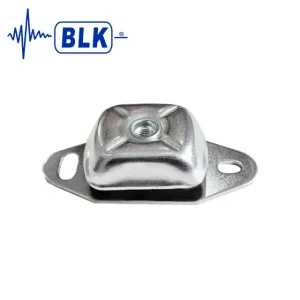
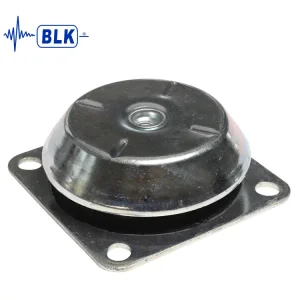
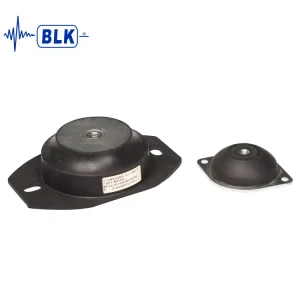
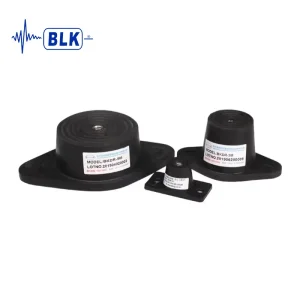
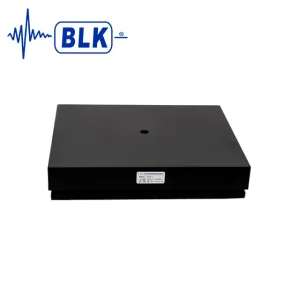
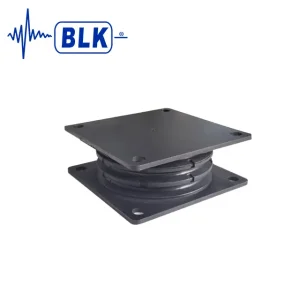
Browse our factory-direct elastomeric isolation series—manufactured in Kunshan, ISO 9001 certified, and available for direct shipment across Massachusetts.
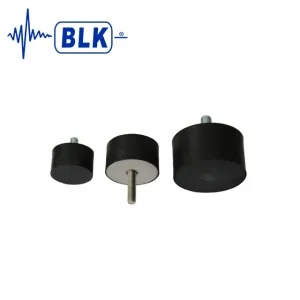

Technical insights compiled by Bellking's senior application engineers to assist Boston engineering consultants and facility directors.
Eliminate wholesale intermediaries, reduce project costs by 40%, and secure precision-engineered vibration isolation solutions tailored to your equipment specifications and local building acoustic regulations.