
Featured Industrial Rubber Isolators for Greater Tokyo Projects
High-durometer natural rubber and synthetic neoprene mounts engineered for fast deployment across Tokyo, Yokohama, and the Kanagawa industrial sector.

Low Price BKVV Type Rubber Mounts Factories, Manufacturers

Custom BKVD Type Rubber Mounts Factories, Manufacturer

High-Quality BKDD Type Rubber Mounts Factories, Manufacturers

Custom BKDE Type Rubber Mounts Factory, Manufacturer
Vibration Control Challenges in the Tokyo Metropolitan Area
Operating in the world’s most densely populated metropolis requires industrial machinery, building services, and precision production lines to coexist with stringent municipal environmental noise codes and relentless seismic activity.
The Demands of Tokyo’s High-Density Vertical Infrastructure
The Greater Tokyo Area, encompassing key economic hubs such as Ota Ward’s precision engineering cluster, the Keihin Industrial Zone, and the growing edge-compute data corridors in Inzai and Tama, represents an ultra-demanding operating environment for industrial elastomeric dampers. Unlike sprawling suburban manufacturing parks, Tokyo's commercial and light industrial footprints are predominantly vertical and intertwined with commercial and residential living zones.
The Tokyo Metropolitan Environmental Security Ordinance enforces rigid boundary vibration limits—often requiring ground-transmitted acceleration to remain below 55 dB to 65 dB (Vibration Level, L10) in mixed zones. HVAC chillers, water pumps, emergency gensets, and air compressors installed on high-rise rooftops or subterranean basements propagate structural noise directly through concrete framework unless decoupled by scientifically calculated elastomeric mounts.
- Subway & Shinkansen Dynamic Transients: Decoupling precision machinery from 10–30 Hz ground-borne pulse waves generated by Tokyo Metro and JR rail networks.
- Building Standard Law of Japan (Kenchiku Kijun-hō): Compliance with lateral seismic acceleration factors (often requiring horizontal restraint up to 1.0G–2.0G).
- Stringent JIS Damping Benchmarks: Complete compliance with JIS K 6386 (rubber isolators for building vibration control) and JIS B 0906 standards.
Direct Kunshan-to-Tokyo Fast-Track Supply
Located in Kunshan, China—just 45 minutes from Shanghai Port and adjacent to major international freight airports—Bellking provides Tokyo engineering firms, general contractors, and equipment builders with rapid lead times that bypass traditional multi-tiered trading markups.
What Global & Japanese Engineering Procurement Demands
Procurement directors and chief structural engineers at multinational corporations and Japanese general contractors (Zenecon) demand verifiable compound chemistry, deterministic lifespan metrics, and documented dynamic-to-static stiffness ratios.
Deterministic Dynamic Stiffness (Kd/Ks)
Global engineers avoid generic rubber mounts with high dynamic drift. Bellking formulations maintain a tightly controlled dynamic-to-static stiffness ratio (Kd/Ks between 1.2 and 1.45 for natural rubber, and 1.35 to 1.8 for synthetic neoprene), preventing shift in natural frequency under varying thermal and rotational loads.
Zero-Sag Vulcanization & Creep Limits
Long-term creep under sustained vertical loads ruins mechanical alignment. Utilizing virgin polymer blending, optimal carbon black dispersion, and Chemlok bonding systems, our mounts restrict creep deflection to under 4% over a 15-year operational service window.
Corrosion Immunity (900h Salt Spray)
Tokyo Bay’s maritime atmosphere and industrial condensation corrode standard electroplated carbon steel. Bellking equips structural metal inserts with advanced Dacromet or hot-dip galvanized coatings, certified to pass 900+ hours of continuous neutral salt spray testing.
Elastomeric Damping Physics & Transmissibility Modeling
Effective vibration isolation depends on establishing the correct frequency ratio (r = fd / fn) and loss factor (tan δ). Sizing a rubber vibration mount requires evaluating the system's dynamic response to prevent amplification within the resonance window.
The Transmissibility Formula & Isolation Efficiency
The degree of force transmitted from an oscillating industrial motor, pump, or press into the building substrate is defined by the transmissibility ratio (T):
Where r = f / fn represents the tuning ratio between the excitation frequency (f) and the mount's natural frequency (fn), and ζ is the damping ratio of the elastomer matrix.
Isolation occurs only when r > √2 (≈ 1.414). For high-speed machinery (1,800 to 3,600 RPM) standard across Tokyo manufacturing plants, Bellking rubber isolators target a frequency ratio of r ≥ 3.0 to 4.5, delivering proven vibration attenuation efficiencies between 88% and 97% without risking lateral rock or destabilizing the center of gravity.
Elastomer Selection Comparison Matrix
Matching dynamic polymer compounding to the ambient environment and chemical contact typical in Tokyo industrial facilities.
| Series Code | Mount Geometry | Durometer Range | Max Dynamic Load | Natural Frequency (fn) | Recommended Tokyo Application |
|---|---|---|---|---|---|
| BKVV | Male-Male Cylindrical Stud | 40 to 70 Shore A | 15 kg – 1,200 kg / pt | 8 Hz – 15 Hz | Small Pumps & Fans Light rotating plant equipment |
| BKVD | Male-Female High-Shear | 45 to 65 Shore A | 25 kg – 850 kg / pt | 7 Hz – 12 Hz | Ota Ward Precision CNC Grinders & metrology tables |
| BKDD | Female-Female Bobbin Mount | 40 to 75 Shore A | 30 kg – 2,400 kg / pt | 6 Hz – 14 Hz | Tokyo High-Rise HVAC AHUs, blowers & compressors |
| BKDE | Conical Shear-Compression | 50 to 70 Shore A | 50 kg – 3,200 kg / pt | 5 Hz – 10 Hz | Power & Gensets Diesel backup in Inzai data centers |
Technology Roadmap: Next-Gen Elastomeric Innovation (2025–2030)
As semiconductor photolithography approaches sub-2nm nodes and Tokyo targets zero-emission sustainable architecture, vibration isolator technology is moving toward smart sensing, nano-reinforced compounds, and bio-circular elastomers.
Embedded Piezo-Sensors
Integration of low-power MEMS accelerometers within the vulcanized elastomeric core, feeding continuous frequency, temperature, and degradation telemetry into Tokyo facility SCADA networks.
CNT & Graphene Reinforcement
Carbon Nanotube (CNT) matrix doping that doubles shear fatigue life under violent seismic shocks while decreasing internal thermal buildup during high-frequency cyclical oscillation.
Bio-Based Synthetic Monomers
Transitioning from fossil-derived rubbers to bio-butadiene and bio-EPDM compounds, lowering lifecycle carbon footprints by 42% to fulfill the Tokyo Green Building Environmental Plan.
Hybrid Active-Passive Air/Rubber
Coupling low-frequency rubber dampers with pneumatic air bladders to achieve attenuation down to 1.2 Hz for electron microscopes and quantum computing hardware in Tokyo research institutes.
Years Engineering Expertise
Patents (16 National Invention)
Peak Attenuation Efficiency
Annual Piece Factory Output
Factory-Direct Quality: Kunshan Manufacturing Hub
Bellking Vibration Reduction Equipment Manufacturing (Kunshan) Co., Ltd. is not an intermediary or trading house. We operate a fully integrated 2,000 m² state-of-the-art facility equipped with precision tooling, automated compounding, and in-house testing rigs.
Robotic Vulcanization & CNC Tooling
Precise vacuum compression molding machines eliminate micro-voids, porosity, and uneven wall thicknesses. Tight control over vulcanization temperature profiles prevents internal under-curing, ensuring homogeneous load dispersion across the isolator.
Dynamic Mechanical Analysis (DMA)
Every rubber batch undergoes spectral testing, dynamic shear testing, and fatigue cycling up to 10,000,000 cycles. We provide comprehensive test certs showing tan δ, storage modulus (E'), and loss modulus (E'') matching project specifications.
Custom Mold Turnaround in 3 Days
Need non-standard stud lengths, metric/inch mixed threading (M6 to M36), or non-linear durometer gradients? Our in-house mold shop fabricates precision prototypes within 72 hours, backed by full finite element analysis (FEA) strain reports.
Compliance for Japanese Engineering Standards
Specifying vibration isolation hardware for installation across the Tokyo metropolitan infrastructure mandates adherence to domestic building codes, hazardous material prohibitions, and seismic fail-safe guidelines.
Full Harmonization with Japanese Industrial Standards (JIS)
Bellking’s engineering team manufactures rubber mounts aligned with JIS standards, allowing Tokyo contractors to specify our hardware without risk of local site audit rejection:
- JIS K 6386 Alignment: Rubber vibration isolators for buildings, covering physical properties, dynamic characteristics, and tensile bond strength.
- JIS B 0906 Mechanical Vibration: Criteria for vibration velocity severity assessment across fixed plant equipment.
- RoHS 3 & REACH SVHC Free: Fully tested and certified free of restricted phthalates, lead, and polybrominated biphenyls for Tokyo cleanroom use.
- Bilingual Engineering Submittals: Full CAD, STEP 3D models, and Japanese/English inspection certificates supplied with every project.
Tokyo Contractor Verification Guarantee
We guarantee that all dynamic stiffness and static deflection test charts match physical delivery within a ±5% tolerance band, satisfying the third-party structural audit standards enforced by Japanese engineering inspectors.
Engineered Rubber Vibration Isolators Catalog
Standardized, modified, and custom elastomer isolation units manufactured in Kunshan and deployed across Tokyo's heavy industrial, power, and commercial systems.

High-Quality BKVE Type Rubber Mounts Factory, Factories

High-Quality BKH Type Rubber Mounts Factory, Price
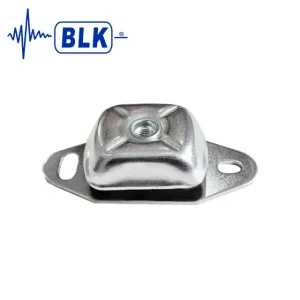
Custom BKM Type Rubber Mounts Factories, Manufacturers

High-Quality BKHQ Type Rubber Mounts Factory, Manufacturers

Low Price BKP Type Rubber Mounts Manufacturers, Manufacturer

Custom BKDR Type Rubber Mounts Factories, Price

Custom BK-DSR Type Damped Rubber Mounts Factories, Manufacturer

Custom BKSWA Type Multi-Layer Antivibration Dampers Factory, Price
Frequently Asked Questions: Industrial Rubber Isolators
Direct engineering answers regarding durometer selection, dynamic performance, seismic restraint, and direct importation into Tokyo.
What parameters are required to calculate the exact rubber isolator sizing for Tokyo projects?
How does Bellking prevent low-temperature crystallization during cold Kanto winters?
Can Bellking produce custom metric and imperial threading combinations for imported equipment?
What is the expected operating life of Bellking rubber isolators under continuous industrial loads?
How does Bellking manage customs clearance and direct delivery into Greater Tokyo?
Equip Your Tokyo Facility with Factory-Direct Isolation Mounts
Submit your equipment parameters today. Our engineering department calculates natural frequency, dynamic deflection, and isolation efficiency with a full submittal package delivered in 24 hours.