
Precision Rubber Mounts for Nordic Industrial Applications
Engineered to mitigate mechanical harmonic resonance, structural fatigue, and noise pollution across Sweden's manufacturing base.
-
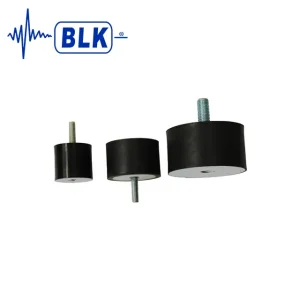
 Sweden Heavy EquipmentLow Price BKVV Type Rubber Mounts Factories, Manufacturers
-
-
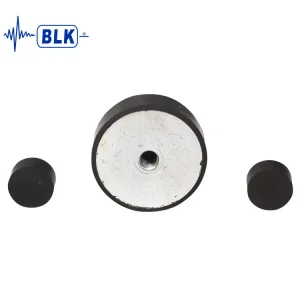
 Mining & Heavy IndustryHigh-Quality BKDD Type Rubber Mounts Factories, Manufacturers
-
Sweden's Industrial NVH Standards: Precision Meets Arctic Durability
Sweden represents one of Europe's most technologically sophisticated industrial ecosystems. From vehicle assembly hubs in Gothenburg and Södertälje to heavy subterranean mining in Kiruna and maritime logistics along the western coastline, industrial vibration control is not merely a component choice—it is a critical determinant of operational uptime and environmental conformity.
Operating in Sweden requires strict compliance with Arbetsmiljöverket (the Swedish Work Environment Authority) provisions on occupational vibration exposure (AFS 2005:15) and environmental noise criteria (SS-EN ISO 4866). Machinery operates across vast thermal differentials, where standard elastomers quickly undergo glass transition ($T_g$), resulting in hardening, premature cracking, and complete loss of damping efficiency.
- Sub-Zero Resilience: Specially compounded natural and synthetic rubber functional down to -40°C without cryogenic embrittlement.
- Full EU Compliance: 100% REACH compliant (zero Substances of Very High Concern - SVHC) and RoHS III certified.
- Corrosion Invariance: Dacromet-coated & SS316 metal substrates passing 900-hour salt spray tests for offshore Baltic exposure.
Technical Specification Benchmark
Standard performance metrics configured for Swedish OEM equipment integration:
Elastomeric Isolation Dynamics: Mathematical Modeling & Sizing
Understanding the balance of static deflection, dynamic stiffness ratio ($K_d/K_s$), and transmissibility under variable Nordic mechanical loads.
1. Frequency Tuning Ratio ($r$)
Vibration isolation occurs strictly when the ratio between the equipment excitation frequency ($f_d$) and the isolator's natural frequency ($f_n$) exceeds $\sqrt{2} \approx 1.414$. For industrial machinery operating across Sweden's manufacturing lines, our engineering target ratio is:
At $r = 3$, structural transmissibility collapses to less than 12%, isolating more than 88% of incoming dynamic kinetic energy before it propagates into civil foundations.
2. Dynamic Stiffening Ratio ($K_d / K_s$)
Unlike linear steel helical springs, elastomers exhibit non-linear viscoelastic properties. Under dynamic cyclic oscillations, the dynamic stiffness ($K_d$) is invariably higher than static stiffness ($K_s$). For natural rubber, this factor ranges between $1.2$ and $1.4$, while for synthetic nitrile or chloroprene, it can exceed $1.8$ to $2.2$.
Bellking uses automated servo-hydraulic test benches to quantify the exact dynamic stiffness curve, preventing under-sizing errors in critical Swedish installations.
3. Metallurgical Bonding Strength
The failure mode of rubber-to-metal isolators in heavy vibration environments almost universally occurs at the bonding interface. Our Kunshan facility employs computerized multi-stage surface phosphating followed by automated dual-coat adhesive application (Chemlok® priming and top-coating).
Vulcanization occurs under high pressure (20 MPa) to achieve cohesive rubber failure ($100\%$ rubber tear) rather than adhesive debonding during tensile test overloads.
| Elastomer Polymer | Hardness (Shore A) | Operating Temp (°C) | Damping Loss Factor (η) | Oil & Fuel Resistance | Typical Swedish Use-Case |
|---|---|---|---|---|---|
| Natural Rubber (NR) | 40 - 75 | -40 to +80 | 0.05 - 0.10 | Fair / Poor | Standard HVAC, centrifugal pumps, diesel genset skids |
| Neoprene / Chloroprene (CR) | 45 - 80 | -35 to +100 | 0.10 - 0.18 | Good (Ozone & Weather) | Offshore maritime, outdoor district energy units |
| Nitrile / NBR | 50 - 85 | -30 to +110 | 0.12 - 0.22 | Excellent (Hydraulic oils) | Hydraulic power units, automotive powertrain test rigs |
| EPDM Synthetic | 40 - 70 | -45 to +130 | 0.08 - 0.14 | Excellent (Glycol, Steam) | Extreme sub-zero installations, heat recovery heat pumps |
| Fluoroelastomer (FKM) | 60 - 90 | -20 to +200 | 0.15 - 0.30 | Maximum Chemical/Acid | Specialized chemical processing, high-heat industrial exhaust |
Kunshan Advanced Manufacturing: The Scalable Partner for Swedish Industry
Combining proprietary tooling rapid prototyping with continuous quality verification to deliver non-standard dampers at scale.
1:1 Mold Rapid Prototyping
With an in-house CNC mold workshop in Kunshan, Bellking turns bespoke CAD designs into functional vulcanized elastomeric prototypes within 3 working days. This agility allows Swedish machine builders to iterate quickly without typical 6-to-8 week European tooling delays.
Strict ISO 9001:2015 QC
Every batch undergoes automated rheometer analysis, dynamic fatigue endurance testing up to 2 million cycles, tensile bonding strain tests, and Shore A verification. 100% factory inspection reports accompany shipments direct to Nordic destinations.
Streamlined Logistics to Sweden
Direct multimodal transport links Kunshan to major Swedish commercial centers including Gothenburg (Göteborgs Hamn), Stockholm, Malmö, and Helsingborg. Air express fulfillment dispatches standard product inventories within 24 hours.
Engineering Case Studies: Swedish Industrial Environments
Real-world integration across Sweden's foundational engineering, energy, extraction, and marine sectors.
Case A: Subterranean Mining & Screening (Kiruna / Gällivare)
In northern Sweden's massive iron ore extraction facilities, vibrating screens, feed hoppers, and secondary crushers operate under punishing impact cycles. Standard industrial isolators experience continuous plastic deformation and dynamic fatigue tear within months under constant subterranean exposure to heavy dust and sub-zero moisture.
Bellking High-Load BKDD & Custom Shear Dampers
By engineering high-tear synthetic-natural composite compounds paired with reinforced M24 stud arrays, Bellking delivered custom damped isolation units capable of sustaining dynamic shocks up to 5G acceleration, increasing component replacement intervals from 6 months to over 3.5 years.
Case B: Municipal District Heating & Heat Pumps (Stockholm / Malmö)
Sweden is an international pioneer in large-scale district heating networks (Fjärrvärme). Multi-megawatt industrial heat pumps and circulating booster stations situated near high-density residential developments must meet acoustic thresholds under 32 dBA at foundation boundary walls.
BKVD & BKVE Low-Frequency Isolators
Bellking implemented custom-tuned BKVD rubber mounts with high static deflection (7-12mm), shifting the combined natural frequency ($f_n$) down to 6.2 Hz. This effectively decoupled the 50 Hz fluid pulsation harmonics, completely resolving structure-borne complaints from local municipalities.
Case C: Maritime Propulsion & Auxiliary Gensets (Gothenburg Archipelagos)
Commercial vessels, coastal tugs, and ferries navigating the Skagerrak and Baltic waterways encounter severe mechanical roll and saltwater mist. Engine mounts must carry steady static loads while restraining sudden multi-axis thrust transitions during dynamic maneuvering.
Marine-Grade BKH & BKHQ Captive Rubber Mounts
Featuring an integrated fail-safe mechanical stop, our captive anti-vibration mounts prevent equipment displacement even in the event of vessel rollover or excessive surge impacts, fully certified with 900-hour Dacromet salt spray protection.
Case D: EV Powertrain Dynamics & Testing Labs (Södertälje R&D Hubs)
The rapid expansion of battery-electric heavy transport requires high-speed dyno test cells operating at frequencies above 15,000 RPM. High-frequency electromagnetic excitation produces micro-vibrations that distort delicate sensor measurements.
BKM & BKSWA Multi-Layer Dampers
Combining precision-molded rubber elements with viscous interlayers, Bellking engineered ultra-compact test bench mounts that filter out high-frequency electromagnetic noise while maintaining absolute sub-millimeter shaft alignment.
Emerging NVH Trends: Decarbonization & Predictive Maintenance
How modern elastomer chemistry and smart sensing align with Sweden’s 2045 carbon neutrality goals.
Halogen-Free & Bio-Elastomers
Sweden's stringent environmental procurement mandates demand non-toxic end-of-life cycles. Bellking is pioneering carbon-black replacements derived from sustainable bio-fillers and halogen-free vulcanization compounds that maintain tensile properties above 18 MPa while cutting embodied product carbon footprints by 28%.
IoT-Enabled Predictive Mounts
For mission-critical installations in remote facilities across Norrland, unplanned maintenance is costly. We are prototyping integrated micro-piezoelectric wireless strain sensors within industrial mounts to provide real-time degradation telemetry, warning maintenance engineers prior to catastrophic failure.
Broadband Harmonic Tuning
Variable-frequency drive (VFD) motors generate shifting excitation frequencies that defeat single-rate passive dampers. Bellking's dual-modulus composite geometries maintain consistent isolation profiles across multi-octave operational envelopes (10 Hz through 250 Hz).
Heavy-Duty & Specialized Rubber Dampers
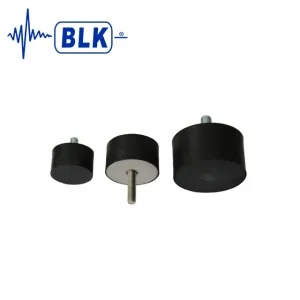
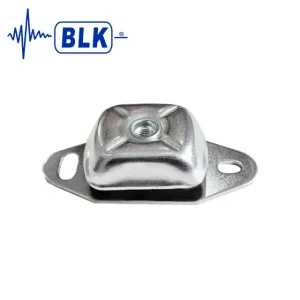
Explore our full range of standardized and custom-molded elastomeric solutions ready for rapid international dispatch.
-
-

-
-
-

-

-

-
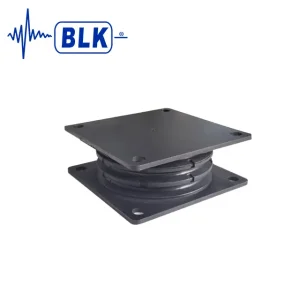 Multi-Layer ArchitectureCustom BKSWA Type Multi-Layer Antivibration Dampers Factory, Price
Engineering Sizing Protocol for Swedish OEM Procurement
A systematic framework for mechanical engineers to size, verify, and order exact vibration isolators.
Step 1: Operational Weight & COG
Calculate total wet operating weight, including all auxiliary fluid payloads (oil, coolant). Determine center of gravity (COG) coordinates to allocate point-specific static load vectors ($W_1, W_2, \dots, W_n$). Uneven mass distribution requires different durometer Shore A isolators across mounting corners.
Step 2: Excitation Frequency ($f_d$)
Determine lowest operating motor speed or harmonic frequency:
$f_d = \frac{\text{RPM}}{60}$.
For a 1,450 RPM motor (standard Swedish 50 Hz grid speed), $f_d \approx 24.17\text{ Hz}$. To achieve $85\%+$ isolation efficiency, isolator natural frequency ($f_n$) must be engineered below $8\text{ Hz}$.
Step 3: Calculate Static Deflection
Natural frequency correlates to vertical deflection ($\delta_{st}$ in mm):
$f_n \approx \frac{5}{\sqrt{\delta_{st}}}$.
For $f_n = 6.5\text{ Hz}$, required static compression is approximately $3.5\text{ to } 4.5\text{ mm}$. Our engineering team cross-references this against shear and compression curves to prevent premature rubber creep.
Custom Engineering Sizing Support within 24 Hours
Send your equipment parameters (operating weight, RPM, mount count, environmental constraints) to Bellking's engineering team. We deliver complete 3D FEA modal analysis, static deflection charts, and certified quotations tailored to your Swedish facility.
Frequently Asked Questions by Scandinavian Engineering Teams
Detailed technical answers addressing environmental, regulatory, and mechanical sizing challenges.
How do Bellking rubber isolators behave in sub-zero winter environments down to -30°C in Northern Sweden?
Are your products fully compliant with EU REACH and Swedish environmental requirements?
What is the practical lifespan of industrial rubber isolators in continuous-duty applications?
When should engineers specify rubber vibration isolators instead of helical steel springs?
Can Bellking manufacture custom rubber mounts with bespoke dimensions and metric threads for Swedish equipment?
What are your lead times and logistics capabilities for deliveries into Sweden?
Optimize Your Mechanical NVH Performance Today
Partner with an established manufacturer capable of meeting rigorous Scandinavian industrial standards. Get immediate factory pricing, comprehensive FEA damping calculations, and custom tooling turnarounds within 3 days.