
High-Performance Rubber Vibration Isolators for French Industrial Plants
Pre-engineered cylindrical, male-female, and heavy shear-compression elastomeric mounts for immediate application across French manufacturing and MEP installations.

BKVV Type Double Male Thread Rubber Mounts - France Standard
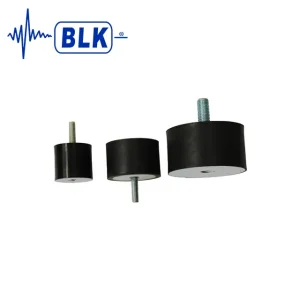
Custom BKVD Male-Female Stud Dampers for France Machinery

BKDD Internal Female Thread Dampers - Paris Metro & HVAC Grade
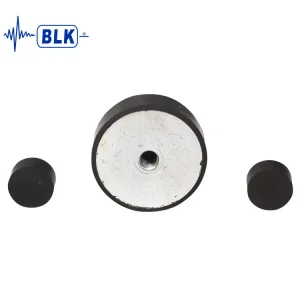
BKDE Single Flange Cylindrical Mounts - French Industrial Automation
Macro Commercial & Industrial Landscape in France
How the revitalization of French domestic manufacturing (France 2030) and stringent acoustic regulations (RE2020) are reshaping industrial vibration isolation procurement.
Stringent French Acoustic Norms: RE2020 & NF S 31-010
Under France's strict Réglementation Environnementale 2020 (RE2020) and statutory industrial noise thresholds defined by standard NF S 31-010, acoustic emissions transmitted into building structures must not exceed emergence limits of 3 dB(A) at night and 5 dB(A) during the day. HVAC systems, heat pumps (PAC), cooling towers, and data center chillers located in densely populated metropolitan areas like Paris, Lyon, and Marseille face severe operational sanctions if structure-borne vibrations pass through foundations. Engineered rubber isolators act as indispensable physical decoupling barriers, cutting transmissibility by up to 98% in frequencies above 15 Hz.
Regional Industrial Clusters: Auvergne-Rhône-Alpes to Occitanie
Vibration isolation requirements vary sharply across France's economic corridors. In the Auvergne-Rhône-Alpes region (the Arve Valley precision machining cluster), CNC tool builders demand compact, micro-vibration elastomeric pads to suppress tool chatter and ensure surface roughness within sub-micron tolerances. In Occitanie and Nouvelle-Aquitaine, Airbus subcontractors and aerospace test equipment fabricators require dynamic vibration damping for shaker tables and test rigs. Meanwhile, in the naval strongholds of Brest, Toulon, and Saint-Nazaire, naval shipbuilders mandate salt-spray-resistant rubber-to-metal bonding capable of surviving maritime mechanical shocks.
Worker Health & Safety: Directive 2002/44/EC
France strictly enforces European Directive 2002/44/EC transposing into the French Code du Travail (Articles R4441-1 to R4447-1), setting occupational exposure action values for whole-body vibration (0.5 m/s² daily) and hand-arm vibration (2.5 m/s²). French manufacturers operating stamping presses, vibrating screens, industrial centrifuges, and compressors are legally compelled to install certified elastomeric isolators to mitigate occupational vibrational trauma, preventing costly ergonomic penalties and civil liability claims.
Rubber Vibration Isolators Price Structure in the France Market
Comprehensive cost analysis for French purchasing directors, mechanical contractors, and machine builders: factory direct rates vs French domestic catalog prices.
Industrial rubber mounts sold in France have historically been supplied through entrenched domestic distributors or European brands (e.g., Paulstra Hutchinson, Trelleborg, Continental). Because these components flow through multiple intermediaries, markup multiples commonly reach 250% to 400% above raw manufacturing costs. By partnering directly with an ISO 9001:2015 Tier-1 manufacturer, French procurement teams can drastically reduce bill-of-materials (BOM) expenditure without compromising technical compliance, material integrity, or delivery speed.
| Mount Type / Model Equivalent | Dimensions & Load Rating | Elastomer Compound | French Catalog Distributor Price (€/unit) | Bellking Direct OEM Price (FOB/DDP €/unit) | Typical Volume MOQ | Estimated Savings |
|---|---|---|---|---|---|---|
| Cylindrical Bobbin Mounts (BKVV / BKVD) M6–M10 studs (Paulstra Radiaflex equiv.) |
Ø 20–50 mm 15 kg – 180 kg/mount |
Natural Rubber (NR 55 Shore A) | € 6.80 – € 14.50 | € 1.85 – € 3.90 | 100 pcs | -68% to -73% |
| Heavy Machine Leveling Mounts (BKM / BKH) Adjustable bolt, oil-resistant base |
Ø 80–160 mm 250 kg – 1,500 kg/mount |
NBR (Nitrile) / High-Tear NR | € 28.00 – € 62.00 | € 8.90 – € 18.20 | 50 pcs | -65% to -70% |
| Marine & Naval Bell Isolators (BKP Series) Captive fail-safe interlocking hood |
Bolt size M12–M20 300 kg – 2,200 kg/mount |
CR (Neoprene) / Spec NR 60 | € 75.00 – € 165.00 | € 24.50 – € 52.00 | 20 pcs | -64% to -68% |
| High-Damping Seismic Rubber Pads (BK-DSR) Multi-layer elastomeric steel composite |
150×150 mm to 300×300 mm Up to 6,000 kg/pad |
High-Damping EPDM / Polyurethane | € 95.00 – € 240.00 | € 32.00 – € 78.00 | 10 pcs | -66% to -67% |
| HVAC Multi-Layer Anti-Vibration Pads (BKSWA) Waffle / ribbed acoustic pad sheets |
Standard modular tiles 500×500×20 mm |
Oil & Weatherproof Synthetic Rubber | € 45.00 – € 85.00 | € 14.50 – € 26.00 | 25 tiles | -67% to -69% |
Commercial Procurement Note on Delivery to France (Incoterms 2020)
All unit quotes can be provided on an FOB Shanghai or full DDP France (Le Havre / Fos-sur-Mer / Roissy CDG Air Cargo) basis. DDP terms include full customs clearance under French tariff classification (Code TARIC 4016 99 97 90 for rubber articles), EU anti-dumping checks, and direct bonded road haulage straight to your regional plant in Lyon, Toulouse, Lille, or Paris.
Technical Roadmap: Elastomeric Formulation & Dynamic Damping Science
Vibration isolation efficiency is governed by non-linear polymer mechanics, chemical metal-rubber vulcanization, and accurate dynamic-to-static stiffness ratios ($K_d / K_s$).
Polymer Selection & Operational Durability
Standard industrial mounts rely heavily on Natural Rubber (NR) due to its unparalleled mechanical resilience, superior tear resistance, and high tensile elongation (up to 600%). However, French industrial installations frequently impose harsh environmental stressors: synthetic cutting oils in Rhone Valley machine shops, atmospheric ozone along the Mediterranean seaboard, or extreme thermal variations in refrigerated logistics centers. We formulate customized elastomers utilizing Chloroprene (Neoprene) for flame and weather resistance, Nitrile (NBR) for hydrocarbon immunity, and Fluorocarbon (FKM) for high-temperature chemical processing up to 180°C.
Chemical Rubber-to-Metal Vulcanization
The weakest point of any conventional rubber isolator is the interfacial adhesion between the elastomeric core and metal hardware. Bellking implements a proprietary multi-stage chemical surface conversion process: automated grit-blasting (Sa 2.5), ultrasonic vapor degreasing, and automated robotized spray application of dual-coat Chemlok® silane adhesive primers. Thermal vulcanization occurs in vacuum-assisted hydraulic compression presses at 155°C ± 2°C. The resultant chemical bond exceeds the parent elastomer's cohesive shear strength, preventing delamination failures even under cyclic shear stress.
Dynamic Hardening & Transmissibility Calculations
Unlike steel coil springs, rubber displays viscoelastic behavior: dynamic stiffness ($K_d$) is consistently higher than static stiffness ($K_s$), with dynamic hardening ratios typically ranging from 1.2 to 2.0 depending on the loss factor ($\tan \delta$) and excitation frequency. When sizing isolators for French HVAC chillers operating at 2,950 RPM (49.1 Hz), our application engineers perform FEA dynamic response simulations, calculating the exact static deflection ($\delta_{st}$) and ensuring the disturbing-to-natural frequency ratio ($f_d / f_n$) strictly exceeds $\sqrt{2}$, securing safe entry into the high-attenuation zone (>90% efficiency).
Macro Industry Solutions Across French Sectors
Field-proven elastomeric vibration damping tailored to the specific engineering mandates of French manufacturing, construction, energy, and transport infrastructure.
Commercial HVAC, Heat Pumps & Paris Data Centers
With the explosion of cloud data centers along the Plaine Saint-Denis and commercial mixed-use developments across Grand Paris, roof-mounted chillers, VRV heat pumps, and primary circulating pumps present severe structure-borne noise risks. Our BKH and BKDD series provide comprehensive structural decoupling, insulating penthouse concrete slabs against low-frequency secondary acoustic radiation while handling high static loads up to 1,500 kg per mounting point.
Rolling Stock, Rail Auxiliary & SNCF / RATP Standards
French rolling stock suppliers (such as Alstom, CAF France) and regional transit networks demand anti-vibration mounts engineered to survive multi-axial dynamic fatigue and extreme shock impulses. Bellking manufactures captive fail-safe bell mounts (BKP series) engineered for onboard air compressors, traction converters, and brake auxiliary cabinets. These isolators integrate internal mechanical stops, preventing equipment detachment in the event of high acceleration shocks.
Industrial Automation, Machine Tools & Presses
In stamping, injection molding, and CNC manufacturing facilities across Hauts-de-France and Grand Est, undamped shock transmission damages concrete factory floors and distorts neighboring coordinate measuring machines (CMMs). Our heavy-duty leveling mounts and composite polymer damping pads (BK-DSR) absorb sudden shock impulses up to 5G, providing rapid kinematic settling and prolonging machine tool bearing life.
China Factory 4.0: Supply Chain Resilience & Global Capacity
Direct manufacturing capability from Kunshan, China—combining high throughput, automated precision molding, and strict European traceability standards.
2,000 m² Advanced Production Facility
Operating out of Kunshan (Jiangsu Province), Bellking maintains a modernized production facility equipped with high-tonnage multi-station vacuum vulcanizing presses, automated CNC metal lathe machining centers, and cryogenic deflashing equipment. With an annual output exceeding 100,000 finished vibration isolators, we guarantee French enterprise customers rapid production scaling for large capital infrastructure projects without supply chain bottlenecks.
100% In-House Physical & Dynamic Testing
Quality assurance is verified directly on the factory floor before export packaging. Every production batch undergoes comprehensive testing: static load-deflection mapping via calibrated computerized hydraulic test rigs, dynamic stiffness characterization, and durometer Shore A verification according to ISO 7619-1. Furthermore, all metal hardware receives high-grade zinc electroplating or Dacromet coating tested to pass 900 hours of continuous neutral salt spray (ISO 9227).
EU Regulatory Compliance: REACH & RoHS 3
French and EU environmental import regulations are strictly managed. Our elastomer formulations contain zero prohibited aromatic amines, phthalates, or SVHC substances under Regulation (EC) No 1907/2006 (REACH). Full compliance with EU RoHS 3 (Directive 2015/863/EU) ensures that all rubber isolators enter French ports smoothly, accompanied by full Material Safety Data Sheets (MSDS) and mill inspection certificates (EN 10204 3.1).
Engineered Rubber Mounts Available for French Procurement
Select from our standard industrial catalog with exact CAD dimensional interchangeability with legacy French and European product lines.
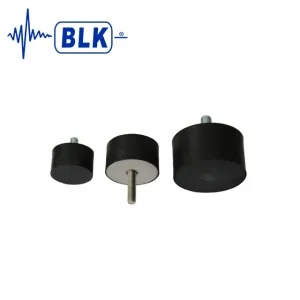
BKVE Series Cylindrical Bobbin Mounts - Female/Base Plate

BKH Heavy Shear-Compression Industrial Mounts - France OEM
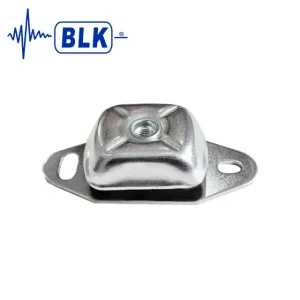
BKM Machine Leveling Damping Mounts - French Tooling Shops
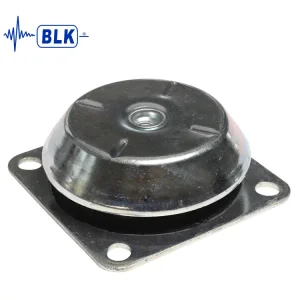
BKHQ Heavy Equipment Rubber Mounts - High Dynamic Load

BKP Captive Marine Bell Mounts - French Naval & Genset Grade

BKDR Parabolic & Conical Rubber Bumpers - France Heavy Impact

BK-DSR Engineered Composite Damping Pads - Acoustic Retrofits
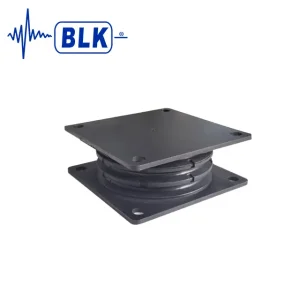
BKSWA Multi-Layer Anti-Vibration Mats - High Load Inertia Bases
Engineering Calculation Framework for French Project Tenders
Accurate vibration isolation design based on mass distribution, center of gravity (CoG), and excitation harmonics.
Step-by-Step Elastomer Mount Sizing Formula
For French mechanical contractors submitting technical files (*Dossier d'Ouvrage Exécuté - DOE*) to French engineering inspection bodies (e.g., Bureau Veritas, Socotec, Apave), isolation calculations must be clearly documented. Natural frequency ($f_n$) of an elastomeric mount in compression is calculated from its static deflection ($\delta_{st}$ in cm):
Where $f_d$ represents the disturbing frequency of the equipment (for a motor running at 1,450 RPM, $f_d = 1,450 / 60 = 24.17\text{ Hz}$). If an elastomer mount with a static deflection of 4.5 mm ($\delta_{st} = 0.45\text{ cm}$) is selected:
• Mount natural frequency: $f_n = 5 / \sqrt{0.45} \approx 7.45\text{ Hz}$.
• Frequency ratio: $r = f_d / f_n = 24.17 / 7.45 \approx 3.24$ (safely above the recommended ratio of 3.0).
• Theoretical transmissibility: $T = 1 / (3.24^2 - 1) = 1 / (10.5 - 1) = 0.105$ → 89.5% Isolation Efficiency.
Questions French Engineering & Sourcing Teams Ask Us
Direct technical answers addressing customs, Paulstra/Trelleborg dimensional cross-referencing, compound aging, and delivery timelines to France.