Rubber Vibration Isolators Manufacturers & Manufacturer in the London Market
Precision Elastomeric Mounts, High-Damping Structural Buffers, and Acoustic Isolation Bearings Engineered for UK Building Standards (BS 6177 / BS 6472) and Greater London Infrastructure.
Engineered for high-frequency isolation, pump plant attenuation, and HVAC air-handling vibration damping across commercial developments in Central London and the M25 tech corridor.
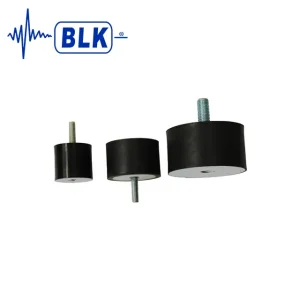
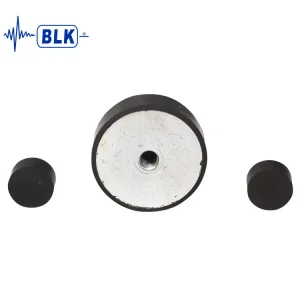
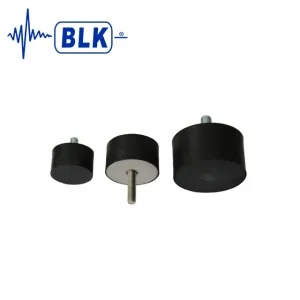
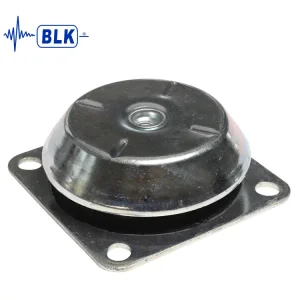
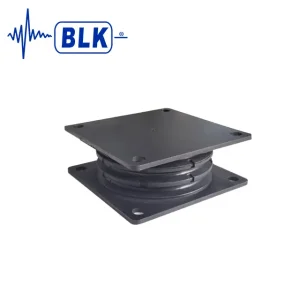
Cylindrical Male/Male Mount
London Commercial BKVV Cylindrical Rubber Isolator
Designed for compact HVAC compressor units, split water pumps, and air terminal units operating within tight urban ceiling cavities.
Structural Acoustics & Elastomeric Dynamics in the London Metropolitan Area
A rigorous examination of ground-borne vibration transmission, geotechnical soil dynamics in the London Basin, and compliance mandates for modern urban MEP installations.
1. The Geotechnical Challenge: London Clay and Sub-Surface Vibration Transmission
The Greater London built environment presents a uniquely intricate mechanical challenge for acoustic consultants, structural engineers, and building services contractors. The London Basin is predominantly underlain by dense, stiff over-consolidated deposits of London Clay, overlain in localized Thames floodplains by river terrace gravels and post-industrial alluvium. From an elastodynamics perspective, London Clay acts as a remarkably efficient transmission medium for low-to-mid frequency mechanical energy (specifically within the critical 16 Hz to 80 Hz spectrum).
With the extensive operations of the Transport for London (TfL) tube network, the Elizabeth Line (Crossrail), Thameslink, and deep-level subterranean logistics arteries, sub-surface structure-borne acoustic vibration regularly impinges upon building sub-structures. When rotating mechanical plant—such as water chillers, multi-stage booster pumps, rooftop variable-refrigerant-flow (VRF) condensing units, and combined heat and power (CHP) generators—is rigidly anchored to building floors, mechanical resonance couples directly into the concrete superstructure. This produces reradiated acoustic "rumble," exceeding strict British Standard BS 6472-1:2008 (Vibration Dose Value criteria) and failing BREEAM UK Hea 05/Pol 05 acoustic rating benchmarks. High-performance vulcanized rubber vibration isolators are the frontline engineering defense to break this structural flanking path.
92%–98%
Typical Isolation Efficiency
Achieved when excitation frequency exceeds 3x natural frequency.
BS 6177
British Standard Aligned
Elastomeric bearings and resilient mountings for building isolation.
Dacromet/Sherardized metal components resisting UK maritime humidity.
2. Mathematical Principles of Elastomeric Vibration Isolation
Vibration isolation relies upon establishing a physical mismatch between the disturbing excitation frequency ($f_d$) emitted by mechanical machinery and the fundamental natural frequency ($f_n$) of the elastomeric mounting system. When equipment is supported by elastomeric rubber mounts, static deflection ($\delta_{st}$) under gravitational dead load dictates the theoretical vertical natural frequency according to linear elasticity:
Static Deflection to Natural Frequency Derivation
Where $g$ represents gravitational acceleration ($9.81\ \text{m/s}^2$) and $\delta_{st}$ denotes static deflection in millimeters. True rubber dynamics, however, exhibit non-linear viscoelasticity, necessitating the calculation of the dynamic-to-static stiffness ratio ($K_d / K_s$).
In practice, rubber compounds exhibit dynamic stiffening. For natural rubber (NR) compounded at 45 to 60 Shore A durometer, $K_d / K_s$ typically ranges between 1.2 and 1.45, whereas for chloroprene (Neoprene) or nitrile (NBR) it can range from 1.4 to 2.2 depending on filler loading (carbon black). Bellking’s advanced polymer compounding precisely stabilizes dynamic stiffness across temperature shifts, ensuring that calculated transmissibility ($T$) matches real-world performance:
Where $r = f_d / f_n$ is the frequency tuning ratio and $\zeta$ is the material damping ratio. Isolation only commences when $r > \sqrt{2} \approx 1.414$. In prime London developments—such as high-specification offices in the City of London, Canary Wharf, or high-value residential schemes in Kensington and Chelsea—mechanical engineers mandate an operating ratio $r \ge 3.0$, yielding an isolation efficiency ($E = (1 - T) \times 100\%$) superior to 90% to 96%.
Elastomer Base Polymer
Hardness Range (Shore A)
Dynamic Stiffness Ratio ($K_d/K_s$)
Operating Temp Range (°C)
Hydrocarbon & Oil Resistance
Primary London Application Environment
Natural Rubber (NR)
40 – 70
1.15 – 1.35
-40°C to +75°C
Moderate (Requires shielding)
Critical low-frequency building bearings, HVAC floating floors, chillers.
Polychloroprene (Neoprene)
45 – 75
1.30 – 1.60
-30°C to +100°C
High (Self-extinguishing)
Rooftop plant rooms, AHU brackets, external cooling tower support.
Exposed Thames Estuary waterfront facilities, high UV/thermal environments.
High-Damping Silicone
30 – 70
1.10 – 1.25
-60°C to +200°C
High chemical inertness
Cleanrooms, biomedical laboratories in King's Cross Knowledge Quarter.
3. Localized Application Frameworks Across Greater London Sectors
The deployment of elastomeric vibration control systems within London requires an acute appreciation of sector-specific regulatory and physical constraints:
Central London High-Rise Commercial Office Complexes (The City & Canary Wharf): In Grade-A commercial spaces, rooftop mechanical equipment rooms operate directly above premium leased floors. Chilled water systems and cooling towers generate disturbing frequencies corresponding to motor rotation speeds (typically 1,450 RPM or 24.1 Hz; variable speed drives often drop to 15 Hz / 900 RPM). Rubber mounts provide critical high-frequency isolation and structure-borne acoustic break capabilities that prevent motor harmonic hum from propagating into steel-frame structural columns.
Mission-Critical Data Infrastructure (Slough & London East Data Centers): The Slough Availability Zone and East London Docklands host Europe’s highest concentration of hyperscale and colocation data facilities. Continuous standby diesel gensets, high-capacity rotary UPS systems, and massive adiabatic fluid coolers generate severe oscillatory forces. Bellking elastomeric buffers provide secondary high-amplitude snubber stabilization, preventing resonance catastrophe during sudden generator load pickup or seismic earth shifts.
Acoustic & Media Studio Facilities (Soho & West End Creative Districts): Broadcasting suites, recording studios, and post-production houses operate under stringent Noise Rating (NR) criteria—frequently demanding NR-20 or lower. Here, rubber hangers and composite isolation pads isolate ceiling ducting, electrical conduit, and floating acoustic floor decks to suppress reradiated mechanical noise.
Historic Building Retrofits & Residential Conversions (Westminster & Camden): Victorian masonry and heritage cast-iron frames possess negligible inherent structural damping compared to modern reinforced concrete. Retrofitting modern heat pump chillers onto unreinforced timber or lightweight steel joists requires specialized low-stiffness rubber isolators that avoid point-load concentration and preserve historic architectural fabric.
Need Comprehensive Vibration Calculations for Your London Site?
Provide our acoustic design team with your equipment operating weight, RPM, center-of-gravity schematics, and floor structure parameters for a full transmissibility analysis within 24 hours.
4. Global Industrial Dynamics vs. London Market Evolution
The global vibration control market is undergoing a structural transformation driven by urbanization, higher-density zoning, and increasingly stringent environmental noise regulations. Historically, procurement teams treated rubber mounts as generic commodity hardware—selecting molded blocks purely by dimensional fit. Today, Tier-1 European construction frameworks and UK engineering consultants demand fully traceable, polymer-engineered isolators with verifiable dynamic stiffness profiles, non-linear finite element validation (FEA), and long-term fatigue data.
Supply chain pressures have also prompted London contractors to move away from multi-tiered distributor markups in favor of direct engagement with specialized, accredited manufacturing facilities. As an established ISO 9001 certified manufacturer with over 13 years of specialized precision damping production, Bellking provides the London market with factory-direct engineering support, rapid prototyping (3-day turnaround on bespoke compounds), and certified third-party testing that complies with international building codes.
5. UK Regulatory Compliance Roadmap: BREEAM, CIBSE, and British Standards
Specifying rubber vibration isolators in the United Kingdom requires strict conformity to established statutory and advisory frameworks:
BS 6177:1982:Selection and use of elastomeric bearings for vibration isolation of buildings. Outlines core performance metrics for creep under dead load, aging characteristics, and long-term static modulus stability.
BS 6472-1:2008:Guide to evaluation of human exposure to vibration in buildings. Establishes Vibration Dose Values (VDV) for daytime and nighttime occupancy in residential and commercial developments.
CIBSE Guide B4: Noise and Vibration Control for Building Services Systems: Sets standard criteria for equipment mounting deflections based on structural floor span length and equipment operating speed.
The London Plan (Policy D14 - Noise): Mandates that major developments manage noise and vibration through the 'Agent of Change' principle, requiring developers to mitigate vibration at source to prevent adverse impacts on adjacent communities.
How advanced polymer synthesis, bio-based elastomers, and digital-twin modeling are reshaping vibration control in dense urban environments.
1. Graphene-Enhanced Elastomers
Integrating functionalized graphene nanoplatelets into natural rubber matrixes to enhance thermal conductivity (mitigating internal hysteretic heat build-up under cyclic loading) and boost dynamic fatigue thresholds by over 300%.
2. Closed-Loop Bio-Polymers
Aligning with the UK Net Zero 2050 framework and London Embodied Carbon charters by replacing petroleum-derived polymers with sustainably sourced guayule rubber and recycled carbon black fillers without sacrificing loss-factor consistency.
3. Embedded IoT Strain Metrology
Vulcanizing low-profile piezo-resistive sensor filaments directly inside critical structural bearings to provide real-time dynamic deflection, load shifts, and aging analytics straight to central Building Management Systems (BMS).
Macro Industry Solutions: Complete Engineering Isolation Packages
Bellking delivers comprehensive turnkey isolation packages tailored to the structural configurations of Greater London building projects:
HVAC & MEP Plant Room Isolation: A synchronized assembly of BKVV and BKVE rubber mounts paired with flexible pipe connectors and inertia bases to arrest reciprocating momentum in chilled water pump arrays.
Building Box-in-Box Acoustic Decoupling: High-deflection elastomeric pads and hangers designed for West End cinemas, concert auditoriums, and high-end recording facilities requiring full structural separation from tube line rumbles.
Electrical Transformer & Substation Isolation: High-damping neoprene and nitrile cushions installed beneath urban distribution transformers to mitigate 100 Hz/120 Hz magnetostrictive hum in accordance with BS EN 60076-10.
Acoustic Engineering Q&A
Frequently Asked Questions: London Engineering & Procurement
Authoritative technical guidance compiled by Bellking application engineers for MEP specifiers, acoustic consultants, and site contractors.
What distinguishes rubber vibration isolators from steel spring mounts in Central London installations?
Steel springs excel at providing large static deflections (25 mm to 75 mm), resulting in very low natural frequencies (2 Hz to 4 Hz) suitable for low-speed chillers and slow-speed cooling towers. However, steel springs suffer from high-frequency acoustic wave surge—meaning audible, structure-borne noise (>200 Hz to 2 kHz) can bypass the spring coils directly into the floor. Rubber vibration isolators offer superior high-frequency attenuation and internal material damping ($\eta = 0.10 - 0.25$), effectively blocking acoustic hum and flanking noise. In many London specifications, composite solutions (spring isolators seated in series with a vulcanized rubber acoustic cup) are mandated to capture both spectra.
How does Bellking ensure compliance with BS 6177 and BS 6472 in London residential developments?
BS 6177 sets the criteria for elastomeric bearings used in structural isolation, focusing on long-term creep, dynamic-to-static modulus ratios, and environmental resistance. Bellking conducts accelerated aging trials (ISO 188) and dynamic mechanical analysis (DMA) to verify that our elastomeric compounds will not experience excessive settlement or dynamic stiffening over their design life (typically 15 to 30 years). To satisfy BS 6472-1 (Vibration Dose Value within human comfort thresholds), we calculate specific point-load deflections to ensure disturbing frequencies from HVAC systems maintain an isolation efficiency above 90%, preventing re-radiated sound levels from exceeding NC-25/NR-30 limits.
Which elastomer compound is recommended for rooftop installations along the River Thames corridor?
For external installations along the Thames estuary corridor (subject to industrial pollutants, marine salt air, and high UV/ozone exposure), we recommend high-grade Polychloroprene (Neoprene) or EPDM polymers. While standard natural rubber offers slightly higher resilience and lower damping, it is vulnerable to ozone cracking and surface degradation unless shielded. Our Neoprene-based isolators are formulated to pass 96-hour ozone resistance tests (ASTM D1149) and feature Dacromet-coated or 316 stainless steel hardware that withstands 900+ hours of continuous salt-spray exposure without flaking or galvanic corrosion.
Can Bellking provide 1:1 custom non-standard rubber isolator designs for legacy building retrofits?
Yes. A substantial portion of central London construction involves the refurbishment of historic Grade-II listed buildings with non-standard joist spacing, load-bearing masonry, and strict height clearance restrictions. Bellking maintains in-house tooling, CNC machining, and rubber mold fabrication capabilities. Our engineering team can develop custom 1:1 footprint adapters, bespoke durometer blends, and asymmetric threaded studs within 3 working days from approved technical submittals, ensuring seamless installation without modifying existing heritage structural elements.
What lead times and shipping schedules apply to mechanical deliveries into the London area?
Standard catalog items—including BKVV, BKVD, BKDD, and BKDE isolators—are kept in regular production stock and can be dispatched within 24 hours. For commercial project quantities destined for London, we offer coordinated air-freight consolidation (typically 4–7 days port-to-door) to meet tight crane lifting schedules, as well as containerized ocean freight for major project developments. Every consignment includes full factory acceptance test (FAT) certs, material traceability documentation, and dynamic compliance reports.
Direct Factory Technical Procurement
Optimize Your Vibration & Noise Isolation Performance
Whether you are retrofitting commercial chillers in the City of London, designing a quiet basement studio in Soho, or engineering mission-critical backup power in Slough, Bellking's engineering specialists deliver calculated isolation performance tailored to your project schedule.