
Custom Air Compressor Rubber Feet Factories & Manufacturer
Industrial Whitepaper on Anti-Vibration Elastomeric Mounts, FEA Load Analysis, and Global OEM Procurement Solutions
Industrial Air Compressor Mounts & Dampers
Precision-engineered elastomeric mounts, pneumatic isolators, and heavy-duty rubber feet certified for ISO 9001 industrial applications.


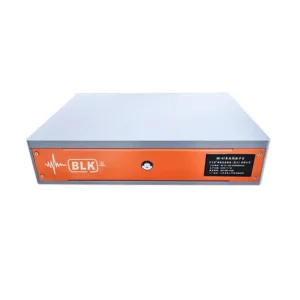





Air Compressor Vibration Dynamics & Isolation Engineering
Understanding kinetic energy transfer, structural resonance, and elastomeric dampening in modern industrial compressed air systems.
Harmonic Transmissibility
Air compressors generate intense low-frequency forces during stroke cycles. Without targeted isolation, harmonic vibrations travel through mounting skids into factory floorings, accelerating equipment wear and generating severe acoustic interference.
Shear vs. Compression Stress
Custom elastomeric feet are calibrated to operate under hybrid shear-compression loading. By configuring internal vulcanized metal plates with high-grade synthetic elastomers, dynamic stiffness ($K_d$) is optimized against static creep.
Durometer Optimization
Selectable Shore A hardness ranges (40 to 75 Shore A) allow design engineers to tune natural frequencies ($f_n$) down to 3–8 Hz, successfully decoupling compressor motor speeds (1200–3600 RPM) from support substrates.
Material Formulations & Finite Element Analysis (FEA)
Integrating modern compounding techniques with advanced computer simulation to build failure-proof dampeners.
The performance of modern custom air compressor rubber feet extends beyond basic vibration dampening. In industrial environments where oil mists, ozone, thermal fluctuations, and continuous dynamic compression collide, compound formulation is critical. Leading factories utilize precise elastomeric recipes backed by strict FEA modeling to predict real-world fatigue life.
| Elastomer Type | Tensile Strength (MPa) | Oil & Solvent Resistance | Operating Temperature | Primary Compressor Application |
|---|---|---|---|---|
| Natural Rubber (NR) | 18 – 25 MPa | Fair / Low | -40°C to +80°C | Heavy Reciprocating Units (Max Resilience) |
| Nitrile Rubber (NBR) | 14 – 20 MPa | Excellent (Petroleum-based) | -30°C to +120°C | Industrial Rotary Screw Compressors |
| EPDM Elastomer | 12 – 18 MPa | Good (Ozone & Weathering) | -40°C to +150°C | Outdoor Refrigeration & HVAC Compressors |
| Fluoroelastomer (FKM) | 10 – 16 MPa | Superior Chemical Resistance | -20°C to +200°C | High-Temp Chemical & Process Compressors |
FEA (Finite Element Analysis) Driven Vulcanization
By simulating static displacement and dynamic fatigue loading in ANSYS software, Bellking engineers eliminate high-stress concentrations at the rubber-to-metal bonding interface. This guarantees that metal studs (Dacromet or SS304 coated) will not tear away from the rubber core under high shock conditions up to 5G acceleration.
Why Sourcing Air Compressor Rubber Feet from China Factories Excels
Unmatched supply chain integration, automated vacuum compression molding, and rigorous quality verification.
Complete Supply Integration
Located in Kunshan, Jiangsu, China's core precision manufacturing hub, Bellking benefits from instant access to raw polymer compounding, automated CNC mold production, and advanced surface coating facilities within a 15-mile radius.
Custom Tooling Agility
Tooling lead times for custom mold designs are reduced from industry-standard 6 weeks down to 5–7 business days. Fully automated vacuum vulcanization presses ensure sub-millimeter geometric accuracy across batch production runs.
Cost-to-Performance Ratio
Integrated high-volume production enables Tier-1 OEM suppliers to achieve up to 40% cost reduction compared to European or North American manufacturing, while fully retaining ISO 9001, RoHS, and REACH material compliance.
Targeted Isolation Solutions Across Industries
Tailored mounting architectures designed for diverse real-world operating conditions.
Rotary Screw Compressors
Continuous high-frequency vibration damping. Specialized NBR matrix mounts prevent frame warping and mitigate high-pitched acoustic resonance in factory utility rooms.
Medical & Cleanroom Units
Oilless compressors demand zero off-gassing and non-marking silicone or FDA-grade rubber feet to meet strict cleanroom air cleanliness standards.
Portable / DIY Compressors
Compact, high-durability rubber buffer feet with anti-slip tread design ensure rock-solid stability on smooth job site concrete or uneven flooring.
HVAC Chillers & Heat Pumps
Heavy-duty spring-rubber hybrid isolators engineered for exterior rooftop installations, passing 900-hour salt spray corrosion resistance criteria.
Selecting the Correct Vibration Isolator: Mathematical Guide
Systematic design formulas used by vibration isolation engineers to calculate load deflection and transmissibility.
1. Natural Frequency ($f_n$) Formula
The system's natural frequency is dictated by the static deflection ($\delta_s$) under compressor weight loading:
f_n = 5 / √δ_s (in Hz, where δ_s is in cm)
To decouple vibration, target a ratio where excitation frequency ($f_e$) divided by natural frequency ($f_n$) is greater than 2.82:
f_e / f_n ≥ 3.0 (For >90% Isolation Efficiency)
2. Transmissibility ($T_r$) Calculation
Transmissibility measures the proportion of force transmitted through the rubber feet to the foundation:
T_r = 1 / | (f_e / f_n)² - 1 |
When $f_e / f_n = 3$, Transmissibility $T_r = 1 / |9 - 1| = 0.125$, meaning 87.5% of vibration forces are effectively absorbed by the custom rubber isolators.
Global Corporate Procurement Standards for Rubber Isolators
Key quality metrics, compliance documentation, and OEM batch verification protocols for international buyers.
Material Compliance
Every production lot must pass REACH, RoHS 3.0, and California Proposition 65 testing to prevent restricted SVHC phthalates or heavy metal contamination in global shipments.
Dacromet Plating
Metal studs and threaded inserts are subjected to Dacromet / zinc-nickel alloy plating capable of standing up to 900 hours of neutral salt spray (NSS) testing per ISO 9227 without red rust.
Custom OEM/ODM Process
Standardized 5-step custom manufacturing flow: 3D CAD step filing → FEA Stress Report → Fast Prototyping (3-5 days) → Mold Trial Batch → Mass Automated Production with Cpk ≥ 1.33 quality control.
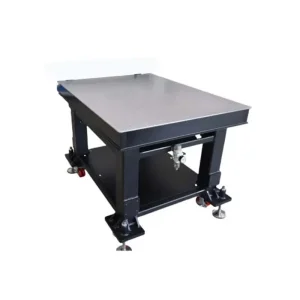
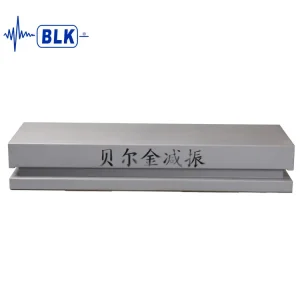
Specialized Vibration Hangers, Buffers & Platforms
Extended product lines including spring hangers, low-frequency optical platforms, and matrix isolators.






Frequently Asked Questions (FAQ)
Detailed technical answers from Bellking engineering teams regarding design selection, installation, and manufacturing capabilities.
Accelerate Your Compressor Performance with Custom Vibration Engineering
Consult directly with our polymer scientists and vibration control engineers for custom drawing evaluations, CAD models, and factory-direct pricing within 24 hours.