
Precision Elastomeric & Pneumatic Isolation Series
Explore factory-direct isolation mounts engineered for high load capacity, low natural frequency, and durable dynamic performance.

Fundamentals of Elastomeric Isolation & Viscoelastic Damping Mechanics
An In-Depth Engineering Analysis of Mechanical Energy Dissipation, Elastomer Polymer Chemistry, and Dynamic Transmissibility Ratios.
The Physics of Structural Vibration Isolation
In modern industrial and acoustic engineering, managing kinetic excitation and structure-borne sound transmission is critical for protecting sensitive equipment, preserving structural integrity, and achieving stringent acoustic compliance (such as ISO 3744 and ASHRAE targets). Elastomeric isolation mounts function by introducing a controlled compliant element between a dynamic source (e.g., HVAC compressors, heavy stamping presses, rotary pumps, power transformers) and its supporting substrate.
Unlike purely elastic metallic springs—which store mechanical strain energy and release it back into the structure with minimal inherent hysteresis—elastomeric materials exhibit viscoelastic damping properties. Elastomers combine elastic behavior (Hookean solids) with viscous fluid behavior (Newtonian fluids). When subjected to cyclic shear or compressive forces, the polymer chains slide past one another, converting mechanical vibration energy into benign thermal energy through internal molecular friction.
Vibration isolation performance is governed by the classical force transmissibility equation:
$T_r = \sqrt{\frac{1 + (2\zeta \cdot r)^2}{(1 - r^2)^2 + (2\zeta \cdot r)^2}}$
Where $r = f_d / f_n$ is the frequency ratio (forcing frequency divided by system natural frequency), and $\zeta$ is the damping ratio. Effective isolation occurs exclusively when $r > \sqrt{2} \approx 1.414$. At $r = 3$, efficiency exceeds 88%, and at $r \ge 5$, efficiency reaches over 96%.
Polymer Chemistry Comparison for Custom Mount Formulation
The operational lifespan and vibration attenuation profile of an elastomeric mount are fundamentally dictated by compound chemistry, durometer hardness (Shore A), tensile strength, and compression set parameters. At Bellking, our rubber compounding engineers formulate tailored elastomeric matrix blends matching operational environments:
| Polymer Type | Operating Temp | Damping ($\eta$) | Key Resistance Traits |
|---|---|---|---|
| Natural Rubber (NR) | -40°C to +80°C | Medium (0.05-0.10) | Superior tensile fatigue life, high mechanical resilience. |
| Neoprene (CR) | -35°C to +100°C | High (0.10-0.20) | Flame retardant, excellent oil, ozone, and weather resistance. |
| Nitrile (NBR) | -30°C to +120°C | Medium (0.08-0.15) | Exceptional resistance to petroleum fuels, hydraulic oils, and greases. |
| EPDM Rubber | -45°C to +150°C | Low-Medium | Outstanding UV, steam, thermal aging, and outdoor weathering endurance. |
| Silicone (VMQ) | -60°C to +200°C | High (0.15-0.30) | Extreme temperature stability, low off-gassing for cleanrooms. |
Why Sourcing Custom Elastomeric Mounts from China (Bellking Kunshan) Delivers Superior ROI
Combining Full-Chain Manufacturing Infrastructure with Precision Engineering Rigor in the Yangtze River Delta Industrial Hub.
Unmatched Supply Chain Synergies
Situated in Kunshan, Jiangsu (adjacent to Shanghai), Bellking integrates high-grade raw polymer compounding, precision mold making, automated vulcanization presses, and metal stamping under one roof. This geographic cluster eliminates supply chain friction, reducing prototyping lead times to as low as 3 working days.
Strict Quality Systems & ISO 9001 Compliance
Every custom elastomeric isolation batch undergoes rigorous quality assurance: Rheometer curing curve evaluation, Durometer Shore A testing, compression set testing (ISO 815), dynamic fatigue loading up to 10 million cycles, and 900-hour salt spray corrosion testing for all steel fasteners and inserts.
Advanced FEA & Custom Mold Tooling
Our in-house R&D engineering team utilizes 3D Finite Element Analysis (FEA) nonlinear elastomer modeling to simulate stress distribution and static/dynamic stiffness prior to mold fabrication. This guarantees 1:1 matching with your equipment’s physical footprint and load requirements.
Inside Bellking’s Kunshan Manufacturing Facility
Bellking Vibration Reduction Equipment Manufacturing (Kunshan) Co., Ltd. spans over 2,000 m² of specialized manufacturing space. Equipped with automated rubber compression molding machines, robotic welding stations, laser cutting tools, and modern dynamic testing laboratories, we produce over 100,000 high-grade isolators annually. Holding 37 national patents (including 16 invention patents), Bellking bridges high-end R&D capability with ultra-competitive OEM manufacturing economics.
Future Trends in Elastomeric Vibration & Shock Isolation Technology
How Modern Automation, Clean Energy, Microelectronics, and Acoustic Regulations are Transforming Dynamic Mounting Standards.
1. High-Frequency Decoupling for Semiconductor & Metrology
As microchip fabrication node sizes shrink below 2nm, environmental micro-vibrations—even ambient footsteps or building HVAC airflow—can cause lethal alignment errors in lithography tools and atomic force microscopes (AFM). The trend involves pairing custom elastomeric sub-mounts with active pneumatic levelers (such as Bellking BK-PA series) to achieve 99.9% vibration cancellation above 5 Hz.
2. Electric Vehicle (EV) Test Rigs & Powertrain Isolation
The transition from Internal Combustion Engines (ICE) to High-RPM Electric Motors introduces high-frequency tonal whine (1,000 Hz to 10,000 Hz). Modern elastomeric mounts require ultra-low dynamic-to-static stiffness ratios ($K_d / K_s \le 1.2$) across broad frequency bands to eliminate high-pitch structural transmission into chassis frames.
3. Eco-Friendly & REACH/RoHS Compliant Elastomer Formulations
Global environmental mandates strictly enforce the elimination of Polycyclic Aromatic Hydrocarbons (PAHs), heavy metals, and toxic plasticizers. Bellking’s green polymer formulations comply fully with EU REACH and RoHS regulations, allowing seamless export and auditing for global OEM equipment manufacturers.
4. Hybrid Viscous-Elastomeric Damping Architectures
For applications experiencing high transient shock impact—such as marine defense propulsion or seismic structural isolation—pure rubber mounts may reach shear deformation limits. Advanced hybrid mounts combine high-durability elastomeric bodies with internal fluid-filled viscous orifices to dissipate shock energy instantly.
Targeted Application Scenarios & Turnkey System Solutions
Custom-Engineered Mounting Configurations Tailored to Critical Industrial Operating Environments.
HVAC Plant Rooms, Chillers & Cooling Towers
Challenge: Variable-speed centrifuges, screw chillers, and heavy circulation pumps generate intense low-frequency vibrations (10 Hz – 30 Hz) that propagate through concrete building slabs, causing severe acoustic disruption in luxury hotels, commercial offices, and medical centers.
Solution: Bellking deploys custom heavy-duty elastomeric pads (BKDJ Type) combined with CPB-Type Inertia Bases and spring mounts. The added inertial mass stabilizes pump start-up torque, while multi-layer elastomeric elements damp high-frequency harmonics, achieving >95% noise reduction.
Data Center & Substation Electrical Transformers
Challenge: Power transformers emit continuous magnetostrictive hum at 100 Hz / 120 Hz fundamental frequencies and harmonics. Unisolated transformers in urban substations or hyperscale data centers trigger strict municipal noise violations.
Solution: Specialized anti-vibration elastomeric mounts for transformers engineered with high oil-resistant Neoprene/Nitrile matrix. Formulated with specific damping factor $\eta = 0.18$, these mounts isolate core magnetostriction without degrading under heavy static load or exposure to transformer dielectric oil.
Precision Optical Benches & Cleanroom Inspection
Challenge: Laser interferometers, CMM Coordinate Measuring Machines, and optical microscopes require floor vibration levels below VC-E guidelines ($3.12 \mu m/s$). Standard rubber pads fail to isolate subtle floor tremors.
Solution: BK-PA Precision Air Mounts combined with precision BKHQ elastomeric secondary isolators. The dual-stage isolation mechanism lowers system natural frequency down to 1.7 Hz, completely decoupling optical benches from sub-floor structural waves.
Marine Auxiliary Engines & Defense Equipment
Challenge: Marine diesel generator sets experience continuous multi-axis motion, pitch, roll, and harsh marine atmospheric corrosion (salt spray, oil splash).
Solution: Captive BKM & BKDR Type Rubber Mounts featuring interlocking metal housings that prevent engine breakaway during rough sea conditions. Treated with Dacromet 900-hour anti-corrosion coating, these mounts withstand severe maritime environments.
Global Procurement Guide: Step-by-Step Elastomeric Mount Sizing & Vendor Auditing
How Procurement Directors & Engineering Leads Can Mitigate Risk and Specify the Exact Mount Code.
Phase 1: Critical Sizing Data Collection
- Total Operating Mass ($M$): Include frame, fluid weight, and motor weight.
- Center of Gravity ($CoG$): Identify load distribution per support point (unequal load distribution requires varied durometer mounts).
- Minimum Forcing Frequency ($f_d$): Determine Lowest Operating Speed (RPM / 60). E.g., 1750 RPM = 29.1 Hz.
- Target Isolation Efficiency ($E$): Specify required attenuation (>90% standard, >98% critical).
- Environmental Hazards: Presence of oils, ozone, ambient heat (>80°C), or outdoor weather.
Phase 2: Factory Audit & Quality Verification Checklist
- Durometer Tolerance: Ensure supplier guarantees Shore A tolerance within $\pm 5$ units.
- Bonding Strength Test: Require metal-to-rubber shear strip testing (ASTM D429 Standard).
- Compression Set Compliance: Verify compression set stays below 15-20% after 22h at 70°C.
- Traceability: Batch-coded production ensuring raw material certificates (MTC) link to finished isolation units.
When you submit equipment operating parameters to Bellking’s engineering desk, our team returns a detailed vibration isolation plan—complete with 3D CAD models, dynamic stiffness calculations, and price quotes—within 24 hours. Standard products ship directly within 24 hours, and custom molds are completed in as little as 3-5 business days.
Frequently Asked Questions: Custom Elastomeric Isolation Mounts
Direct Answers from Bellking Application Engineers to Common Sizing, Selection, and Manufacturing Questions.
How do I choose between elastomeric rubber mounts, metallic spring isolators, and pneumatic air mounts?
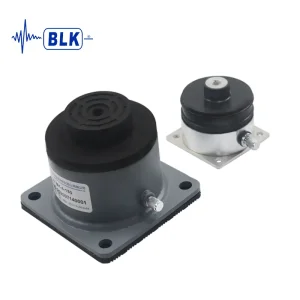
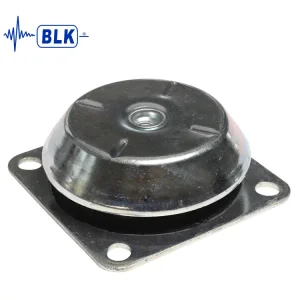
- Elastomeric Rubber Mounts: Ideal for medium-to-high speed equipment (>1,200 RPM / >20 Hz) such as motors, small compressors, fans, and electrical cabinets. They excel at high-frequency acoustic attenuation and shock absorption in compact profiles.
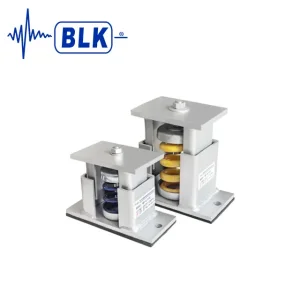
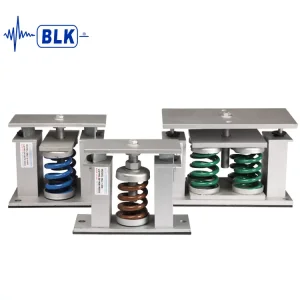
- Spring Isolators (e.g., Bellking MB, MD Series): Best for low-speed equipment (300 to 1,200 RPM / 5 to 20 Hz) like heavy HVAC chillers, pumps, and gensets requiring large static deflections and natural frequencies around 3–5 Hz.
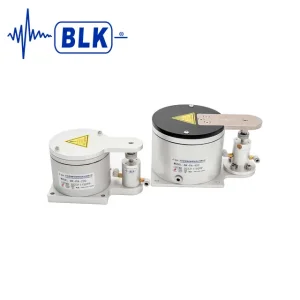
- Pneumatic Air Mounts (e.g., Bellking BK-PA Series): Essential for ultra-sensitive equipment (CMMs, semiconductor lithography, optical benches) requiring dynamic isolation down to 1.7 Hz.
What parameters are required for Bellking to design a custom elastomeric isolation mount?
- Total equipment mass and weight distribution across support points.
- Equipment operating speed range (RPM) or forcing frequency spectrum.
- Physical installation limits (maximum envelope dimensions, bolt hole patterns).
- Environmental operating conditions (ambient temperature, oil/chemical exposure, UV/outdoor exposure).
- Any dynamic shock or transient overload requirements (e.g., seismic restraints, MIL-STD shock resistance).
What is the typical operational service life of Bellking elastomeric mounts?
How does durometer (Shore A) affect isolation performance?
Can Bellking manufacture custom non-standard isolators with short lead times?
Are Bellking products certified for international quality and environmental standards?
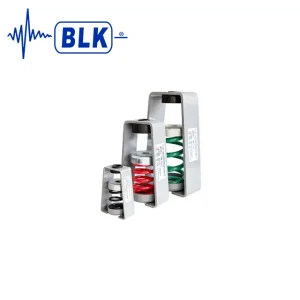
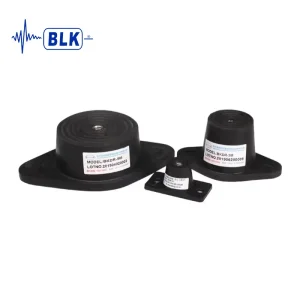
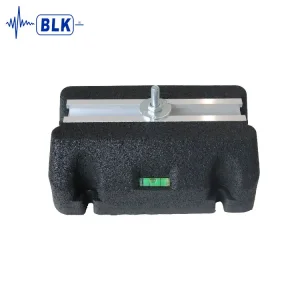
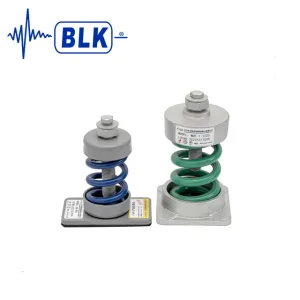
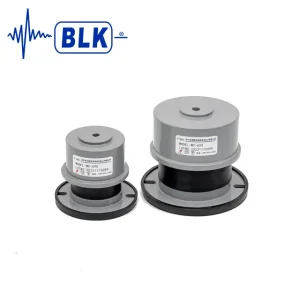
Industrial Spring Hangers, Dampers & Heavy Rubber Mounts
Full-range structural vibration damping components for piping, suspended ducts, and industrial machinery.

Request a Customized Vibration Isolation Plan Within 24 Hours
Submit your equipment weight, operating RPM, and space constraints. Our senior application engineers will calculate transmissibility ratios and supply tailored 2D/3D CAD mounting blueprints.