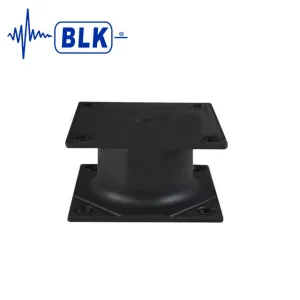
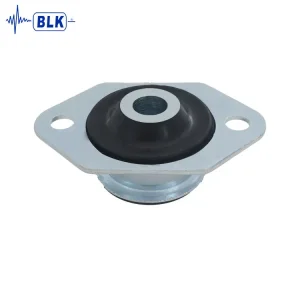
Precision Engine & Equipment Isolation Mounts (Series I)
Engineered for low dynamic transmissibility, aggressive chemical resistance, and severe 3–5 G shock survivability across marine, power generation, and precision industrial assemblies.
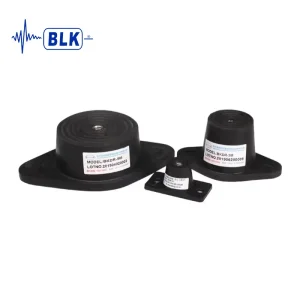


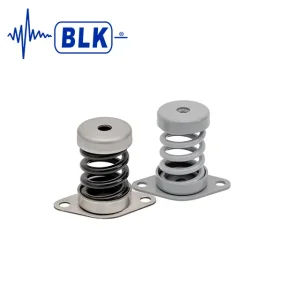


Engineering Evolution of Custom Engine Vibration Mounts
From static elastomeric cushions to computationally optimized multi-axis dynamic dampers: addressing torsional harmonics, thermal extremes, and acoustic transfer in mission-critical powertrains.
Modern Powertrain Harmonic Shifting
The global shift toward downsized, turbocharged diesel engines and dual-fuel internal combustion generator sets has radically shifted the low-frequency disturbing spectrum (fd). Modern 3- and 4-cylinder engines produce intensified low-order unbalanced rolling moments that induce high structure-borne vibration if paired with conventional, off-the-shelf elastomeric mounts.
- Shift in excitation frequencies down into the 10 Hz–25 Hz window.
- Requirement for dynamic-to-static stiffness ratios (Kd/Ks) approaching 1.15–1.35.
- Need for multi-directional tuning (asymmetric horizontal vs. vertical compliance).
Harsh Operational Environment Surpass
Engine mounts no longer operate solely in climate-controlled compartments. Heavy-duty construction machinery, offshore propulsion systems, and decentralized data center backup power plants expose isolators to sustained radiant temperatures up to 120°C, mineral oils, diesel fuel mist, and airborne salinity.
- Transition from standard natural rubber (NR) to engineered NBR, EPDM, and HNBR compounds.
- Dacromet and zinc-nickel surface engineering to surpass 900-hour salt spray testing.
- Fail-safe interlocked metallic housings certified for 3–5 G shock displacement limits.
NVH & Acoustic Decoupling Mandates
Stringent municipal noise ordinances and marine habitability standards (such as DNV, Lloyd's Register, and ISO 6954) necessitate structure-borne noise attenuation exceeding 25 dB(A) to 40 dB(A) across the audible 63 Hz–1,000 Hz frequency range, making custom vulcanization engineering compulsory.
- Elimination of high-frequency acoustic bridging through elastomeric isolation pads.
- Combined viscous and mechanical damping to control peak amplitude resonance at startup.
- Finite Element Analysis (FEA) validation of hyperelastic strain energy profiles.
Global Sourcing Demands & Technical Criteria Matrix
Strategic purchasing teams and chief mechanical engineers evaluate vibration mount factories not simply on unit cost, but on compound consistency, fatigue life validation, and rapid customization agility.
1. Dynamic Stiffness vs Static Sag
Procurement must verify the supplier's rheological and dynamic test data. An engine mount must have adequate static stiffness (Ks) to prevent driveline misalignment and excessive pipe-stress deflection under static engine weight, yet maintain a low dynamic stiffness (Kd) at operational frequencies to prevent transmitting dynamic firing pulses.
Bellking conducts 100% batch testing with in-house servo-hydraulic test frames to verify dynamic transmissibility curves.
2. Interfacial Bonding Integrity
The primary failure mode in heavy-duty engine mounts is delamination between the vulcanized elastomer and the metallic core or flange plate. Global OEMs demand chemlok-based automated hot-vulcanization bonding systems that exceed standard ASTM D429 Method B peel tests.
Our Kunshan automated production facility utilizes robotic shot-blasting, multi-stage adhesive priming, and temperature-controlled curing to guarantee zero bondline separation under continuous 3–5 G cyclic shear.
3. Fail-Safe Captive Mechanical Design
In mobile machinery, marine engine propulsion, and seismic building installations, catastrophic elastomer rupture must not allow the supported engine assembly to break free. Buyers must specify captive cone mounts (e.g., BKCN Series) or enclosed spring housings equipped with mechanical limiters.
This design maintains equipment position during emergency shock stops, severe sea conditions, or transient seismic shocks without degrading acoustic isolation during standard run mode.
Custom Engine Vibration Mounts: Price Determinants & Benchmarks
Transparent cost breakdown based on raw compound selection, precision metal casting/stamping, surface passivation, and custom tooling amortizations.
| Mount Type & Design Architecture | Typical Load Rating | Compound / Material | Isolation Efficiency | Estimated Factory Price Range (USD) | Key Cost Drivers |
|---|---|---|---|---|---|
| Custom BKDR Cylindrical Bushing / Mount | 50 kg – 800 kg | Natural Rubber (NR) / NBR | 90% – 95% | $8.50 – $38.00 / pc | Durometer hardness control, insert threading, volume scale. |
| BKCN Heavy-Duty Captive Marine Cone Mount | 250 kg – 4,500 kg | High-damping Synthetic Rubber + Cast Iron / Ductile Base | 94% – 97% | $45.00 – $210.00 / pc | Ductile iron housing machining, 3-axis captive safety limits, Dacromet finishing. |
| ME / MB Viscous-Damped Spring Engine Mount | 150 kg – 8,000 kg | Alloy Spring Steel (60Si2Mn) + Viscous Damping Chamber | 96% – 99% | $65.00 – $420.00 / pc | Precision spring winding, shot-peening, viscous fluid sealing, leveling hardware. |
| BK-RT / Matrix Precision Damped Platform Mount | 500 kg – 15,000 kg | Multi-layer Elastomeric Matrix + Structural Steel Frame | 98% – 99.5% | $280.00 – $1,650.00 / unit | CNC sub-frame machining, custom dynamic resonance tuning, low natural frequency (fn < 3 Hz). |
| BK-PA / BK-R High-Precision Pneumatic Air Mount | 100 kg – 3,000 kg | Multi-ply Polyurethane / Neoprene Diaphragm + Auto-Level Valve | Up to 99.8% | $180.00 – $850.00 / pc | Ultra-low 1.7 Hz capability, automated proportional pneumatic leveling controllers. |
Elastomeric Compounding Impact
Natural Rubber offers superior dynamic resilience and lowest dynamic stiffness at standard temperatures ($), whereas Nitrile (NBR) and Neoprene (CR) provide fuel/oil resistance (+18% to +35% cost). High-temperature Silicone (VMQ) or Fluoroelastomer (FKM) suited for extreme turbo environments can increase polymer raw material expenses by 3x–6x.
Tooling & Mold NRE Costs
For custom geometric contours, initial non-recurring engineering (NRE) costs range from $800 to $3,500 depending on single-cavity vs. multi-cavity injection molds. At Bellking, customer orders exceeding designated batch thresholds qualify for full tooling rebate amortized across initial production runs.
Surface Protection & Salt Spray
Standard zinc galvanizing provides 72–120 hours of salt spray protection. Specifying proprietary Dacromet or multi-layer Zinc-Nickel coatings with high-bake epoxy electro-deposition ensures 900+ hours resistance against coastal humidity and marine brine, adding roughly 8%–14% to finishing costs.
Macro Industry Solutions: Targeted NVH Implementations
Engine vibration mounting is not one-size-fits-all. Explore how Bellking customizes isolation geometry and damping coefficients to match mission-critical application spectra.
Continuous Power Gen-Sets
Primary diesel and natural gas gensets operating in hospitals, financial centers, and remote mining sites generate persistent 1,500 RPM (25 Hz) or 1,800 RPM (30 Hz) primary vibrations. Bellking ME and BKCN assemblies utilize sub-5 Hz natural frequency isolation to eliminate low-frequency structural hum from penetrating concrete foundation pilings.
Marine Main Propulsion
Marine diesel engines must transfer high propeller thrust while filtering harsh torsional torque pulses. Bellking engineered captive cone mounts feature specialized shear-compression dual profiles: stiff in longitudinal propulsion axis to maintain shaft seal alignment, yet soft in vertical and transverse axes to isolate waterborne acoustics.
Off-Highway Construction
Excavators, wheel loaders, and mining haul trucks impose violent 3–5 G shock loads across rugged terrain. Standard mounts tear within months. Bellking heavy-duty encapsulated mounts incorporate internal polyurethane bump stops to absorb shock peaks, preventing metal-to-metal collision and shielding chassis weldments.
HVAC Centrifugal Chillers
Large-scale refrigeration chillers and industrial cooling towers placed on commercial rooftops present high risk of transmitting structural resonance into occupied office space below. Combined inertia base systems with Bellking floor-mounted spring isolators lower the center of gravity and deliver 98%+ isolation.
Factory Certification, Testing Rigor & Compliance Standards
Bellking operates an ISO 9001:2015 certified 2,000 m² advanced manufacturing facility in Kunshan, China. We combine domestic cost efficiencies with full Western compliance documentation.
37 Patents & High-Tech Accreditations
Recognized as a National High-Tech Enterprise and Jiangsu Private Technology Enterprise, Bellking holds 37 registered patents, including 16 national invention patents covering damping materials, active-passive integration, and heavy structural isolation mechanics.
Every customized mount design is backed by detailed numerical calculation notes and FEA modal verification before steel is cut or tooling is commissioned.
In-House Metrology & Destructive Testing
Our quality lab is equipped with 100 kN dynamic servo-hydraulic cyclic testing stations, static tension-compression testers, digital durometer verification, rheometer cure analyzers, and certified salt spray corrosion testing chambers.
We supply full 3.1 Material Test Reports (MTR), dynamic spring-rate curves, durometer certificates, and RoHs / REACH environmental declarations with every export shipment.
Rapid Delivery & Localized Engineering
Standard models ship directly from factory inventory within 24 hours. For non-standard configurations, our engineering team delivers 2D dimensional drawings and 3D CAD/STEP models within 24 hours of receiving excitation frequency and mass specs.
Physical custom prototypes are vulcanized, inspected, and shipped in as fast as 3 to 5 business days, cutting project lead times by more than 60% compared to typical Western lead cycles.
Engineering Roadmap: Next-Generation Vibration Control
As engines transition toward hydrogen internal combustion, hybrid electrified drivetrains, and smart connected industry, vibration isolation is transforming from passive compliance to active intelligence.
Integration of micron-sized iron particles suspended in synthetic carrier fluid. Mount stiffness and damping can be altered in milliseconds via electromagnetic coils to counteract transient resonance during engine startup and shutdown cycles.
Embedding micro piezoresistive sensing arrays inside the vulcanized elastomeric core. Enables real-time condition monitoring of dynamic creep, temperature build-up, and structural fatigue for predictive maintenance in mission-critical applications.
Deploying sub-wavelength periodic geometric metamaterial structures inside spring isolator bases. Blocks low-frequency acoustic wave transmission in specific stopbands without compromising static load-bearing capability.
Transitioning from petroleum-derived polymers to bio-based, high-modulus elastomer blends that reduce manufacturing carbon footprints by 40% while preserving superior dynamic loss factor (tan delta) and chemical resistance.
Engineering FAQ: Custom Engine Vibration Mounts & Sourcing
Detailed technical answers addressing resonance prevention, elastomer degradation, procurement timelines, and dynamic stiffness calculations.
How do you calculate the required natural frequency (fn) for an engine mount?
Effective vibration isolation requires that the disturbing frequency (fd = Engine RPM / 60 for 2-stroke or (RPM/60)*(Number of Cylinders / 2) for 4-stroke firing frequency) satisfies the ratio fd / fn > √2 (≈ 1.414). For over 90% isolation efficiency, design engineers mandate fd / fn ≥ 3.0. For example, a diesel engine idling at 900 RPM has a fundamental 15 Hz shaft rotation speed. To isolate this frequency, the mount's natural frequency must be designed below 5 Hz under static load, dictating spring isolators or soft conical rubber mounts with sufficient static deflection (δ ≥ 25mm / fn²).
Why is static spring rate insufficient for calculating dynamic vibration transmission?
Elastomers exhibit viscoelastic behavior, meaning their dynamic stiffness (Kd) during high-frequency oscillation is significantly higher than their static stiffness (Ks) measured during slow compression. The dynamic-to-static ratio (Kd/Ks) typically ranges from 1.2 to 2.0 depending on carbon black filler loadings and polymer chemistry. Calculating isolation efficiency using static stiffness leads to severe under-estimation of transmitted vibration forces. Bellking performs dynamic sweep characterization to provide authentic Kd and loss angle (δ) metrics for design modeling.
What parameters must an OEM provide to configure a custom engine mount?
To design a 1:1 tailored engine vibration mount, we require: (1) Total wet operating mass of the engine and driven equipment; (2) Three-dimensional Center of Gravity (CoG) coordinates; (3) Proposed number and spatial footprint of mounting points; (4) Operating RPM range and idle speed; (5) Maximum allowable dynamic displacement under transient shock (e.g., emergency stops); (6) Ambient temperature envelope and chemical exposure (fuels, lubes, salt air); (7) Seismic or captive transport restraint requirements.
How does Bellking prevent elastomer vulcanization failure and delamination?
Elastomer-to-metal bond failure occurs primarily due to poor surface preparation or improper adhesive activation. Bellking utilizes automated robotic grit-blasting (SA 2.5 cleanliness standard) followed immediately by automated dipping in dual-coat Chemlok adhesive systems. Vulcanization takes place in computerized multi-stage vacuum compression-transfer presses with real-time temperature, pressure, and cure-time logging. Destructive pull-testing ensures the elastomer tears internally before interfacial bond failure occurs (100% rubber-tearing failure mode).
What is the typical prototype lead time and MOQ for custom factory orders?
For custom non-standard designs requiring new tooling, Bellking provides 3D CAD models and finite element analysis within 24–48 hours. Tooling fabrication and physical prototype samples are completed in 3 to 5 business days. Minimum Order Quantities (MOQ) are exceptionally flexible: prototyping batches start at just 2 to 4 units for validation, transitioning seamlessly into mass production runs of 100 to 50,000 pieces per month backed by our 100,000 unit annual factory capacity.
How do Bellking engine mounts survive marine and coastal salt spray corrosion?
Standard commercial mounts with decorative zinc plating corrode within 72–120 hours in marine settings, leading to premature delamination and structural rusting. Bellking treats metallic housings, washers, and fastener components with an advanced Dacromet (zinc-aluminum flake) surface treatment. This creates a non-electrolytic, heat-resistant barrier coating that easily surpasses 900 hours of continuous neutral salt spray testing (ASTM B117) without red rust formation, ensuring a 15+ year operational lifespan.
Heavy Machinery & High-Frequency Vibration Isolation (Series II)
Specialized pneumatic platforms, extreme low-frequency optical tables, industrial buffers, and cone mounts tailored to heavy engine plant rooms, compressors, and high-precision testing apparatus.