
High Elasticity Rubber Mounts & Industrial Damping Systems
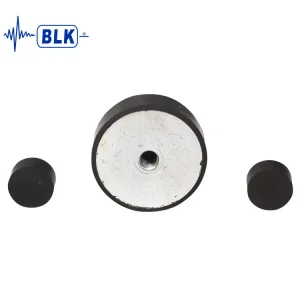
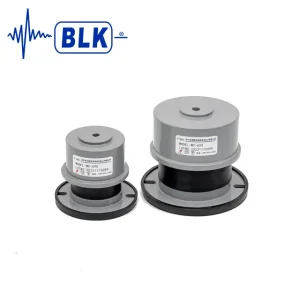
Explore our engineering-gradeelastomeric mounts, isolation platforms, and high-deflection spring isolators designed for critical vibration mitigation across industrial machinery.






Proven Vibration Control Benchmarks
Rheological Mechanics of High Elasticity Rubber Mounts
Understanding the viscoelastic properties, dynamic-to-static stiffness ratio ($K_d/K_s$), loss factor ($\tan \delta$), and shear vs. compression load behavior in industrial vibration isolation.
In modern industrial noise, vibration, and harshness (NVH) suppression, high elasticity rubber mounts serve as vital elastomeric decouplers between dynamic excitation sources (such as HVAC chillers, marine propulsion engines, and power transformers) and supporting structural substructures. Unlike rigid metal mechanical fasteners, elastomeric vibration isolators operate by storing kinetic energy during dynamic displacement and converting a significant portion of that energy into non-reversible thermal energy through internal polymer chain friction.
Viscoelastic Polymer Physics & Damping Loss Factor
High elasticity rubber compounds—ranging from Natural Rubber (NR) formulations to highly cross-linked Synthetic Elastomers (EPDM, Neoprene/CR, Fluorocarbon/FKM, and Nitrile/NBR)—exhibit complex viscoelastic behavior combining linear elasticity (described by Hooke's Law) and viscous fluid dissipation (described by Newton's Law of Viscosity). The complex shear modulus ($G^*$) is expressed mathematically as:
G* = G' + i G''
Where G' represents the dynamic storage modulus (proportional to elastic energy storage), G'' denotes the loss modulus (proportional to viscous energy dissipation), and $i = \sqrt{-1}$. The mechanical loss factor ($\tan \delta = G'' / G'$) quantifies the internal material damping capability. Custom formulated high elasticity mounts engineered by top-tier manufacturers achieve $\tan \delta$ values between 0.05 (low-damping high-resilience natural rubber) and 0.45 (high-damping modified polymer matrices).
Elastomer Material Property Matrix & Operational Compatibility
Selecting the optimal polymer base requires balancing mechanical elasticity, environmental resilience, dynamic amplification factors, and thermal creep resistance:
| Elastomer Material Type | Durometer Range (Shore A) | Temp Range (°C) | Damping Ratio ($\zeta$) | Oil & Solvent Resistance | Primary Industrial Application |
|---|---|---|---|---|---|
| High-Resilience Natural Rubber (NR) | 40 – 70 Shore A | -40°C to +80°C | 0.03 – 0.08 | Fair / Poor | Precision instruments, HVAC chillers, high-speed rail bogies |
| Neoprene / Chloroprene (CR) | 45 – 75 Shore A | -35°C to +100°C | 0.08 – 0.15 | Good / Moderate | Marine main propulsion mounts, generator sets, outdoor HVAC |
| Ethylene Propylene (EPDM) | 50 – 80 Shore A | -45°C to +130°C | 0.06 – 0.12 | Excellent (Weather/Ozone) | Substation power transformers, chemical processing pumps |
| Nitrile Rubber (NBR) | 50 – 85 Shore A | -30°C to +110°C | 0.07 – 0.14 | Excellent (Petroleum Oils) | Industrial hydraulic power units, automotive engine bays |
| Fluorocarbon Elastomer (FKM) | 60 – 90 Shore A | -20°C to +200°C | 0.10 – 0.22 | Superior (Severe Chemical) | Aerospace test benches, high-temp petrochemical compressors |
Global Industrial Landscape & Regional Application Scenarios
Market expansion drivers, regulatory compliance standards, and localized deployment contexts across high-growth industrial sectors worldwide.
Heavy Commercial HVAC & Building Acoustics
In high-rise commercial structures and municipal acoustic retrofits, unmitigated vibration from roof-mounted chillers, cooling towers, and centrifugal water pumps propagates through concrete floors as structure-borne noise. Custom high elasticity rubber pads (such as BKDJ series) and damped spring-rubber hybrid mounts decouple sub-60Hz structural hum, complying with stringent ASHRAE and ISO 3744 noise limits.
Transportation, High-Speed Rail & Marine Propulsion
Marine diesel engines, electric pod thrusters, and rail car bogies demand dual-axis shear and compression mounts capable of withstanding extreme multi-directional dynamic shock loadings up to 3G to 5G. High elasticity neoprene and natural rubber mounts deliver severe fatigue endurance while isolating diesel combustion impulses from naval hulls.
Semiconductor Manufacturing & Optical Metrology
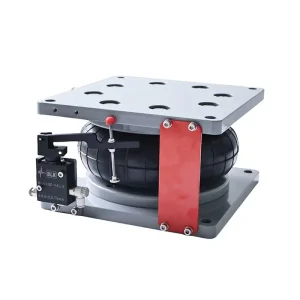
Sub-micron lithography tools, Coordinate Measuring Machines (CMMs), and optical inspection tables require total isolation from ambient ground vibrations (VC-E and VC-G acoustic criteria). Low-frequency precision pneumatic air mounts integrated with high-elasticity elastomeric bladders filter out micro-seismic disturbances down to 1.7 Hz.
Custom Manufacturing Technology Roadmap & Finite Element Analysis
From non-linear Mooney-Rivlin material modeling to robotic rubber-to-metal vulcanization, explore how advanced manufacturers engineer military-grade elastomeric isolators.
The transition from standard off-the-shelf rubber grommets to heavy-duty custom high elasticity rubber mounts involves sophisticated numerical simulation, proprietary chemical formulation, and multi-stage quality assurance.
Non-Linear FEA Modeling & Hyperelastic Strain Energy Density
Rubber materials do not exhibit linear elastic moduli under high shear or compressive strain. Leading manufacturers utilize Finite Element Analysis (FEA) based on 2-parameter or 5-parameter Mooney-Rivlin and Ogden hyperelastic material models to simulate dynamic strain distribution before physical mold cutting:
W = C₁₀(I₁ - 3) + C₀₁(I₂ - 3) + 1/D₁ (J - 1)²
By accurately modeling stress concentration hotspots during peak axial compression and lateral tilt, engineers optimize rubber shape factors ($S = \text{Loaded Area} / \text{Free Unloaded Area}$), preventing localized material tearing and extending component fatigue life beyond 10 million dynamic cycles.
The 4-Step Engineering & Production Roadmap
Elastomer Compound Design
Custom polymer compounding, carbon black reinforcing filler distribution, and sulfur/peroxide vulcanization package selection tailored for target shore durometer and temperature resilience.
Rubber-to-Metal Bonding
Substrate shot-blasting, chemical degreasing, and dual-layer silane Chemlok adhesive primer application ensuring metal-elastomer bond failure tensile stress exceeds 10 MPa (ASTM D429 Method B).
Transfer & Compression Molding
Precision CNC mold curing under 200–500 Ton hydraulic press control at 160°C–180°C, maintaining strict dimensional tolerances (+/- 0.1mm) and zero internal voiding.
Dynamic QC Verification
100% batch testing via electro-hydraulic dynamic testing rigs, verifying static spring rate ($K_s$), dynamic spring rate ($K_d$), 900-hour Dacromet salt spray coating corrosion resistance, and ISO 10816 vibration limits.
Commercial Price Determinants & Cost Optimization Matrix
A transparent procurement framework breaking down raw material indexes, mold amortization costs, customization premiums, and volume-discount thresholds.
B2B procurement teams and engineering specifiers must navigate wide price variations when sourcing custom high elasticity rubber mounts. Unit prices typically range from $3.50 USD for standard compact cylindrical isolators to over $450.00 USD for engineered multi-directional heavy machinery mounts or precision active-ready air mounts. The primary cost-building blocks include:
| Cost Driver Component | Impact on Unit Price | Technical Cost Determinants & Trade-offs |
|---|---|---|
| Raw Polymer Compound | 25% – 40% | Standard NR / SBR compound is highly economical. Specifying Specialty Fluorocarbon (FKM), HNBR, or high-purity Silicone increases material compound cost by 300% to 700%. |
| Tooling & Mold Engineering | 15% – 30% (NRE) | Single-cavity prototype molds range from $800 to $2,500 USD. Multi-cavity production molds range from $4,000 to $15,000 USD, amortized over total production volume. |
| Metal Insert Machining & Surface Finish | 20% – 35% | Standard carbon steel with zinc plating is baseline. Stainless Steel 316 inserts or Dacromet 900-hour anti-corrosion treatments add a 18% to 35% premium. |
| Dynamic Testing & Certification | 10% – 20% | Standard batch dimensional QC is included. Requiring third-party dynamic stiffness curves, 10-million cycle fatigue certificates, or seismic shake-table reports adds testing fees. |
Turnkey Isolation Packages for Heavy Industry
Engineered systemic vibration reduction solutions combining rubber mounts, inertia base frames, spring hangers, and active platforms.
1. High-Power Substation Transformer Isolation
Transformer magnetostriction causes continuous low-frequency tonal humming (100Hz–120Hz harmonics). Customized oil-resistant EPDM rubber mounts placed beneath transformer mounting wheel assemblies attenuate structure-borne noise transmission into substation foundations by up to 28 dB(A), protecting surrounding residential zones.
2. Industrial Pump & Inertia Base Systems
High-capacity centrifugal water pumps create rotational imbalance and fluid turbulence. Pairing Bellking CPB Type Inertia Bases with custom high elasticity BKDE and BKH rubber-to-metal mounts lowers the center of gravity, stabilizes transient start-up torque, and isolates mechanical vibration from building piping networks.
3. Industrial Genset Shock & Acoustic Decoupling
Emergency diesel power generators demand severe shock absorption during sudden load changes. High-deflection multi-layer elastomeric mounts engineered with integrated failsafe mechanical snubbers prevent generator displacement during seismic events while delivering 96%+ continuous vibration isolation.
Next-Generation Smart Mounts & Bio-Elastomers
Emerging trends shaping the future of industrial vibration control over the next decade.
As smart manufacturing Industry 4.0 standards mature, the industrial mount sector is transitioning from purely passive components to intelligent, adaptive vibration control systems:
- Integrated IoT Sensor Embedded Mounts: Next-generation rubber mounts incorporate embedded MEMS piezoelectric accelerometers and wireless thermistors. These "Smart Mounts" continuously transmit real-time vibration spectra ($RMS\text{ acceleration}$) to predictive maintenance dashboards, alerting plant engineers to motor bearing wear or elastomer thermal degradation before catastrophic equipment failure occurs.
- Magnetorheological (MR) Adaptive Damping: Hybrid MR rubber mounts utilize synthetic elastomers infused with micron-scale iron particles. By modulating an external electromagnetic field, the mount's loss factor ($\tan \delta$) can be dynamically adjusted in milliseconds to instantly suppress transient resonance spikes during machinery start-up.
- Sustainable Bio-Based Elastomer Compounds: In alignment with global ESG goals, leading manufacturers are formulating high-elasticity compounds using devulcanized recycled rubber matrixes, bio-derived silica from rice husk ash, and dandelion-derived natural rubber, reducing lifecycle carbon footprints by up to 40% while preserving mechanical dynamic resilience.
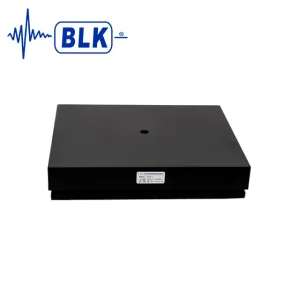
Advanced Anti-Vibration Mounts & Damping Platforms
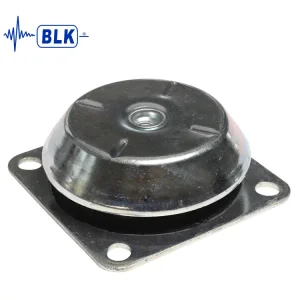
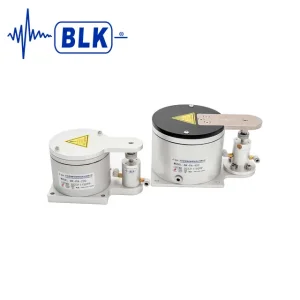
Select specialized isolation solutions engineered for precise dynamic performance, high load capacity, and harsh operating environments.




Frequently Asked Technical & Procurement Questions
In-depth responses from senior application engineers regarding mount sizing, elastomer selection, and dynamic fatigue testing.