
Industrial Grade Vibration Dampers & Isolation Systems
Precision-engineered spring mounts, rubber dampers, and inertia supports manufactured directly in our Kunshan OEM/ODM facility.

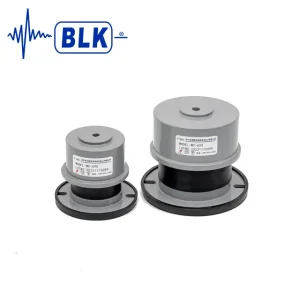
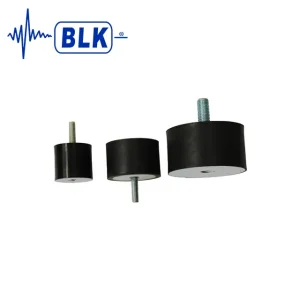
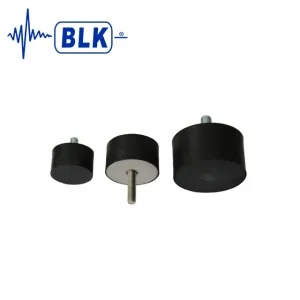
1. Technical Foundations of Industrial Vibration Control & Damping Dynamics
Understanding kinetic transfer functions, resonance avoidance, and structural energy dissipation in heavy industrial machinery.
The Physics of Kinetic Energy Transmissibility
In industrial manufacturing environments, dynamic mechanical force generated by reciprocating pumps, heavy rotary compressors, and high-velocity HVAC turbines creates harmonic oscillations. When left unattenuated, these dynamic forces transmit structural excitation into the building shell, causing fatigue, equipment misalignment, and micro-vibration pollution.
The primary metric governing dampener performance is the Transmissibility Ratio ($T_r$), defined mathematically by the relationship between forcing frequency ($f_d$) and the system's natural frequency ($f_n$):
To achieve isolation efficiency exceeding 95%, the system operating ratio ($f_d / f_n$) must exceed $\sqrt{2}$. When selecting a custom industrial vibration damper factory, precise stiffness ($k$) and damping coefficient ($c$) calculations are mandatory to prevent catastrophic resonance where $f_d \approx f_n$.
Core Attenuation Mediums: Elastomeric vs Spring vs Pneumatic
Industrial anti-vibration dampers employ distinct physical mediums to handle variable payload spectrums and disturbing frequencies:
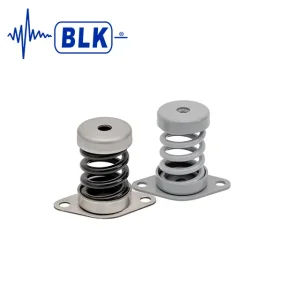
- Open Coil Steel Spring Mounts: Provide low natural frequencies ($3.0 \text{ Hz}$ to $5.0 \text{ Hz}$) suited for low-speed chillers, large cooling towers, and diesel generator sets. High static deflection characteristics allow absorption of low-frequency kinetic waves.
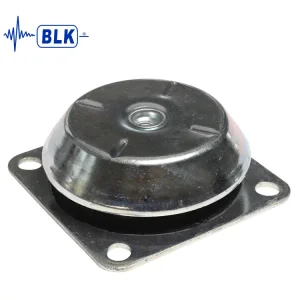
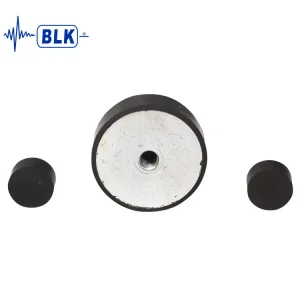
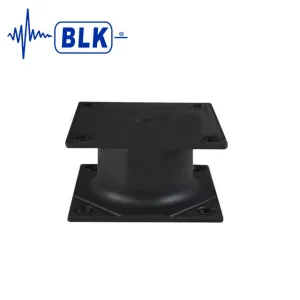
- Engineered Elastomeric & Rubber Isolators: High internal hysteresis makes rubber mounts ideal for high-frequency attenuation ($> 15 \text{ Hz}$). They prevent high-frequency sound transmission while damping transient impact shocks.
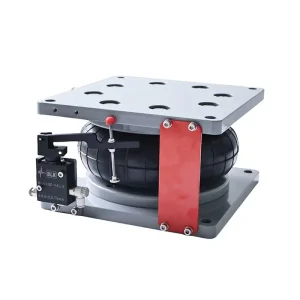
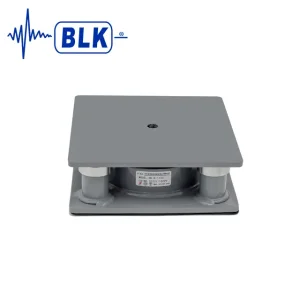
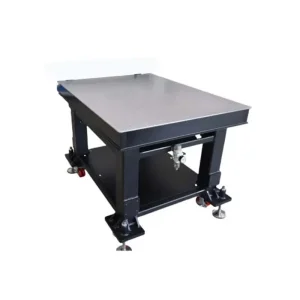
- Pneumatic Air Mounts: Achieving ultra-low natural frequencies down to $1.7 \text{ Hz}$, pneumatic isolation platforms utilize compressed air chambers and servo-leveling valves to protect sub-micron semiconductor metrology tools.
2. China's Industrial Vibration Isolation Manufacturing Ecosystem & Factory Advantages
How localized supply chain integration in Kunshan, Jiangsu delivers high-precision OEM/ODM dampening solutions at global scale.
Precision Metallurgy & Spring Steel Supply Integration
Operating within China's Yangtze River Delta industrial corridor grants direct access to specialized spring steel alloys (such as 60Si2MnA and 50CrVa) with elevated yield strength and fatigue resistance. Spring coil winding, heat treatment tempering, and stress-relieving shot peening are conducted under strict metallurgical control, preventing spring sag over decades of continuous compression cycles.
Synthetic Elastomer & Vulcanization Engineering
China’s chemical processing maturity enables custom synthetic elastomer formulation. By compounding Neoprene, EPDM, and Nitrile with specific anti-aging, UV-resistant, and oil-repellent agents, our vulcanization processes produce rubber vibration mounts capable of maintaining stable durometer hardness (40° to 70° Shore A) across extreme ambient temperature swings ($-40^\circ\text{C}$ to $+120^\circ\text{C}$).
Rapid 1:1 Engineering Customization & Tooling
Unlike Western distributors who rely on off-the-shelf standard catalogs, our Kunshan production base houses in-house CNC machining centers, automated robotic welding stations, and 3D mold prototyping. Non-standard bolt patterns, specialized height adjustments, and custom load distribution plates can be designed, simulated via Finite Element Analysis (FEA), and prototyped within 3 working days.
3. Sector-Specific Application Scenarios & Localized Engineering Solutions
Tailored vibration attenuation systems deployed across high-demand industrial sectors globally.
Semiconductor Fabs & Optical Cleanrooms
In wafer fabrication plants, ground ambient micro-vibration ($VC-C$ or $VC-E$ criterion) disrupts photolithography and scanning electron microscopes. Deploying precision pneumatic air mount platforms with active level feedback isolates acoustic floor rumble and step transients, securing sub-nanometer processing tolerances.
Commercial High-Rise Building HVAC Plant Rooms
Chillers, large centrifugal pumps, and roof-mounted cooling towers located above residential or commercial office space generate low-frequency hum. Structural isolation using concrete-filled inertia base frames paired with heavy-duty spring vibration isolators eliminates secondary acoustic radiation through concrete slabs.
Power Transmission & Transformer Substations
Core magnetostriction in high-voltage oil and dry-type transformers produces continuous $100 \text{ Hz} / 120 \text{ Hz}$ noise emissions. Installing specialized transformer anti-vibration mounts reduces sound power output by up to $18 \text{ dB(A)}$, ensuring compliance with municipal environmental noise standards (ISO 3744).
4. Macro Industry Solutions & Dynamic Isolation System Architecture
Systemic engineering approaches to severe industrial kinetic forces, transient shock events, and acoustic bridge prevention.
Inertia Base Concrete Mass Stabilization
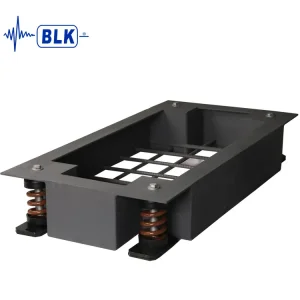
For high-eccentricity pumps and reciprocating machinery, flexible isolated mounts alone are insufficient to control start-up rocking modes. An inertia base engineered with heavy-gauge structural steel channels and rebar reinforcement increases total mass, lowering the equipment's overall center of gravity (CG).
Adding concrete mass (typically $1.5\times$ to $2.5\times$ machine mass) reduces dynamic displacement amplitude during transient startup resonance, protecting rigid piping flanges and expansion joints from fatigue rupture.
Seismic Restraint Integration for Critical Infrastructure
Modern building codes (such as IBC and California OSHPD) require industrial equipment to remain anchored during seismic acceleration events. Advanced vibration dampener design incorporates multi-directional snubbers and heavy-duty steel housings.
Under normal operating conditions, internal elastomeric pads cushion machine motion without bridging the spring; during lateral seismic shock ($>0.5\text{g}$ forces), integrated structural steel stops catch the assembly, preventing tip-over and catastrophic utility disconnects.
5. Global Procurement Requirements, Quality Assurance & Testing Standards
Rigorous factory testing, international certification compliance, and anti-corrosion treatments for severe industrial environments.
900-Hour Dacromet Corrosion Resistance
Industrial dampers installed in coastal power plants, chemical refineries, or outdoor rooftop cooling units face aggressive atmospheric oxidation. Our steel housing and spring surfaces undergo specialized zinc-aluminum chromate dispersion coatings (Dacromet Surface Treatment).
Tested under ASTM B117 neutral salt spray standards, our coatings withstand over 900 hours of continuous exposure without red rust formation, outperforming traditional paint finishes threefold.
ISO 9001:2015 & Factory Inspection Protocols
Every production lot produced at our facility undergoes strict Quality Assurance routines:
- Load-Deflection Curve Testing: Verification of spring rate ($k$) stiffness on dynamic hydraulic press rigs.
- Dynamic Hysteresis Analysis: Checking damping loss factor ($\eta$) across operating frequency spectrums.
- Non-Destructive Weld Testing: Magnetic particle and ultrasonic inspection on load-bearing brackets.
BIM / CAD Integration & Engineering Submittals
Global EPC contractors and mechanical consultants require rapid design integration. We provide 3D CAD step files, Revit BIM models, and comprehensive submittal sheets detailing static weight loads, maximum deflections, and seismic rating calculations to streamline engineering approval cycles.
6. Industry 4.0 Trends & Next-Generation Smart Dampening Technologies
The evolution of industrial vibration control towards real-time IoT condition monitoring and sustainable manufacturing.
IoT-Enabled Smart Condition Monitoring
Integrating MEMS tri-axial accelerometer sensors directly inside heavy-duty vibration dampeners enables continuous structural health monitoring. Real-time vibration FFT frequency spectra are wirelessly transmitted to predictive maintenance dashboards, alerting engineers to motor bearing degradation or spring fatigue before catastrophic failure occurs.
Active Electrodynamic Isolation Systems
Where passive mechanical springs hit physical isolation limits, hybrid active-passive systems utilize electromagnetic actuators driven by real-time DSP feed-forward algorithms. These systems generate instantaneous opposing force vectors, canceling ambient building vibrations in ultra-sensitive nanotechnology research.
Eco-Compliant Green Manufacturing
Aligning with global ESG directives, modern elastomer compounding eliminates heavy metal catalysts and toxic plasticizers. Recyclable thermoset polymers and low-VOC surface coating lines ensure our manufacturing processes meet strict REACH, RoHS, and European environmental standard compliance.
7. Industrial Vibration Dampener Technical Selection Matrix
Match equipment operating parameters with optimal damper engineering medium and natural frequency target.
| Equipment Category | Disturbing Frequency ($f_d$) | Recommended Damper Type | Target Natural Freq. ($f_n$) | Typical Isolation Efficiency |
|---|---|---|---|---|
| Chillers & Heavy Pumps | $10\text{ Hz} - 30\text{ Hz}$ (600 - 1800 RPM) | Open Coil Spring Mounts / Inertia Base | $3.0\text{ Hz} - 5.0\text{ Hz}$ | $92\% - 98\%$ |
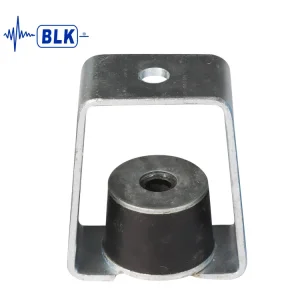
| Air Handling Units & Fans | $15\text{ Hz} - 50\text{ Hz}$ (900 - 3000 RPM) | Spring Isolation Hangers / Rubber Pad | $3.5\text{ Hz} - 6.0\text{ Hz}$ | $90\% - 96\%$ |
| Precision Metrology & CMM | $1\text{ Hz} - 10\text{ Hz}$ (Ambient Floor Waves) | Precision Pneumatic Air Mounts | $1.7\text{ Hz} - 2.5\text{ Hz}$ | $98\% - 99.5\%$ |
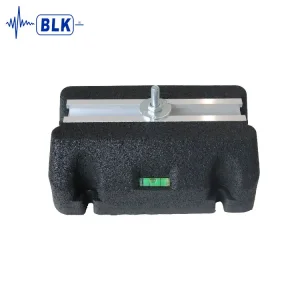
| Power Transformers | $100\text{ Hz} / 120\text{ Hz}$ (Electromagnetic Hum) | High-Damping Rubber / Transformer Mounts | $8.0\text{ Hz} - 12.0\text{ Hz}$ | $85\% - 94\%$ ($15 - 18\text{ dB}$ attenuation) |
| Punch Presses & Stampers | Transient Impact Shocks | High-Impact Rubber Buffers / Viscous Damped Springs | Custom Calibrated | Transient Dynamic Shock Absorption |
8. Expert Q&A: Procurement & Structural Engineering Inquiries
Technical insights from our application engineering team addressing common sizing, installation, and material selection questions.
Q: How do I calculate required spring static deflection for a low-speed industrial chiller?
Static deflection ($\delta_{st}$) directly dictates natural frequency ($f_n$) according to the formula: $f_n = \frac{1}{2\pi}\sqrt{\frac{g}{\delta_{st}}}$. To isolate a chiller running at $1200\text{ RPM}$ ($20\text{ Hz}$ disturbing frequency), target a natural frequency of $4\text{ Hz}$ or lower (frequency ratio $>5$). Solving for static deflection yields $\delta_{st} \approx \frac{250}{f_n^2} = \frac{250}{16} \approx 15.6\text{ mm}$. Selecting a spring mount with $25\text{ mm}$ nominal static deflection provides comfortable margin and $>95\%$ isolation.
Q: Why is neoprene rubber preferred over natural rubber in outdoor HVAC damper mounts?
While natural rubber offers high tensile strength, it quickly degrades under atmospheric ozone, UV radiation, and petroleum hydrocarbon oil droplets common in mechanical plant rooms. Neoprene (Polychloroprene) exhibits superior chemical stability, flame retardancy, and ozone resistance, maintaining elastic modulus stability over decades of outdoor exposure.
Q: What parameters are mandatory when submitting a custom OEM vibration dampener request?
To ensure precise dampener design, provide: (1) Total equipment operating weight including fluid load; (2) Number and spatial arrangement of mounting points; (3) Center of Gravity (CG) location if asymmetric; (4) Minimum equipment operating RPM or excitation frequency spectrum; (5) Site environmental conditions (chemical exposure, temperature, indoor/outdoor); and (6) Any required seismic shear restraint codes.
Q: How does an inertia base improve pump vibration isolation compared to direct spring mounting?
Directly mounting an end-suction water pump on soft springs can lead to excessive rocking motion during fluid pressure surges, causing high stress on pipe flanges. An inertia base adds heavy mass ($1.5 - 2\times$ pump weight), lowering the overall center of gravity, damping transient startup rocking, and ensuring equalized load distribution across all support isolators.
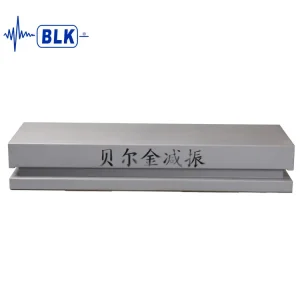
Precision Anti-Vibration Mounts & Isolation Systems
Explore our full specialized series including low-frequency air mounts, damped springs, and matrix isolators.
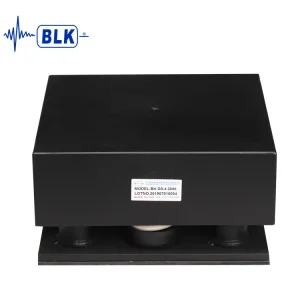
Request a Custom Vibration Attenuation Solution
Submit your machine operating specs (weight, RPM, footprint) to our application engineers. We return a tailored 3D model, load calculation, and factory direct price quote within 24 hours.